Quick Verdict
If you can only visit one UNESCO town in Albania, choose Berat if you want accessible Ottoman architecture, riverside cafes, and a more relaxed vibe. Choose Gjirokastër if you’re drawn to dramatic stone citadels, authentic mountain culture, and don’t mind steeper climbs.
Honestly though? You should visit both if you have 4+ days in Albania. They’re different enough that seeing one doesn’t make the other redundant.
At a Glance
| Factor | Berat | Gjirokastër |
|---|---|---|
| Best For | First-time visitors, photographers | History buffs, adventurous travelers |
| Atmosphere | Relaxed riverside charm | Dramatic mountain fortress |
| Main Attractions | Mangalem Quarter, castle, Onufri Museum | Stone bazaar, castle, Skenduli House |
| Getting There | 2 hours from Tirana, easy roads | 3.5 hours from Tirana, mountain roads |
| Accommodation | €20-60/night | €15-50/night |
| Time Needed | 1-2 days | 1-2 days |
Berat: What Makes It Special
I’ll be honest—when I first saw Berat from across the Osum River at sunset, I understood why they call it the “City of a Thousand Windows.” The white Ottoman houses stacked up the hillside, each with identical-looking windows, create this optical illusion where you can’t tell where one house ends and another begins. It’s the most photographed view in Albania for good reason.
What it’s known for: Berat is Albania’s most accessible UNESCO World Heritage Site, recognized for its rare Ottoman urban architecture that survived the communist-era destruction that leveled most other historic towns. The old quarters—Mangalem (Muslim quarter) and Gorica (Christian quarter)—face each other across the river, connected by a stone bridge that’s been rebuilt several times since the Ottoman era.
Top things to do:
The castle (Kalaja) is still a living neighborhood where about 200 people actually live among the Byzantine churches and Ottoman fortifications. I watched a grandmother hang laundry outside a 14th-century church—surreal. Inside the castle walls, the Onufri Museum houses stunning Orthodox icons by Albania’s most famous medieval painter. Entry is 200 LEK (€2).
Wander Mangalem Quarter without a map. The cobblestone streets climb steeply, and every turn reveals another postcard-worthy house facade. The lower town has dozens of traditional restaurants—Antigoni (Rruga Antipatrea) serves the best fergese (baked peppers with cheese and tomato) I’ve had in Albania for about 600 LEK (€6).
Cross the Gorica Bridge at sunset for the classic Mangalem view. There’s a lookout point on the Gorica side where every tour group stops, but climb 50 meters higher and you’ll have it to yourself.
Who it’s best for: Berat works for almost everyone. Families (though watch kids on steep streets), older travelers (most restaurants and hotels are in the flat lower town), photographers, and first-time visitors to Albania all love it. It’s also Albania’s best destination if you only have one day for a UNESCO town—the compact old quarters are walkable in 4-6 hours.
Practical info: Accommodation ranges from €20 hostels to €60 boutique hotels in restored Ottoman houses (book Mangalem Hotel if you can afford it). Most travelers base in Mangalem Quarter. Furgons from Tirana (700 LEK/€7) leave from near the train station every hour until 4 PM. If driving, parking is challenging in the old quarter—use the lot near the Gorica Bridge (300 LEK/day).
The town gets crowded July-August, especially on weekends when half of Tirana seems to descend for lunch. Visit May-June or September-October for better weather and fewer crowds.
Gjirokastër: What Makes It Special
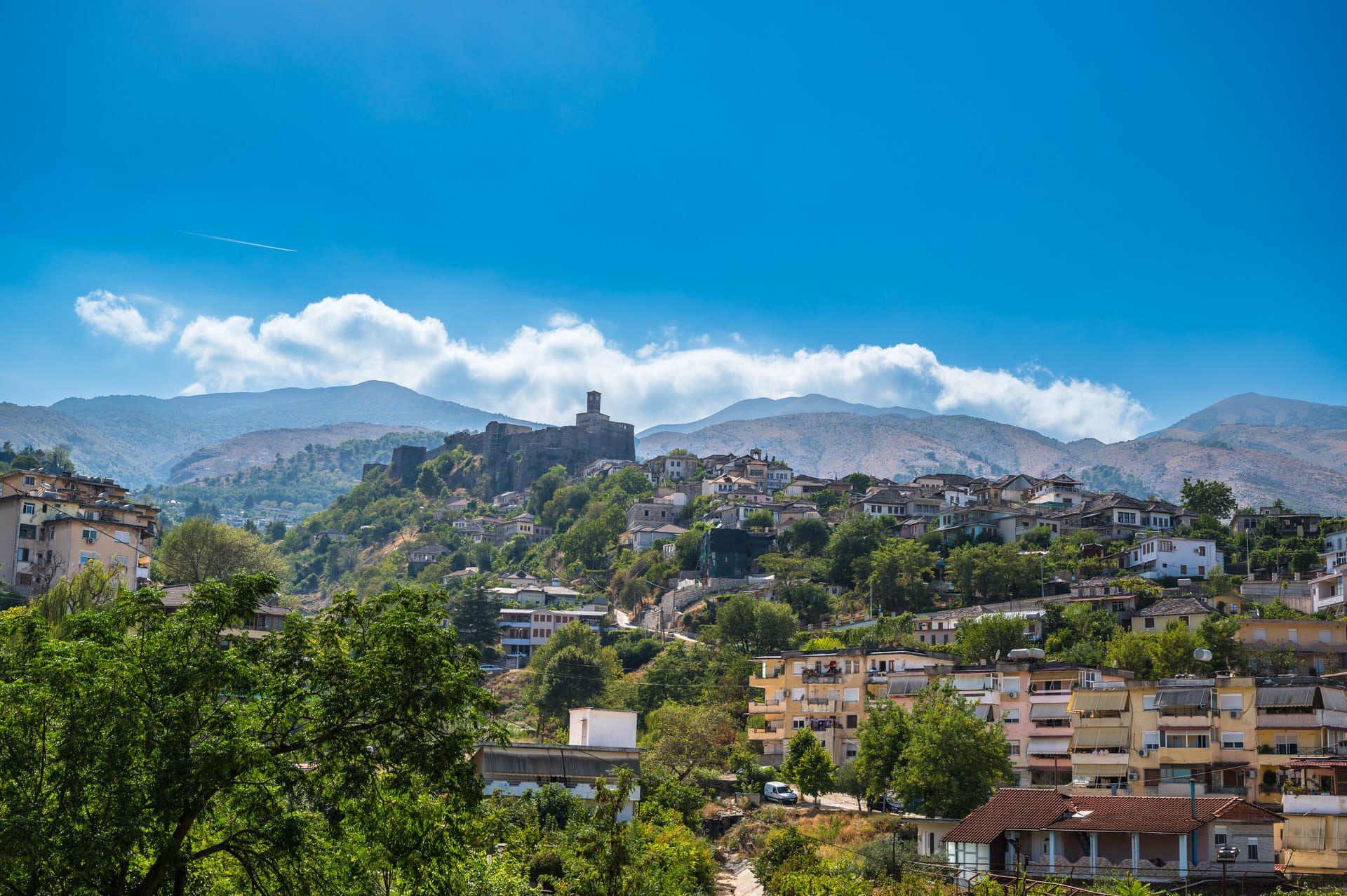
Gjirokastër hits differently. Where Berat is soft white plaster, Gjirokastër is gray limestone cut into fortress-like houses that cling to a mountain. The whole town looks like it was designed to repel an Ottoman siege (ironic, since it thrived under Ottoman rule for 500 years).
What it’s known for: This is Albania’s best-preserved Ottoman-era town, recognized by UNESCO for its unique architecture—stone houses with distinctive stone roofs and wooden balconies. It’s also the birthplace of Albania’s communist dictator Enver Hoxha (there’s a museum, though it’s complicated) and Nobel Prize-winning novelist Ismail Kadare, whose books capture Gjirokastër’s brooding atmosphere perfectly.
Top things to do:
The castle dominates everything. It’s enormous—second largest in the Balkans after Belgrade’s fortress. Inside you’ll find a military museum (with a weirdly out-of-place US Air Force jet that crash-landed in 1957), underground cold war tunnels, and the best views in southern Albania. Entry is 200 LEK (€2), and you need 1-2 hours to explore properly.
The Old Bazaar (Pazari i Vjetër) is still functional—locals actually shop here. Stone-paved lanes wind between coppersmith workshops, spice vendors, and traditional handicraft shops. More authentic than Berat’s commercialized old town, though that means fewer tourist amenities.
Tour Skenduli House (400 LEK/€4) for the best example of an 18th-century Ottoman mansion. The carved wooden ceilings and secret passages are impressive, but the real attraction is the passionate guide who’s related to the original owners and tells family stories spanning three centuries.
Walk the cobblestone lanes at dusk when the stone architecture glows golden. Most tourists leave by 5 PM to drive back to Saranda, so you’ll have the town to yourself.
Who it’s best for: History enthusiasts who don’t mind hills (everything in Gjirokastër is uphill or downhill—there is no flat). Also great for travelers looking for authenticity over polish. This isn’t a manicured tourist town; it’s rough around the edges in the best way. Not ideal for families with small children (too many steep stone steps) or anyone with mobility issues.
Practical info: Accommodation is cheaper than Berat—€15-30 for guesthouses, €40-50 for boutique hotels in Ottoman houses. Hotel Kalemi (in a restored mansion) is worth the splurge.
Getting here requires commitment. From Tirana it’s 3.5 hours through mountain passes (the road is good but winding). Most travelers arrive from Saranda (1 hour) or Berat (2.5 hours). Furgons are infrequent—check local schedules.
Winters are cold (snow is common December-February), and many hotels close November-March. Summer brings a famous folklore festival in May and the National Folklore Festival every five years (next in 2025—if you can time it, do).
Which Should You Choose?
Choose Berat If…
- You have limited time (it’s closer to Tirana and more compact)
- You want the “classic” Albania photo (Mangalem at sunset is that view)
- You prefer accessible sightseeing without constant uphill climbs
- You’re traveling with family or older adults
- You want more restaurant and accommodation options
- You’re visiting in winter (Berat is lower altitude and milder)
Choose Gjirokastër If…
- You’re a history buff who wants deeper Ottoman-era immersion
- You prefer dramatic mountain scenery over riverside charm
- You don’t mind fewer tourists and less infrastructure
- You’re already going to Saranda (it’s just 1 hour away)
- You’ve read Ismail Kadare and want to see his hometown
- You want authentic Albanian mountain culture
Can You Visit Both?
Absolutely—and you should if you have 4+ days in Albania. They’re 2.5 hours apart by car through gorgeous mountain scenery (the road passes through Këlcyrë Gorge, which alone is worth the drive).
Suggested itinerary:
- Fly into Tirana, spend 1-2 days in the capital
- Drive to Berat (2 hours), stay 1-2 nights
- Drive to Gjirokastër (2.5 hours), stay 1-2 nights
- Continue to Saranda or the Albanian Riviera (1 hour from Gjirokastër)
This covers Albania’s cultural highlights before hitting the beaches. You can do it as a road trip (rent a car in Tirana, drop off in Saranda) or piece together furgon rides if you’re on a budget.
Cost comparison: Doing both adds about €50-80 in accommodation and €20-30 in transport compared to visiting just one. Given how different they are, it’s absolutely worth it.
If you genuinely have to pick one? I’d say Berat for first-timers to Albania (it’s the more iconic image), Gjirokastër for return visitors or anyone with Ottoman history obsession. But honestly, you’re missing out either way if you skip one.