How to Get to Gjirokastër
From Tirana
- By Bus: Buses depart from Tirana’s southern terminal 3-4 times daily. Journey takes 4-5 hours and costs 1,000-1,200 LEK (€9-10).
- By Car: 230km via Fier and Tepelenë. Drive time approximately 3.5-4 hours on mountain roads with increasingly scenic views.
- By Tour: Day trips from Tirana available starting at €50-60, though the 4-hour drive each way makes this a long day.
From Saranda
- By Bus: Frequent buses (every 1-2 hours) take 1-1.5 hours and cost 300-400 LEK (€2.50-3.50).
- By Car: 60km via SH4. Drive time approximately 1 hour on good mountain roads.
Where Albania’s Contradictions Crystallize in Stone
On October 16, 1908, Enver Hoxha was born in a modest house in Gjirokastër’s old bazaar quarter, son of a cloth merchant in a town that had been part of the Ottoman Empire for over four centuries. Thirty-six years later, in 1936, Ismail Kadare was born less than a kilometer away, in another stone house on another cobbled street in the same medieval town, entering a world where Hoxha’s communist movement was already gaining power. The first would become Albania’s most ruthless dictator, ruling for over four decades with paranoid brutality that isolated the country completely from both Western and Eastern blocs, creating one of the 20th century’s most repressive regimes and leaving psychological and economic scars still healing thirty years after his death. The second would become Albania’s greatest living writer, a Nobel Prize nominee whose novels like “The General of the Dead Army” and “Chronicle in Stone” explore tyranny, history, memory, and the Albanian experience with psychological precision that earned international acclaim and made Albanian literature visible to world audiences for the first time. Both men spent their formative early years walking the same steep stone streets that climb Gjirokastër’s mountainside, passing the same fortress-like tower houses built for defense during centuries of blood feuds, looking up at the same medieval castle looming over everything from its ridge-top position. How the exact same place—the same streets, the same stones, the same cultural environment—could produce such radically divergent visions of Albania, one violently closed and one courageously open and searching, captures something essential about Gjirokastër itself: this is a city built on contradictions, where architectural beauty and historical brutality coexist in the same buildings, where efforts at preservation and forces of decay wage continuous battle with uncertain outcomes, where every stone seems to hold multiple competing truths that residents interpret differently. That complexity makes Gjirokastër one of Albania’s most intellectually fascinating destinations—not despite its difficulties and contradictions, but specifically because of them, because the city refuses to offer simple narratives about Albanian identity or history.
Why Visit Gjirokastër
If you need immediate gratification from your tourism, skip Gjirokastër. The town doesn’t perform for visitors. Its steep cobblestone streets challenge knees and ankles. Many of its most interesting buildings remain private residences rather than museums. The castle requires a punishing climb. Infrastructure can be inconsistent. English fluency drops significantly compared to coastal resort towns.
What Gjirokastër offers instead is weight—historical and architectural density that few Albanian cities can match. This is one of the Balkans’ best-preserved Ottoman towns, where hundreds of distinctive tower houses still stand in their original configurations, where 18th and 19th-century urban planning remains largely intact, where you can walk streets that have functioned continuously for centuries without significant alteration.
UNESCO recognized this significance in 2005, designating the entire old town as World Heritage Site alongside Berat. Unlike many heritage cities that preserve a few showcase buildings while surrounding them with modern development, Gjirokastër maintains architectural coherence across entire neighborhoods—the townscape as a whole creates the value, not individual monuments in isolation.
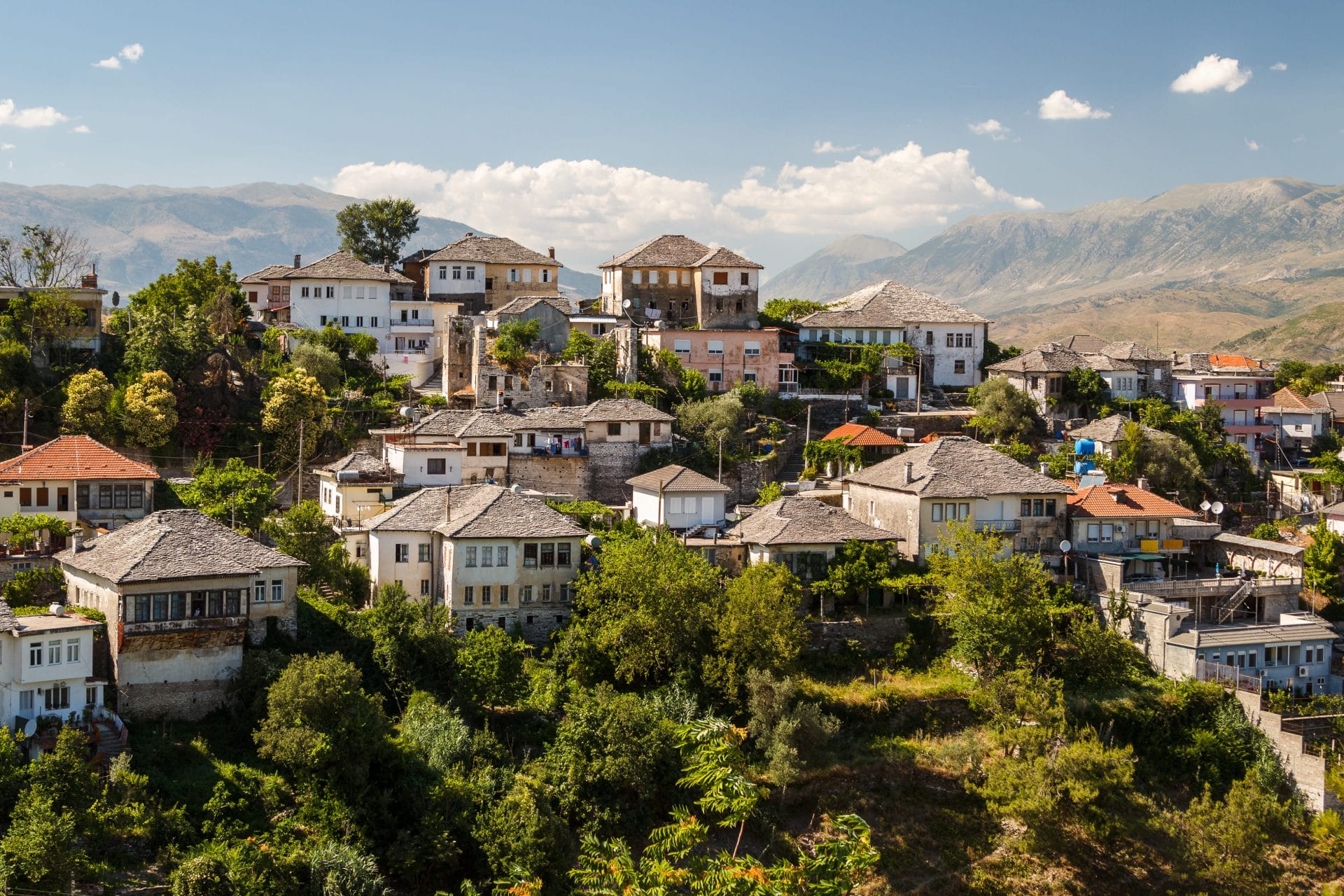
The setting amplifies everything. Gjirokastër cascades down the western slope of the Gjerë mountain, its stone houses stacked in tiers that climb toward the fortress crowning the ridge. From a distance, particularly when winter snow caps the mountains behind, the town looks less like conventional architecture and more like geological formation—as if the mountain itself crystallized into these particular shapes.
The stone construction creates visual unity. Nearly everything—houses, roads, walls, fountains—uses the same gray limestone quarried from nearby mountains. When rain darkens the stone or morning mist softens edges, the entire town seems to merge with the landscape in ways that conventional cities built from diverse materials never achieve.
But Gjirokastër also shows Albania’s challenges clearly. Many houses deteriorate slowly, their owners lacking resources for proper maintenance. Communist-era concrete construction interrupts the historic fabric in jarring ways. Youth migration has hollowed some neighborhoods, leaving elderly residents maintaining buildings that need younger energy and capital. Tourism brings income but also threatens to convert living neighborhoods into museum-pieces.
Visiting Gjirokastër means engaging with these tensions rather than escaping them. If you’re comfortable with complexity, willing to walk a lot on uneven surfaces, and interested in places where history remains lived rather than merely displayed, this stone city rewards attention generously.
The Architecture of Defense
Gjirokastër’s distinctive houses—locally called “kullas”—represent architecture designed first for survival, only secondarily for aesthetics.
The typical tower house rises three to four stories, built entirely from local stone with minimal wood except for interior floors and ceilings. The ground floor typically housed animals and storage—practical insulation and a source of heat during mountain winters. The second floor contained kitchens, workrooms, and winter living spaces. Upper floors held summer quarters and reception rooms where families entertained guests.
What makes these houses immediately recognizable is their top-heavy profile. Lower floors use thick walls with minimal windows, creating fortress-like bases. Upper floors expand outward, supported by stone corbels, with larger windows and sometimes elaborate wooden balconies. From the street, this creates the impression of buildings leaning over you, their upper stories reaching toward each other across narrow lanes.
The roofs use flat stone slabs (locally called “guri i zi” or black stone) rather than tiles. These slabs split naturally from the local limestone in thin sheets, creating weatherproof covering that can last centuries if properly maintained. When wet, the stone turns dark gray to nearly black, giving the roofs their characteristic appearance. When dry, especially in summer dust, they lighten to silver-gray.
This roof style became so associated with Gjirokastër that Albanians nicknamed the city “Qyteti i Gurit” (City of Stone)—a name that captures both the construction material and the resulting aesthetic of a settlement that seems carved from the mountain rather than merely built upon it.
The tower design reflected the region’s historical instability. Until the late 19th century, blood feuds remained common, with extended families conducting generations-long conflicts following the Kanun (traditional law code). The tower house’s defensive features—thick walls, small lower windows, height allowing surveillance—provided protection while also serving as status symbols demonstrating a family’s wealth and power.
Walking through the old town’s steep alleys, with tower houses rising on both sides and the castle looming above, you understand viscerally how architecture can shape psychology. These streets were designed for defense, for watching approaches, for creating controlled zones where outsiders moved through carefully monitored spaces. The openness and public visibility that characterize modern urban planning simply didn’t exist here—privacy and security trumped all other considerations.
The Castle’s Accumulating Histories
Gjirokastër Castle dominates the town from its ridge-top position 336 meters above sea level. The fortress you see today represents over eight centuries of continuous military use, with each period adding layers that never completely erased what came before.
The earliest fortifications date to the 12th century, when local rulers built a relatively modest defensive position controlling trade routes through these mountains. Byzantine sources mention a fort at this location, though little of that original construction survives visibly.
The castle’s current configuration largely reflects Ottoman modifications, particularly those made by Ali Pasha of Tepelena in the early 19th century. Ali Pasha—the semi-independent Ottoman governor who controlled much of southern Albania and northern Greece—recognized the fortress’s strategic importance and expanded it significantly, adding the massive stone walls, towers, and interior buildings that define the structure today.
Inside the castle grounds, one building stands out as particularly incongruous: a renovated palace-style structure with regular windows and almost domestic scale. This was Ali Pasha’s residence during his time in Gjirokastër, demonstrating that even military fortresses accommodated more refined living for those commanding them.
World War II added another layer. Italian occupation forces used the castle as military headquarters, as did German troops when they replaced the Italians in 1943-44. Greek resistance fighters besieged it during the chaos at war’s end. Bullet scars still mark some walls, physical evidence of conflicts now eighty years past.
Then came perhaps the castle’s darkest period. Enver Hoxha’s communist government converted part of the fortress into a political prison, holding dissidents, intellectuals, and anyone suspected of opposing the regime. The prison section—preserved now as memorial—shows the tiny cells where prisoners spent years, sometimes decades, in conditions designed to break spirits as much as confine bodies.
Walking through these cells creates profound discomfort. The spaces are claustrophobically small, poorly lit even today with electric lighting, oppressively silent. Trying to imagine spending years here, cut off from family, subject to interrogation and abuse, watching others disappear and never return—the castle stops being merely historical site and becomes testimony to what humans inflict on each other when ideology overrides empathy.
The prison operated until 1968, when Hoxha built purpose-designed political prisons elsewhere. But those decades left marks that restoration can’t erase. The castle holds too much pain to function purely as tourist attraction—it demands acknowledgment of what happened within these walls.
The castle also houses the National Museum of Armaments, displaying weaponry spanning from medieval swords through World War II tanks and artillery. The collection includes pieces from various armies that fought over this territory—Ottoman, Italian, German, Greek, partisan—creating an inadvertent history of conflict told through the evolution of weapons technology.
The fortress grounds offer extraordinary views. From the ramparts, you see the entire town spreading down the mountainside, its stone roofs creating textured patterns of gray and silver. The Drino Valley stretches south toward the Greek border. On clear days, you can identify individual villages kilometers away, understanding immediately why whoever controlled this castle controlled the region.
Inside the Tower Houses: Skenduli and Zekate
Two particular houses open to visitors, offering rare access to see how wealthy Gjirokastër families lived during the Ottoman period.
Skenduli House
Built in the early 18th century and expanded in 1700s and early 1800s, Skenduli House represents one of the old town’s finest examples of upper-class domestic architecture. The house has remained in the same family for over three centuries, with current descendants maintaining it as a house-museum while still living in portions of the structure.
The ground floor follows typical patterns—stone-vaulted rooms used for storage and housing animals, creating thermal mass that moderated temperature year-round. Climb the internal stone stairway to the second floor and the character changes completely.
The winter living rooms feature carved wooden ceilings, wall niches for storage and decoration, low seating areas around braziers that once provided heat. Everything reflects Ottoman aesthetic preferences: geometric patterns, arabesque motifs, careful attention to proportions that create surprisingly comfortable spaces despite the lack of modern amenities.
The third floor’s summer quarters receive more natural light through larger windows, with wooden balconies providing outdoor living space during hot months. The top floor’s reception rooms—where the family entertained important guests—show the greatest architectural elaboration: carved and painted ceilings, built-in closets with decorative doors, windows providing views across the town and valley.
One unusual feature: the house contains twelve bathrooms, an extraordinary number for any building from this period. This reflects both the family’s wealth and their adoption of Ottoman hygiene practices that emphasized regular washing far beyond European norms of the same era.
Skenduli House tours (given by family members, typically in Albanian with some English) reveal details about daily life—where women’s spaces separated from men’s, how cooking happened, how families dealt with winters in mountain climates, how social hierarchies manifested in room placement and decoration.
Zekate House
Built in 1811-1812 by a wealthy merchant family, Zekate House shows even more elaborate decoration and architectural sophistication. This was a family at the peak of Gjirokastër’s commercial prosperity, when the town’s position on trade routes brought wealth that merchants invested in increasingly grand residential architecture.
The house follows the same basic tower-house formula but executes it with exceptional craftsmanship. The carved wooden elements—ceilings, doors, built-in furniture—demonstrate skills that required years of apprenticeship. The decorative painting throughout, while faded from its original brightness, still shows intricate floral and geometric patterns.
One room, the çardak (glassed-in balcony room), provides particularly fine views and demonstrates how these houses maximized natural light and ventilation before electricity and mechanical cooling. The room projects outward from the main structure, with windows on three sides, creating an interior space that feels almost outdoor.
Zekate House also shows the transition between traditional and modernizing influences. Some rooms maintain pure Ottoman character, while others incorporate European furniture and decoration styles that became fashionable among wealthy Albanians in the late 19th century. The mixture creates interesting tensions—how do you modernize while maintaining cultural identity? How much change constitutes adaptation versus abandonment of traditions?
Both houses charge modest entrance fees (300-400 lek, roughly €3-4) and allow photography. Visit in morning or late afternoon when angled sunlight enhances the carved woodwork and painted details.
Ismail Kadare’s Chronicle in Stone
Ismail Kadare’s 1971 novel “Chronicle in Stone” uses Gjirokastër as both setting and character—the stone city shapes the nameless boy narrator as much as the people around him. The novel captures Gjirokastër during World War II, when Italian and German occupations transformed daily life while the town’s physical structure endured essentially unchanged.
Kadare writes: “The city was paved with stone, roofed with stone, and surrounded by stony mountains… In our city, stone had replaced wood, flesh, and even clouds in the sky.” That obsession with stone—its weight, its permanence, its indifference to human struggles—runs through the novel like the narrow alleys run through the physical town.
Reading “Chronicle in Stone” before visiting Gjirokastër (translations exist in dozens of languages) adds dimension to experiencing the actual place. Kadare describes specific streets, particular houses, the way winter fog settles into valleys, how the fortress looms over everything. Walking where his fictional boy narrator walked, seeing buildings he described, you understand how place shaped one of Albania’s defining literary voices.
Kadare’s own birthplace house, near the old bazaar, operates as a small museum. The collection focuses on his literary career rather than his childhood, displaying first editions, translations, awards, correspondence with international publishers and writers. It’s modest by museum standards but touching in its demonstration that Gjirokastër recognizes its greatest living cultural export.
The contrast between how Gjirokastër treats its two most famous sons remains striking. Enver Hoxha’s birthplace, for decades maintained as mandatory pilgrimage site, fell into deliberate neglect after communism’s collapse. Nobody wanted to maintain a shrine to tyranny. The building deteriorates, its future uncertain—should it become museum acknowledging dark history, or simply be allowed to disappear?
Kadare’s house, meanwhile, receives careful preservation. The city has produced only one Kadare, unlikely to produce another of similar international stature. His literary success brings Gjirokastër recognition that helps justify UNESCO preservation funding and tourism investment.
The Old Bazaar and Daily Life
Below the castle and grand tower houses, the old bazaar quarter represents where Gjirokastër functioned economically. This was the commercial heart—workshops, shops, inns for traveling merchants, bathhouses, mosques serving the Ottoman Muslim population.
The bazaar’s architecture is more modest than residential neighborhoods, built for utility rather than status display. Single and two-story structures line narrow lanes, their ground floors opening directly to the street for commerce. Many retain traditional craft workshops: coppersmiths hammering pots and trays, silversmiths creating filigree jewelry, woodworkers producing furniture and decorative items.
Tourism has inevitably altered the bazaar’s character. Many workshops now produce primarily for visitors—silverwork particularly suffers from mass production of lower-quality pieces made for souvenir market rather than traditional high-craftsmanship items wealthy locals once commissioned. Some shops selling “traditional” clothing stock mass-manufactured goods rather than genuine handicrafts.
Yet some authentic workshops persist. Watch for craftsmen actually working rather than simply minding shops full of completed items—those workshops typically maintain higher standards and produce work worth buying. The price difference between genuine craft and souvenir schlock is obvious once you learn to recognize quality.
The bazaar also remains where locals shop for daily needs. Vegetable vendors occupy stone arcades, selling produce from small plots. Meat shops display whole lamb carcasses. Bread bakeries produce the crusty loaves Albanians prefer. Coffee houses—most rebuilt or modernized but occupying locations they’ve held for decades—fill with men conducting business over espresso.
This mixture of tourism and daily life creates interesting dynamics. You’re walking past souvenir shops when you turn a corner and find elderly women sorting beans, men repairing roof tiles, children playing in courtyards—ordinary life proceeding regardless of whatever tourism happens around it.
Practical Gjirokastër
Reaching Gjirokastër from Tirana requires either rental car (3.5-4 hours via decent highway through increasingly mountainous terrain) or bus (roughly 5 hours, departing from Tirana’s southern bus terminal, cost 1,000-1,200 lek).
From Saranda on the coast, the journey takes 60-90 minutes by car, less than 2 hours by bus. This makes Gjirokastër feasible as a day trip from coastal resorts, though overnight stay allows experiencing the town in evening and morning when day-trippers have departed.
The old town is entirely pedestrian once you enter its core—streets too steep and narrow for vehicles. Be prepared for serious walking on cobblestones and stairs. Proper walking shoes essential; flip-flops or dress shoes will make the experience miserable.
Accommodation ranges from converted tower houses operated as boutique hotels (€40-80 for doubles in summer) to simpler guesthouses (€20-30) and a few modern hotels on the town’s periphery. The tower house hotels offer atmospheric experiences—sleeping in centuries-old buildings with stone walls and traditional decoration—though often with modern bathrooms retrofitted into historic structures.
Hotel Kalemi occupies a restored tower house in the old town’s heart, offering comfortable rooms with period details and breakfast served in a courtyard with castle views. Argjiro Hotel, similarly positioned in a historic building, provides similar quality at comparable prices.
For eating, Kujtimi Restaurant near the bazaar serves traditional Gjirokastër dishes—slow-cooked lamb, rice and organ meat pie called “oshaf,” sheep’s milk cheese—in settings that feel genuinely local rather than touristic. Taverna Vasilis offers simpler grilled meats and salads at lower prices.
Best Time to Visit
Spring (April-June) brings comfortable temperatures ideal for walking the steep streets, with mountain wildflowers blooming and tourist numbers still moderate. This is perhaps optimal timing for serious exploration.
Summer (July-August) means warmest weather but also peak tourist season. The stone streets and minimal shade create hot conditions that make daytime walking exhausting. Visit early morning and late afternoon, rest during midday heat.
Autumn (September-October) rivals spring for ideal conditions—warm days, cool evenings, autumn colors in the surrounding mountains. The National Folk Festival typically occurs in early October (every five years), bringing traditional music, dance, and crafts demonstrations that fill the town with celebratory energy.
Winter (November-March) brings cold temperatures, occasional snow, and reduced tourism infrastructure as many hotels and restaurants close. The town takes on completely different character—fewer people, more locals conducting their actual lives, stone turning dark and somber under gray skies. If you’re comfortable with limited services and cold weather, winter Gjirokastër offers rare access to the place without tourism mediating the experience.
Nearby Destinations
Gjirokastër’s position in southern Albania makes it a natural base for exploring the region:
Blue Eye Spring (30km north): Natural spring emerging from underground with water so clear and blue it seems artificially colored. Popular day trip, though summer crowds can overwhelm the small site.
Saranda (55km southwest): Coastal resort town, ferry connection to Corfu, access to Butrint archaeological site.
Përmet (55km northeast): Mountain town known for thermal baths, wine production, and whitewater rafting on the Vjosa River.
Greek Border (20km south): The town of Kakavia marks the crossing into Greece, making Gjirokastër accessible for visitors basing in Corfu or other Greek locations.
The Weight of Stone
Gjirokastër forces questions most tourist destinations avoid: What do we preserve and why? Whose history do we memorialize? How do we acknowledge that beautiful places sometimes witnessed terrible things, that architectural excellence and human brutality can coexist in the same buildings?
The castle is beautiful in its engineering and commanding in its position. It’s also where political prisoners endured torture and decades of imprisonment. The old town represents remarkable cultural continuity and architectural achievement. It’s also where Enver Hoxha learned to see Albania as fortress requiring absolute defense against foreign contamination.
These contradictions don’t resolve. They exist simultaneously, making Gjirokastër more intellectually challenging than destinations offering simple pleasures or uncomplicated narratives.
But that complexity is precisely what makes the city valuable. Albania’s history isn’t simple. The Ottoman period brought both cultural flowering and imperial domination. The fight for independence produced both genuine heroes and brutal warlords. The communist era combined modernization with oppression. Any place claiming to represent Albanian experience must somehow hold these tensions without collapsing them into easy stories about progress or decline.
Gjirokastër, built from stone that records every modification and every scar, does exactly that. The stones endure—recording invasions, occupations, celebrations, daily life, and slow weathering—while humans continue arguing about what it all means.
If you visit, spend time simply sitting in various places: in the castle watching clouds move over mountains, in the bazaar watching craftsmen work, on stone benches where old men gather to talk, in hotel courtyards at dawn before the day begins. The town reveals itself slowly to those willing to wait, showing gradual accumulations of detail that quick tours miss entirely.
That’s appropriate for a place made of stone. You don’t rush stone. You acknowledge its weight, its persistence, its indifference to hurry. Gjirokastër has waited centuries. It will wait a bit longer while you figure out what you’re actually seeing.