What the SH8 Opened
In 2009, Albanian authorities completed comprehensive reconstruction of the SH8 coastal highway connecting Vlorë to Sarandë—a road originally built by Italian engineers in the 1930s but left largely unmaintained for 60 years following World War II and 45 years of communist isolation. The reconstruction converted what had been a challenging 4-5 hour drive requiring careful navigation of potholes, washouts, and sections where pavement had eroded entirely into a 2-2.5 hour journey on smooth asphalt with proper guardrails and marked passing zones.
The improved road opened the coastal villages to tourism. Prior to 2009, reaching places like Dhërmi, Vuno, or Himarë meant accepting difficult access that deterred most visitors. After 2009, those same villages became accessible to anyone with a rental car and willingness to drive mountain roads. What followed was tourism development occurring faster than almost any comparable Mediterranean coastline—villages with 5-6 guesthouses in 2010 had 40-50 accommodation options by 2020.
The Albanian Riviera—the stretch of Ionian coastline from Vlorë south approximately 130 kilometers to Sarandë—shifted from isolated backwater to internationally recognized tourism destination in under 15 years. Frommer’s proclaimed it “2012 Top Value Destination.” DJ Tiësto held a concert in Dhërmi in 2010 that attracted international media coverage. Top Gear filmed an episode driving the coastal road. Instagram discovered the turquoise water and white pebble beaches, creating viral content that reached millions.
The Geography That Defines It
The Albanian Riviera occupies the narrow coastal zone where the Ceraunian Mountains meet the Ionian Sea. The mountains rise directly from the coastline in many locations, creating topography where the SH8 frequently climbs to 200-400 meters elevation to navigate around headlands before descending back to sea level at village locations. The highest point, Llogara Pass (Qafa e Llogarasë), reaches 1,043 meters approximately 40 kilometers south of Vlorë.
This geography explains both the historical isolation and the dramatic scenery. Roads were essentially impossible until 20th-century engineering made mountain highway construction feasible. The same topography that prevented road access created the coastal landscapes that now attract tourism—vertical cliffs dropping into clear water, beaches accessible only via steep descents, villages occupying the only flat ground available between mountain and sea.
The 15 primary villages along the Riviera (Palasë, Kondraq, Dhërmi, Ilias, Vuno, Himarë, Pilur, Kudhës, Qeparo, Borsh, Piqeras, Sasaj, Lukovë, Shën Vasil, Nivicë-Bubar) sit on alluvial fans or small coastal plains where streams have deposited enough sediment to create buildable ground. Most villages occupy less than 1 square kilometer of flat terrain, with residential areas extending up mountain slopes via steep lanes and staircases carved directly into limestone.
What Makes It “Albanian” Rather Than Just Coastal
The Greek minority population concentrated in Himarë and several surrounding villages creates linguistic and cultural complexity that distinguishes the southern Riviera from generic Mediterranean coastline. Road signs in these areas appear in both Albanian and Greek (Χειμάρα/Himarë), reflecting legal requirements for minority language accommodation. The Greek Orthodox churches and monasteries scattered through the region document continuous Greek-speaking settlement dating to Byzantine period, creating communities that identify as both Albanian citizens and ethnically Greek.
This dual identity creates occasional political tension—Greek government officially recognizes areas with Greek minorities as “North Epirus,” while Albanian government considers the territory unambiguously Albanian with minority communities entitled to language rights but not territorial autonomy. For visitors, the practical impact is primarily cultural—Greek restaurants operate alongside Albanian establishments, Orthodox Easter celebrations follow different calendar than Catholic observances further north, and language shifts between Albanian, Greek, and English depending on who you’re speaking with.
The communist period attempted to suppress Greek identity through forced assimilation, renaming villages with Albanian names and prohibiting Greek-language education. When communism collapsed in 1991, Greek language and cultural practices resumed openly. Current reality is communities navigating between Albanian state identity and Greek cultural preservation, creating distinct character compared to purely Albanian or purely Greek coastal areas.
The Road Journey Itself
Driving the SH8 from Vlorë to Sarandë requires 2-2.5 hours under normal conditions, though this assumes continuous driving without stops for viewpoints, beaches, or villages. Realistic touring of the Riviera means 4-7 days minimum, allowing time to actually explore rather than simply transit.
Vlorë to Llogara Pass (40km, 1 hour): The road climbs from sea level to 1,043 meters through continuous switchbacks. The ascent provides expanding views backward toward Vlorë and the Karaburun Peninsula. Llogara National Park occupies the pass area, with several restaurants and viewpoints at the summit. The pass itself is forested (primarily Greek fir and black pine), creating marked temperature drop compared to coastal elevations—bring layers even in summer.
Llogara Pass to Dhërmi (18km, 30 minutes): The descent from Llogara toward Dhërmi is the SH8’s most dramatic section. The road drops approximately 800 meters in 12 kilometers via hairpin turns that provide constant views of the coastline and Dhërmi village below. This section appears in most Albanian Riviera photography—the serpentine road descending toward turquoise water creates iconic images that helped establish the region’s international profile.
Dhërmi to Himarë (30km, 45 minutes): The road continues south through Vuno, Jale, and smaller settlements, maintaining elevation 100-300 meters above sea level with frequent descents to beach areas. This section has most developed tourism infrastructure—beach clubs, hotels, restaurants operate continuously along the route during summer months.
Himarë to Sarandë (62km, 1.5 hours): South of Himarë, the road continues through Qeparo, Borsh, and smaller villages, gradually descending toward Sarandë. Development decreases south of Himarë until you reach Sarandë itself, where urban sprawl extends several kilometers north along the coast.
The Tourism Transformation’s Visible Impact
The rapid development created infrastructure mismatches visible throughout the region. Villages built for populations of 300-500 year-round residents now accommodate 2,000-3,000+ during July-August peaks. Water systems strain under usage exceeding design capacity. Waste collection struggles to keep pace with generation. Parking infrastructure designed for resident vehicles can’t handle tourist numbers—August weekends see cars parked on highway shoulders for kilometers approaching popular beaches.
Dhërmi provides clearest example. The village had approximately 200 permanent residents in 2010, with perhaps 500 during summer when migrants returned from abroad. By 2020, summer population regularly exceeded 2,000, with 40-50 hotels and guesthouses operating plus several large beach clubs. The infrastructure—roads, water, waste, emergency services—was designed for the village that existed in 2000, not the tourist destination that emerged by 2020.
This doesn’t mean the Riviera is dysfunctional—services generally work, businesses operate successfully, visitors have positive experiences. But the visible strain documents what happens when tourism development occurs faster than infrastructure investment can accommodate. You’re visiting a region still adapting to its new reality as international destination rather than isolated provincial coastline.
The Cultural Shifts Tourism Created
Traditional Riviera villages sustained themselves through subsistence agriculture (olives, citrus, vegetables on terraced slopes), fishing, and remittances from family members working abroad. Tourism created alternative economy that’s now primary income source for most coastal residents during April-October operating season.
The shift created generational divide. Older residents often own property that became valuable for tourism development but don’t necessarily welcome the transformation—they remember quieter villages where everyone knew everyone and summer meant returned family members rather than foreign tourists. Younger residents generally embrace tourism as economic opportunity providing income without requiring migration to Tirana or emigration abroad.
The compromise position most communities reached: tourism during summer months funds year-round residence, allowing families to remain in ancestral villages rather than abandoning them for urban opportunities. The guesthouses operate April-October, then close as owners migrate to winter homes (often still in the same village, just not the renovated tourist-facing properties) or travel abroad themselves during off-season.
Practical Touring Considerations
Vehicle Requirements: The SH8 is paved and maintained to good standard, but it’s a mountain road with switchbacks, limited passing zones, narrow sections, and places where one lane sits meters from unguarded cliff drops. Rental cars manage fine—you don’t need 4x4 or special equipment. You do need comfort with mountain driving and acceptance that Albanian driving culture includes passing on curves, minimal use of turn signals, and speeds that often exceed posted limits.
Accommodation Strategy: July-August requires advance booking for popular villages (Dhërmi, Jale, Himarë, Qeparo). June and September allow more flexibility. May and October see many properties closed as owners consider tourism season finished. Booking.com, Airbnb, and Booking Albania cover most options. Expect €30-60/night for basic guesthouses with breakfast, €60-150/night for hotels with amenities.
Village Selection: Most visitors base in 2-3 villages and make day trips to others rather than moving accommodation daily. Common strategies: Dhërmi for nightlife and convenience, Himarë for local culture and restaurants, Qeparo or Borsh for quieter atmosphere. The villages are similar enough that choosing wrong one isn’t catastrophic—you’re within 30-minute drive of alternatives.
Off-Season Reality: October through April, many businesses close completely. Restaurants that operate year-round serve local residents rather than tourists, meaning Albanian menus, limited hours, and atmosphere that’s welcoming if you’re comfortable as obvious outsider but not designed for international visitors expecting English menus and explanatory service.
The Honest Assessment
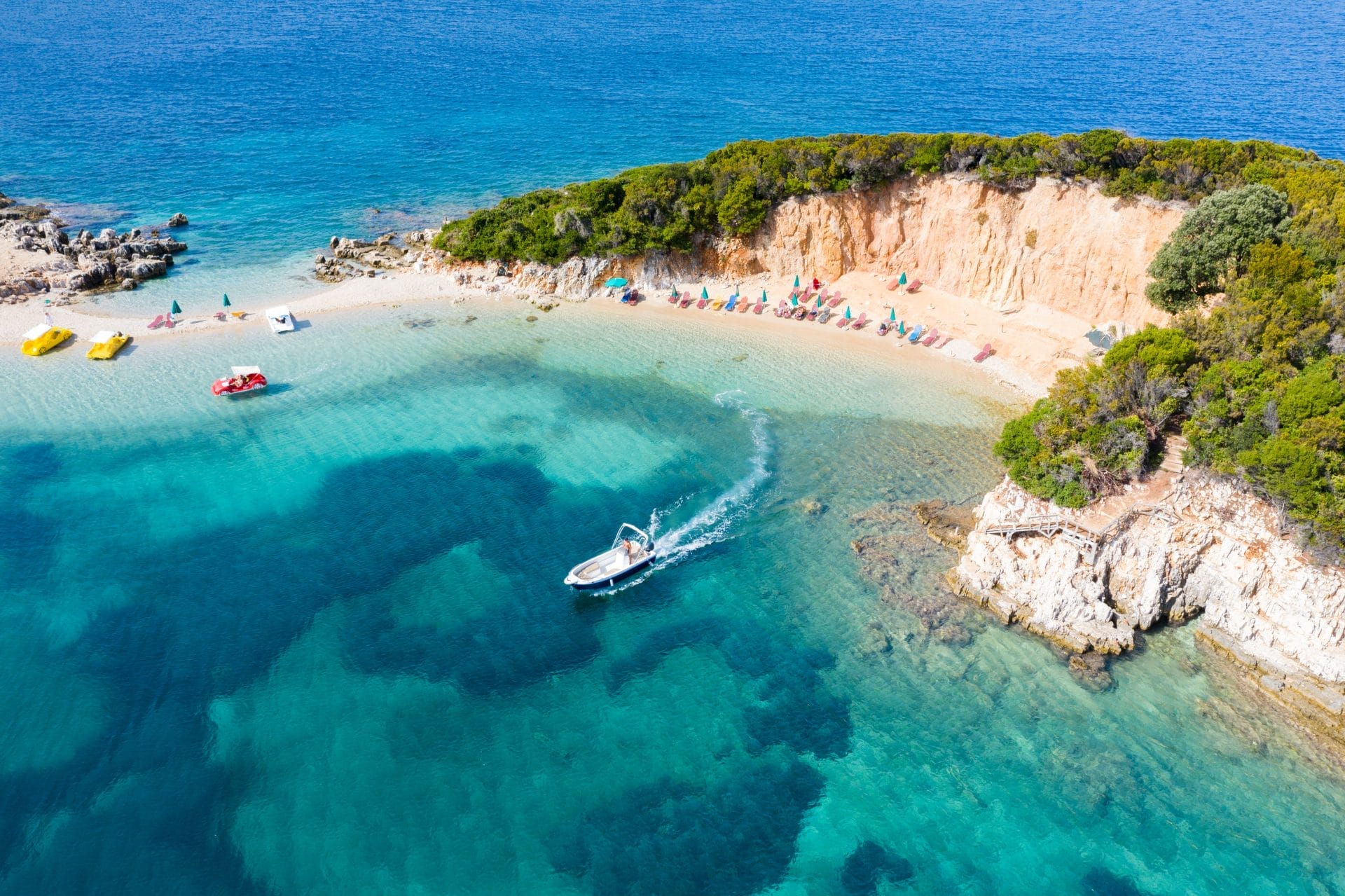
The Albanian Riviera delivers on coastal scenery and water clarity. The limestone geology creates genuinely clear water. The mountain-meets-sea topography produces dramatic landscapes. The beaches range from developed and crowded to isolated and empty depending on access difficulty.
What the Riviera doesn’t deliver anymore is undiscovered isolation. The 2010s transformation means you’re visiting established tourism destination with crowds matching popular Greek or Croatian equivalents, infrastructure still catching up to visitor numbers, and prices that have increased substantially while remaining cheaper than Western European alternatives.
The cultural complexity adds depth if you’re interested—the Greek minority communities, the communist legacy, the rapid modernization contrasted with traditional village structures create layers beyond simple beach tourism. If you’re just seeking beach time, the Albanian Riviera works fine but isn’t dramatically different from alternatives elsewhere in the Mediterranean that might offer better infrastructure and easier access.
Skip the Albanian Riviera if you have limited Albania time (the beaches aren’t the country’s most compelling attractions), if you’re visiting July-August and expect to avoid crowds, if you need polished tourism infrastructure, if you’re uncomfortable with mountain driving, or if you’ve already seen the region’s major historical sites (Butrint, Gjirokastër, etc.) and are just adding beach days.
Visit if you have 4+ days for proper exploration beyond single-village stays, if you’re traveling May-June or September-October, if you’re interested in the cultural and historical layers beyond beaches, if you’re comfortable with developing infrastructure and occasional service gaps, or if you want to witness rapid tourism transformation in real-time—the Albanian Riviera in 2025 is different place than 2015 and will be different place again by 2035.
The SH8 road is worth driving for the journey itself, independent of beach destinations. The Llogara Pass descent toward Dhërmi creates one of the Mediterranean’s most dramatic coastal drives. Whether that’s sufficient reason to visit the Albanian Riviera depends on your travel priorities and how much time you’re allocating to Albania overall.