Opening: The City Built on Three Coffees Daily
By 9:30 AM, every cafe in Tirana is full. This isn’t breakfast rush—it’s the first of three mandatory daily coffee sessions that structure Albanian life with more regularity than work schedules. The cafes maintain Europe’s highest density per capita, a statistic that becomes visceral when you realize finding an empty table before 10 AM is genuinely difficult. The espresso costs €1.50 as of January 2025, a price point deliberately kept low because coffee isn’t optional luxury in Albania—it’s social infrastructure. No one’s in a hurry; conversations run for forty-five minutes or longer while the small cup sits barely touched on the table. This pattern repeats at 1 PM and 7 PM with the precision of a cultural law that nobody wrote down because everybody participates, from teenagers to pensioners, making the three-coffee rhythm as fundamental to Albanian daily life as meals or sleep.
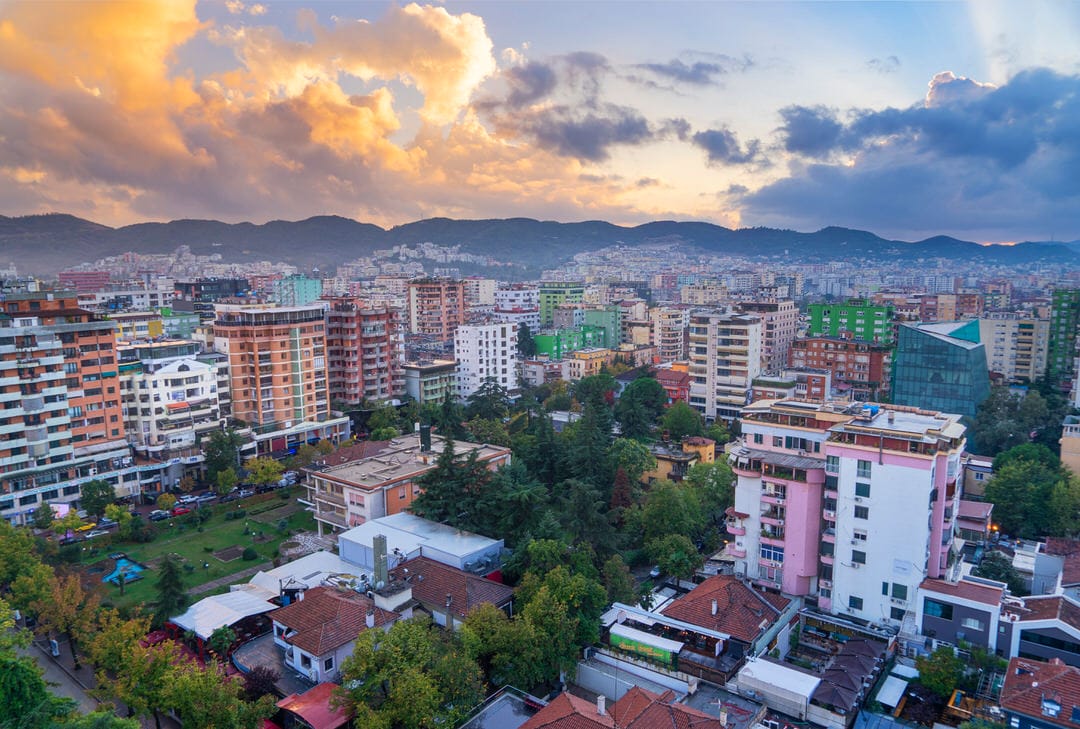
Look up: international architecture studios are building an experimental skyline that didn’t exist five years ago. MVRDV’s 85-meter Skanderbeg Building designed as a sculptural portrait. OODA’s Hora Vertikale stacking 13 cube volumes 140 meters high like carelessly placed toy blocks. Look around: neon-painted communist blocks from a mayor’s 2000 experiment in using color to fight depression. A five-story nuclear bunker with 106 rooms now opening as a museum at 15°C. Blloku—the neighborhood that was forbidden territory for forty-six years where guards shot unauthorized visitors—now filled with rooftop bars in former secret police villas.
Nothing is carefully curated. Traffic ignores rules with the kind of creative interpretation that makes crosswalks more decorative than functional. Construction cranes cover every sight line, their presence so constant that locals navigate the city by which streets are currently torn up rather than traditional landmarks. Sidewalks become parking lots when convenient, forcing pedestrians into the street in an endless negotiation between cars, walkers, and the occasional food cart claiming its own territory. Radical skyscrapers by MVRDV and OODA go up next to painted Soviet blocks next to Ottoman mosques, all simultaneously, with no master plan coordinating the aesthetic chaos. The transformation from communist isolation to EU candidate status happened in thirty years—too fast for orderly planning, too chaotic for preservation, too urgent for anyone to agree on what should be kept versus demolished versus repurposed. That’s exactly why it’s worth visiting—Tirana doesn’t perform a curated version of itself for tourists; it lets you watch an entirely new city being built in real time while the old one refuses to disappear.
Quick Facts
Getting There & Around
- From airport: Tirana International Airport (TIA) 17km northwest. Airport bus 200 LEK (~€2, Jan 2025), taxi €20-25 fixed rate, ride-share apps €15-18. Journey time 20-30 minutes depending on traffic.
- City transport: Buses €40 LEK (~€0.40 per ride). Taxis cheap (€3-8 within city center). Bolt works reliably. Center is walkable but prepare for creative sidewalk usage (they double as parking).
- Parking: Street parking chaotic. Hotels charge €5-10/night (Jan 2025 rates). Better to park outside center and use taxis.
When to Visit
- Best: September-October (20-25°C, fewer tourists, cultural season active)
- Good: April-June (15-25°C, spring energy, outdoor cafes opening)
- Busy: July-August (30-35°C heat, some businesses close for August holiday, peak tourist crowds)
- Winter: December-February (5-15°C, cafes packed indoors, few tourists, locals only)
- Honest warning: Summer heat is real (30-35°C), many locals leave in August, construction never stops regardless of season.
Where to Stay (Jan 2025 pricing)
- Budget: Hostels €10-20/night dorm, €25-40 private room. Trip’n’Hostel and Tirana Backpacker Hostel central.
- Mid-range: Hotels €50-80/night. Blloku location costs €10-15 more but worth walkability. Hotel Colosseo, Rogner Hotel good options.
- Splurge: Boutique hotels €90-150/night. Marriott/Hilton €100-180. Plaza Tirana, Maritim Plaza solid choices.
- Neighborhoods: Blloku (trendy, nightlife, walkable to everything, louder). Center near Skanderbeg (convenient, noisier, construction). Artificial Lake area (quieter, residential, 15-min walk to center).
How Long
- Minimum: 2 days (Bunk’Art, Blloku, Skanderbeg Square, one evening xhiro)
- Ideal: 3-4 days (adds Mt. Dajti, The Pyramid, deeper Blloku exploration, proper coffee culture immersion)
- Extended: 5+ days (use as base for day trips to Krujë, Durrës, Berat while returning nightly to Tirana’s energy)
Budget (Jan 2025, per person/day)
- Budget: €40-50 (hostel €15, street food €12-15, one museum €7, buses €2, mandatory 3 coffees €4.50, one beer €3-5)
- Mid-range: €70-90 (hotel €60, sit-down meals €25-30, museums/cable car €20, 3 coffees €9, drinks €8-12)
- Comfortable: €120-150 (nice hotel €80-100, good restaurants €40-50, all activities €25, 3 premium coffees €12, nightlife €20-30)
Safety Essentials
- Solo travelers: Safe. Women report feeling comfortable walking at night in Blloku/center. Standard urban awareness applies.
- Common issues: Pickpockets in crowded buses/Skanderbeg Square (rare but happens). Traffic chaos (look both ways twice, drivers creative). Construction zones (sidewalks torn up, watch footing).
- Health: Tap water drinkable but locals buy bottled. Pharmacies everywhere. Public hospitals crowded, private clinics better (Amerikan Hospital 3 recommended).
- Money: ATMs everywhere. Cards accepted widely but carry cash for street food, buses, small cafes. EUR more accepted than USD.
Pro Tip: Download Bolt app before arrival (works better than hunting taxis), bring earplugs (Tirana is LOUD—traffic, construction, nightlife), and accept that you’ll drink more coffee than you planned because social life literally requires it.
Why Visit Tirana
Visit Tirana if you want:
A city that’s figuring itself out in real time rather than performing a curated version for tourists. The transformation from forty-one years of totalitarian isolation to EU candidate status happened in thirty years—too fast for tidy narratives, too chaotic for Instagram-perfect preservation. You’ll drink three coffees daily (it’s genuinely mandatory for social participation, not optional), watch teenagers learn Python in the building Hoxha’s daughter built to glorify the man who banned exactly this kind of education, and witness international architecture studios building an experimental skyline that changes monthly.
For a detailed guide to the city’s best attractions and experiences, see our 15 best things to do in Tirana.
The communist past hasn’t been erased or turned into tasteful museum districts. It’s been repurposed: bunkers become museums at 15°C, forbidden neighborhoods become bar districts, monuments built to glorify dictators become climbing equipment for teenagers. You’ll see MVRDV’s radical skyscrapers going up next to painted Soviet blocks next to Ottoman mosques, all simultaneously, with no master plan coordinating the aesthetic chaos.
If you want to understand what post-communist transformation actually looks like (messy, loud, developing too fast for comprehensive planning, completely uninterested in performing “authenticity”), Tirana demonstrates it more honestly than any Balkan capital I’ve visited.
Skip Tirana if:
- You want perfectly preserved historic centers - Development happened fast, preservation happened slow. The old city exists in fragments between construction sites.
- You can’t handle urban chaos - Traffic ignores rules, sidewalks function as parking, construction happens on every block simultaneously, noise is constant.
- You need quiet romantic getaway - Tirana is energetic, loud, urban. Beaches are 40km away, mountains nearby, but the capital itself is relentlessly city.
- You want traditional Balkan culture - Tirana skews young, Western-influenced, modern. Old traditions exist but you’ll work harder to find them here than in Gjirokastër or Berat.
- You expect things to “make sense” - Buildings rise then get permits retroactively, streets close without warning for construction, the visual aesthetic is deliberately mixed. If you need order, this isn’t your city.
Bunk’Art: Inside Hoxha’s Nuclear Paranoia
Between 1972 and 1978, Albanian engineers carved five stories into the mountain near Mt. Dajti for a nuclear war that never came. The bunker holds 106 rooms designed to shelter Hoxha and the communist elite while the rest of the country burned—decontamination chambers with original equipment still mounted on concrete walls, communication centers with 1970s telephones and radio equipment arranged exactly as they were left, living quarters with beds made up and furniture placed as if the elite might arrive any moment to wait out the apocalypse.
They never came. When the regime collapsed in 1991, soldiers abandoned the complex and sealed the entrances. For twenty-three years it sat empty in the dark, holding its constant 15°C temperature with no one inside to appreciate the climate control. In 2014, it reopened as Bunk’Art 1.
The cold hits immediately when you enter—15°C feels shock-cold after August heat outside, a temperature designed to remain constant year-round for the bunker’s climate control systems (I learned this the hard way in July, standing there in a t-shirt while my breath almost fogged, wishing I’d brought the jacket the ticket seller had recommended). Your body temperature drops noticeably within five minutes of entering the first corridor, making you physically understand how this bunker would have felt during extended occupation. The concrete corridors stretch in multiple directions off the main passages, creating a maze-like environment where fluorescent lights cast the same institutional glow they would have cast during the Cold War—nothing about the lighting has been upgraded or softened for museum purposes. Video installations play declassified Sigurimi footage in rooms that once held surveillance equipment, the grainy black-and-white recordings showing party meetings, military exercises, and public events orchestrated for propaganda purposes. Contemporary art pieces comment on the paranoia with varying degrees of subtlety—some installations effectively provoke reflection on fear and power, while others feel heavy-handed in their symbolic choices.
Mostly, though, the bunker speaks for itself: 106 rooms of prepared paranoia, never tested, preserved as monument to fear made physical. You can see the decontamination showers that were never used. The communication equipment that never transmitted the nuclear war orders it was installed to handle. The beds that were never slept in by the elite who would have sheltered here while everyone else died above ground.
Bunk’Art 2 occupies a different bunker downtown near Skanderbeg Square, this one focused entirely on the Ministry of Interior and the Sigurimi (secret police). The exhibits here document methods: surveillance techniques, interrogation rooms with original furniture, political prisoner testimonies recorded as audio that plays in cells barely large enough for the metal bed frame bolted to the floor. It’s darker than Bunk’Art 1, both literally and thematically—where the nuclear bunker feels absurd in its over-preparation, the secret police bunker documents actual suffering inflicted on actual people whose names appear on placards next to their photographs.
Practical Details (Jan 2025 pricing):
- Bunk’Art 1: 700 LEK (~€7), located near Dajti cable car station
- Bunk’Art 2: 500 LEK (~€5), downtown near Skanderbeg Square
- Time needed: 1.5-2 hours minimum for Bunk’Art 1 (easily 3 hours if you read everything), 1 hour for Bunk’Art 2
- Critical: Bring jacket even in summer—15°C constant temperature year-round
- Pro Tip: Visit Bunk’Art 1 first (more impressive), combine with Mt. Dajti cable car same trip (they’re next to each other)
Blloku: From Forbidden Zone to Rooftop Bars (And Why That Matters)
For forty-six years, Blloku existed as a neighborhood within Tirana that ordinary Albanians couldn’t enter without written permission. Party officials lived in villas behind checkpoints. Secret police occupied houses with gardens. Hoxha’s own family walked streets where guards had orders to shoot unauthorized visitors. The elite ate imported food while the rest of the country queued for rationed bread. They watched Western films while everyone else watched state propaganda.
February 20, 1991: the regime collapsed. By evening, thousands had walked past the abandoned checkpoints into streets they’d spent their entire lives forbidden to approach. My neighbor in Tirana (who was 19 at the time) describes the feeling as surreal—walking into Blloku felt like entering a movie set of a Western city that had been hidden five minutes from where she’d lived her entire life. They looked inside the villas. They walked the gardens. They saw where the people who’d controlled their lives had themselves lived—often comfortably, sometimes luxuriously, always separately.
Thirty-four years later, those villas house rooftop bars. Young Tirana drinks Aperol spritz (€5-7 as of Jan 2025) on terraces where commissars once held private meetings. Boutiques sell the Western brands Hoxha banned. Cafes with outdoor seating occupy ground floors where informants filed reports about neighbors. The checkpoints are gone. The gardens are now outdoor seating. The privilege enforced by bullets has become real estate priced for the emerging middle class and visiting tourists.
The irony is neither subtle nor accidental—Blloku’s entire economy runs on the transformation of symbols of oppression into symbols of freedom, commercialized. You can drink coffee (€1.50-3, Jan 2025) where secret police lived. You can buy Italian shoes where privilege once required party membership. You can join the evening xhiro (stroll) on streets that were, within living memory, off-limits territory where crossing the boundary could get you killed.
Where to Experience This:
- Komiteti Kafe Muzeum: Traditional raki (€3-5/glass) and coffee surrounded by communist-era artifacts—propaganda posters, rotary phones, Hoxha photographs—arranged as decor that evokes the period without endorsing it. The owner deliberately curated the space to remember without glorifying.
- Radio Bar: Occupies a former villa with garden now converted to outdoor seating. Good for people-watching the parade of fashionable young Albanians who’ve never known checkpoints.
- Sky Club: Rooftop with city views. Drinks €5-8 (Jan 2025), weekend cover €10-15 with drink included.
The past is visible everywhere in Blloku, but only as backdrop to the present’s relentless commercialization of what used to be forbidden. Whether that’s healthy processing or troubling amnesia depends on who you ask—and Albanians themselves haven’t reached consensus.
The Buildings Painted Neon to Fight Depression (And Why They’re Still Painted 25 Years Later)
In 2000, Tirana looked exactly like what it was: a post-communist capital traumatized by the 1997 pyramid scheme collapse that had bankrupted sixty percent of the population and triggered near-civil war conditions. Gray concrete apartment blocks lined every boulevard. Crumbling infrastructure failed regularly. People looked defeated in a way that went beyond economics into something closer to collective shell shock.
Edi Rama, an artist turned politician, won the mayoral election and immediately deployed paint crews across the city without requesting permits or consulting residents. Entire apartment blocks got painted fluorescent orange. Ten-story buildings turned bright yellow. Facades became canvases for green, blue, pink, and combinations that looked less like urban planning and more like a painter’s rebellion against monochrome despair.
Rama’s reasoning, as he explained it later, was deliberately simple: Albanians were depressed. Gray concrete made depression worse. Color might help. Why deliberate for years when you could just paint and see what happened?
The paint didn’t fix the plumbing—those Soviet-era buildings still have water pressure problems and electrical issues that paint can’t solve. It didn’t address the structural problems or the economic stagnation. But residents reported feeling different about their city. The visual shock worked psychologically in ways that careful urban planning studies might have dismissed as superficial. Breaking the aesthetic monopoly of communist-era grayness turned out to matter more than anyone had predicted.
Rama served as mayor through 2011, then became Prime Minister (he still holds the position in 2025). The buildings remain painted, though faded now—orange weathered to rust-orange, yellow paled to cream, the colors aging but still distinctly non-gray. Some facades have been repainted. Others peel. None have returned to uniform concrete gray. The city claimed color as identity, communist architecture reclaimed through paint rather than demolished and replaced.
Walk the residential boulevards beyond Skanderbeg Square to see the painted blocks. They’re most concentrated along Rruga e Durrësit heading northwest and around the Artificial Lake area. The paint is peeling on many—this wasn’t a one-time perfect solution, it’s an ongoing maintenance commitment the city doesn’t always keep up with. But even faded and peeling, the colors remain, which tells you something about how much the visual break from grayness mattered.
Coffee Three Times Daily (Mandatory, Not Optional)
Look, I need to be clear about this: the three-coffee-daily thing isn’t travel blog hyperbole. It’s actual social infrastructure that functions with more reliability than posted bus schedules.
By 9:30 AM, every cafe in Tirana is full. Not busy—full. Every table occupied, conversations running simultaneously in overlapping waves, the specific sound of dozens of espresso cups meeting saucers creating a ceramic percussion that defines the morning soundscape. This is morning coffee, the first of three daily sessions that function less as caffeine delivery and more as required social participation.
Albanians don’t drink coffee casually. They drink it ritually, at specific times, with specific people, following unwritten rules that everyone understands and no one questions. Morning coffee (9-10 AM) happens with friends over discussion of news, politics, plans, and gossip that couldn’t be efficiently communicated via text. The espresso or macchiato sits on the table—often barely touched—while conversations run for an hour or longer. No one rushes. The cafes make their money on volume and turnover, but the cultural expectation is that coffee time is sacred time, not to be abbreviated for efficiency.
Post-lunch coffee (1-2 PM) arrives automatically after meals with the inevitability of gravity. You don’t order it separately—it comes as the final course, an espresso to close the meal. Skipping it would be like leaving without paying: technically possible but so socially aberrant that almost no one attempts it. (I tried once, out of curiosity. The waiter looked genuinely confused and brought the coffee anyway, assuming I’d simply forgotten to specify espresso versus macchiato.)
Evening coffee (7-8 PM) precedes the xhiro (evening stroll), another small cup serving as the transition ritual between daytime and nighttime social life. The cafes fill again, conversations restart, the same ceramic percussion builds as hundreds of cups meet hundreds of saucers across hundreds of tables occupying every available square meter of sidewalk and street.
Tirana maintains Europe’s highest cafe-to-capita density. You cannot walk fifty meters in the center without passing multiple cafes, all of them full, all of them serving the same small cups of strong coffee for €1.50-3 (Jan 2025 pricing). The low price enables the frequency, but the frequency exists because coffee isn’t optional refreshment—it’s the medium through which social and business life happens. Meetings require coffee. Negotiations happen over coffee. Relationships begin and end over coffee.
Skip the three daily sessions and you’re not just missing caffeine, you’re opting out of the fundamental social rhythm that structures life in the capital. Which is fine if you’re visiting for two days. But understand that locals will notice, and you’ll miss how the city actually functions socially.
Ordering: Say “makjato” for macchiato (espresso with milk foam), “espresso” for straight shots. Lattes and cappuccinos exist for tourists—locals drink small, strong, and frequently all day every day.
The Pyramid: From Dictator’s Museum to Climbable Tech Hub (Or: The Perfect Revenge)
Hoxha’s daughter built the Pyramid in 1988 to glorify her father three years after his death. The concrete brutalist structure opened as a museum just as the regime that had commissioned it was collapsing around it—timing that made the building instantly symbolic of failed ideology rather than triumphant legacy.
For thirty-five years, no one could agree what to do with it. NATO occupied it briefly during the 1999 Kosovo War as a command base. It became a nightclub. Then a conference center. Then gradually a graffiti-covered ruin that teenagers climbed illegally while the city debated whether to demolish the building entirely or preserve it as historical artifact. The debate itself mattered more than the building—how do you handle monuments to dictators? Erase them completely? Preserve them as warnings? Transform them into something their builders would have hated?
October 2023: transformation won. Dutch firm MVRDV completed a renovation that kept the concrete pyramid structure but made it genuinely climbable. The stepped facades now function as public stairs leading to the summit where you can look across Tirana from architecture that was built to honor oppression but now serves as literal climbing equipment for anyone who wants the view. Colorful boxes attached to and scattered throughout the structure house cafes, studios, workshops, and classrooms.
Half the building belongs to TUMO Tirana, a non-profit running free afterschool programs for teenagers in software development, robotics, animation, music production, and filmmaking. On any weekday afternoon, you can watch Albanian 14-year-olds learn Python and 3D modeling in the building that Hoxha’s daughter built to celebrate the man who isolated Albania from exactly this kind of global, forward-thinking education.
The computers run on fast internet. The instructors use Western curricula. The students collaborate on projects with other TUMO centers across Europe. Everything about the program represents what Hoxha’s regime banned as Western corruption designed to undermine Albanian values. The irony isn’t accidental—as MVRDV founder Winy Maas explained: “The transformed Pyramid has now become a monument for the people and their ability to overcome and outlive dictators.”
You can climb it for free (open daily, Jan 2025). Grab coffee in one of the bright boxes (€2-4). Watch teenagers code where propaganda once played. The building that was supposed to preserve Hoxha’s legacy now demonstrates exactly how completely that legacy was rejected—not just torn down, but repurposed into infrastructure for the kind of future he spent forty years trying to prevent.
Which, honestly, is the perfect revenge.
The Skyscraper Boom: Building a New Skyline Faster Than Anyone Can Track
Stand at Skanderbeg Square and count the construction cranes. You’ll lose count around fifteen. Every sight line includes scaffolding, tower cranes, concrete forms climbing toward heights that didn’t exist in Tirana’s profile five years ago. International architecture studios have descended on the capital with the kind of concentrated attention usually reserved for Gulf states with unlimited budgets—except Tirana isn’t Dubai, and the budgets aren’t unlimited, and somehow that’s made the architecture more experimental.
MVRDV finished the Skanderbeg Building in 2024—85 meters tall, designed as a literal sculptural portrait of the 15th-century military commander who revolted against Ottoman rule. The building functions as office and residential space while simultaneously serving as three-dimensional public art. Portuguese firm OODA has eight proposals under development simultaneously, including Hora Vertikale: 13 stacked cube volumes reaching 140 meters that look like oversized toy blocks carelessly placed into position. Bond Tower, also by OODA, bends at the middle like a ballet dancer’s plié—two towers leaning toward each other at the kinked joint.
Downtown One currently holds the title of tallest building in the country at 140 meters, though multiple competitors are rising to challenge that status. Swiss architect Valerio Olgiati has plans for a trio of towers reaching 150, 192, and 266 meters. Barcelona Tower will hit 202 meters across 51 floors. Eyes of Tirana by Henning Larsen topped out at 135 meters in 2023. Tirana Society Towers aims for 300 meters.
The question architects ask isn’t “why Tirana?” but rather “why not work in Tirana?” As Italian architect Stefano Boeri told Dezeen in 2023: “Tirana is changing so fast, so very, very fast, and in an explosive way.” OODA co-founder Diogo Brito added: “It’s very difficult to find an architect that is not working in Tirana or Albania right now.”
The speed creates uncanny juxtapositions. OODA’s radical high-rises go up next to Rama’s 2000-era painted blocks next to Ottoman-era mosques next to MVRDV’s 2023 Pyramid renovation next to Soviet brutalism that was never painted. No single aesthetic dominates. No master plan coordinates the chaos. Politicians court international architects with unusual freedom to push boundaries, resulting in a cityscape that looks less like urban planning and more like a real-time architectural exhibition where every major studio wants representation.
Walk through the center during construction hours—7 AM until dark—and the soundscape is concrete mixers, tower cranes beeping backup warnings, jackhammers breaking foundation rock, rebar being tied with wire. The dust hangs in afternoon heat. Traffic routes around construction zones that appear overnight. The old city is still visible beneath and between the new towers, but every month the proportion shifts further toward the radical skyline that didn’t exist when people currently in their twenties were teenagers.
Whether this transformation will age well or become a cautionary tale about unregulated development is a question for 2045. Right now, in 2025, Tirana is the rare city where you can watch an entirely new architectural identity being constructed in real time, with construction timelines so compressed that the skyline changes faster than guidebooks can update their photos.
(And yes, the noise and dust are real. Bring earplugs. Accept that your favorite sight line will include at least three tower cranes.)
Mt. Dajti: Escape the Chaos (Temporarily)
The Dajti Ekspres cable car climbs 1,050 vertical meters in fifteen minutes, the gondola swaying slightly as it ascends from Tirana’s eastern edge toward the summit of Mt. Dajti. Below, the capital spreads across the valley in its characteristic pattern—neon-painted brutalist blocks, construction cranes, traffic congestion visible even from altitude. Above, beech forests cover the mountainside in green that deepens as you climb. The temperature drops noticeably—you can feel the change through the gondola windows as urban heat gives way to mountain cool.
At 1,613 meters elevation, the view extends in all directions: the entire Tirana valley to the west, the Adriatic Sea glinting thirty kilometers away on clear days (hazy days show only the nearer mountains), and the ring of peaks that enclose the capital like an amphitheater. The restaurant at the summit serves overpriced food you’re better off skipping (€15-25 for mediocre pasta, Jan 2025 pricing)—eat in the city before or after. Hiking trails wind through the beech forests if you want to explore beyond the summit station. Mostly people come for the air, which feels qualitatively different from sea level—cooler, cleaner, offering genuine relief from July and August heat that can make the city uncomfortable.
Sunset draws crowds. The cable car develops queues between 7 and 8 PM during summer evenings when everyone wants the same view of golden light hitting those painted buildings from above. If you’re committed to sunset timing, arrive by 6:30 PM or accept the wait. Otherwise, midday visits avoid crowds and still deliver the same view, just in different light.
Practical Details (Jan 2025):
- Cost: 1,200 LEK (~€12) return ticket
- Hours: 9 AM-9 PM summer (Apr-Oct), 9 AM-7 PM winter (Nov-Mar)
- Getting there: Taxi from city center €5-8, combine with Bunk’Art 1 visit (they’re adjacent)
- Food: Skip the overpriced summit restaurant, pack snacks or eat before/after
- Weather: Can be 10-15°C cooler than city, bring light jacket year-round
- Pro Tip: Clear mornings (9-11 AM) best for Adriatic views, afternoons often hazy
Two-Day Tirana Itinerary (If You Only Have a Weekend)
Day 1: Communist History + Blloku
- 9:00 AM: Mandatory first coffee in Blloku (€1.50-3)
- 10:00 AM: Bunk’Art 1 near cable car station (700 LEK, bring jacket, 2 hours)
- 1:00 PM: Lunch + mandatory second coffee (€10-15 total)
- 3:00 PM: Skanderbeg Square + National History Museum (200 LEK, 1 hour)
- 5:00 PM: The Pyramid - climb to summit, watch TUMO kids code (free)
- 7:00 PM: Mandatory third coffee + evening xhiro stroll (€1.50-3)
- 9:00 PM: Blloku rooftop bars (€5-8/drink)
Day 2: Modern Tirana + Mountain Escape
- 9:00 AM: Coffee in center (€1.50-3) while observing morning rush
- 10:30 AM: Bunk’Art 2 downtown (500 LEK, 1 hour)
- 12:00 PM: Walk painted buildings neighborhoods
- 1:00 PM: Traditional Albanian lunch + coffee (€12-18)
- 3:00 PM: Dajti Ekspres cable car (1,200 LEK return, 2-3 hours including summit time)
- 7:00 PM: Return for evening coffee + final xhiro
- 9:00 PM: Farewell dinner at Oda or Mullixhiu (€25-40)
Budget for 2 days: €80-120 depending on accommodation choice and nightlife appetite.
The Capital That Refuses to Be Defined (Final Thoughts)
Tirana isn’t beautiful like Berat. It’s not ancient like Apollonia or a beach resort like Saranda. The capital is chaotic, loud, developing at speeds that make comprehensive urban planning impossible, painted in colors that fade and peel but never quite return to gray.
The city performs no curated version of itself for visitors—what you see is the unfinished transformation happening in real time. Traffic ignores most posted rules as suggestion rather than law. Construction happens on every block simultaneously. Sidewalks function as parking lots when convenient. Buildings rise without proper permits, then get legalized retroactively.
Young people work remote jobs for European companies while sitting in cafes next to grandparents who speak Italian learned from decades of illegally watching RAI broadcasts during isolation. The older generation remembers Hoxha personally. The younger generation climbs the pyramid built to honor him, now repurposed into exactly the kind of tech hub his regime would have banned as Western corruption.
Transformation rather than erasure defines the pattern. Communist monuments become museums. Forbidden neighborhoods become bar districts. Bunkers become art installations. The Pyramid becomes a coding school. The city works out its relationship with a difficult past in public, without consensus about what the final result should look like or whether consensus even matters.
Budget €50-70 daily for comfortable visits (Jan 2025): accommodation €40-60, food €15-25, activities €10-15, plus €4.50-9 for the mandatory three daily coffees that function less as caffeine delivery and more as social infrastructure.
Bring comfortable walking shoes (sidewalks are obstacle courses). Bring earplugs (Tirana is LOUD). Bring acceptance that the chaos isn’t accident or problem requiring solution—it’s the defining characteristic of a capital that went from total isolation to EU candidate status in thirty years and hasn’t paused long enough to develop a coherent narrative about what that transformation means.
Come for the coffee culture (genuinely fascinating). Stay for the bunker museums (genuinely moving). Leave understanding that post-communist transformation is messy, loud, contradictory, and completely uninterested in your Instagram aesthetic preferences.
Which is exactly what makes it honest.