One Euro for a Mountain
How Albania’s Mountains Package sells public highland for a symbolic euro and ten tax-free years in the name of helping villagers — and why critics call it a clientelist giveaway that endangers the Balkans’ last wild parks.
How Albania’s Mountains Package sells public highland for a symbolic euro and ten tax-free years in the name of helping villagers — and why critics call it a clientelist giveaway that endangers the Balkans’ last wild parks.
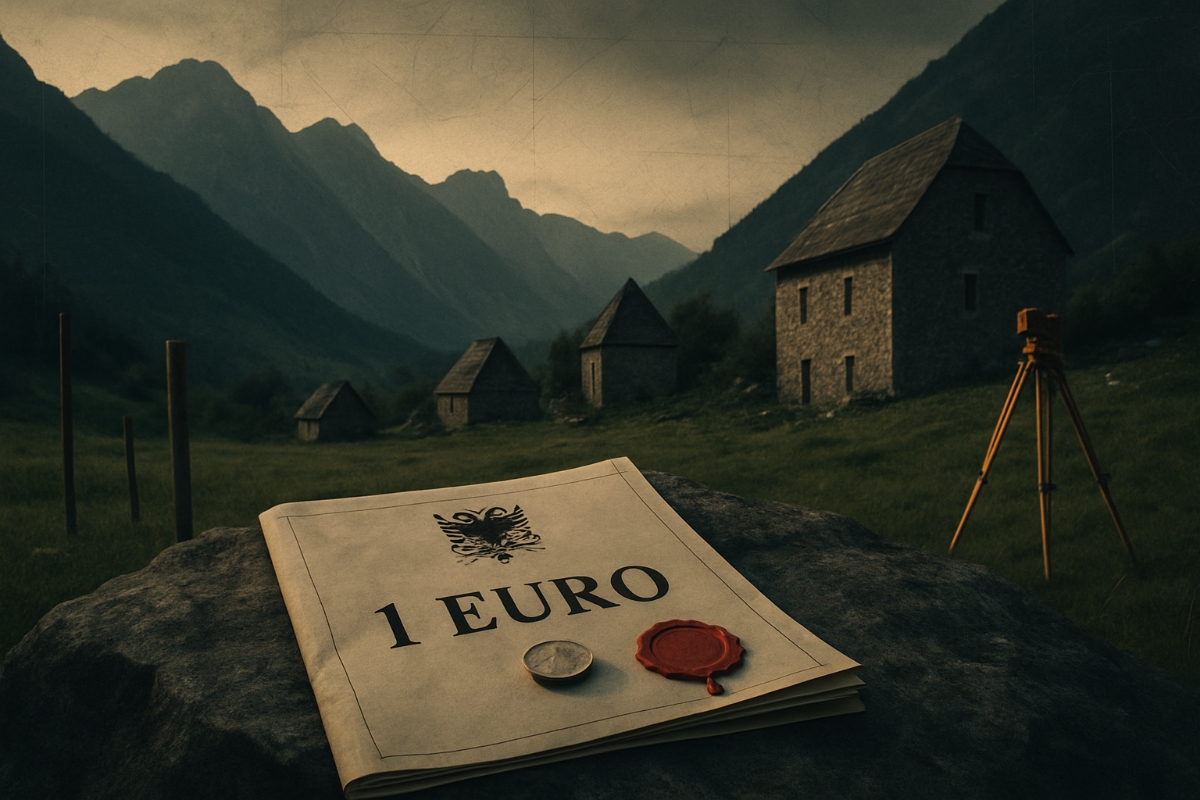
The third folder in the machine. A 2025 law sells state land in the mountains for a symbolic euro and waves ten years of taxes, in the name of helping villagers. Critics say it is a mini-fiscal paradise for a connected few, and a threat to the Balkans’ last wild parks.
The price of a mountain in Albania is now one euro.
That is not a figure of speech. Under the law known as the “Paketa e Maleve,” the Mountains Package, the Albanian state can transfer a parcel of public land in its highland regions to a private holder for a symbolic single euro. It is the third of the three laws that critics describe as one machine: where the protected-areas amendment made the coast buildable and the Strategic Investments Law decided who gets to build, the Mountains Package handles the supply of land itself. And it does so at a price that tells you most of what you need to know about who it is really for.
The government approved the Mountains Package in January 2025 and Parliament adopted it as Law no. 20/2025 on March 13, 2025. Its public justification is sympathetic: Albania’s mountain regions have fallen far behind the coast and the cities, many highland residents have used state land for generations without ever holding title to it, and the law promises to fix both problems at once by giving long-time users ownership and an incentive to invest.
The mechanism is specific. A person who has used a piece of state mountain land for at least ten years can acquire ownership of it for a symbolic one euro. But the transfer is conditional. It comes as a sales contract that only converts into full title once the holder builds the development described in a previously approved project, within three years. On top of the giveaway price sits a fiscal sweetener: a ten-year exemption from a slate of taxes for those who take up the land and carry out their declared projects. Early reporting put the number of beneficiary subjects in the hundreds.
Stated that way, it sounds like rural justice: titles for shepherds, a leg up for a forgotten interior. The design tells a different story.
The gap between what the Mountains Package says and what it does is where the criticism lives, and the critics are not only activists.
The first problem is who can actually use it. A law pitched at modest highland families is built around a requirement to finance and complete an approved development within three years. A shepherd with a grazing plot does not have a bankable project and a three-year construction timeline. A tourism or energy company does. Analysts who have read the architecture argue it quietly favors large tourist and energy investments, far from the “family model” in the government’s brochures. The land is cheap; the capacity to meet the conditions is not, and that filter decides who walks away with title.
The second problem is where the decisions are made. Critics point out that authority over the scheme is centralized rather than placed with the communities the land belongs to, which “opens the way for benefits to go to non-resident subjects rather than local communities.” In other words, the people most likely to end up owning a mountain village’s land may not be from the village at all.
The verdict from Albania’s civil-society monitors has been harsh and specific. The Mountains Package, they argue, does not in fact contain the mechanisms it would need to help the emigrants and locals it claims to serve. Instead it creates a “mini-fiscal paradise” for a small group connected to the government, appearing to benefit poor regions while in practice “donating” land, forests and forgone taxes to “easily identifiable persons.” It has been called, flatly, another clientelist law. The opposition MP Ina Zhupa framed it as the “end of respect for property as a sacred right.” It also reaches back into one of Albania’s most contested legacies, the disputed agricultural titles created by the 1991 Law 7501, layering a new transfer regime on top of land whose ownership was never cleanly settled.
The Mountains Package is not only a property story. It is an environmental one, and the stakes cross borders.
Conservation analysts warn that the law’s logic, cheap land plus a building mandate plus a decade of tax relief, risks “irreversible consequences for the alpine ecosystem” and runs against the principles of sustainable development it claims to honor. The specific fear is that the scheme does not clearly exclude Albania’s most valuable highland nature, including the “Albanian Alps,” a territory central to cross-border conservation efforts that knit together the last wild mountain parks of the Balkans. A one-euro sale with a construction deadline is not a conservation tool. Pointed at a national park, it is a demolition order with a grace period.
This is the thread that binds the Mountains Package to the coastal fight. The same instinct that fenced a thousand-year-old dune system at Zvërnec for a luxury resort is at work in the highlands: treat protected nature as inventory, price it to move, and let the building begin before anyone can object.
Unlike the marquee coastal deal, the Mountains Package has been advancing quietly and at scale. By early 2026 the number of applications had reached several hundred, with the government openly targeting a thousand by year’s end, and priority zones have already been approved across a string of municipalities. This is not a dormant statute waiting to be tested. It is a live pipeline, parcel by parcel, while national attention is fixed on the flamingos of the Adriatic.
The Mountains Package shares its opponents, and its escape route, with the Strategic Investments Law.
The civic movement “Shqipëria Bëhet” (Albania Becomes), led by the lawyer and activist Adriatik Lapaj, has asked the Central Election Commission for the forms to collect signatures toward a national referendum to repeal both laws, 50,000 signatures for each. Lapaj’s case is that the two statutes together amount to legalized theft of the country’s patrimony. “It is time,” he has said, “to stop the theft of the Homeland by law.”
The obstacle is structural and familiar. Albania’s referendum mechanism has been effectively unusable for years, and the governing majority that passed the Mountains Package is not about to repeal it. So the law keeps working in the background, converting public mountains into private title one approved project at a time, while the route to stopping it runs through a referendum system that may first have to be unblocked at the constitutional level.
Of the three laws, the Mountains Package is the one that wears the kindest disguise. It speaks the language of fairness, of titles for the landless and life for dying villages, and that language is not entirely cynical: the grievance it addresses is real. But a real grievance can be the wrapping on a transfer that serves someone else. A scheme that sells land for a euro to whoever can build within three years is not designed for the shepherd. It is designed for the company that can.
Put the three folders side by side and the pattern is hard to miss. One law opened the protected coast. One chose the investors and gave them the state’s help. And this one supplies the land, cheaply, quietly, with the tax bill waived. The coast was the part you could see from the road. The mountains are the part the country may only notice once they are already sold.
It is Law no. 20/2025, adopted in March 2025, which lets people who have used state-owned land in Albania’s mountain regions for at least ten years acquire ownership of it for a symbolic price of one euro, on the condition that they complete an approved development project within three years. Beneficiaries also receive a ten-year exemption from several taxes.
Critics argue that despite being marketed as help for poor highland families and returning emigrants, the law’s conditions — financing and completing a development within three years — favor large tourist and energy investors, and that centralized decision-making lets benefits flow to non-residents and government-connected interests. Conservationists warn it threatens the alpine ecosystem and may not exclude protected areas such as the “Albanian Alps.”
The state transfers ownership through a sales contract for a symbolic one euro. Full title is granted only after the beneficiary completes the declared development within three years, and beneficiaries receive a ten-year exemption from several taxes.
It is the third of three laws critics describe as a single system: Law 21/2024 opened protected areas to development, the Strategic Investments Law fast-tracks chosen investors and gives them access to state land, and the Mountains Package supplies cheap state land in the highlands. Together they move public land into private development.
The movement “Shqipëria Bëhet,” led by Adriatik Lapaj, has requested forms from the Central Election Commission to collect 50,000 signatures toward a national referendum to repeal both the Mountains Package and the Strategic Investments Law. Albania’s referendum process faces significant legal and constitutional obstacles, so the path is uncertain.