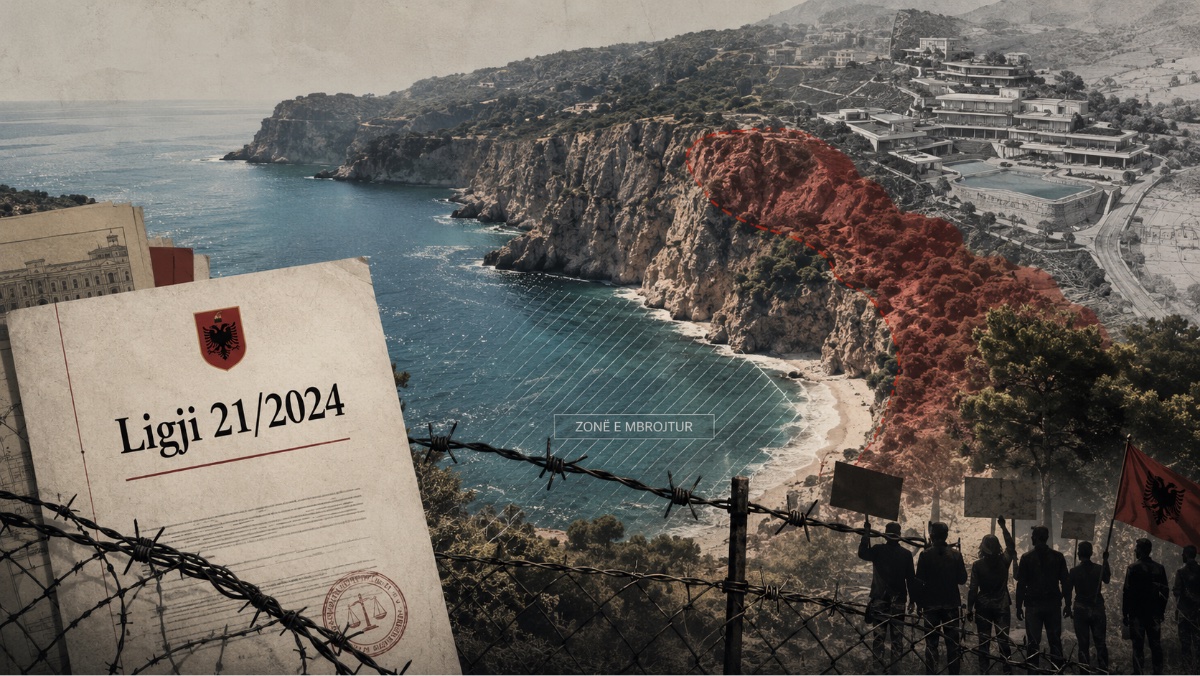
Ligji 21/2024
The barbed-wire fence at Zvërnec did not begin with a bulldozer. It began with a sentence.
On the night of May 30, 2026, video of private guards beating a protester on a cliff above the Adriatic traveled across Albania faster than the government could explain it. But the legal authority that put that fence on a protected beach was written more than two years earlier, in a short amendment to an environmental statute that almost nobody outside Parliament read at the time. Its name is Ligji nr. 21/2024, and a growing movement now treats it as the keystone of everything: pull it out, they say, and the whole arch of deals built above it comes down. That claim is half right, which is exactly why it is worth getting precisely right.
What the law changed
Law 21/2024 is, on paper, a modest-sounding thing: “some additions and amendments” to the 2017 Law on Protected Areas. Parliament adopted it on February 22, 2024. The decisive change is Article 14, which completely rewrites Article 33 of the older law, the article that lists what may be done inside a protected area.
The new Article 33 permits activities in five-star (or higher) accommodation structures, plus any supporting infrastructure, inside protected areas. Then comes the clause that does the real work: “pavarësisht nëse kjo përcaktohet në VKM-në e shpalljes së zonës së mbrojtur” — regardless of whether this is specified in the decree that declared the protected area.
Before that sentence, every protected area was governed by its own founding decree, which spelled out what was allowed inside it. A resort that the decree did not permit was simply illegal. After that sentence, a five-star resort is permitted by default, and the area’s own decree no longer stands in the way. The law inverts the basic logic of conservation, from nothing is built unless this specific place allows it to luxury tourism is allowed unless newly and specifically forbidden.
It does not stop at the gentler categories. A companion provision (Article 7) carves the same five-star exception into national parks, the strictest designation. Another (Article 20, rewriting Article 48) reaches the core zone, the first-degree-protection heart of a reserve: its list of banned activities still prohibits highways, railways, hydropower and oil and gas lines, but it does not prohibit a luxury resort, and it explicitly allows the new Article 33 activities. And Articles 15 and 16 hand the executive the pen: the Council of Ministers may now change a protected area’s boundaries, zoning, and list of permitted activities by decree. That is the mechanism that had already been used to cut the Vlora airport site out of the Vjosa-Narta landscape.
In plain terms, Law 21/2024 is the instrument that made it legal to build a resort in a nature reserve and to redraw the reserve if the resort needs more room. Everything that followed at Zvërnec and Sazan was built on this foundation.
How it passed: the quiet route
The way the law was passed matters as much as its text. It was introduced “me propozimin e një grupi deputetësh” — as a members’ bill, sponsored by a group of MPs rather than by the government.
That distinction is not procedural trivia. A government bill must clear a regulatory impact assessment and formal public and stakeholder consultation. A members’ bill does not. Routing a law of this consequence through the back door of a deputies’ initiative meant it never faced the scrutiny that an environmental statute of this reach would normally require. Critics, including the law’s most persistent parliamentary opponent, read that choice as deliberate. Whether or not it was, the effect was a foundational change to Albania’s conservation regime that arrived with almost no public debate.
Three laws, one machine
Here is where the viral version of this story goes wrong, and where a careful reader can avoid being discredited. Online, Law 21/2024 is often described as a “special law that gives the government power to approve strategic projects,” with fast-track expropriation and tax breaks. That is not what 21/2024 does. It conflates three separate instruments that happen to work together.
Law 21/2024 governs protected areas: it removes the wall that made building in them illegal. The investor privileges, the fast-tracked permits, the long leases and the tax holidays, come from a different statute, the Strategic Investments law. And the headline-grabbing transfers of state land to private hands for a symbolic one euro come from a third, the “Paketa e Maleve“ or Mountains Package (Law 20/2025), passed in March 2025.
They interlock into a single machine for moving public land into private development. But they are legally distinct, and the distinction is a journalist’s protection. Blur them and the government can wave away the entire argument on a technicality. Keep them separate and each one is individually documented and damning. Of the three, 21/2024 is arguably the most consequential, because it is the one that decided that a protected coast could be sold at all.
The 4–4 court
The most important correction to the popular narrative concerns the courts. The constitutional fight over Law 21/2024 is not pending, and it was not won. It was lost on a tie.
In 2024 and 2025, 37 opposition deputies — one-fifth of Parliament, the minimum needed to petition — joined the environmental groups AOS (the Albanian Ornithological Society) and EcoAlbania in asking the Constitutional Court to strike the law down. They argued it violated the constitutional rights to property and to a healthy environment, the state’s duty to protect nature, the rule of law, and the hierarchy of legal norms. The Court took the unusual step of admitting the conservation groups as third parties.
On July 31, 2025, the Court rejected the petition on a 4–4 split. A tie falls short of the majority required to annul, so the law survived. The reasoning offered was that 21/2024 is a framework law that “does not create direct and concrete consequences for the environment” — the harm, the Court said, would come, if at all, from the later implementing decrees, not from the statute itself.
Read that outcome honestly and it cuts both ways. The government can say the law passed constitutional review. The critics can say that half the constitutional judges found it unconstitutional, and that “it’s only a framework law” is precisely the reasoning that lets the damage proceed one decree at a time, each one too small to challenge on its own. The split has fed a popular conviction, unproven but widely held, that the high court is captured. What is certain is narrower: the domestic constitutional road is, for now, closed.
Europe says repeal it
If the strongest case against Law 21/2024 lived only in Albanian politics, the government could dismiss it as partisan. It does not. The demand to repeal or amend the law has been made, formally, at nearly every level of the international system Albania is trying to join.
The European Parliament said it first. In its 2026 report on Albania, the Parliament’s Foreign Affairs Committee explicitly called for the repeal of the 2024 protected-areas amendments. Point 46 of the report states that they “allow large-scale development of tourism infrastructure within protected areas and transfer key governance and decision-making competencies to the National Territorial Council, thereby weakening environmental oversight.” That last clause tracks the law’s text exactly: the National Territorial Council, the KKT, was handed authority over building rules inside reserves.

The IUCN, the world’s principal conservation authority, followed at its 2025 World Conservation Congress, where Motion 130 — calling on Albania to amend Law 21/2024 and restore protections against airports and resorts in the strictest reserve categories — passed with the support of more than 98 percent of members. The motion was initiated by the Albanian group PPNEA and co-sponsored by fourteen organizations across thirteen countries, including BirdLife International and EuroNatur. EuroNatur and PPNEA have since pressed for repeal to be made a non-negotiable benchmark of Albania’s path to EU membership. The Bern Convention has called for the Vlora airport works to be suspended. And the European Commission, in May 2026, said it was “closely monitoring” the Pishë Poro–Narta site and reminded Tirana that closing Chapter 27, the environmental chapter of accession, requires proof that Albania can manage protected areas rather than pave them.
This is the contradiction the government cannot easily talk its way out of. Albania is courting Brussels on the strength of its institutions and its environmental law, while the European Parliament tells it to repeal an environmental law it just passed and defended in its own courts.
The fight to undo it
Three routes exist to kill the law. None is easy.
The first is parliamentary repeal. On May 14, 2026, timed to the European Parliament’s resolution, opposition MP Ina Zhupa deposited a draft law to repeal 21/2024 outright, arguing it “severely violated constitutional principles” and clashed with EU integration standards. The obstacle is arithmetic: Edi Rama’s Socialist Party holds the majority, and the bill, in the words of one report, “sleeps in Parliament.”
The second is a referendum. A civic initiative is gathering signatures, with a target around 50,000, though its primary aim is the Strategic Investments law and the Mountains Package rather than 21/2024 itself. The obstacle here is structural and rarely understood: Albania’s referendum machinery has been effectively unusable for some two decades because the enabling legal framework is missing or contested, a gap that may require a constitutional change to close before any vote could happen.
The third is EU conditionality — making the closure of Chapter 27 contingent on repeal. This is the most powerful lever the critics have, because it speaks in the one language the government has staked its legitimacy on. The obstacle is that the Commission opened environmental negotiations “despite concerns,” so the pressure is real but has not yet been made decisive.
What repeal would, and would not, do
The slogan now spreading through Albanian social media is blunt: repeal Law 21/2024 and not just Rama falls but the whole system, because those who installed it lose billions. As your own instinct to interrogate claims would suggest, that statement is part true and part overreach, and the difference is worth stating plainly.
The true part is substantial. Law 21/2024 really is the legal foundation that made five-star development in protected areas lawful. The sums resting on it are large and concentrated: the Sazan and Vjosa-Narta resort, the Vlora airport, and a pipeline of further projects all depend on the regime it created, reinforced by the Strategic Investments and Mountains-Package scaffolding. It was passed without proper scrutiny and survived court only on a tie. As a foundation, it is genuinely fragile.
The overreach is in the word collapse. Repeal would operate going forward, not backward. It would not automatically void signed contracts, return money already paid, or by itself send anyone to prison; vested-rights and compensation disputes would be litigated for years. What repeal would actually do is remove the legal cover for future construction and strengthen the hand of Albania’s anti-corruption prosecutors, who are already examining how protected status was changed. Whether that cascades into the fall of a government is a question of politics, not of statute.
There is also a deeper layer circulating in the comment threads, tying this law to the archive fires of 1997, to old land-title politics, and to a theory that weakly populated villages are being deliberately “tested” for acquisition. Those claims are community sentiment and speculation, not established fact, and any serious account should label them as such. The documented core is strong enough on its own. It does not need them, and leaning on them only hands the government a way to dismiss the whole.
The Bottom Line
Strip away the noise and Law 21/2024 is a small, precise instrument with an outsized job. In a single rewritten article, it converted Albania’s protected areas from land that could not be built on into land that could, handed the executive the power to redraw the map, and did it all through a members’ bill that skipped the scrutiny such a change should have faced. It then survived its only constitutional test by the narrowest possible margin while being condemned for repeal by the European Parliament, the IUCN, and Europe’s leading conservation bodies.
That is why the movement has concentrated on it. The fence at Zvërnec can be torn down in an afternoon. The sentence that made the fence legal is harder to remove, and as long as it stands, the next protected coast is already for sale.
Frequently Asked Questions
What is Law 21/2024 in Albania?
Ligji nr. 21/2024 is an amendment to Albania’s 2017 Law on Protected Areas, adopted by Parliament on February 22, 2024. Its central effect is to permit five-star and higher luxury tourism development inside protected areas — including national parks and their strictest core zones — even when the area’s own founding decree does not allow it, and to let the Council of Ministers change protected-area boundaries and zoning by decree.
Why is Law 21/2024 controversial?
Because it removed the legal barrier that made building in protected nature reserves illegal, opening the way for projects like the Kushner-linked resort at Sazan and Vjosa-Narta and the Vlora airport. It was passed as a members’ bill without a full impact assessment or public consultation, survived a Constitutional Court challenge only on a 4–4 tie, and has been formally criticized by the European Parliament, the IUCN, and conservation groups.
Did the Constitutional Court strike down Law 21/2024?
No. On July 31, 2025, the Constitutional Court rejected the petition to annul the law on a 4–4 split decision, which falls short of the majority needed to strike it down, so the law remains in force. The Court reasoned that it is a framework law that does not by itself create direct environmental consequences. The challenge had been brought by 37 opposition MPs and the environmental groups AOS and EcoAlbania.
Is anyone trying to repeal Law 21/2024?
Yes. Opposition MP Ina Zhupa deposited a draft repeal law in Parliament on May 14, 2026, following a European Parliament resolution calling for repeal, but it has not advanced against the governing majority. A separate civic initiative is collecting signatures toward a referendum aimed mainly at the Strategic Investments law and the Mountains Package. The European Parliament, IUCN, EuroNatur, and PPNEA have all called for the law to be repealed or amended.
Is Law 21/2024 the same as the “strategic investor” law?
No, and the distinction matters. Law 21/2024 governs protected areas. The “strategic investor” privileges — fast-tracked permits, long leases, tax breaks — come from a separate Strategic Investments law. The transfer of state land for a symbolic one euro comes from a third law, the 2025 “Mountains Package.” The three work together but are legally distinct.