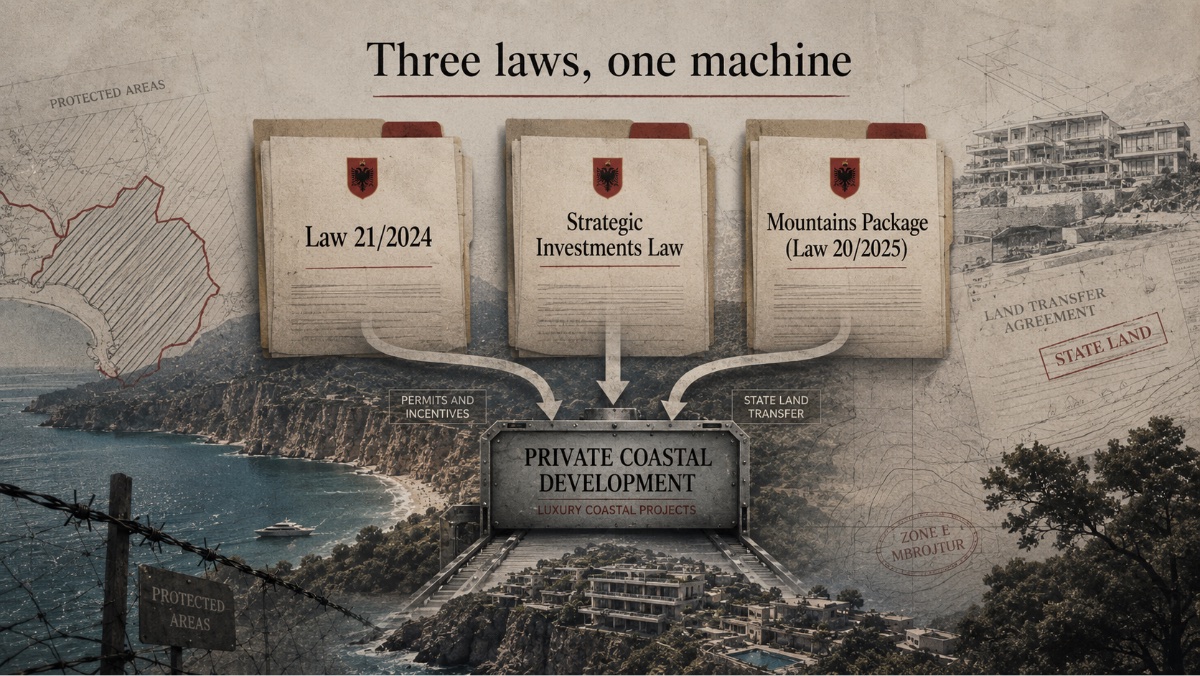
Three Laws, One Machine
A fence on a protected beach, a mountain sold for the price of a coffee, and a billionaire’s signature dated two days before the new year. They look like three separate stories. They were built to fit together.
Over thirteen months, between February 2024 and March 2025, the Albanian Parliament passed three pieces of legislation that almost nobody read together. One amended a law on protected areas. One extended a framework for “strategic” investment. One created a scheme to sell mountain land. Reported separately, each was a minor item in the parliamentary churn, the kind of bill that earns a paragraph and is forgotten.
Read together, they are something else. They are the three moving parts of a single machine, an apparatus for converting Albania’s public natural patrimony, its protected coast and its wild mountains, into private development for a politically connected few. The first law makes the land buildable. The second decides who gets to build and gives them the state’s help. The third supplies the land itself, cheaply and quietly. Feed a deal in at the top, and a protected coastline comes out the bottom, fenced, cleared, and legal.
This is not a metaphor the protesters invented. It is the structure that emerges when you lay the statutes side by side and watch what each one removes from the path. And the clearest proof that the machine works is that it has already run once, at full scale, on the coast at Zvërnec and the island of Sazan, where a company linked to Jared Kushner is now the owner of a piece of the Adriatic that used to belong to everyone.
How to read the machine
Every system for moving public assets into private hands has to solve the same three problems: the thing being taken must be made legally takeable, the taker must be chosen and empowered, and the asset must actually change hands. Albania’s three laws solve those problems one each.
The genius of the design, if that is the word, is that no single law does anything that looks decisive on its own. The protected-areas amendment does not name an investor. The strategic-investment framework does not mention any specific beach. The mountains law speaks the language of helping shepherds. Each can be defended in isolation as ordinary policy. It is only in combination, and in sequence, that they become an instrument, and the combination is exactly what the country was not invited to examine.
What follows is each folder in the machine, and then the part that matters most: the day the machine ran.
Folder one: the door
The first law is the one that makes the rest possible, because without it everything downstream would be illegal.
Law 21/2024, adopted on February 22, 2024, amended Albania’s Law on Protected Areas. Its decisive provision, Article 14, rewrote the article governing what may be done inside a protected area to permit five-star and higher tourism development, with a clause specifying that this holds regardless of whether the protected area’s own founding decree allows it. In a sentence, it inverted the logic of conservation: from “nothing is built here unless this place specifically allows it” to “luxury tourism is allowed unless newly forbidden.” It reached even the strictest categories, national parks and first-degree core zones, and it handed the Council of Ministers the power to redraw a reserve’s boundaries by decree.
Two details give the door away. It was passed not as a government bill but as a members’ bill, sponsored by a group of deputies, a route that skips the impact assessment and public consultation a change of this magnitude would otherwise require. And when it was challenged, it survived the Constitutional Court not on its merits but on a 4–4 tie in July 2025, with the court reasoning that it was merely a “framework law” with no direct consequences. Half the constitutional bench thought it unconstitutional. It stood anyway.
That is folder one: the legal wall, quietly removed.
Folder two: the fast lane
The second law decides who gets to walk through the door, and clears their path.
The Strategic Investments Law, Law 55/2015, lets the government designate a project “strategic” and pull it out of the ordinary permitting queue into a fast lane of priority handling, state assistance, access to state-owned land, and fiscal benefits. The decision rests with a single body, the Strategic Investment Committee, chaired by the prime minister. It is Edi Rama, at the head of that committee, who decides who is strategic.
Two provisions reveal the machine’s purpose. The first is a clause that empowers the state to expropriate private property for a private project, taking land from one owner in the interest of another, with the cost borne by the investor. By the U.S. State Department’s account, that specific power has not yet been used, but it sits loaded on the books. The second is the verdict of that same State Department on who has actually benefited: so few foreign investors had received strategic status that it fueled “the perception among foreign investors that the law has benefited mostly domestic companies with strong ties to the ruling majority.” A law sold as a magnet for the world’s capital has worked, in practice, as a channel for insiders.
That is folder two: the chosen builder, lifted over the process.
Folder three: the supply
The third law makes sure there is always more land to feed in, and it points the machine inland, away from the cameras.
The Mountains Package, Law 20/2025, adopted in March 2025, lets someone who has used state land in Albania’s highlands for ten years acquire ownership of it for a symbolic one euro, on the condition that they build an approved development within three years, sweetened by a ten-year exemption from a slate of taxes. It is dressed as rural justice, titles for the landless, life for dying villages. Its architecture tells another story: a requirement to finance and complete a development in three years is not built for a shepherd, it is built for a tourism or energy company, and centralized decision-making lets the benefit flow to non-residents and connected interests. Civil-society monitors called it a “mini-fiscal paradise” for a small group close to the government, a scheme that “donates” land, forests and forgone taxes to “easily identifiable persons.”
And unlike the marquee coastal deal, it is moving quietly and at scale, hundreds of applications already filed, a thousand targeted, parcel by parcel, while the nation watches the flamingos.
That is folder three: the cheap, endless supply, sold in the dark.
The day the machine ran
A blueprint proves nothing. What turns this from an argument into an indictment is that the machine has already been run, and the timeline of that single run reads like an assembly line.
In February 2024, the door opened: the protected-areas law was amended to make five-star development legal inside protected zones. Ten months later, on December 30, 2024, two days before the new year, the Strategic Investment Committee chaired by Rama granted strategic-investor status to Atlantic Incubation Partners LLC, an affiliate of Kushner’s Affinity Partners, for a roughly $1.4–1.6 billion plan to build hotels, villas and a marina across Sazan island and the Vjosa-Narta coast. The fast lane received its first marquee passenger almost the moment the door was open. In March 2025, the third folder was added to the set.
Then the machine did what machines do. By late April 2026, according to BirdLife International and EuroNatur, bulldozers were clearing the core of the protected landscape, removing thousand-year-old dunes and cutting roads, with no completed environmental assessment, no construction permit, and no public consultation. Barbed-wire fences went up across beaches that families from Vlora had used for generations. The prime minister told Parliament the environmental study was not finished, which was not a defense but a confession: the destruction had begun before the law’s own safeguards had been satisfied.
You do not need a conspiracy to see the apparatus here. You need only the dates. A wall removed, an investor chosen, a coastline cleared, in that order, each step legalized by a different statute, the whole sequence completed before the public understood that any of it was happening. That is what a machine looks like when it is working.
Who the machine is for
Strip the three laws down to their incentives and the same shape appears in each: public risk, private reward, and a beneficiary class that keeps coming into focus.
The protected-areas law transfers value from the commons, the coast that belongs to everyone, to whoever holds the five-star permit. The strategic-investment law, by Washington’s own assessment, has channeled its privileges to domestic companies tied to the governing majority, and stands ready to expropriate private land for private projects. The mountains law donates highland and forest, and a decade of taxes, to identifiable persons who can build. Across all three, the executive holds the controls: the prime minister chairs the committee that anoints investors, and the Council of Ministers redraws protected boundaries by decree. Across all three, the safeguards that exist to protect the public, environmental review, public consultation, competitive process, are precisely the parts that get bypassed.
This is the through-line that connects a fenced beach to a one-euro mountain. It is not that each law is corrupt in some legalistic sense. It is that all three are built to move things the public owns to people the government favors, while leaving the public to carry the risk. The resort is not the story. The resort is the receipt.
The tell
Defenders of the government will say this is reading a pattern into coincidence: three unrelated laws, each with its own honest rationale, bundled by activists into a conspiracy. It is a fair challenge, and it deserves a fair answer.
The honest version is this. The laws do have separate official justifications, and tourism, investment and rural development are real policy areas, not inventions. No document has surfaced in which officials describe a unified plan, and none may exist. The “machine” is an interpretive frame, not a signed blueprint.
But the frame is not arbitrary, because the design has tells. The three laws solve three sequential obstacles to a single outcome, and they solve them in the order you would need. They were passed quickly and quietly, one as a members’ bill that dodged scrutiny, the strategic-investment extension on Socialist votes alone. They concentrate decision-making in the same hands. They bypass the same safeguards. They share the same beneficiary profile. And they were used, together, on the same coast, within a year. When independent parts consistently combine to serve one end, benefit one class, and bypass the same protections, “coincidence” stops being the more economical explanation. You are allowed to call a machine a machine when you can watch it run.
The counter-machine
If the three laws are an apparatus for taking, what has risen against them is, for the first time in years, an apparatus for refusing.
It is being called the Flamingo Revolution, and its defining feature is that it carries no party’s flag. It began with local activists at Zvërnec and broke into national consciousness through a single viral voice, a 23-year-old engineer named Brunela Mërtiri, who answered Ivanka Trump’s description of Sazan as a “private island” she had “discovered” with a line that has outrun the news cycle: “Ivanka may have seen the island, but she didn’t see the Albanians.” When the country’s captured television channels looked away, the story moved through social media instead, exactly as Mërtiri described, the videos “deleted within minutes,” the broadcasters not blind but averted.
And crucially, the resistance has learned to aim at the machine and not only at the receipt. There is now a route against each folder. Against the protected-areas law, opposition MP Ina Zhupa has deposited a parliamentary repeal bill, timed to a European Parliament resolution that explicitly called for the law’s repeal. Against the strategic-investment and mountains laws, the civic movement “Shqipëria Bëhet” (Albania Becomes), led by the lawyer Adriatik Lapaj, is collecting signatures for a national referendum to strike both down, on the argument that together they amount to “the theft of the Homeland by law.” And around all of it, an international chorus, the European Parliament, the IUCN (whose Motion 130 passed with over 98 percent), EuroNatur, PPNEA and the Bern Convention, has demanded repeal, while the European Commission warns that the environmental chapter of Albania’s EU accession cannot close on a country that paves its protected areas. Meanwhile SPAK, the anti-corruption prosecution, is investigating how the protected status was changed in the first place.
The machine was built to operate in silence. The counter-machine’s single greatest weapon is that the silence has broken.
The honest ledger
It would be easy, and wrong, to end on the note now spreading through the comment threads: that pulling one lever, repealing Law 21/2024, brings the whole structure and the government with it. The truth is more demanding and, in the end, more useful.
Repeal would matter, enormously, but it would work going forward, not backward. Striking the laws would not automatically void signed contracts, claw back money, or send anyone to prison; vested-rights and compensation fights would run for years. What repeal would do is dismantle the legal machinery before it processes the next coast, and strengthen the corruption case against how it processed this one. The most potent lever is not domestic at all: it is EU conditionality, the one pressure the government cannot dismiss as a partisan stunt, because it speaks the language of the membership Tirana has staked its legitimacy on. And the conspiracy maximalism that has attached itself to the story, the talk of secret depopulation plots and burned archives, should be left at the door, because the documented machine is damning enough on its own and does not need the embroidery that would let the government wave all of it away.
Here is the ledger, then, stated plainly. Three laws, passed in thirteen months, each removing a different obstacle to the same end. One executive holding the controls. One beneficiary class. The same safeguards bypassed every time. A single billion-dollar run already completed on a protected coast, bulldozers ahead of permits. A court that blessed the keystone by one vote. And, against it, a movement with no flag, a prosecutor with an open file, and a continent of institutions saying the same word: repeal.
The Bottom Line
What is happening in Albania is not, at bottom, a fight about a resort, or even about flamingos. It is a fight about a question the three laws were designed to answer without ever asking the public: does the coast, the mountain, the lagoon, the island belong to the country, or to whoever the state decides to favor?
The machine’s answer was clear, and it was poured in concrete before anyone could vote on it. The counter-machine’s answer is still being written, in signatures, in court files, in a 23-year-old’s voice that shakes and keeps going. The laws can be repealed. The dunes cannot be rebuilt. Which of those facts ends up mattering more is, for now, the only open question in the story, and the reason the people are still in the square.
Frequently Asked Questions
What are the “three laws” behind Albania’s coastal development controversy?
They are Law 21/2024, which amended the Protected Areas Law to allow five-star development inside protected zones; the Strategic Investments Law (Law 55/2015), which fast-tracks chosen investors and gives them access to state land and tax benefits; and the Mountains Package (Law 20/2025), which sells state highland for a symbolic one euro to those who build approved projects. Critics describe them as a single system for moving public land into private development.
Why are they described as “one machine”?
Because each law removes a different obstacle to the same outcome, in sequence: one makes protected land legally buildable, one chooses and empowers the developer, and one supplies cheap state land. They concentrate decisions in the executive, bypass the same environmental and public-consultation safeguards, share the same beneficiary profile, and were used together on the Sazan and Vjosa-Narta coast within a single year.
How was the Kushner/Sazan deal connected to all three?
The protected-areas amendment (Feb 2024) made development in the Vjosa-Narta protected landscape legal; the Strategic Investment Committee chaired by Edi Rama granted strategic-investor status to a Kushner-linked company on December 30, 2024, fast-tracking the roughly $1.4–1.6 billion project; and the same period saw the Mountains Package extend the model inland. Bulldozers later cleared the protected core without a completed environmental assessment, permit, or public consultation.
Is the “machine” a proven conspiracy?
No single document describes a unified plan, and the laws have separate official justifications. The “machine” is an interpretive framework, not a signed blueprint. But the sequencing, the shared concentration of power, the bypassed safeguards, the common beneficiary class, and the real-world convergence on one coast make it a well-grounded reading rather than mere speculation. The maximalist conspiracy claims circulating online are not supported and are best avoided.
Can the three laws be repealed?
There are three routes, each difficult. Opposition MP Ina Zhupa has filed a parliamentary bill to repeal Law 21/2024; the “Shqipëria Bëhet” movement led by Adriatik Lapaj is collecting signatures for a referendum to repeal the Strategic Investments Law and the Mountains Package; and the European Parliament, IUCN and conservation bodies have demanded repeal as a condition of EU accession. Albania’s governing majority and a blocked referendum system make all three paths uncertain, and any repeal would operate prospectively rather than undoing completed deals.