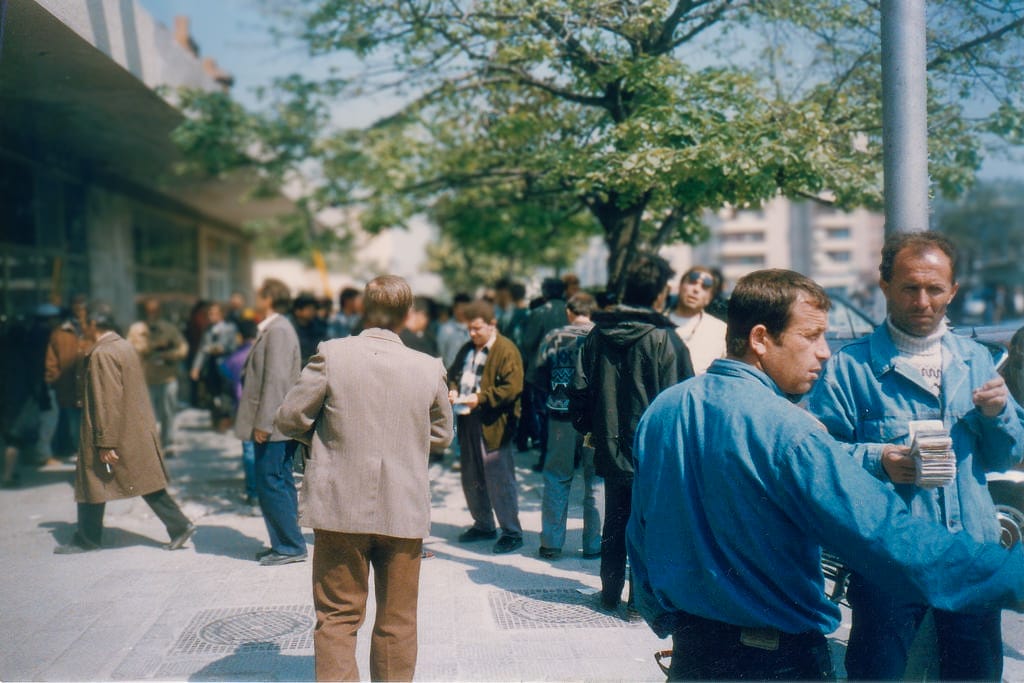
When My Uncle Sold His House for a Ponzi Scheme
My uncle wasn’t stupid. He was an engineer who’d survived 47 years of communism, spoke three languages, and could fix anything mechanical. But in 1996, he sold his apartment in Tirana to invest in VEFA Holdings, which promised 25% monthly returns.
Not annually. Monthly.
When I asked him if that seemed suspicious, he said: “Everyone’s doing it. My neighbor quit his job because he’s making more from his investment. The government hasn’t shut them down, so they must be legitimate.”
By March 1997, he’d lost everything. So had two-thirds of Albania. And the country descended into civil war.
This is the story of how an entire nation got scammed, and why 47 years of communist isolation made it possible.
Why We Were Perfect Victims
Here’s what you need to understand: Albanians in the 1990s had zero experience with capitalism. None. We’d spent 47 years in the most isolated country in Europe, where:
- Private business was illegal
- The state controlled all money
- Foreign currency possession could get you imprisoned
- Nobody owned stocks, bonds, or investments
- Banking meant the state holding your wages (which were assigned, not earned)
When communism collapsed in 1991, we went from that to “free market economy” literally overnight. We knew the words but not the meaning. Capitalism, investment, interest rates, risk assessment—these were foreign concepts we’d never encountered.
The average Albanian in 1992 earned about $80 per month. Most people had savings from working under communism (you couldn’t spend money because there was nothing to buy), but they had no idea what to do with it.
Enter the pyramid schemes.
How It Actually Worked (Or Didn’t)
Starting around 1992-1993, several “investment companies” emerged offering returns that would make modern financial regulators have heart attacks:
- VEFA Holdings: 8-10% monthly returns
- Gjallica: 15-20% monthly
- Xhaferri: 25-30% monthly
- Populli: Up to 50% monthly (I’m not kidding)
For context: legitimate banks in 1996 were offering maybe 10-12% annually. These schemes promised to double your money every few months.
How did they pay these returns? Simple: they didn’t earn them. They paid early investors with money from new investors. Classic Ponzi scheme. But nobody in Albania had ever heard the term “Ponzi scheme” because we’d spent half a century isolated from global financial education.
My neighbor’s mother invested her life savings (about $3,000—a fortune in Albania) in Xhaferri in 1995. For six months, she received monthly payments totaling about $4,500. She thought she’d discovered magic money. She borrowed from relatives to invest more. Everyone did.
The Numbers That Destroyed a Country
By early 1997, here’s what had happened:
- 2 million Albanians invested (out of 3 million population—two-thirds of the entire country)
- $1.5 billion total invested (equivalent to roughly half of Albania’s GDP at the time)
- Average monthly income: $80
- Average investment per household: $750-1,500 (representing years of savings)
People sold houses, farms, livestock. They borrowed from everyone they knew. My uncle’s friend remortgaged his family home. Another acquaintance sold his car and his wife’s jewelry.
The government under Sali Berisha’s Democratic Party knew something was wrong but did nothing. Some claim government officials were profiting from the schemes. Others say they were just incompetent. Probably both.
January-March 1997: The Collapse
In January 1997, the schemes started failing. First the smaller ones (Xhaferri, Populli), then the big ones (VEFA, Gjallica). When people realized their money was gone, they lost their minds. And I mean that literally—rational people became violent mobs almost overnight.
What happened next shocked Europe:
- 2,000 people died in rioting and violence
- Military armories were looted (an estimated 600,000-1,000,000 weapons stolen)
- The government collapsed in March 1997
- Southern Albania descended into complete anarchy
- The Albanian lekë lost half its value against the dollar
- Production stopped, inflation exploded, the economy basically ceased functioning
I remember watching news footage of armed gangs in Vlorë and Gjirokastër. These weren’t criminals—they were desperate fathers who’d lost everything and wanted someone to pay. Ex-military personnel organized militias. Former factory workers seized weapons. The country that had barely survived the collapse of communism six years earlier was now tearing itself apart.
The Italian-led “Operation Alba” (March-August 1997) sent 7,000 international troops to restore order. Think about that: a European country needed foreign military intervention to stop its own citizens from killing each other over financial fraud.
What We Lost (Beyond Money)
The financial damage was catastrophic—$1.5 billion vanished, wiping out decades of savings. But the psychological damage was worse.
Trust collapsed. If your neighbor convinced you to invest in Gjallica and you both lost everything, how do you stay neighbors? If your brother-in-law borrowed your savings to invest in VEFA and lost it all, how do you maintain family relationships?
The schemes didn’t just destroy savings—they destroyed social bonds. Albania’s strongest asset during the communist years was community trust. The pyramid schemes obliterated it.
Government credibility evaporated. The Democratic Party lost the 1997 elections in a landslide because everyone blamed them (fairly) for not stopping the schemes. But the Socialist Party that replaced them was equally corrupt. The lesson Albanians learned: all governments are thieves, just in different ways.
Economic development stalled. Foreign investors looked at Albania in 1997—armed gangs, collapsed government, stolen weapons everywhere—and decided to invest literally anywhere else. It took a decade to recover from the damage.
The Recovery (Sort Of)
A new government formed after the 1997 elections, and major reforms followed—new banking regulations, financial oversight institutions, consumer protection laws. Albania enacted some of the strictest financial regulations in the Balkans because we’d learned (the hard way) what happens without them.
The World Bank now classifies Albania as an “upper-middle income country”—a remarkable transformation from the chaos of 1997. But that classification hides ongoing problems:
- Informal economy: Huge portions of Albania’s economy operate off the books because people still don’t trust formal institutions
- Emigration: An entire generation left for Greece, Italy, Germany, the UK because they didn’t want to rebuild what their parents lost
- Persistent corruption: The lesson many Albanians learned from 1997 wasn’t “don’t scam people” but “scam better and don’t get caught”
My uncle? He never got his apartment back. He rents now, at 70 years old. He won’t invest in anything—not banks, not stocks, not even Albanian government bonds. He keeps cash in a safe at home. So do many Albanians his age. The pyramid schemes created a generation that will never trust financial institutions again.
What Modern Albania Learned (Maybe)
Twenty-eight years later, Albania has mostly moved past 1997. Younger Albanians (born after the collapse) hear about pyramid schemes the way Americans hear about the Great Depression—as history, not lived experience.
The country now has:
- Functioning banking system with international oversight
- Financial regulations aligned with EU standards
- Consumer protection laws
- Deposit insurance (up to a certain amount)
- Financial literacy programs (though these came way too late)
But distrust persists. Albania still has one of the lowest rates of bank account usage in Europe. Many people prefer cash transactions. Older generations warn younger ones: “Don’t trust anyone with your money.”
The EU accession process requires Albania to maintain strict financial oversight, which helps. International pressure prevents the kind of government complicity that enabled the schemes in the 1990s.
But here’s the uncomfortable truth: If a charismatic scammer promised Albanians 20% monthly returns tomorrow, some people would still invest. The desperation for quick wealth—born from decades of poverty and reinforced by seeing neighbors emigrate and send back money—hasn’t disappeared.
Pro Tips for Understanding This
Don’t judge Albanians for falling for pyramid schemes. Easy to mock from countries with centuries of financial literacy and regulation. We went from communist planned economy to wild-west capitalism in six years. We had no consumer protection, no financial education, and a government that didn’t care.
Understand why many Albanians distrust all institutions. Banks, government, political parties, even international organizations—1997 taught people that everyone lies and nobody protects you except family.
Recognize that emigration patterns trace back to 1997. The massive Albanian diaspora in Greece, Italy, Germany, UK—many left after the pyramid schemes destroyed their families’ futures. They’re not just “economic migrants;” they’re refugees from economic catastrophe.
This explains Albanian attitudes toward corruption. If the government lets $1.5 billion vanish in pyramid schemes, why should anyone expect it to fight small-scale corruption? The schemes normalized large-scale theft in ways Albania still hasn’t recovered from.
Don’t invest in anything in Albania without serious due diligence. Modern regulations are much better, but cultural attitudes toward financial scams are still… complicated. If something promises unusually high returns, it’s probably a scam. This applies everywhere, but especially in Albania.
Talk to older Albanians carefully about this. Everyone lost something or knows someone who did. The trauma is recent and real. Families still don’t speak to each other because of money lost in 1997.
What This Means for Albania Today
The 1997 pyramid schemes weren’t just an economic crisis—they were a fundamental rupture in Albanian society that we’re still processing.
Every Albanian over 40 remembers exactly where they were when the schemes collapsed. We remember who lost everything, who profited, who fled the country. We remember the armed gangs, the stolen weapons (some still haven’t been recovered), the Italian troops patrolling our streets.
We also remember the lesson: Trust nobody. Protect yourself. Everyone’s out for themselves because institutions will fail you.
That’s not the foundation for building a healthy democracy or economy. But it’s what we got. Modern Albania is still trying to rebuild the trust destroyed in 1997—one painful reform at a time.