The Day Hoxha’s Statue Fell (And Everything Changed)
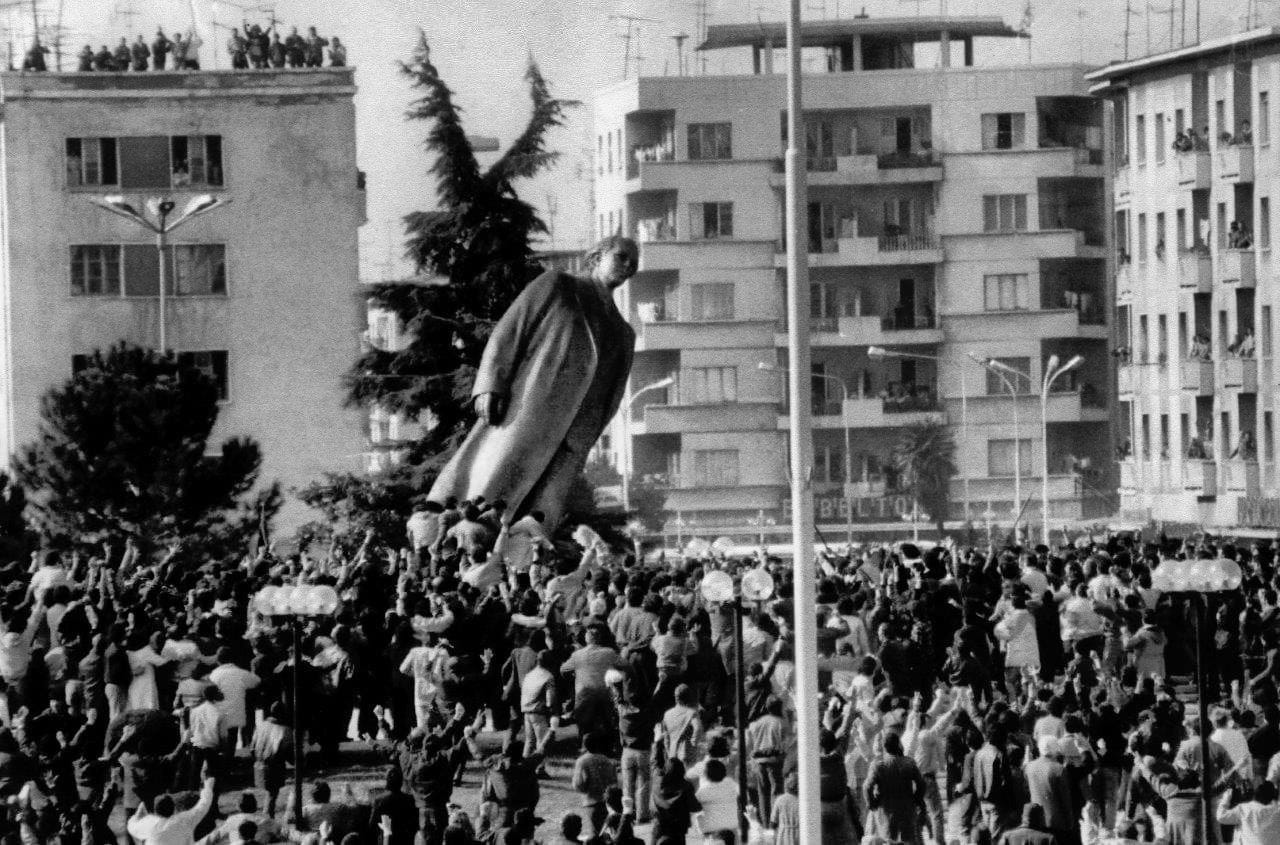
I was nine years old on February 20, 1991, when thousands of Albanians gathered in Skanderbeg Square and tore down Enver Hoxha’s statue. My parents took me to watch from a distance—close enough to see, far enough to run if security forces opened fire (which we genuinely thought might happen).
The statue didn’t fall easily. People tried pulling it with ropes. Then they brought a crane. When it finally toppled, my mother cried. Not from sadness—she hated Hoxha—but from shock that this was actually happening. That 47 years of totalitarian rule could end with a crowd and a rope and nobody stopping them.
But that wasn’t where it started. The real beginning was December 8, 1990—a date Albanians still commemorate annually—when university students dared to do what nobody had done in almost five decades: protest openly.
December 8, 1990: When Students Finally Said “Enough”
Here’s what most Western narratives miss: the protests didn’t start with grand political demands. They started with electricity.
University students in Tirana wanted access to electricity in their dormitories so they could study at night. They wanted clean water. They wanted heat in winter. Basic things the regime couldn’t or wouldn’t provide despite decades of propaganda about worker prosperity.
What began as a simple strike escalated into a hunger strike. Then students added political demands: freedom of speech, freedom of assembly, the right to form independent organizations. Things that sound mundane in a democracy but were revolutionary in a state where even owning a typewriter without permission was illegal.
By mid-December, protests spread to Shkodër and other cities. The regime, watching Romania’s Ceaușescu get executed weeks earlier, realized they couldn’t shoot their way out of this. On December 11, 1990, Ramiz Alia (who’d succeeded Hoxha in 1985) legalized opposition parties.
Just like that. 47 years of one-party rule ended with a decree. The Democratic Party formed almost immediately under Sali Berisha, and suddenly Albania had political opposition for the first time since my grandparents were children.
Every December 8th, Albania commemorates these student protests—34 years later in 2024, we still mark it as Youth Day. Not the day communism officially ended (that came later), but the day ordinary people stopped being afraid.
The Messy Middle (March-December 1991)
Alia signed the Helsinki Human Rights Agreement, met with intellectuals, promised reforms—all the classic authoritarian moves when you’re trying to survive. In March 1991, Albania held its first multi-party elections since 1944.
The Communist Party of Labour won. Not because people loved communism, but because:
- Rural areas (which outnumbered cities) were terrified of change
- The party controlled all media and resources
- Nobody else had any infrastructure to campaign
But here’s where it gets interesting: winning the election didn’t save them.
The Chaos Nobody Talks About (Summer 1991)
What happened next doesn’t fit the neat “fall of communism = freedom and democracy” narrative.
Albania basically collapsed. Not just the government—society itself.
Food shortages became critical. State shops were empty. The economy, which had been barely functional under communism, completely stopped working. Factories closed. Farms abandoned. Nobody got paid because the currency became worthless almost overnight.
People were desperate. And I mean genuinely desperate—not “can’t afford new iPhone” desperate, but “my children are hungry and I have no options” desperate.
August 8, 1991: The Ships to Italy
On August 7-8, 1991, thousands of Albanians in Vlorë hijacked a merchant ship called the Vlora and forced it to sail to Italy. Around 20,000 people (some estimates say more) crammed onto a vessel designed for maybe 1,000. They stood on deck, on railings, on each other. When it arrived in Bari, Italian authorities were completely unprepared.
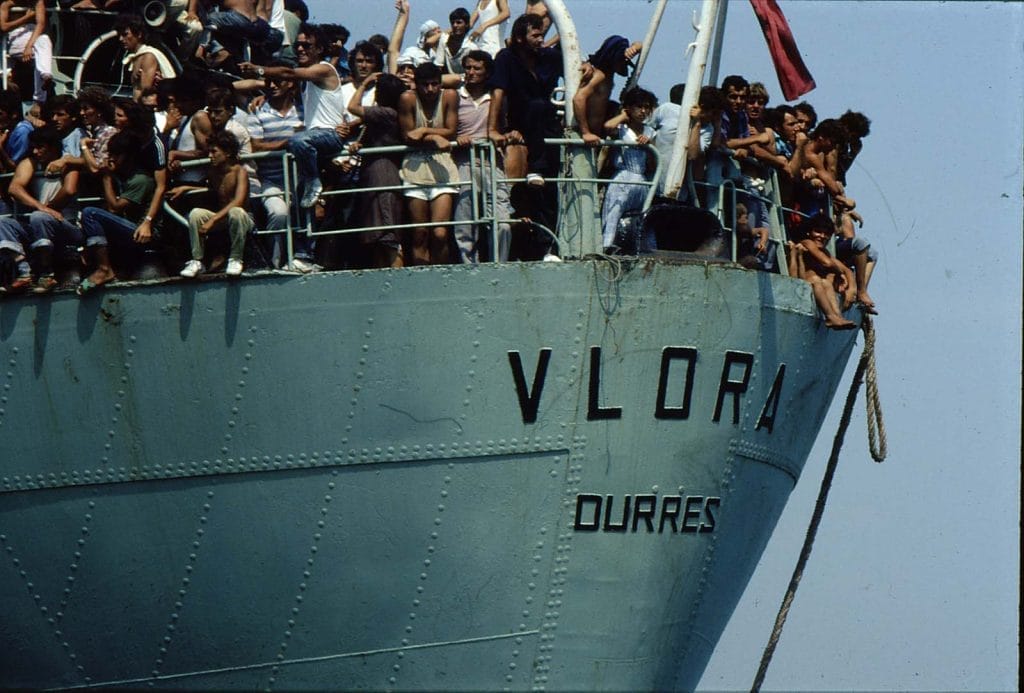
Over the following weeks, around 40,000 Albanians fled to Italy by any means possible—hijacked ships, fishing boats, rafts, swimming. The Italian navy tried turning them back. Some drowned. Most got sent back anyway. But the images shocked Europe: thousands of people risking death to escape a country that was supposed to be “free” now.
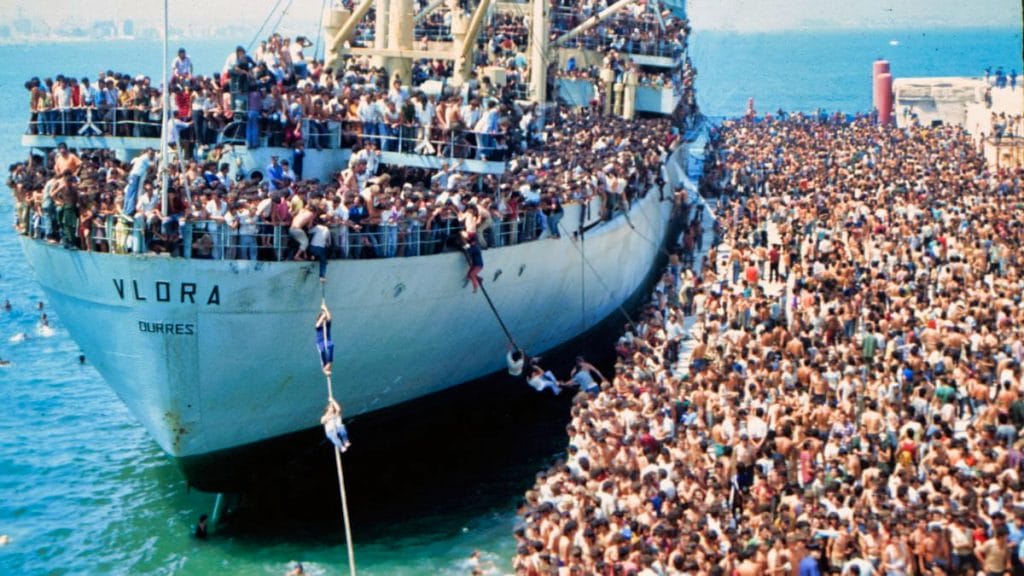
This was Albania’s secret shame and desperation. We weren’t fleeing communism anymore—communism was dead. We were fleeing the aftermath, the chaos, the complete collapse of everything.
The UN launched “Operation Pelican” to provide humanitarian aid. International relief organizations arrived to discover a country that had basically stopped functioning. No food distribution. No healthcare system. No functional government. Just crowds of desperate people and ex-Sigurimi agents getting beaten in the streets by revenge-seeking victims.
March 1992: Actual Democracy (Sort Of)
In March 1992—a year after the first “democratic” election that the communists won—Albania held another vote. This time, the Democratic Party under Sali Berisha won decisively.
The Communist Party of Labour (which had renamed itself the Socialist Party) got destroyed at the polls. Ramiz Alia resigned. 47 years of communist rule officially ended.
But here’s what nobody prepared us for: democracy doesn’t automatically fix 47 years of isolation, poverty, and psychological damage. The Democratic Party took office inheriting a country in complete chaos:
- The economy: Nonexistent. The lekë (Albanian currency) was worthless. Nobody had jobs.
- Infrastructure: Crumbling. Roads were potholed. Electricity was sporadic. Water systems barely worked.
- Social fabric: Shredded. Blood feuds revived in northern mountains. Crime exploded. Ex-Sigurimi informants got attacked openly.
- Psychology: Broken. We’d spent 47 years being told what to think, where to work, how to live. Now suddenly we were “free” with zero skills for navigating freedom.
I remember my parents arguing constantly about whether things were better or worse than under communism. Better because we could speak freely. Worse because we had no food and the streets were unsafe. Both were right.
What Came Next (Spoiler: Not Great)
The Democratic Party promised Western-style democracy and free-market prosperity. What Albania got was the 1997 pyramid scheme collapse that wiped out two-thirds of the country’s savings, triggered a civil war, and basically proved that you can’t jump from isolated Stalinism to functioning capitalism in five years.
But that’s a different article. The point is: the fall of communism in Albania wasn’t the triumphant “freedom wins” story Western documentaries love. It was messy, violent, chaotic, and terrifying. It also was necessary—nobody sane wanted to stay under Hoxha’s system.
How We Remember It Now (2024-2025)
December 8th remains Youth Day in Albania—in 2024, we commemorated the 34th anniversary of the student protests that started it all. Schools teach about it. Politicians give speeches. Every Albanian knows what December 8, 1990 means: the day we stopped being afraid.
February 20th (the day Hoxha’s statue fell) isn’t an official holiday, but Albanians remember. Photos of the toppling statue are everywhere—in museums, textbooks, social media every February 20th with captions like “Never again.”
The Bunk’Art museums attracted 400,000 visitors in 2024, many coming specifically to understand what we escaped and why the transition was so brutal. The exhibits on the fall of communism don’t glorify it—they show the complexity, the chaos, the price paid.
“Memory Days” (February 20-26) are organized annually by the Institute for Democracy, Media and Culture. These events focus on dealing with Albania’s communist past, giving voice to victims of the Sigurimi, and ensuring younger generations who never experienced the regime understand what their grandparents survived.
In 2024, 95-year-old Lekë Tasi—a political prisoner who survived Spaç labor camp—participated in Memory Days opening ceremony. His presence reminded everyone that this history isn’t abstract. These people are still alive. The trauma is recent.
What This Means for Modern Albania
The fall of communism in 1991 didn’t solve Albania’s problems. It created new ones while exposing old ones we’d ignored for 47 years.
But it gave us something communism never could: the freedom to fail on our own terms rather than succeed by someone else’s script.
Albania today is corrupt, chaotic, imperfect, and frustrating. It’s also free, democratic (ish), and part of Europe again. We’re pursuing EU membership, building infrastructure, and slowly figuring out how to be a normal country instead of a paranoid hermit kingdom.
The fall of communism was the beginning, not the end. We’re still figuring out what comes next.
Pro Tips for Understanding This
Visit during Memory Days (Feb 20-26) if you want to understand what this period meant. The events, exhibitions, and talks give context you won’t find in guidebooks.
Talk to Albanians about 1991 carefully. Everyone has stories. Many lost relatives fleeing to Italy. Others have family members who worked for the regime and faced revenge attacks. The trauma is recent and personal.
Don’t romanticize the transition. Western narratives love “freedom wins” stories. Albania’s transition was brutal, chaotic, and in many ways hasn’t finished yet.
Understand that December 8th matters more than independence day to many Albanians. November 28, 1912 gave us a country. December 8, 1990 gave us a chance to decide what that country would become.
The communist-era museums in Tirana (House of Leaves, Bunk’Art 1 & 2) put the fall of communism in context. You can’t understand why the transition was so hard without understanding how complete the isolation was.
Read about the 1997 pyramid schemes if you want to understand what happened after 1991. The chaos didn’t end with democracy—it morphed into different chaos, and it took until the 2000s for Albania to find any stability.