When a Mountain Village Rivaled Istanbul
In the 18th century, Voskopojë (also spelled Voskopoja or Moscopole) functioned as one of the Balkans’ largest and wealthiest cities, with population estimates ranging from 20,000 to 40,000 (sources vary, but most historians settle on 20,000-25,000 as conservative estimate). This mountain town at 1,160 meters elevation in southeastern Albania controlled critical position on the Via Egnatia trade route connecting Constantinople to the Adriatic, accumulating wealth through commerce, crafts, and transhumant shepherding that moved flocks seasonally between mountain pastures and lowland plains.
The prosperity manifested in extraordinary cultural achievements—24 to 26 churches built during the 18th century (exact count disputed by historians), the New Academy established 1744 as the first Greek-language educational institution in Ottoman Balkans outside Constantinople, a printing press established 1731 (one of the first in the region after Istanbul’s 1567 press), master painters including David Selenica and Kostandin Shpataraku creating Byzantine frescoes rivaling Athos monasteries, and intellectual life attracting scholars from across the Orthodox world.
The city’s Aromanian population (also called Vlachs—Romance-language speaking people descended from Romanized populations who maintained distinct identity through Ottoman period) created cosmopolitan atmosphere where Greek served as liturgical and educational language, Aromanian functioned as vernacular, and Ottoman Turkish provided administrative communication. The wealth came partly from controlling transhumant shepherding networks extending across Balkans—Aromanian families would spend summers in mountain pastures around Voskopojë, then winter their flocks in lowland plains as far as Thessaly, controlling sheep, wool trade, and creating commercial networks that made the city wealthy beyond its mountain isolation.
This golden age lasted roughly 1700-1769. In that year, Muslim Albanian irregulars led by various Ottoman-affiliated commanders (exact attribution remains disputed—some sources blame Ali Pasha of Tepelenë, others cite different raiders) attacked Voskopojë, destroying churches, killing residents, and looting accumulated wealth. The city recovered partially, but in 1788, Ali Pasha of Tepelenë (the same Ali Pasha who later controlled much of Albania and northern Greece) launched devastating campaign against Aromanian communities he viewed as economically powerful and potentially disloyal. His forces burned much of Voskopojë, destroyed additional churches, and drove most residents into exile.
The 1788 destruction effectively ended Voskopojë as major city. Population dropped from 20,000+ to perhaps 2,000-3,000 within years, continuing to decline through 19th century. By 1900, Voskopojë existed as small mountain village of several hundred residents. The 24+ churches dwindled to perhaps 7-8 surviving structures, most damaged or abandoned. The New Academy closed, the printing press disappeared (equipment likely destroyed or looted), and intellectual life dispersed to other centers.
Today, Voskopojë’s population hovers around 500 permanent residents (seasonal fluctuations bring more during summer tourism and winter skiing), with five partially preserved Byzantine churches, ruins documenting vanished prosperity, and Aromanian community maintaining linguistic and cultural traditions despite overwhelming demographic and economic collapse from 18th-century heights.
Why Visit Voskopojë
Voskopojë attracts travelers seeking Byzantine church frescoes created by master painters in 18th-century golden age, Aromanian cultural heritage and linguistic traditions maintaining Romance-language identity in Balkans, historical significance as educational and cultural center that rivaled Istanbul before destruction, mountain scenery at 1,160 meters elevation providing hiking and winter sports, authentic Albanian mountain village maintaining traditional architecture and rhythms, and tangible documentation of how quickly prosperity can vanish through military violence and economic disruption.
What Voskopojë offers: five Byzantine churches with extraordinary 18th-century frescoes (three reasonably accessible, two requiring keys from caretakers), ruins of additional churches documenting lost architectural heritage, accommodation €18-40 nightly from guesthouses to small hotels, traditional Aromanian cuisine blending Romanian/Latin and Greek influences, proximity to Korçë (21km) for urban amenities, hiking trails through beech and pine forests, winter skiing at modest resort, and village life maintaining Aromanian language and customs.
What Voskopojë doesn’t offer: dramatic church preservation (frescoes show damage from weather, vandalism, and neglect), extensive interpretation or museums explaining 18th-century history beyond basic signage, English-speaking guides (arrangement through Korçë hotels necessary), varied accommodation and dining options beyond basic mountain village facilities, or destination appeal beyond historical and cultural significance.
Skip Voskopojë if you prioritize: perfectly preserved Byzantine art over damaged-but-authentic frescoes, destinations with extensive tourism infrastructure, English proficiency and interpretation, varied services and entertainment, or places offering immediate visual impact without requiring historical context.
Choose Voskopojë if you value: Byzantine fresco art in situ where created rather than museums, Aromanian cultural heritage and linguistic traditions, historical sites documenting rise and fall of regional powers, authentic mountain village life, proximity to Korçë, mountain scenery and hiking, winter skiing at small resort, or interest in places whose past significance vastly exceeds current size.
The honest assessment: Voskopojë rewards travelers interested in Byzantine art, Balkan history, and cultural anthropology rather than those expecting dramatic tourist destinations or extensive services. The churches preserve extraordinary frescoes despite damage—colors remain vibrant, compositions demonstrate sophisticated theological programs, and artistic quality justifies the journey. But accessing them requires finding caretakers with keys, understanding historical context without extensive interpretation, and accepting that five damaged churches represent remnants of 24+ that once existed. The village maintains authentic mountain character—traditional stone houses, seasonal farming, Aromanian language heard among elderly residents—but this isn’t tourism-focused destination with infrastructure catering to international visitors.
The New Academy: Enlightenment in the Mountains
In 1744, Aromanian merchants and ecclesiastical authorities in Voskopojë established the New Academy (Νέα Ακαδημία in Greek, the language of instruction), creating the first Greek-language educational institution in Ottoman Balkans outside Constantinople functioning at academy rather than basic school level. The institution taught philosophy, mathematics, theology, rhetoric, ancient Greek language and literature, and sciences using curriculum modeled on Venetian and Italian universities while adapting to Orthodox theological context.
The Academy’s founding reflected Voskopojë’s wealth—creating and maintaining such institution required substantial resources for teachers’ salaries, books (imported from Venice and other European centers), building maintenance, and student support. The merchant families controlling transhumant trade networks and commercial operations had both money and motivation—educating sons ensured commercial and intellectual leadership, while supporting Greek-language education demonstrated commitment to Orthodox identity and Greek cultural heritage that Aromanian communities embraced despite their Romance-language vernacular.
The faculty included notable scholars—Theodoros Anastasios Kavalliotis (1718-1789), who taught at the Academy while also creating some of the earliest printed materials in Aromanian language, attempting to develop written form for language previously transmitted primarily orally. Other teachers included graduates of Italian universities, monks from Athos bringing theological expertise, and self-taught mathematicians and scientists working with limited equipment but genuine intellectual curiosity.
The curriculum combined traditional Orthodox theology with Enlightenment-influenced sciences and philosophy—students studied Aristotle alongside contemporary natural philosophy, memorized Byzantine liturgical traditions while learning mathematics applicable to commerce and navigation, and mastered ancient Greek while also receiving practical education in Latin (for commercial correspondence with Italian merchants) and Ottoman Turkish (for administrative purposes).
The Academy functioned approximately 1744-1788. The 1788 destruction by Ali Pasha’s forces ended its operation—buildings burned, library dispersed or destroyed, faculty fled to other centers. Some teachers relocated to Ioannina (where Ali Pasha ironically later supported Greek educational institutions as part of his complex relationship with Greek culture), others went to Vienna where Aromanian diaspora communities existed, and some returned to villages losing intellectual continuity that Voskopojë had maintained.
For contemporary visitors, no buildings definitely identified as Academy structures survive intact—ruins throughout Voskopojë might include Academy foundations, but centuries of destruction, rebuilding, and decay make identification uncertain. The legacy exists in historical records documenting that this mountain village created educational institution rivaling urban centers, demonstrating how commercial wealth translated into intellectual culture before military violence erased both.
The Printing Press: 1731-1788
Voskopojë’s printing press, established 1731, represented extraordinary achievement for mountain town in Ottoman Balkans—printing remained rare technology in Ottoman Empire (Constantinople’s first press operated 1567-1742 intermittently, then closed due to religious opposition from manuscript copyist guilds claiming printing threatened their livelihoods). Greek-language printing existed primarily in Venice and other Italian cities serving Orthodox communities unable to print within Ottoman territories.
The Voskopojë press produced primarily religious texts—liturgical books for churches, theological treatises, collections of sermons and saints’ lives—printed in Greek for use throughout Orthodox communities. The technical achievement was substantial—importing press equipment (likely from Venice), acquiring metal type fonts (extremely expensive and requiring skilled metalworkers), obtaining paper (scarce in Balkans), and training printers required capital and expertise that Voskopojë’s merchants possessed.
Theodoros Anastasios Kavalliotis, the same scholar teaching at the New Academy, also pioneered Aromanian-language printing, producing in 1770 a Greek-Aromanian dictionary and primer attempting to establish written form for Aromanian language. This work represented both linguistic preservation and cultural assertion—Aromanian identity had persisted through oral tradition and endogamy maintaining community boundaries, but creating written language elevated status and enabled transmission beyond oral memory.
The press operated 1731-1788, when Ali Pasha’s destruction ended printing operations. The equipment’s fate remains unknown—possibly destroyed, looted as valuable metal, or transported elsewhere. No printed books from Voskopojë press are known to survive in Albania (though examples may exist in Greek, Romanian, or diaspora community collections abroad), making physical evidence scarce for operation whose historical importance is documented through references in other texts and institutional records.
The printing press, like the New Academy, demonstrates how Voskopojë’s commercial prosperity created intellectual and cultural institutions unusual for provincial town—these weren’t luxuries added to existing cultural landscape but integral to community identity and religious practice, making their loss in 1788 destruction particularly devastating to Aromanian cultural continuity.
The Byzantine Churches: Five Survivors from Twenty-Four
Of the 24-26 churches built in Voskopojë during 18th-century prosperity, approximately five survive in condition allowing access and preservation efforts. Three are relatively accessible to visitors (though conditions vary), while two require finding caretakers with keys. All five were included on World Monuments Fund’s 2002 Watch List of 100 Most Endangered Sites, recognizing both their artistic significance and preservation challenges.
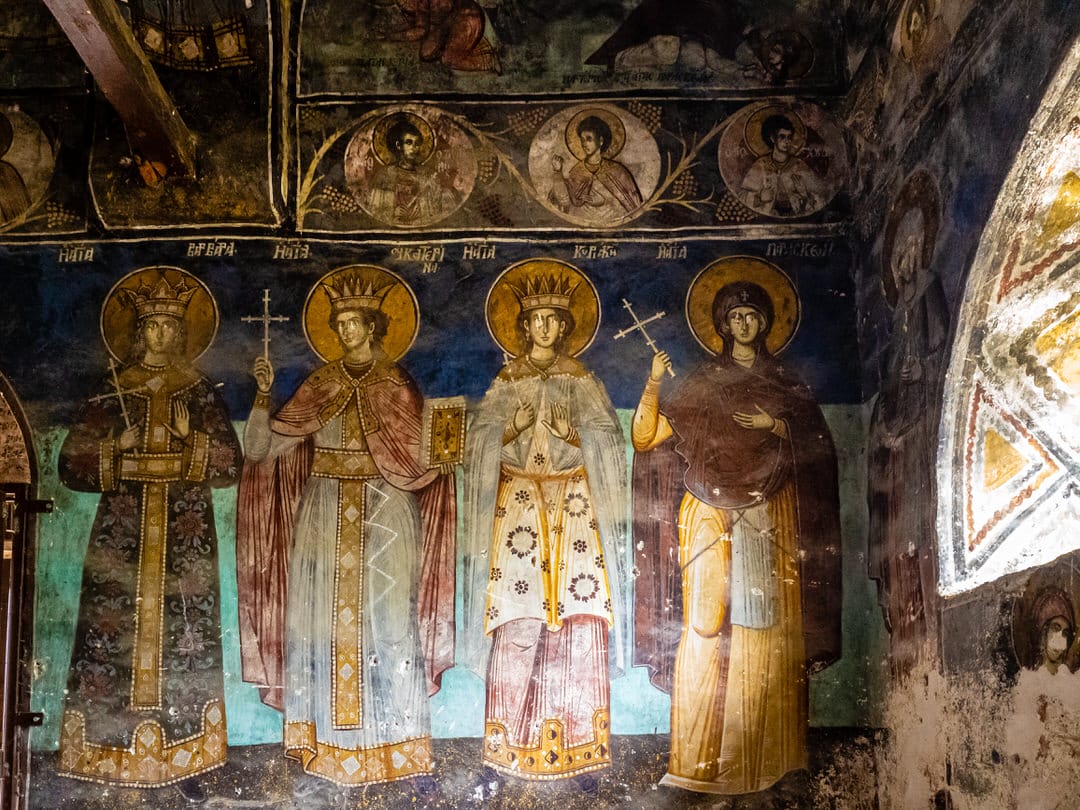
Church of St. Nicholas (Shën Kolli): Built 1721-1722, this church preserves frescoes by David Selenica, considered among the finest Byzantine painters working in 18th-century Balkans. His work demonstrates mastery of Byzantine iconographic traditions while incorporating stylistic innovations reflecting Italian Renaissance influences filtering through Venetian trade connections. The frescoes depict biblical scenes, saints’ lives, and Last Judgment imagery with vibrant colors (achieved using mineral pigments), sophisticated composition balancing theological symbolism with naturalistic details, and technical precision in perspective and anatomy unusual in provincial Byzantine work.
The church suffered damage during 1769 and 1788 attacks—portions of frescoes deliberately defaced, roof partially burned causing water damage, and structural cracks from seismic activity. Post-1991 restoration efforts stabilized structure and cleaned frescoes, though funding constraints limited comprehensive conservation. The church functions irregularly for services—Voskopojë’s current population includes both Orthodox Christians maintaining traditions and Muslims, with religious practice reflecting contemporary demographics rather than 18th-century exclusively Orthodox community.
Church of St. Mary (Shën Maria): Constructed early 18th century (exact date uncertain), this church contains frescoes attributed to Kostandin Shpataraku and his workshop. The artistic program emphasizes Marian iconography—representations of Mary across different theological contexts including Theotokos (Mother of God), Panagia (All-Holy), and various feast day depictions. The style demonstrates competent execution of Byzantine traditions without Selenica’s innovative approach—more conservative, emphasizing continuity with medieval precedents.
Preservation challenges include roof leakage causing water damage to frescoes, vandalism (some faces deliberately scratched, reflecting iconoclastic impulses or simply destructive behavior during periods when building lacked protection), and structural settling creating cracks. The church requires key from caretaker—ask at village guesthouses or municipality building for contact information (expect 100-200 lek tip for caretaker’s time).
Monastery of St. John the Baptist (Shën Prodhrom): Dating to 1632 (predating Voskopojë’s golden age but renovated during prosperity period), this monastery complex includes church, cells, and courtyard. The church preserves 17th-century frescoes distinct from later 18th-century work—darker palette, more compressed compositions, iconography emphasizing ascetic saints and desert fathers reflecting monastic context.
The monastery suffered extensive damage—most cells destroyed, courtyard walls collapsed, and church roof repeatedly damaged requiring modern replacement. The site sits approximately 2 kilometers from village center, accessible via dirt road or walking path through forest. Visiting requires arranging access through caretakers.
Church of St. Athanasius (Shën Thanasi) and Church of St. Michael (Shën Mihali): Both churches preserve fragments of 18th-century frescoes in deteriorated condition. Access is sporadic—buildings remain locked most of the time, with keys held by caretakers who may or may not be available. The preservation status is concerning—both buildings show advanced deterioration including roof failure, water infiltration, vegetation growth, and structural instability requiring immediate intervention to prevent further loss.
For visitors, accessing the churches requires realistic expectations—these aren’t museum-quality displays with climate control and interpretation but authentic Byzantine churches in mountain village lacking resources for comprehensive conservation. The frescoes’ vibrancy despite damage testifies to original artistic quality and mineral pigments’ durability, but viewing requires adjusting to dim interiors (bring flashlight), accepting fragmentary preservation, and understanding theological symbolism without extensive explanatory signage.
Practical Voskopojë
Getting There: Voskopojë lies 21 kilometers west of Korçë, accessible via paved mountain road requiring 30-40 minutes by car. From Korçë, occasional buses operate to Voskopojë (departure times inconsistent—ask at Korçë bus station, journey 45-60 minutes, cost 200-300 lek), or arrange taxi (€15-20 one-way, €30-35 return with waiting time).
From Tirana (approximately 180 kilometers), travel to Korçë first (buses depart from southern terminal, journey 3-3.5 hours, cost 800-1,000 lek), then connect to Voskopojë. Total journey approximately 4-5 hours.
Self-driving from Tirana requires 3.5-4 hours via national highways to Korçë, then additional 30-40 minutes on good paved road to Voskopojë.
Accommodation: Options are limited to small hotels and guesthouses (€18-40/night) serving primarily domestic Albanian tourists and diaspora visitors returning to ancestral village. Royal Hotel Voskopoja provides mid-range option with restaurant and basic amenities. Several family-run guesthouses offer simpler accommodation. July-August and winter ski season (December-February) see highest occupancy; other months rarely fill completely.
Dining: Restaurants serve traditional Albanian mountain cuisine with Aromanian influences—grilled meats, byrek, stews, cornmeal preparations, and mountain cheeses. Some dishes reflect Aromanian heritage through Latin-derived names or preparation methods. Expect €5-10 per person for meals at village restaurants. The cuisine is hearty rather than refined, suitable for mountain climate and traditional tastes.
Activities: Visiting the five surviving churches constitutes primary activity (allow 3-4 hours including finding caretakers for locked churches). Walking village streets reveals traditional stone architecture, some houses maintaining 18th-19th century construction methods. Hiking trails lead through surrounding beech and pine forests to viewpoints, ruins of destroyed churches, and mountain pastures. Winter brings modest skiing at Voskopojë resort (basic facilities, suitable for beginners and families rather than serious skiers).
No museums or interpretation centers exist—understanding Voskopojë’s history requires prior knowledge or arranged guide (through Korçë hotels, €40-50 for day).
Timing: May-October provides optimal visiting window for churches and hiking. Summer (July-August) brings warmest temperatures (20-25°C at 1,160m elevation) and most visitors. Winter (December-February) offers skiing but cold temperatures (often below freezing) and limited services beyond ski resort and hotels remaining open.
Money and Logistics: No ATMs exist in Voskopojë—withdraw cash in Korçë. Budget €25-45 daily including accommodation, meals, and church caretaker tips. Mobile coverage is limited. English proficiency is minimal—Italian or Greek more commonly understood among older residents, with younger generation having some English from school.
Nearby Destinations
Korçë (21km): Southeastern Albania’s cultural capital with museums, French colonial architecture, and urban amenities providing contrast to Voskopojë’s village atmosphere.
Pogradec (55km north): Lake Ohrid town offering lakeside relaxation and access to UNESCO-designated natural and cultural heritage.
Prespa Lakes region (40km southeast): Albanian portion of Great and Small Prespa lakes with wetland ecosystems, traditional fishing villages, and cross-border connections to North Macedonia and Greece.
Dardha: Mountain village 5km from Voskopojë offering additional traditional architecture, skiing, and hiking in similar elevation range.
From Twenty-Four Churches to Five
Voskopojë’s story is fundamentally about loss—how commercial prosperity, intellectual achievement, and cultural flowering can be erased through military violence and economic disruption within single generation. The 24+ churches dwindled to five damaged survivors. The New Academy closed permanently after 44 years of operation. The printing press disappeared. The population dropped from 20,000+ to 500. The Aromanian language shifted from lingua franca of Balkan trade to minority tongue spoken primarily by elderly residents.
What remains documents what existed—the five churches preserve frescoes demonstrating artistic quality that justified Voskopojë’s reputation as cultural center. The ruins scattered throughout village and surrounding mountains mark locations where additional churches stood. The traditional stone architecture maintains construction methods from prosperity period. The Aromanian community, though diminished, preserves linguistic and cultural traditions connecting contemporary village to vanished golden age.
For travelers, Voskopojë offers rare opportunity to experience place whose historical significance vastly exceeds current size—this isn’t preserved museum but working village where people live among ruins of past that community memory maintains despite demographic catastrophe. The Byzantine frescoes in damaged churches provide tangible connection to artists whose work rivaled Athos monasteries. The village streets reveal settlement patterns reflecting 18th-century prosperity. The mountain setting demonstrates why transhumant shepherds chose this elevation for summer pastures, creating commercial networks that generated wealth funding churches, Academy, and printing press.
Whether Voskopojë satisfies depends on interest in Byzantine art, Balkan history, and cultural loss. If you seek dramatic well-preserved destinations with extensive interpretation and services, Voskopojë disappoints. If you value authentic sites documenting historical significance through fragmentary remains, traditional villages maintaining cultural heritage despite demographic collapse, and Byzantine frescoes viewed in situ rather than museums, Voskopojë delivers experiences unavailable in more tourism-developed destinations.
The five surviving churches stand as testament both to 18th-century achievement and to fragility of prosperity dependent on trade routes, political stability, and absence of military violence. Walking through Voskopojë reveals how quickly cities become villages, how cultural flowering requires economic foundation, and how loss of population means loss of knowledge, tradition, and continuity that wealth alone cannot restore.