How to Get to Shkodër
From Tirana
- By Bus: Frequent buses (every 30-60 minutes) from northern terminal. Journey takes 1.5-2 hours and costs 300-400 LEK (€2.50-3.50).
- By Car: 100km via A1/SH1 highway. Drive time approximately 1.5 hours on good roads.
- By Tour: Day trips available starting at €35-45 per person including Rozafa Castle.
From Theth or Albanian Alps
- By Car: 70km to Theth village (summer only, road closed Nov-May). Drive time 2 hours on rough mountain roads requiring careful driving.
- By Furgon: Summer minibuses to Theth and Valbona (irregular schedules, arrange through hotels).
From Montenegro
- By Bus: Cross-border buses from Ulcinj (45 minutes, €5-8) or Podgorica (1.5 hours, €8-12). Border crossing at Hani i Hotit.
- By Car: 25km from Ulcinj, 70km from Podgorica via border at Hani i Hotit.
Why Visit Shkodër
In 168 BCE, Illyrian king Gentius made his last stand against Rome right here. The Romans picked this spot for the final battle because three rivers—the Buna, Drin, and Kir—converge near Lake Shkodër, controlling access to both the Adriatic coast and the mountain interior. Whoever held Shkodër controlled the western Balkans.
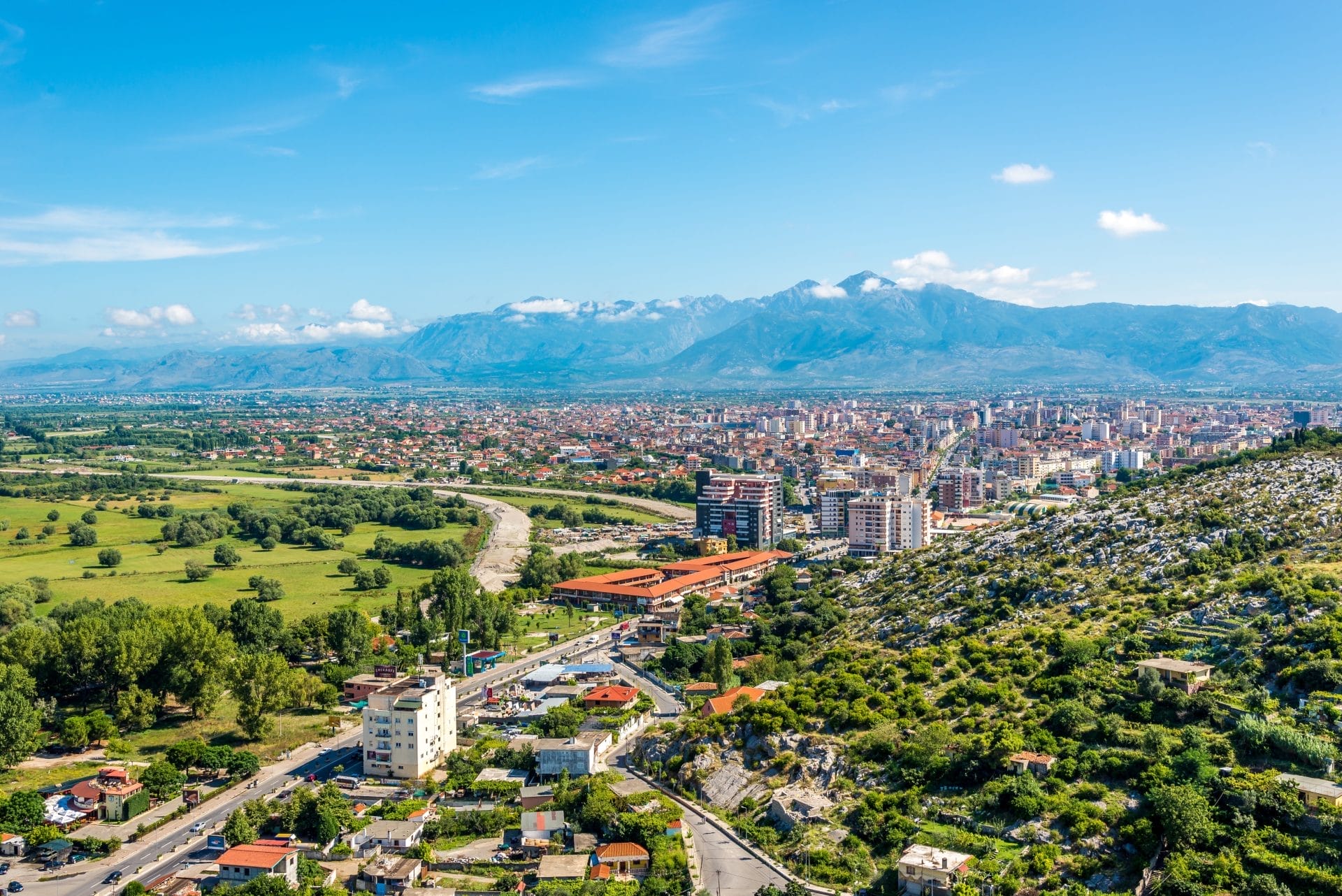
Twenty-two centuries later, that geographic advantage matters differently. Shkodër (population 110,000) is now Albania’s intellectual capital and the gateway to the Alps. Every road to Theth, Valbona, and the Lake Koman ferry runs through here. Southern Europe’s largest lake (368 sq km, two-thirds in Montenegro) laps at the city’s edge. The Albanian Alps rise 40km northeast, visible from castle ramparts.
But here’s what makes Shkodër different from Berat or coastal towns: this city kept the Albanian language alive when the Ottomans tried to kill it. Publishing houses here printed newspapers, books, and poetry in Albanian despite Ottoman bans. Intellectuals kept writing through 400 years of empire, then through 45 years of communism when Hoxha’s regime was particularly suspicious of Shkodër’s Catholic population and Western connections.
One family—the Marubis—photographed all of it. 150,000 glass plate negatives documenting Albanian society from 1856 to 1952. Ottoman officials, highland chiefs with rifles, Albania’s 1912 independence declaration, WWII occupations, early communism. The entire visual archive of a nation defining itself while empires collapsed around it.
What You’re Actually Getting
Shkodër won’t blow your mind with UNESCO architecture or beach resort vibes. It’s a working northern city of 110,000 that happens to have extraordinary cultural depth.
You get: A 2,400-year castle with actual Illyrian foundations. A world-class photography museum most travelers have never heard of. A pedestrianized center where Ottoman mosques sit next to Catholic cathedrals. Lake Shkodër’s wetlands hosting endangered Dalmatian pelicans. Bicycle culture (rare in mountainous Albania). The staging point for Alps adventures.
You don’t get: Beach access (Adriatic is 30km away at Velipojë). Dramatic mountain scenery in the city itself (Alps are visible, 40km away). Nightlife like Tirana or the coast. Instant visual gratification.
This is cultural tourism. If you need every destination to look amazing in photos, skip this. If you’re curious about how Albanians kept their language and identity alive through 400 years of Ottoman rule and 45 years of communism, this is where it happened.
The Castle Where a Woman Still Weeps Milk
Rozafa Castle sits on a 130-meter limestone hill with 360-degree views: Lake Shkodër, three rivers converging, the city below, Albanian Alps to the northeast. Illyrians built the first fortifications here around the 4th century BCE.
The legend: Three brothers kept trying to build the fortress but it collapsed every night. An elder told them they had to immure (wall up alive) the first wife who brought lunch the next day. The youngest brother’s wife Rozafa arrived first—the older brothers had warned theirs. She accepted her fate but made one request: leave one breast exposed to nurse her baby, one hand free to caress him, one foot to rock the cradle.
A limestone outcrop in the castle still seeps water continuously. Locals say it’s Rozafa’s milk, still flowing for her child 2,400 years later.
But here’s the wild historical part: this castle has a continuous 2,400-year occupation sequence. You can see Illyrian foundations. Roman reinforcements from 168 BCE when they beat Gentius. Byzantine reconstruction (6th century CE). Venetian walls (1396-1479) - the squared limestone blocks you see now. Ottoman modifications after they finally captured it in 1479 following a brutal 15-month siege.
The Ottomans had tried three times (1474, 1478-79, 1479) before the Venetian-Albanian defenders surrendered with honors. That’s how strategic this position was - you could control the western Balkans from up here.
Visit: 200 LEK entry (~€2). Open 8 AM-7 PM summer, 8 AM-4 PM winter. Steep 15-20 minute climb (bring water) or taxi to the entrance. The archaeological museum inside shows artifacts from all the different civilizations. Byzantine cisterns, Venetian towers, Ottoman mosque ruins. Sunset views toward Montenegro are spectacular - many people time visits for late afternoon.
150,000 Photographs of a Nation Defining Itself
Pietro Marubbi showed up in Shkodër around 1856, running from Italian unification struggles. Political refugee. He adopted the Albanian name Pietro Marubi, opened the Balkans’ first commercial photography studio, and trained local apprentices.
What happened next is extraordinary: three generations of one family documented Albania’s entire transformation from Ottoman province to independent nation to communist state. 150,000 glass plate negatives spanning 1856-1952.
Pietro Marubi (1834-1903): Photographed Ottoman officials, Catholic clergy, wealthy families, highland tribal leaders carrying rifles. Photography was exotic tech in the 1850s-1890s—most of his subjects had never seen a camera.
Kel Marubi (1870-1940, adopted son): Shot Albania’s November 28, 1912 independence declaration. Documented WWI occupations. Captured the chaos of interwar Albania when governments collapsed faster than he could photograph them.
Gegë Marubi (1907-1984, Kel’s son): Maintained the studio through WWII Italian and German occupations. Photographed early communism until 1944 when Hoxha’s regime started restricting private business. In 1970, the communists nationalized the archive, transferring all 150,000 negatives to state control.
Ironically, nationalization saved the collection. If it had stayed private through Albania’s 1990s chaos and economic collapse, those glass plates might have been lost forever.
The portraits are incredible. You can read someone’s entire social position - ethnicity, religion, regional identity, wealth - from their clothing, jewelry, weapons, insignia. Visual codes contemporary Albanians understood instantly but we need explanations for.
UNESCO recognized this archive’s importance. It’s not just Albanian history - it’s Balkan society’s transformation from empire to nation-states, preserved in silver halide on glass.
Visit: Open Tuesday-Sunday 9 AM-4 PM, closed Monday. Entry 200 LEK (~€2). Allow 1-2 hours. English signage explains context. Museum shop sells postcards featuring the photographs. The building itself is a restored 19th-century structure - appropriate setting for viewing a vanished world.
Why They Call It the “Jerusalem of Albania”
Shkodër kept 60% Catholic population through 400+ years of Ottoman Muslim rule (1479-1913). That’s basically unheard of in the Balkans. Most regions converted to Islam for tax benefits, social advantage, or religious conviction. Shkodër’s Catholics held on through Franciscan schools, hospitals, secret masses.
The Ottomans built mosques too. The Ebu Beker Mosque (1773) with its distinctive lead dome. Muslim community grew. Orthodox Christians (mostly Greek and Slavic merchants) maintained smaller presence. Three religions, walking distance from each other.
Families often had members of different faiths through intermarriage. Business partnerships crossed religious lines. Albanian identity mattered more than which prayer you said.
Then 1967: Hoxha declared Albania “the world’s first atheist state.” Closed all 2,169 religious buildings nationwide. Catholic cathedral became a sports hall. Mosques shuttered. Clergy imprisoned. Twenty-four years of enforced atheism.
But families kept praying in secret. Teaching children prayers behind locked doors. Preserving faith through decades of official prohibition.
December 1990, before communism officially collapsed: thousands showed up for Christmas Mass at the cathedral. Religion’s return to public life. When the regime finally fell in 1991, Shkodër’s religious communities immediately resumed worship. The coexistence tradition resumed too—interfaith marriages still common, holidays celebrated community-wide regardless of faith.
Southern Europe’s Largest Lake
Lake Shkodër: 368 sq km, split between Albania (148 sq km) and Montenegro (220 sq km). Southern Europe’s largest lake. Shallow—average depth 5 meters, max 8.5 meters. The shoreline fluctuates wildly: spring snowmelt expands it to 530 sq km, summer drought shrinks it to 350 sq km.
Over 280 bird species recorded. Dalmatian pelicans (vulnerable—fewer than 5,000 breeding pairs worldwide), pygmy cormorants, great white egrets. Critical stopover on the Adriatic flyway. Best birdwatching: April-May and September-October migrations.
Boat tours (€15-25, 2-3 hours) run through reed channels to Grmozur fortress island—19th-century Montenegrin prison ruins on an artificial island. Book through hotels in Shkodër or at Shiroka village (15km away).
The Albanian shore is way less developed than Montenegro’s side. That means authentic experiences, fewer crowds, lower prices. It also means minimal facilities, limited English, activities you have to organize yourself. Montenegro’s Skadar Lake National Park offers polished tourism infrastructure if that’s what you need.
The Gateway to Everything
Shkodër is Albania’s intellectual capital and the staging point for the Alps. It’s where 150,000 photographs preserved national identity through chaos. Where publishing houses kept Albanian alive despite Ottoman bans. Where three religions lived together for centuries. Where a castle weeps milk from a woman walled alive 2,400 years ago.
It’s not beautiful like Berat. It’s a working city of 110,000 that happens to hold extraordinary depth if you’re willing to engage with it. The Marubi archive alone justifies the visit—you’re looking at how a nation defined itself during its most formative century, preserved in silver halide on glass.
Three rivers still converge beneath Rozafa Castle just like they did when Illyrian king Gentius made his last stand. The geographic constant persists while civilizations rise, transform, adapt. Shkodër’s significance lies not in frozen preservation but in living continuity—a city that honors traditions while embracing bicycles and pedestrianized streets, maintains religious tolerance while acknowledging communist persecution, serves as gateway to wilderness while providing urban comforts.
Budget €40-60 daily. Bring curiosity. The Alps are waiting 40km northeast.