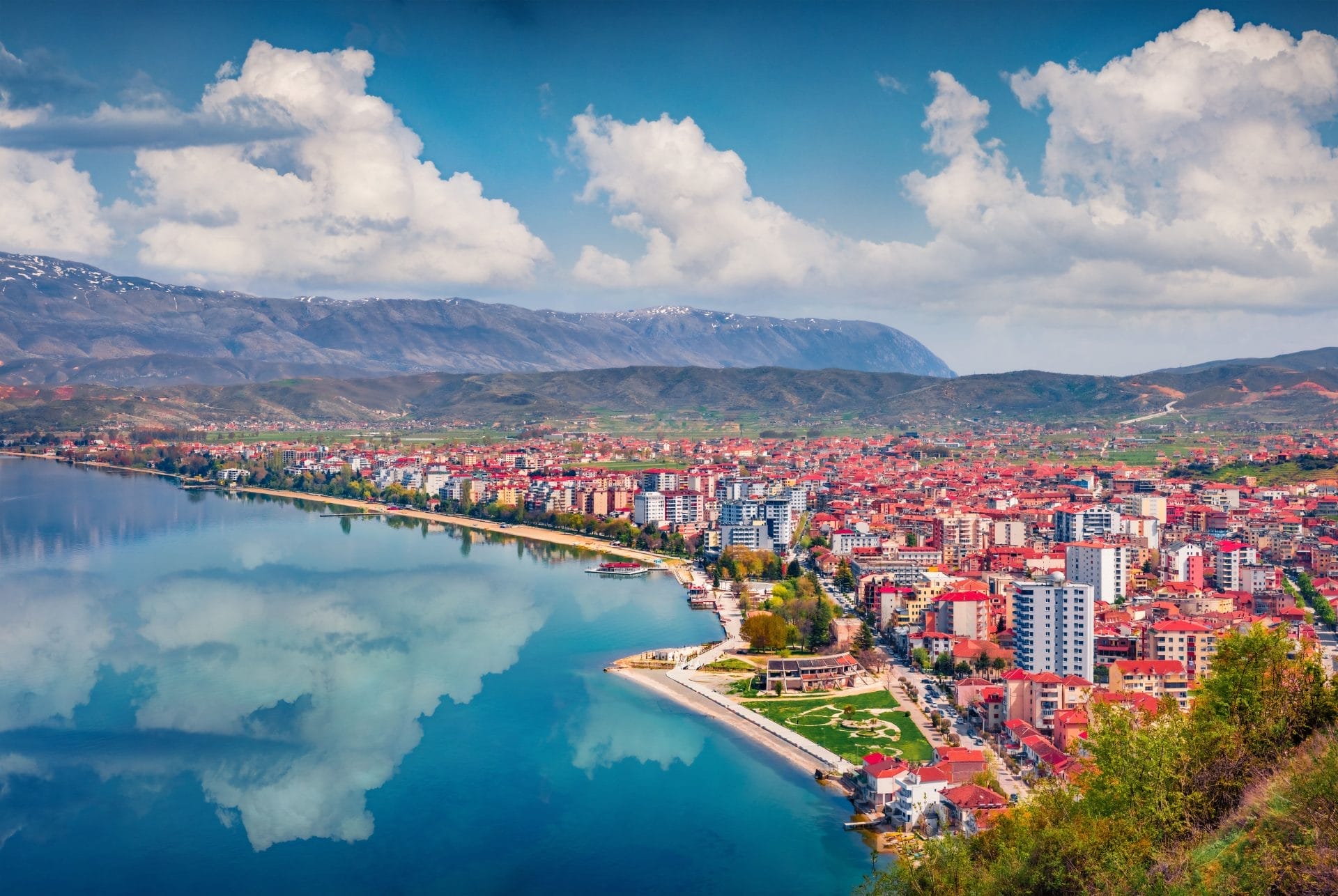
How to Get to Pogradec
From Tirana
- By Bus: Multiple daily buses from southern terminal. Journey takes 2.5-3 hours and costs 600-800 LEK (€5-7).
- By Car: 140km via A3 highway through Elbasan and Librazhd, then mountain roads ascending to Pogradec’s 735m elevation. Drive time approximately 2.5-3 hours.
- Private Taxi: €65-82 for direct transfer from Tirana.
From Korçë
- By Bus: Frequent buses. Journey takes 1 hour and costs 300-400 LEK (€2.50-3.50).
- By Car: 50km via good roads. Drive time approximately 1 hour.
From North Macedonia
- Border Crossing: Tushemisht border (4km from Pogradec center) opens daily 6 AM-10 PM. Walk across for day trips to St. Naum Monastery (4km on Macedonian side). Buses from St. Naum to Ohrid city (30km) cost €3.
Note: Albanian car insurance (Green Card) not automatically valid in North Macedonia - requires separate policy or border purchase.
The Poet and the Ancient Lake
Lasgush Poradeci—born Llazar Gusho in 1899 in Pogradec—spent his entire life writing poetry about Lake Ohrid. Not metaphorically, but literally: every published poem he wrote engaged with the lake’s waters, its changing light, its mountains, its depths. When Albania’s greatest literary scholar Eqrem Çabej evaluated Poradeci’s work, he declared this local poet from a small lakeside town was “the only Albanian poet Albania will one day bequeath to the world.”
The specificity of Poradeci’s obsession seems remarkable until you spend time with Lake Ohrid itself. The lake is 1.36 million years old—one of only three ancient lakes in Europe (alongside Prespa and Russia’s Lake Baikal) that survived glacial periods without drying or freezing. This extraordinary age allowed unique evolutionary processes: the lake harbors more than 200 endemic species found nowhere else on Earth, including the koran trout (Salmo letnica), several snail species, a unique microorganism community, and specialized algae adapted to the lake’s particular chemistry.
For Neolithic people, for Bronze Age traders, for Roman administrators, for Byzantine monks, for Ottoman governors, for communist officials, and for contemporary Albanian and Macedonian families, Lake Ohrid has been the constant—the geographic and cultural anchor of the region. The lake predates human presence in the Balkans by more than a million years. When Neolithic families built pile dwellings at Lin 8,500 years ago (confirmed by 2023 underwater archaeology), the lake was already ancient beyond their comprehension. When Poradeci wrote “Vallja e yjve” (The Dance of the Stars) in the 1930s, he was engaging with waters that had witnessed 1.36 million sunrises.
UNESCO recognized this significance in 1979 when designating the North Macedonian portion of Lake Ohrid as Natural and Cultural Heritage—one of fewer than 50 sites globally carrying both designations. In 2019, UNESCO extended the designation to include Albania’s portion, acknowledging the lake as indivisible ecosystem requiring cross-border protection. Pogradec, population approximately 17,000, functions as Albania’s primary Lake Ohrid town and the gateway to both the natural and cultural heritage the UNESCO designation protects.
Why Visit Pogradec
Pogradec offers access to Lake Ohrid’s Albanian shore, where tourism development remains modest compared to the North Macedonian side’s established infrastructure. This creates particular appeal for travelers seeking authentic lakeside town experience without resort atmosphere, access to UNESCO-designated natural and cultural heritage, endemic species (particularly koran trout) unavailable elsewhere, archaeological sites spanning from Neolithic through Byzantine periods, and literary heritage connected to Albania’s most celebrated poet.
What Pogradec provides: lakeside location at 735 meters elevation creating 10°C cooler temperatures than Tirana, natural swimming beaches with water temperatures reaching 22-26°C July-September, day-trip access to Lin Peninsula and Drilon National Park, traditional koran trout prepared using family recipes, accommodation ranging €20-55 nightly including lakefront hotels and guesthouses, cultural context through Lasgush Poradeci museum and statue, proximity to North Macedonia border enabling cross-border exploration, and Albanian lakeside life maintaining fishing traditions and seasonal rhythms distinct from coastal tourism patterns.
What Pogradec doesn’t offer: dramatic mountain scenery (the lake sits in relatively gentle topography), extensive organized activities beyond basic boat tours and hiking, international resort amenities or luxury properties (accommodations are comfortable but modest), nightlife or entertainment beyond restaurants and the evening xhiro promenade tradition, or destination attractions beyond the lake itself and nearby archaeological sites.
Skip Pogradec if you prioritize: dramatic landscapes over cultural and natural history, resort amenities and organized activities, vibrant nightlife or entertainment options, or destinations offering variety beyond lakeside relaxation and archaeological exploration.
Choose Pogradec if you value: experiencing UNESCO-designated ancient lake ecosystem, accessing Europe’s oldest confirmed pile dwelling settlement at Lin, tasting endemic fish species, exploring Albanian town life outside primary tourism circuits, comfortable but authentic accommodation at reasonable prices, literary heritage and cultural context, or using lakeside base for regional exploration including North Macedonia border crossings.
The honest assessment: Pogradec rewards travelers interested in natural history, archaeology, and authentic Albanian lakeside culture rather than those seeking dramatic scenery or resort experiences. The lake’s ancient nature and endemic species create genuine significance, but appreciating that significance requires interest in ecological and evolutionary processes rather than immediate visual impact. The town functions primarily for domestic Albanian tourism—families escaping summer heat, Tirana residents seeking weekend retreats, Pogradec diaspora returning home—with international travelers remaining minority. This creates authentic atmosphere but means limited English, modest tourism infrastructure, and experiences requiring engagement with Albanian culture on its own terms rather than adapted international tourism product.
Lake Ohrid: 1.36 Million Years of Continuous Existence
Lake Ohrid formed through tectonic processes approximately 1.36 million years ago (geological dating via sediment cores analyzed by international research teams). The lake occupies a tectonic depression created by faulting along the North Macedonian-Albanian border, with the depression gradually filling to create a lake approximately 30 kilometers long, 15 kilometers wide, and 288 meters deep at maximum. This depth makes Ohrid the Balkans’ deepest lake.
The extraordinary aspect isn’t size or depth but continuous persistence. Most European lakes formed after the last glacial maximum (approximately 20,000 years ago) when glaciers retreated and melted, creating relatively young water bodies. Ancient lakes—those predating Quaternary glacial periods—are globally rare. Lake Ohrid survived repeated glacial cycles over 1.36 million years without completely freezing or drying, maintaining liquid water and living ecosystems through climate changes that eliminated most other water bodies.
This persistence created evolutionary laboratory conditions. Species arriving in the lake over hundreds of thousands of years adapted to specific niches within the stable aquatic environment, eventually evolving into endemic forms found nowhere else. The lake’s mollusk diversity is exceptional—more than 80 endemic snail species evolved from ancestral populations isolated in Lake Ohrid for hundreds of thousands of years. Fish species similarly speciated, including the koran trout which diverged from ancestral salmonid populations and adapted specifically to Lake Ohrid’s conditions.
The water chemistry is distinctive—oligotrophic (low nutrient), high oxygen content even at depth, calcium carbonate saturation creating exceptional clarity, and consistent temperature stratification with surface waters warming to 22-26°C in summer while depths remain around 6°C year-round. Spring feeding contributes substantially to water volume—approximately 25% of inflow comes from underwater and shoreline springs rather than surface rivers, with Drilon springs near Pogradec providing significant contribution.
UNESCO’s designation recognizes both natural heritage (the ancient lake ecosystem with endemic species) and cultural heritage (continuous human habitation creating archaeological sequence from Neolithic through modern periods). The designation requires Albania and North Macedonia to coordinate protection measures, limit development threatening water quality, preserve archaeological sites, and maintain traditional fishing practices that minimize ecological impact.
For visitors, the lake’s ancient nature isn’t immediately apparent—it looks like other clear mountain lakes. The significance emerges through understanding evolutionary processes creating endemic species, geological timescales allowing continuous existence through climate shifts, and cultural continuity as humans lived beside these waters for thousands of years knowing nothing of the lake’s million-year history yet depending entirely on its persistence.
Lin Peninsula: Europe’s Oldest Lakeside Dwelling
Six kilometers from Pogradec’s center, Lin Peninsula extends into Lake Ohrid’s waters, its present-day village of approximately 50 permanent residents sitting above what 2023 underwater archaeology confirmed as Europe’s oldest pile dwelling settlement. The Neolithic occupation dates to approximately 8,500 years ago (radiocarbon dating of wooden posts and organic materials), predating famous Swiss pile dwellings by roughly 2,000 years.
The 2023 confirmation came through Albanian and international underwater archaeology teams using submersible survey equipment, systematic excavation of submerged remains, radiocarbon analysis of organic materials, and documentation of structural elements preserved in lakebed sediments. The discovery pushed back European pile dwelling chronology substantially—previous evidence suggested pile dwellings emerged around 5000 BCE in Alpine regions, but Lin’s settlement dates to approximately 6500 BCE.
The Neolithic residents built wooden structures extending from the peninsula into shallow lake waters, driving posts into the lakebed and creating platforms above water level for dwellings. This construction method offered multiple advantages: protection from flooding and wild animals, natural defensive position with water access on three sides, direct access to fishing grounds, and relatively stable microclimate moderated by lake proximity. The underwater remains show sophisticated construction—regular post spacing, evidence of platform structures, pottery fragments, carbonized plant remains indicating cultivated crops, and stone tools.
The settlement’s position on what’s now the Albania-North Macedonia border created jurisdictional complexities for archaeological work—the international boundary runs through the lake, with Lin on Albanian shore but some underwater remains potentially in North Macedonian waters. The 2023 research involved coordination between both nations and represented broader cooperation under UNESCO’s cross-border Lake Ohrid designation.
Above the underwater Neolithic site, Lin’s hilltop holds a 6th-century Byzantine basilica with extraordinary floor mosaics—birds (peacocks, doves), fish (reflecting Lake Ohrid ecology), bees (Christian community symbolism), and geometric patterns created using thousands of colored stone tesserae. The basilica dates to Emperor Justinian I’s reign (527-565 CE) when substantial resources flowed into church construction across Byzantine territories. The mosaics survive with remarkable preservation after 1,500 years, though protective measures now keep them covered most of the year.
Viewing the mosaics requires contacting the site caretaker through guesthouses in Pogradec or Lin village, with advance arrangement enabling temporary uncovering of portions for viewing (typically 100-300 lek fee). The basilica ruins themselves remain accessible—you can walk the site, understand the architectural footprint, and appreciate the commanding hilltop position Justinian’s builders chose for maximum landscape visibility.
The juxtaposition of Neolithic pile dwellings underwater and Byzantine basilica on the hilltop creates continuous 8,500-year archaeological sequence—one of the most complete records of human lakeside habitation in Europe. For visitors reaching Lin (6km from Pogradec via lakeside road, accessible by car or bicycle), the combination of archaeological significance, Byzantine artwork, and traditional village life makes the site essential despite modest infrastructure and controlled access to the actual mosaics.
Koran Trout: Endemic Species and Culinary Tradition
Salmo letnica, commonly called koran trout or Ohrid trout, evolved in Lake Ohrid’s isolated ecosystem over hundreds of thousands of years. The species descended from ancestral brown trout populations that entered the lake and adapted to its specific conditions—exceptional water clarity, consistent cold temperatures at depth, particular prey species availability (endemic snails, small fish, aquatic insects), and stable chemical environment. Over evolutionary time, these adaptations created distinct species found nowhere else.
The koran trout displays silvery coloration with relatively few spots (compared to typical brown trout), reaches sizes up to 15 kilograms (though most catches are 1-3kg), and lives in both deep water (where it feeds on endemic gobies and snails) and shallow areas (where younger fish feed on insects and crustaceans). The species spawns in tributary streams feeding Lake Ohrid, migrating from the lake into rivers during winter months to lay eggs in gravel beds, then returning to the lake.
Commercial fishing pressure, habitat degradation, and climate change impacts on water temperature have reduced koran populations substantially from historical levels. Albanian and North Macedonian authorities implemented protection measures including fishing season restrictions (prohibited during spawning periods), catch size minimums, commercial fishing quotas, and hatchery programs attempting to supplement wild populations. Despite these efforts, the species remains vulnerable—listed under Albanian environmental protection law and included in international conservation assessments as requiring continued monitoring and protection.
For travelers, koran trout appears on virtually every Pogradec restaurant menu, prepared using traditional recipes developed over generations when the fish represented primary protein source for lakeside communities. The classic preparation is Tavë Korani—the fish baked in clay or ceramic pots with walnuts, garlic, onions, olive oil, and minimal additional spicing that preserves the trout’s delicate flavor. Other traditional preparations include grilled whole fish with lemon and herbs, or pan-fried fillets served with seasonal vegetables.
Restaurants around Pogradec’s waterfront—Restorant Poradeci, Oborri Familjar, Zgara Familjare—serve koran at €10-15 per person including fish, sides, and local wine. The fish you eat likely comes from a combination of wild catches (limited by quotas) and hatchery-raised individuals (increasingly common as wild populations decline). The taste is mild, slightly sweet, with firm flesh that holds up well to baking or grilling—noticeably different from farmed rainbow trout or salmon that dominate international markets.
The cultural significance extends beyond cuisine—koran represents Lake Ohrid’s unique ecology, symbolizes the region’s natural heritage, and connects contemporary life to fishing traditions practiced for thousands of years. When you eat koran trout in Pogradec, you’re tasting species that evolved nowhere else, prepared using techniques refined across generations, served in restaurants looking across waters where Neolithic fishermen pursued the same species 8,500 years ago.
Lasgush Poradeci: The Poet Who Wrote Only About Water
Llazar Gusho, born March 27, 1899, in Pogradec, adopted the pen name Lasgush Poradeci—combining a family nickname with his hometown’s name in Albanian possessive form. He attended Greek schools in Pogradec (then Ottoman territory where Greek education was available), continued studies in Romanian lycée in Monastir (modern Bitola, North Macedonia), and earned university degree in Romance philology from Graz, Austria, in 1926. His linguistic education gave him access to European literary traditions—French symbolism, Romanian poetry, German romanticism—which he synthesized with Albanian verse forms to create distinctive poetic voice.
Poradeci published two primary poetry collections during his lifetime: “Vallja e yjve” (The Dance of the Stars) in 1933 and “Ylli i zemrës” (The Star of the Heart) in 1937. Additional poems appeared in literary journals, and posthumous collections gathered unpublished work after his death on November 12, 1987. Every published poem engages directly with Lake Ohrid—its waters, reflections, stars above it, mountains surrounding it, seasons changing across its surface, fish within it, boats upon it. This singular focus creates body of work unique in Albanian literature and rare in world poetry—complete dedication to single geographic feature sustained across 50+ years of writing.
The poetry itself uses Lake Ohrid as both literal subject and metaphysical symbol. In “Vallja e yjve,” stars dancing in lake reflections become meditation on beauty’s ephemeral nature and art’s attempt to capture transient moments. In “Ylli i zemrës,” the lake functions as mirror revealing inner emotional landscapes through natural imagery. The technical approach combines formal structure (Poradeci mastered traditional Albanian verse forms) with symbolist imagery (water, light, stars, darkness) and pantheistic philosophy suggesting nature contains divine presence accessible through contemplation.
Albanian literary scholars position Poradeci alongside Gjergj Fishta (epic poet of Albanian independence) and Naim Frashëri (romantic poet of national awakening) as forming Albanian poetry’s foundation, but Poradeci’s lyric intensity and metaphysical depth created something distinct from his contemporaries’ more political or narrative work. Scholar Eqrem Çabej’s statement that Poradeci was “the only Albanian poet Albania will one day bequeath to the world” reflected assessment that Poradeci’s achievement transcended national literature and reached universal poetic concerns through intensely local subject matter.
During the communist period (1944-1991), Poradeci lived as dignified recluse in Pogradec, teaching briefly but primarily existing outside official cultural life. He refused to write socialist realist poetry celebrating communist achievements, insisted on being addressed as “Zoti” (Mister) rather than “Shoku” (Comrade), and maintained pre-war bourgeois manners and dress that marked him as ideologically suspect. The regime tolerated him partly because his poetry avoided politics (you can’t extract anti-communist meaning from poems about lake water) and partly because his international reputation (his work had been translated and recognized abroad) made persecution diplomatically awkward.
Poradeci protected his private thoughts by writing diaries in Sanskrit and ancient Greek—languages he’d learned during his philological education and which Albanian security services couldn’t decipher. This linguistic fortress allowed him to maintain inner life separate from external surveillance. Local stories (recorded by literary historians after his death) describe the poet walking Lake Ohrid’s shores daily, stopping to observe water and light, and reminding children never to “turn their backs on Lake Ohrid” when walking the waterfront—teaching younger generations to maintain respectful attention to the lake that defined their home.
Contemporary Pogradec honors Poradeci through bronze statue on the lakeside promenade (showing the poet seated, gazing toward the water), museum in his former residence (preserving his library, manuscripts, and personal effects), annual poetry festival bearing his name, and verses inscribed on public buildings throughout the city. For visitors, Poradeci’s legacy provides cultural context for understanding how this lake inspired artistic achievement—his poetry functions as interpretive lens for experiencing the waters he spent his life documenting.
The Other Writers and Painters Pogradec Produced
Poradeci gets the statue, but he wasn’t working alone. For a city of this size, the output is disproportionate.
Mitrush Kuteli (1907-1967) was born here and, alongside Ernest Koliqi, effectively founded modern Albanian prose. His Netë shqiptare (Albanian Nights) rendered village life around Lake Ohrid in something close to magical realism, filtered through the Romanian literary world he’d trained in. If Poradeci turned the lake into metaphysics, Kuteli turned the villages around it into stories.
Luan Starova put Pogradec into his Balkan Saga novels, which follow his family’s wartime flight into Macedonia and the decades they then spent separated from relatives by a sealed Albania-Yugoslavia border. The detail that stays with you: watching their own hometown through binoculars from St. Naum Monastery, a few kilometres and one impassable frontier away.
On the visual side, Anastas Kostandini—known as Taso—keeps a gallery in town that’s open to visitors, with work available directly from him. Painters Gjergji Lako, Gentian Zeka, and the Dhima brothers all came out of the same small city. The subject is almost always the same: what lake light does against mountain shadow, which changes hour by hour here in a way that clearly gets under people’s skin.
Also worth knowing: ICKA Studio maintains local woodcarving traditions going back centuries, and it’s the kind of place you’ll walk past without noticing unless you’re looking for it.
Three Things Almost Nobody Does Here
Beyond the promenade and the trout, a few things sit just off the standard route:
- The bunker chapel at Lin Peninsula’s tip. One of Hoxha’s concrete pillboxes, converted into a tiny chapel. It’s a five-minute detour once you’re already at Lin for the pile dwellings.
- Going out with the fishermen. Traditional fishing expeditions can be arranged through guesthouses. Early starts, no infrastructure, and the most direct way to understand how the koran fishery actually works.
- Nica. A mountain village above the lake with an old bridge and church, effectively untouched by tourism. You need a car and a willingness to drive a rough road.
Drilon National Park: The Springs That Feed Ancient Waters
Five kilometers south of Pogradec’s center, Drilon National Park protects spring-fed waterways producing 5-6 cubic meters of water per second from karst aquifers underlying the Lake Ohrid watershed. The springs emerge from limestone formations, bringing water filtered through underground passages and maintaining constant year-round temperature (approximately 14°C) regardless of surface conditions.
The springs’ output flows through constructed channels creating network of clear waterways before emptying into Lake Ohrid approximately 300 meters from the spring source. The Ottoman Empire recognized the site’s value—historical records mention gardens and watercourses here during the 16th-17th centuries. Later Albanian administration maintained the area as public space, and during the communist period (1944-1991), Drilon functioned as restricted retreat for party officials—ordinary Albanians couldn’t access the springs that higher-ranking communists enjoyed as exclusive park.
Post-1991, Drilon opened to public use, with basic tourism infrastructure developing through the 1990s-2000s. The park now includes walking paths through woodlands surrounding the spring channels, wooden bridges crossing waterways, restaurant serving traditional Albanian food with outdoor seating beside the flowing water, and boat tours through the spring-fed channels (€5-8 per person, 20-30 minute circuits).
In October 2024, Albanian American Development Foundation announced Drilon-Tushemisht Waterscape Park project—$5 million infrastructure investment creating improved pathways, interpretive signage explaining karst hydrology and spring ecology, upgraded facilities including restrooms and visitor information, and enhanced boat tour operations with electric boats replacing some diesel-powered craft. The project aims to position Drilon as sustainable tourism destination while protecting the spring ecosystem that UNESCO’s Lake Ohrid designation identifies as requiring careful management.
The spring water’s exceptional clarity creates primary visual appeal—you can see pebbles and aquatic vegetation at 3-4 meter depths, and the consistent flow maintains pristine conditions without the seasonal algae growth or sediment accumulation that affects surface streams. Fish (including trout from hatchery release programs and various small species from Lake Ohrid) inhabit the channels, and waterfowl (ducks, herons, occasionally swans) use the waterways year-round.
For visitors, Drilon offers contrast to Lake Ohrid’s expanse—intimate scale, enclosed woodland setting, controlled flows creating calm water perfect for boat tours, and accessible infrastructure making it suitable for families, elderly visitors, or anyone seeking gentle nature experience without hiking or swimming. The combination of natural springs, the historical legacy of Ottoman gardens and communist-era retreat, and contemporary conservation efforts creates layered significance beyond simple scenic beauty.
Practical Pogradec
Getting There: Pogradec lies 140 kilometers from Tirana, requiring 2.5-3 hours by car via Elbasan and Librazhd on generally good roads (A3 highway through Elbasan, then mountain roads ascending to Pogradec’s 735-meter elevation). Multiple daily buses connect Tirana’s southern terminal to Pogradec (600-800 lek, journey 3-3.5 hours including rest stop), operated by various companies with schedules available through Gjirafa Travel platform.
Private taxis from Tirana cost €65-82 for direct transfer. Car rental (€20-25 daily from Tirana agencies) provides maximum flexibility for accessing Lin, Drilon, Selca tombs, and North Macedonia border crossings that public transport doesn’t serve efficiently.
The North Macedonia border at Tushemisht (4km from Pogradec center) opens daily 6 AM-10 PM for pedestrian and vehicle crossing. Walking across enables day trips to St. Naum Monastery (4km on Macedonian side) without vehicle insurance complications—Albanian car insurance (Green Card) isn’t automatically valid in North Macedonia, requiring separate policy or border purchase. Buses from St. Naum to Ohrid city (30km) cost €3 paid in euros or Macedonian denars.
Accommodation: Options span from basic guesthouses (€20-25/night with shared bathrooms) through mid-range lakefront hotels (€35-50/night with private bathrooms and breakfast) to Pogradec’s most upscale property—Grand Hotel Pogradec in Tushemisht (€70-120/night including pool and spa, depending on season). Properties concentrate along the lakefront, with walking access to beaches, promenade, and restaurants.
Booking ahead for July-August peak season is essential—domestic Albanian tourism fills available beds on summer weekends. Shoulder seasons (May-June, September-October) offer 30-40% lower rates with better availability and pleasant weather still suitable for swimming and outdoor activities.
Dining: Restaurants serve koran trout as signature dish (€10-15 per person including sides), alongside standard Albanian fare (grilled meats, vegetables, salads, pasta). The lakefront promenade hosts numerous establishments—quality is generally consistent, with prices reflecting location (restaurants directly on water charge slightly more than those one block inland).
Recommended properties include Restorant Poradeci (family recipes, traditional atmosphere), Oborri Familjar (highest rated, generous portions), and The Change (Mediterranean-Japanese fusion, contemporary approach). Budget meals (byrek, simple grills, vegetables) cost €3-5 at non-lakefront establishments serving local workers rather than tourists.
Activities: Swimming in Lake Ohrid dominates July-September when water temperatures reach 22-26°C. Pogradec Beach (near town center) offers rare sandy shore unusual in Albania, with gradual depth increase suitable for children. Water clarity allows visibility to 2-3 meters depth in near-shore areas.
Boat tours from waterfront depart regularly (€10-15 per person for 1-2 hour tours to Maligrad Island or along shoreline). Bicycle rental (€5-8 daily) enables riding the flat 5-kilometer lakefront promenade. Day trips to Lin Peninsula (6km, accessible by car, bicycle, or taxi €8-10) and Drilon National Park (5km, similar access) constitute primary organized activities.
Hiking Mali i Thatë (Dry Mountain) requires guide (€70 plus transport) for challenging 13.6km trail ascending to 2,288m with 6-8 hour duration. Shorter hikes include Pogradec Castle ruins (20 minutes uphill from town center) and Drilon woodland trails (gentle walking on maintained paths).
Timing: May-June and September-October provide optimal conditions—warm temperatures (20-25°C), swimmable lake water (20-24°C), minimal crowds, and lower accommodation prices. July-August brings peak domestic tourism, highest prices, warmest conditions (28-32°C air, 24-26°C water), and limited availability requiring advance booking.
Winter (November-March) sees reduced tourism operations, cold temperatures (occasionally below freezing), and snow-capped mountain views creating contemplative atmosphere but limited activities beyond restaurants and indoor cultural sites.
Money and Logistics: ATMs exist in Pogradec center—withdraw sufficient Albanian lek as restaurants and hotels outside the main lakefront may not accept cards. Budget €30-45 daily including mid-range accommodation, meals at decent restaurants, and local transport. Add €15-20 for boat tours, guide services, or Lin/Drilon entrance fees.
Mobile coverage is reliable. Limited English proficiency outside larger hotels—translation apps or basic Albanian phrases improve interactions. Pharmacies and medical clinic exist in town center for minor health needs.
Nearby Destinations
Lin (6km): Europe’s oldest pile dwelling settlement and Byzantine basilica mosaics create essential archaeological day trip from Pogradec.
Korçë (50km south): Southeastern Albania’s cultural capital with French colonial architecture, museums, and urban comforts provides contrast to Pogradec’s lakeside focus.
Prespa National Park (40km south): Albania’s portion of Lake Prespa with Maligrad Island and medieval church accessible by boat—challenging unpaved road access rewards adventurous travelers.
Selca e Poshtme (40km): 4th-century BCE Illyrian royal tombs carved into cliff faces require 4WD vehicle for mountain road access but offer significant archaeological interest.
North Macedonia’s Ohrid (30km): Lake Ohrid’s largest town with UNESCO-designated medieval churches, Ottoman architecture, and developed tourism infrastructure contrasts with Pogradec’s quieter Albanian character.
The Quietest Shore of Europe’s Oldest Lake
Pogradec exists as Albania’s window onto Lake Ohrid—not the larger, more developed, more internationally known window (that’s Ohrid city on the North Macedonian shore), but the quieter, more authentically Albanian access point to waters that have persisted for 1.36 million years.
The lake’s extraordinary age and endemic species create genuine natural significance that UNESCO recognition confirms. The Lin settlement’s 8,500-year archaeology pushes European pile dwelling chronology back by two millennia. The koran trout represents evolutionary processes operating across hundreds of thousands of years in isolation. Lasgush Poradeci’s poetry achieves literary significance recognized beyond Albanian national literature. Drilon’s springs provide tangible connection to karst hydrology feeding the ancient lake. These aren’t tourism marketing claims—they’re documented facts about genuinely significant natural and cultural heritage.
What Pogradec doesn’t offer is the tourism polish that transforms significant sites into comfortable visitor experiences. Infrastructure remains modest, English remains limited, activities require self-organization, and the town functions primarily for Albanians rather than international travelers. Lake Ohrid’s visual impact is beautiful but not dramatic—it’s a clear mountain lake, similar in appearance to many others, with its true significance invisible beneath the surface in endemic species, ancient sediments, and million-year continuity.
For travelers interested in natural history, archaeology, or Albanian culture, Pogradec rewards engagement. The lake isn’t just beautiful—it’s genuinely ancient and ecologically unique. Lin isn’t just another archaeological site—it’s Europe’s oldest confirmed lakeside dwelling. Koran trout isn’t just a local fish specialty—it’s an endemic species found nowhere else on Earth. Poradeci isn’t just a local poet—he’s Albania’s greatest literary figure who spent his life writing about these waters.
Whether those facts create compelling destination depends entirely on what you value in travel. If you need dramatic landscapes, resort amenities, or extensive organized activities, Pogradec disappoints. If you appreciate natural and cultural significance, authentic Albanian town life, and meaningful engagement with places outside international tourism circuits, Pogradec provides access to genuinely important heritage in setting maintaining real character rather than tourism performance.
The lake will outlast all of us—it’s persisted for 1.36 million years, it will persist for millions more. Poradeci understood that—his poetry recognized his own transience against the lake’s permanence, finding both humility and meaning in that relationship. When you sit on Pogradec’s waterfront watching light change across water that witnessed the evolution of endemic species, that supported Neolithic families 8,500 years ago, that inspired Albania’s greatest poet, you’re connecting to something genuinely ancient and genuinely significant.
That’s worth the journey, even if the journey requires accepting modest accommodation, limited English, and destination whose greatest significance remains invisible beneath the surface waiting for those interested enough to understand what 1.36 million years of continuous existence actually means.