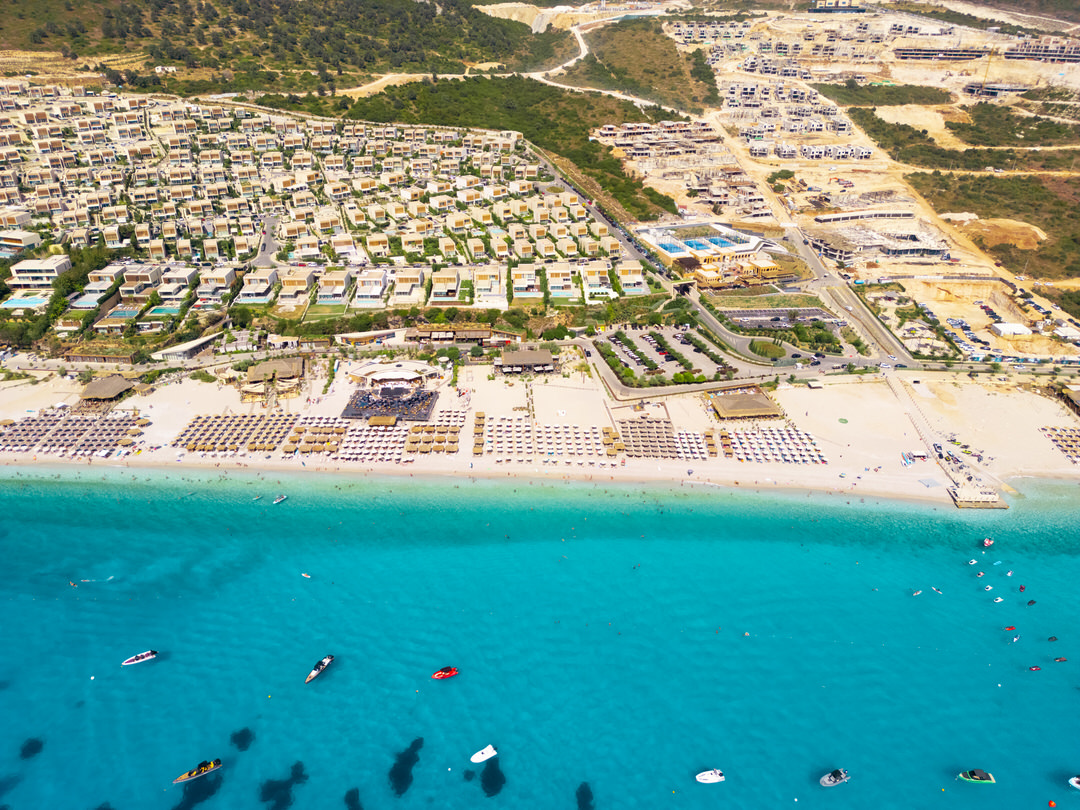
The Gateway Beach That Development Transformed
In July 2024, engineers completed the 5.7-kilometer Llogara Tunnel, boring through the Ceraunian Mountains to connect the coastal lowlands around Vlorë with the Albanian Riviera beaches stretching south. The tunnel reduced the journey from the old mountain road’s serpentine 30-minute descent to a straight 7-minute passage through the mountain. Palasë became the first beach travelers encounter emerging from the tunnel’s southern portal—the Albanian Riviera’s new front door.
This improved accessibility accelerated development already transforming Palasë from fishing village to resort destination. In 2019, the Green Coast Resort opened on 40 acres of beachfront property, establishing Albania’s first large-scale luxury beach development with Mediterranean architecture, infinity pools, multiple restaurants, and accommodation prices (€400-500 per night in peak season) matching mid-range European resorts. By 2024, construction activity dominated portions of the beach—additional hotels under development, infrastructure expansion, tourism facilities proliferating along the 1.5-kilometer shoreline.
The beach itself earned Albania’s first Blue Flag certification—an international environmental standard recognizing water quality, beach cleanliness, safety measures, and environmental management. The Blue Flag program requires meeting 33 specific criteria and maintaining them through annual audits. Palasë achieving this certification in a country where environmental regulation has historically been lax represented significant accomplishment, though maintaining standards while accelerating development creates ongoing tension.
The Ceraunian Mountains—rising from sea level to over 2,000 meters within a few kilometers—create Palasë’s dramatic geography. The mountains plunge nearly directly into the Ionian Sea, leaving only a narrow coastal strip where the village and beach occupy the space between mountain and water. This compressed geography concentrates development, making the resort construction particularly visible and the balance between preservation and development particularly precarious.
Why Visit Palasë
Palasë attracts travelers seeking: resort-level beach amenities (organized beaches with lounger service, multiple restaurants, water sports operations) in Albanian context with lower prices than Greek or Italian equivalents, Blue Flag water quality for families prioritizing swimming safety, dramatic mountain-and-sea geography, and base location for exploring the northern Albanian Riviera within 30-60 minute drives to Dhërmi, Himarë, and Vlorë.
What Palasë offers: Albania’s most developed beach resort infrastructure outside Ksamil, with Green Coast Resort establishing luxury accommodation standards previously unavailable on the Albanian Riviera; certified water quality and beach management; pebble coastline keeping water clarity high (visibility often exceeding 10-15 meters); accessibility via 2024 Llogara Tunnel; and prices lower than comparable Mediterranean beach resorts while offering similar amenities.
What Palasë doesn’t offer: the untouched character of less-developed Albanian beaches, authentic fishing village atmosphere (tourism now dominates the local economy), budget-friendly prices (development has pushed costs higher than most Albanian beach destinations), or escape from crowds (summer brings both international tourists and Albanian domestic visitors, filling the beach and straining infrastructure).
Skip Palasë if you prioritize: undiscovered destinations, budget travel (accommodation and dining costs approach Western European levels during summer), avoiding resort-style tourism, or seeking authentic Albanian coastal village life (commercial development has largely displaced traditional patterns).
Choose Palasë if you value: comfort and amenities over authenticity, certified environmental standards for family swimming, dramatic landscape photography, resort-style vacation within Albanian context, or using established infrastructure as base for day trips to less-developed beaches south.
The honest assessment: Palasë represents Albania’s vision of contemporary beach tourism—international standards, luxury accommodations, organized activities—applied to extraordinary natural geography. Whether this appeals depends on what you seek from the Albanian Riviera. Travelers wanting the Albania of 1990s guidebooks (empty beaches, €10 guesthouses, fishermen’s tavernas) won’t find it in modern Palasë. Those wanting resort amenities in spectacular setting at prices below Greek or Italian equivalents will find exactly what they’re seeking.
From Fishing Village to Resort: 1990-2024
During Albania’s communist period (1944-1991), Palasë functioned as small fishing settlement with perhaps 100 permanent residents living in stone houses, subsisting on fishing, small-scale agriculture on mountain terraces, and limited trade with neighboring villages. The coast was militarized—concrete bunkers still visible today marked defensive positions, and civilians required permits to access beaches. Tourism didn’t exist; the entire southern coast was restricted zone due to proximity to Greek border.
The 1990s brought poverty, not prosperity. Communist system collapse left Albania economically devastated, and the 1996-1997 pyramid scheme collapse wiped out many families’ savings. Palasë residents continued traditional fishing and farming, with some finding seasonal work in Greece (many Palasë families maintained Greek language from historical ties). The beach remained empty except for locals, accessed via the dramatic but poorly-maintained Llogara Pass road that deterred all but the most determined visitors.
The 2000s began gradual change. Some diaspora Albanians returned with capital from working abroad, opening small guesthouses and tavernas catering to the first trickle of budget tourists discovering Albania’s beaches. The beach remained largely natural—minimal infrastructure, no organized services, visitors spreading towels on pebbles beside local families. Prices stayed low (guesthouses €10-15 per night, fish dinners €5-8), and the village maintained its traditional rhythm despite summer visitor influx.
The 2010s accelerated transformation. Albanian and foreign investors began purchasing coastal land, seeing opportunity in undeveloped beaches within driving distance of growing tourism markets. In 2015, the Albanian government announced plans for the Green Coast development—a 40-acre resort complex aiming to establish international luxury standards on the Albanian Riviera. Environmental groups raised concerns about development impact on protected Llogara National Park and coastal ecosystems, but economic development arguments prevailed.
Green Coast Resort opened in 2019 as part of Accor’s MGallery collection, signaling that Albania had attracted major international hotel operators. The resort brought 100+ rooms, multiple restaurants, infinity pools, spa facilities, conference spaces, and employment for perhaps 150-200 local residents (though many management positions went to Tirana-based staff with hospitality experience unavailable in the village). Prices matched mid-range European resorts—dramatically higher than traditional Albanian guesthouses but lower than Greek or Italian equivalents.
The 2024 Llogara Tunnel completion transformed accessibility. The old mountain road required 30 minutes of careful driving on narrow curves with minimal guardrails and sheer drops—spectacular views but stressful journey. The tunnel reduced transit to 7 minutes of straight, well-lit passage, making Palasë accessible for visitors unwilling to attempt mountain driving. Weekend traffic from Tirana increased dramatically, and development accelerated with improved access encouraging additional investment.
By summer 2024, Palasë had become Albania’s most visibly developing beach destination outside Ksamil. Construction sites occupied portions of the shoreline, additional hotels were under development, beach clubs operated with lounge chairs and cocktail service, and prices reflected the transformation—guesthouses starting €50-80 per night, restaurant meals €12-25, organized beach sections charging €5-15 for loungers and umbrellas.
The transformation created economic opportunity. Village residents who owned beachfront land received substantial payments from developers, young people found hospitality employment avoiding emigration, and local businesses benefited from increased visitor spending. But traditional life disappeared—fishing declined as tourism jobs paid better, Albanian language dominated as visitors were international, and summer populations overwhelmed village infrastructure designed for 100 permanent residents, not thousands of tourists.
The Beach and Blue Flag Certification
Palasë beach extends approximately 1.5 kilometers along the shoreline, composed of white pebbles (ranging from small stones to fist-sized rocks) rather than sand. This pebble composition creates two effects: uncomfortable for extended lying directly on the beach (most visitors use loungers, thick towels, or beach mats), and exceptional water clarity because pebbles don’t suspend in water the way sand does, leaving visibility often exceeding 10-15 meters.
The beach slopes gradually into the sea—you can walk 20-30 meters from shore before reaching waist depth on most adults. This gentle gradient makes swimming accessible for children and nervous swimmers, though the pebbles can be uncomfortable for barefoot walking. Most swimmers wear water shoes until reaching depth where they can swim rather than walk.
Water quality is the beach’s primary attraction. Blue Flag certification requires meeting strict standards: fecal bacteria levels below specified limits, no industrial or sewage discharge, regular water testing, visible water quality postings, and environmental management plans. Palasë achieving and maintaining this certification indicates genuine water quality—the Ionian Sea here is reliably clean enough for swimming without health concerns, a standard not guaranteed at all Albanian beaches.
The beach divides functionally into sections. The Green Coast Resort controls approximately 400 meters of beachfront with organized lounger areas, bar service, water sports equipment, and security ensuring only resort guests or day-pass purchasers access this section. Independent beach clubs operate on adjacent sections, offering lounger and umbrella rentals (€5-15 per day depending on season and location) with affiliated restaurants. Public beach areas remain where visitors can spread their own equipment free, though finding space during peak summer weekends requires arriving early.
Water temperatures range from 18-20°C in May, reaching 24-27°C in July-August, and remaining comfortable (20-23°C) through September. The Ionian Sea experiences minimal tidal variation, so water depth and beach width remain relatively constant throughout the day.
Swimming hazards are minimal. The bay’s protected position means small waves except during storms, no significant currents, and no dangerous marine life (jellyfish occasionally appear but aren’t consistently problematic). Lifeguards operate on resort and organized beach sections during summer months, though coverage isn’t universal and vigilance remains important with children.
The beach aesthetic prioritizes function over postcard perfection. The pebble composition lacks the visual appeal of white sand beaches, development has replaced natural shoreline with concrete infrastructure in places, and the visible construction projects create industrial backdrop rather than pristine paradise. But for swimmers prioritizing water quality over beach aesthetics, Palasë delivers reliably clean, clear conditions suitable for extended swimming.
Green Coast Resort and Luxury Development
The Green Coast Resort, opened 2019, occupies 40 acres (approximately 16 hectares) between the Llogara Pass road and the beach. The development includes the MGallery Hotel (part of Accor’s upscale brand), multiple villas and apartment buildings, restaurants, bars, pool areas, spa facilities, shopping areas, and planned expansion including additional hotels and residential units.
The architecture follows Mediterranean resort aesthetics—white and cream buildings with terracotta tile roofs, arched windows and doorways, landscaped gardens with palm trees and subtropical plants, and design emphasizing outdoor spaces (terraces, balconies, poolside areas). The style aims for timeless luxury rather than contemporary minimalism, creating resort atmosphere familiar to visitors experienced with Greek, Italian, or Spanish beach developments.
Accommodation at Green Coast ranges from standard hotel rooms (€250-400 per night peak season, €150-250 shoulder season) to multi-bedroom villas (€800-1,500+ per night). These prices position Green Coast at Albania’s luxury tier—dramatically higher than traditional Albanian guesthouses but 30-50% below equivalent quality in established Mediterranean destinations. The value proposition: international resort standards at emerging market prices.
Facilities include multiple pools (the infinity pool overlooking the sea is the signature feature), private beach section with lounger service, multiple restaurants ranging from casual poolside dining to formal evening establishments, spa offering massages and treatments, fitness center, conference facilities, and concierge services arranging activities (boat trips, paragliding, guided hikes, car rentals).
Guest reviews highlight strengths and limitations. Positive elements include: spectacular setting (mountain backdrop, sea views), professional service by Albanian hospitality standards, good food quality in resort restaurants, and generally well-maintained facilities. Negative elements include: high prices approaching Western European levels (€250 for premium beach loungers, €20-30 for cocktails, €40-60 for dinner entrees), water pressure issues during peak usage hours, construction noise from ongoing expansion, and isolation (the resort functions somewhat separately from the village, requiring car or taxi for exploring beyond the property).
The development generated controversy. Environmental advocates argued that large-scale coastal development threatens Llogara National Park ecosystems, increases pressure on water resources (scarce in Albanian coastal areas), and creates precedent for additional development potentially damaging Albania’s main tourism asset—relatively undeveloped coast. Economic development advocates countered that Albanian Riviera needed international-standard accommodations to attract higher-spending tourists, that regulated development prevents chaotic illegal construction, and that employment and infrastructure improvements benefit local communities.
By 2024, the Green Coast model was replicating. Additional hotels under construction near Palasë and neighboring beaches followed similar patterns—large-scale development, international branding, luxury positioning—indicating that Albanian coastal tourism policy favored organized resort development over maintaining undeveloped coastline.
For visitors, Green Coast represents specific trade-off: resort-level comfort and amenities in Albanian context, at prices below Greek or Italian equivalents but above traditional Albanian costs, in destination whose rapid development creates both opportunity and disruption.
Practical Palasë
Getting There: Palasë lies 140 kilometers southwest of Tirana, requiring 2.5-3 hours by car via the improved Tirana-Vlorë highway and the 2024 Llogara Tunnel. Buses operate Tirana-Vlorë route multiple times daily (600-800 lek, 2-2.5 hours), then local furgons (minivans) depart Vlorë for Palasë (300-400 lek, 40-50 minutes including tunnel transit). Private car rentals (€35-50 per day from Tirana) provide flexibility for exploring multiple beaches.
The 2024 Llogara Tunnel created two routing options. The tunnel (7 minutes, well-lit and straight) offers speed and convenience. The old Llogara Pass road (30 minutes, narrow with hairpin curves) offers spectacular views over the coast from 1,000+ meter elevation—many travelers take the scenic route when descending to appreciate the landscape, then use the tunnel for return journeys.
Planned Vlorë International Airport (proposed opening 2025-2026) would reduce international visitor transit times dramatically, though construction delays are possible.
Accommodation: Options range across spectrum. Green Coast Resort (€250-400/night) and other developing hotels (€150-300/night) target mid-to-upper market. Family-run guesthouses (€50-100/night) offer traditional Albanian hospitality with fewer amenities. Vacation rental apartments (€400-700/week) suit longer stays. Budget options (€30-50/night) exist but are limited and require booking ahead.
Peak season (July-August) sees prices increase 30-50% above shoulder season (May-June, September), and accommodation fills weeks ahead. Book early for summer visits or risk limited availability and inflated last-minute prices.
Dining: Restaurant prices reflect resort development. Green Coast and beach club restaurants charge €15-30 for main courses, €8-15 for cocktails, €4-6 for coffee—approaching Western European levels. Village tavernas maintain lower prices (€8-15 for full meals) with simpler traditional Albanian menus. Grocery minimarkets exist but with limited selection and prices 20-30% above Vlorë or Tirana levels.
Beach Access: Public beach sections are free but can fill completely during peak summer weekends. Organized beach sections charge €5-15 for lounger and umbrella sets. Green Coast beach section requires resort guest status or day passes (€50-100 depending on season). Parking near the beach costs €10-20 per day during summer, or free parking exists further from shore requiring 10-15 minute walk.
Activities: Paragliding from Llogara Pass costs €60-80 for tandem flights (13-15 minutes) with local operators. Boat trips to neighboring bays and beaches (€30-50 per person for group excursions) depart from beach. Water sports (jet skiing, paddle boarding) available through beach clubs at typical resort prices (€40-80 per hour).
Timing: May-June and September offer optimal conditions—warm weather (22-28°C), swimmable water (18-24°C), 30-50% lower prices than peak season, and available accommodation. July-August brings guaranteed sun, warmest water (24-27°C), highest prices, largest crowds, and accommodation scarcity. October sees declining temperatures and services closing. Winter (November-April) means most tourism infrastructure closed and swimming impractical.
Money: ATMs exist in village but charge €5-8 fees. Withdraw cash in Vlorë before arriving or expect to pay premium. Most establishments accept euros or Albanian lek, with less favorable exchange rates for euros. Budget €70-100 per person daily for modest accommodation and dining, €150-250 for mid-range comfort, €300+ for resort luxury.
Nearby Destinations
Vlorë (30km north): Coastal city of 150,000 where Adriatic meets Ionian Sea, with Independence Museum, waterfront restaurants, and urban infrastructure providing services unavailable in beach villages. Gateway for reaching Palasë via tunnel.
Dhërmi (8km south): Albanian Riviera beach with multiple coves, traditional village above, and more laid-back atmosphere than Palasë despite ongoing development. Offers similar beach quality with less resort infrastructure.
Himarë (25km south): Greek-speaking coastal town with complex cultural identity, Byzantine castle ruins, multiple beaches, and established tourism economy balancing development with traditional character.
Llogara National Park (directly above Palasë): Mountain park protecting black pine forests, offering hiking trails, panoramic coastal viewpoints from Llogara Pass (1,027 meters), and traditional mountain restaurants serving lamb and raki.
Gjipe (15km south): Canyon beach accessible via hiking trail, offering completely undeveloped setting for travelers seeking contrast to Palasë resort atmosphere.
Development’s Double Edge
Palasë exemplifies Albania’s tourism dilemma—balancing economic development against preservation of assets that attract tourism initially. The Green Coast Resort brought international standards, reliable infrastructure, employment, and legitimacy to Albanian Riviera as serious tourism destination. The 2024 Llogara Tunnel transformed accessibility. The Blue Flag certification demonstrated that Albanian beaches could meet international environmental standards.
But development costs were visible by 2024: construction projects dominating portions of beachfront, prices approaching levels that exclude budget travelers and strain Albanian domestic tourists’ budgets, traditional village life largely displaced by tourism economy, environmental pressures from concentrated development, and loss of the “undiscovered” character that initially attracted travelers seeking alternatives to developed Mediterranean destinations.
For visitors, Palasë in 2024 offered specific value proposition: resort-style amenities in dramatic natural setting at prices below Greek or Italian equivalents. Whether this appeals depends on priorities. Travelers seeking undiscovered Albania should look elsewhere—development has fundamentally transformed Palasë. Those seeking comfort and organization while experiencing Albanian context will find Palasë delivers exactly what it promises: Albania’s version of Mediterranean resort tourism, executed with reasonable competence in extraordinary geography.
The transformation continues. Additional hotels under construction, more beach sections converting to organized clubs, infrastructure improvements ongoing—Palasë in 2027 will likely offer more amenities and higher prices than 2024 version. Visiting now means experiencing destination mid-transformation, neither undeveloped gem nor fully mature resort, but Albania’s most visible experiment in large-scale beach tourism development.