The Village Hiding Beneath the Lake
In 2023, underwater archaeological teams working in Lake Ohrid’s shallow waters near Lin confirmed what previous surveys had suggested but never definitively proven: wooden posts, pottery fragments, carbonized seeds, and structural remains from a Neolithic stilt-house settlement dating to approximately 6,500 BCE—roughly 8,500 years ago.
This discovery pushed back European lakeside dwelling evidence by nearly two millennia. The famous Swiss pile dwellings, designated as UNESCO World Heritage for representing prehistoric lake settlements, date to around 5,000-500 BCE. The Lin settlement predates even the earliest Swiss examples by approximately 2,000 years, making it currently the oldest confirmed evidence of lakeside stilt-house architecture in Europe.
The Neolithic residents chose their location strategically. The peninsula where modern Lin village sits provided natural defensive advantages—water on three sides, clear sightlines across the lake, access to fishing grounds, and relatively flat land for agriculture on the peninsula’s interior. They built their dwellings on wooden stilts extending into the shallow lake waters, a construction method that offered protection from flooding, wild animals, and potentially hostile neighbors while keeping living spaces dry and providing direct water access for fishing and transportation.
The underwater remains show sophisticated construction techniques. The builders selected and shaped wooden posts, drove them into the lakebed at regular intervals, created platforms above water level, and constructed dwellings using materials that have largely decomposed over 8,500 years but left archaeological traces that specialists can interpret. Pottery fragments recovered from the site show decoration patterns linking the Lin settlement to broader Neolithic Balkan cultural networks, while carbonized plant remains reveal what crops these people cultivated and what wild foods they gathered.
The 2023 confirmation came through collaboration between Albanian and international archaeologists, using underwater surveying technology, radiocarbon dating of organic materials, and systematic excavation methods adapted for submerged sites. The discovery added significant evidence to understanding Neolithic European settlement patterns, demonstrating that sophisticated lakeside dwelling cultures existed earlier than previously documented.
For visitors, the underwater archaeological site remains inaccessible—protective measures keep the fragile remains undisturbed, and the site lies beneath several meters of water in any case. What you experience in Lin is the landscape context where this settlement existed, the same peninsula and lake waters that Neolithic families knew 8,500 years ago, and the knowledge that beneath the surface lies extraordinary evidence of Europe’s earliest lakeside communities.
The Byzantine Basilica on the Hill
While the Neolithic settlement lies underwater and invisible, the 6th-century Byzantine basilica crowns Lin’s highest point, its mosaics representing some of Albania’s finest early Christian artwork.
The church dates to approximately the 6th century CE, during the Byzantine Emperor Justinian I’s reign (527-565), when substantial resources flowed into church construction across Byzantine territories. Justinian’s building program included the famous Hagia Sophia in Constantinople and hundreds of smaller churches throughout the empire, including this basilica in what was then a strategic position on Lake Ohrid’s western shore.
The building follows typical early Byzantine basilica architecture—rectangular plan with nave and aisles separated by columns, apse at the eastern end for the altar, and narthex entrance area. What distinguishes the Lin basilica is its floor mosaics, created using thousands of small colored stone and glass tesserae arranged into complex designs that have survived 1,500 years with remarkable preservation.
The mosaics depict flora and fauna with theological symbolism layered into apparently naturalistic imagery. Birds appear throughout—peacocks (symbols of immortality in early Christian iconography), doves (Holy Spirit, peace), and various species rendered with attention to realistic detail. Bees feature prominently, representing Christian community, industriousness, and the sweetness of faith. Fish—both literal reference to Lake Ohrid’s ecology and symbolic reference to early Christian secret signs—swim through the mosaic compositions.
The designs show sophistication in both technical execution and theological program. The mosaicists worked with colored stone creating gradations and patterns, used geometric borders framing figurative scenes, and integrated Christian symbolism with local natural imagery in ways that made theological concepts accessible to 6th-century congregation members who might not read but could understand visual symbolism.
The basilica suffered various damages over subsequent centuries—earthquakes common in this seismically active region, vandalism during periods when the site wasn’t protected, natural weathering, and vegetation growth that damaged masonry. By the late 20th century, the structure’s condition raised serious preservation concerns.
Albanian authorities and international conservation specialists implemented protection measures in recent decades. The most visible intervention involves covering the mosaics with protective material and earth for most of the year, preventing weathering and degradation while making the artwork invisible to casual visitors. The church ruins remain accessible—you can walk the site, see the architectural footprint, understand the building’s layout, and appreciate its commanding hilltop position—but viewing the actual mosaics requires special arrangement.
To see the mosaics, visitors must contact the site caretaker in advance (information available through guesthouses in Lin or Pogradec tourist information). The caretaker can arrange to uncover portions of the mosaics for viewing, typically requiring advance notice and possibly a small fee (100-300 lek). This controlled access protects the fragile artwork while allowing interested visitors to experience these extraordinary 1,500-year-old creations.
The basilica’s hilltop position provides panoramic views across Lake Ohrid—you can see the North Macedonian shore approximately 10 kilometers east, the lake stretching north and south, and the mountains rising beyond. The strategic and aesthetic value of this location becomes immediately apparent: early Byzantine church builders deliberately chose prominent positions that made their structures visible landmarks asserting Christian presence across the landscape.
Lake Ohrid: Ancient, Deep, and Cross-Border
Lake Ohrid, straddling the Albania-North Macedonia border, represents one of Europe’s most exceptional natural and cultural sites. UNESCO designated the lake and surrounding region as Natural and Cultural Heritage (one of few sites globally carrying both designations), recognizing its extraordinary biodiversity, tectonic origin, and continuous human habitation spanning millennia.
The lake’s age makes it geologically extraordinary. Tectonic processes created Ohrid approximately 2-3 million years ago, making it one of Europe’s oldest continuously existing lakes. This ancient persistence allowed unique evolutionary processes—the lake harbors endemic species found nowhere else, including several fish species, snails, and microorganisms that evolved in isolation over hundreds of thousands of years.
The water depth reaches 288 meters at maximum, making Ohrid the Balkans’ deepest lake. This depth, combined with the lake’s tectonic origin in a depression surrounded by mountains, creates unusual clarity and temperature stability—the water maintains relatively constant temperature at depth, supports unique ecosystem layers, and achieves transparency that allows visibility to considerable depth.
The lake’s surface area of approximately 358 square kilometers divides between North Macedonia (roughly two-thirds) and Albania (one-third), with the border running north-south through the lake’s waters. This cross-border nature creates practical implications for visitors—Lin sits on the Albanian shore, while the larger town of Ohrid (from which the lake takes its name, or vice versa) occupies the North Macedonian eastern shore.
For travelers, this means Lake Ohrid offers experiences on both national sides, each with different character. The Macedonian side has developed tourism infrastructure more extensively—hotels, restaurants, boat tours, organized attractions, and the substantial town of Ohrid with its medieval churches and Ottoman architecture. The Albanian side remains less developed, with smaller villages like Lin maintaining more traditional character and offering quieter, less touristy experiences.
Border crossings between Albania and North Macedonia exist at several points around the lake, with the nearest to Lin being approximately 20 kilometers north. The crossings operate for travelers with appropriate documentation (most European, North American, and many other nationalities can enter both countries visa-free), though processing can be slow during peak summer periods when regional tourists cross frequently.
The lake’s fishing traditions continue despite commercial pressures and environmental challenges. Ohrid trout (Salmo letnica), an endemic species found only in Lake Ohrid and its tributaries, remains important both ecologically and culturally. Local fishermen continue traditional methods, though catch sizes have declined from historical levels due to overfishing pressures, pollution, and climate change impacts on water temperature and quality.
Village Life: Fifty Residents and Summer Visitors
Lin’s year-round population hovers around 50 people—primarily elderly residents who have lived in the village for decades, some families maintaining their ancestral homes, and a few newer arrivals attracted by the village’s tranquility and natural setting. This small permanent population maintains basic village functions but creates an atmosphere of genuine rural Albanian life rather than tourism-focused community.
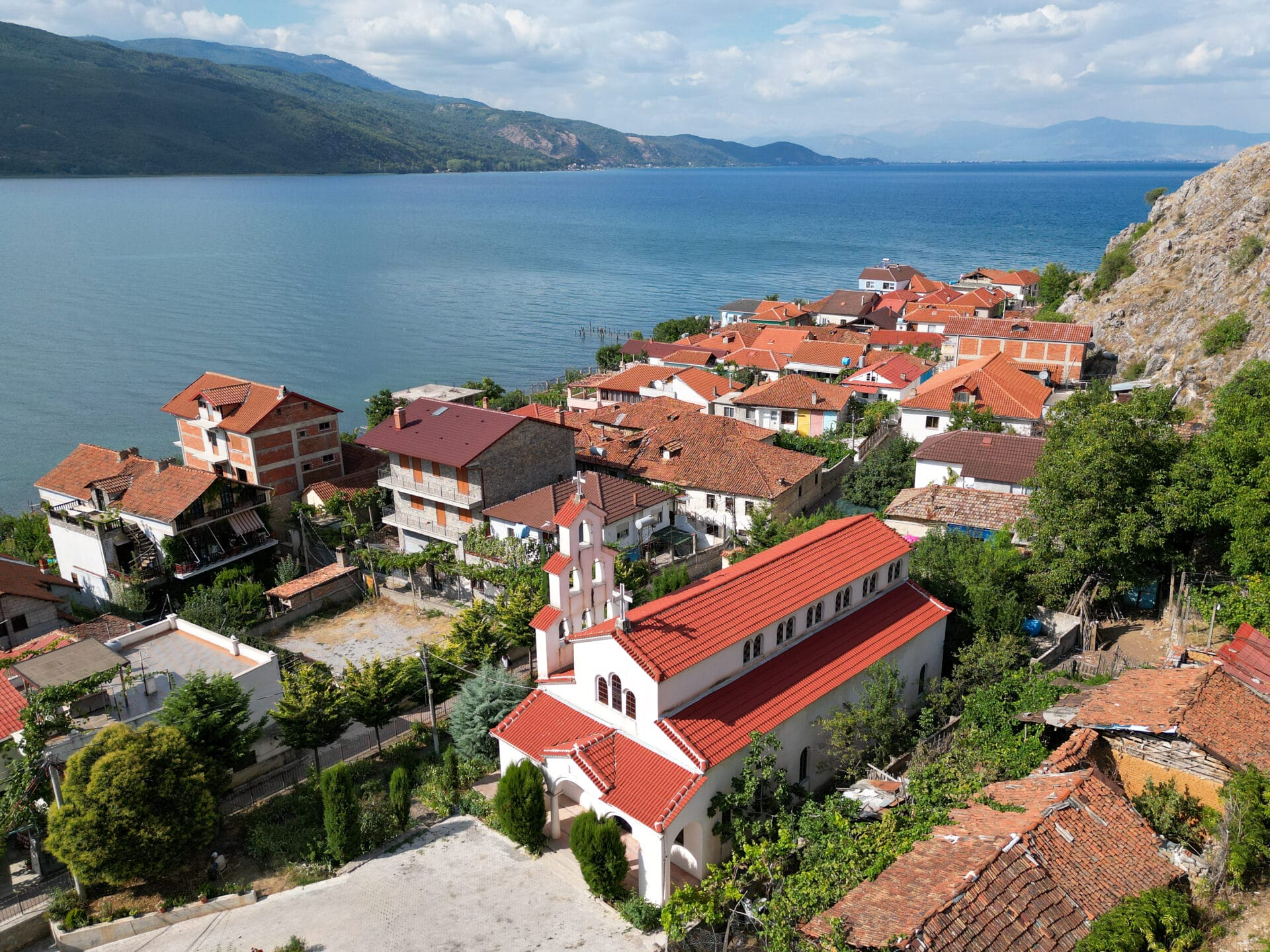
The village architecture mixes older stone houses (some dating to the 19th or early 20th century) with more recent but still traditional construction. Houses typically feature stone or concrete first floors, wooden or mixed upper floors, tiled roofs, small gardens and courtyards, and direct lake access for houses along the waterfront. The overall aesthetic remains modest and functional rather than picturesque—this isn’t a preserved historical village but a working community where buildings serve practical purposes.
Several families have converted their homes into guesthouses, operating them seasonally to supplement income from fishing, small-scale agriculture, or pensions. The guesthouse model in Lin differs fundamentally from hotels—you’re staying in someone’s home, eating meals prepared by your host family, and participating (if you wish) in daily household rhythms. This provides authentic cultural experience but requires adjusting expectations away from hotel service standards and impersonal commercial transactions.
The guesthouse stays typically include breakfast and dinner (arranged when booking), with meals featuring fish from the lake (trout, carp), vegetables from household gardens, bread baked by hosts, local cheese, and simple but genuine home cooking that reflects Albanian rural food culture. The dining isn’t restaurant quality in presentation or sophistication, but it offers authenticity that restaurant meals inevitably lack—you’re eating what the family cooks for themselves, using ingredients they’ve grown or their neighbors have provided.
The village lacks commercial infrastructure beyond the guesthouses—no shops, no restaurants open to non-guests, no cafes or bars, no services beyond what guesthouse hosts provide. This complete absence of tourism commercialization creates both the appeal and the limitation. If you seek genuine village life without tourist overlay, Lin delivers. If you need various dining options, evening entertainment, or activities beyond lake swimming and village wandering, Lin offers little.
Summer brings temporary population increase as Albanian families return to ancestral homes for holiday periods, guesthouse visitors arrive (primarily Albanians from Tirana and diaspora, plus smaller numbers of international travelers), and the village gains temporary vitality. But even summer populations remain modest—perhaps 200-300 people at peak times, creating active atmosphere without overwhelming the village’s small scale.
Practical Lin
Getting There: Lin lies approximately 6 kilometers from Pogradec, the nearest town of substance. From Tirana, the journey covers roughly 140 kilometers requiring 2.5-3 hours by car via Elbasan on generally good roads. Regular buses connect Tirana to Pogradec (journey 3-3.5 hours, cost 600-800 lek), departing from southern bus terminal. From Pogradec, taxis reach Lin in 10 minutes (cost 500-800 lek), or you can walk the 6 kilometers in 70-90 minutes if conditions and energy allow.
Travelers with vehicles can drive directly to Lin, though the final approach uses narrow village lanes where careful navigation is required. Parking exists near the village center, though space is limited during busy summer periods.
Accommodation: The village offers perhaps 6-8 operating guesthouses, with basic rooms (€20-30/night including breakfast and dinner) providing the primary option. These are genuine family guesthouses—simple rooms, shared bathrooms in some cases, minimal amenities, but authentic hospitality and home-cooked meals. Booking ahead is essential during summer (June-September), as the limited beds fill quickly. Contact information often runs through personal phone numbers or booking platforms where some properties list under “Pogradec” rather than “Lin.”
Activities: Swimming in Lake Ohrid’s clear waters provides the primary activity. The lake’s summer temperature reaches 22-24°C (comfortable swimming without wetsuits), and the water clarity allows seeing the pebble bottom at considerable depth. The village shoreline offers multiple access points, though beaches are pebble/rock rather than sand.
Walking the peninsula, exploring the basilica site (even without mosaic access, the ruins and hilltop views justify the visit), observing village life, and simply existing at a slow pace constitute the other main activities. This isn’t a destination for those needing organized excursions or varied entertainment—Lin’s appeal rests in its quietness and simplicity.
Timing: Late May through early October provides optimal visiting window. Water temperatures become swimmable by late May, summer (July-August) brings warmest conditions but also most visitors, and September-early October offers the best balance—warm water, pleasant air temperatures, minimal crowds. Some guesthouses remain open in winter for adventurous travelers, though the lake is too cold for swimming and village life slows to absolute minimum.
Money and Logistics: No ATMs or shops exist in Lin—withdraw cash in Pogradec before arriving. Most guesthouses accept only cash (Albanian lek). Mobile coverage is generally reliable. The village has limited English proficiency—hosts may speak some, but basic Albanian phrases or translation apps prove useful.
Nearby Destinations
Pogradec (6km): Lakeside town with more services, restaurants, accommodation options, and infrastructure for travelers needing more than Lin’s minimal facilities while maintaining Lake Ohrid access.
North Macedonia’s Ohrid (30km): The lake’s largest town, with medieval churches, Ottoman architecture, beach resort infrastructure, and developed tourism that contrasts sharply with Lin’s village simplicity. Accessible via border crossing north of Lin.
Korçë (55km south): Southeastern Albania’s cultural capital with French colonial legacy, brewery, medieval art museum, and intellectual traditions—feasible as day trip or next destination when leaving Lake Ohrid region.
Drilon National Park (15km): Springs and wetland area near Pogradec with boat tours through water channels, restaurant, and relatively developed tourism infrastructure for those seeking organized activities near Lake Ohrid.
The Quietest Archaeological Site
Lin operates outside Albania’s primary tourism circuits. It lacks the dramatic scenery of coastal destinations, the UNESCO designation of Berat or Gjirokaster (though the lake itself holds UNESCO status), or the infrastructure that enables easy tourism. The village functions primarily for its tiny year-round community rather than visitors, which means limited accommodation, minimal English, and accepting isolation from urban conveniences.
What Lin offers instead is something increasingly rare in European tourism—a place where extraordinary archaeological and natural significance exists without corresponding commercial exploitation. The 8,500-year-old underwater settlement represents genuinely important European prehistory, yet no museum, visitor center, or interpretation facilities exist. The Byzantine basilica contains mosaics worthy of major art museums, yet accessing them requires personal arrangements with a village caretaker. Lake Ohrid’s UNESCO-designated ecology and tectonic antiquity make it globally significant, yet the Albanian shore remains undeveloped compared to more famous European lakes.
This combination of significance and obscurity creates particular appeal for travelers interested in experiencing important sites before tourism development inevitably transforms them. Lin won’t remain this quiet and uncommercial indefinitely—the 2023 archaeological confirmation may eventually attract more attention, Albania’s tourism growth will likely reach Lake Ohrid’s Albanian shore more substantially, and development pressures exist even in isolated locations.
For now, Lin exists in a rare state—important enough to justify visiting, quiet enough that you might have the basilica hilltop entirely to yourself, small enough that dinner with your guesthouse family constitutes the evening’s main event. Whether that appeals depends entirely on what you value in travel destinations and how much isolation you find appealing versus frustrating.
The prehistoric people who built their stilt-houses in these lake waters 8,500 years ago chose well—protected position, reliable water access, food resources from fishing and farming, and landscape beauty that persists across millennia. Their descendants, or at least the people who centuries later built villages on the same peninsula, continue living in this exceptional setting, maintaining rhythms that technology has disrupted in more accessible locations.
If you visit Lin, you’re experiencing one of Europe’s oldest continuously inhabited landscapes—not preserved as museum but functioning as living village where people fish the same waters, cook meals using the same lake trout, and watch sunsets across the same mountain-rimmed horizons that Neolithic families witnessed 8,500 years ago.
That continuity has value beyond what tourism statistics or accommodation ratings can measure. Whether it’s worth the journey depends on whether you’re seeking that particular kind of connection to place and time, or whether you prefer destinations that offer more conventional tourism amenities alongside their historical significance.