The Assembly That Defied an Empire
On March 2, 1444, representatives from Albanian principalities gathered in Lezhë for a meeting that would define Albanian resistance to Ottoman expansion for the next quarter-century. The assembly brought together feudal lords who typically competed with each other—the Arianiti, Dukagjini, Thopia, Muzaka, and other families whose territories stretched across what’s now central and northern Albania. They arrived in response to Gjergj Kastrioti Skanderbeg’s call, issued after his November 1443 desertion from Ottoman service and seizure of Krujë fortress.
The gathering produced what historians call the League of Lezhë—a military alliance pledging mutual defense against Ottoman invasions, recognition of Skanderbeg as supreme commander of combined forces, and commitment to maintaining Albanian principality independence. The agreement established administrative structures for coordinating defenses, collecting resources, and adjudicating disputes between member lords—essentially creating proto-state apparatus even while maintaining individual principality sovereignty.
The League’s formation represented extraordinary political achievement. Albanian feudal lords had rarely cooperated for extended periods, their territories functioning as independent domains with competing interests. Bringing them into sustained alliance required navigating complex claims, rivalries, and suspicions while facing immediate Ottoman military threat.
The assembly in Lezhë succeeded where previous attempts at Albanian unity had failed, creating organization that would coordinate resistance for 25 years (1443-1468). During this period, League forces under Skanderbeg’s command defeated multiple Ottoman invasion attempts, including major campaigns in 1450, 1466, and 1467. The resistance prevented Ottoman consolidation of Albanian territories and disrupted Ottoman strategic positioning between their Balkan conquests and further expansion toward central Europe.
Skanderbeg’s death on January 17, 1468, from fever at age 63 effectively ended the League’s military effectiveness. Without his tactical leadership and political skill in maintaining noble cooperation, the alliance fragmented. Individual principalities fell to Ottoman forces over the following decade, with Lezhë Castle itself captured in 1478—the same year Krujë finally fell.
But the historical memory of the League of Lezhë became foundational to Albanian national identity. During the five centuries of Ottoman rule (1468-1912), the story of when Albanian princes united successfully against a more powerful enemy provided template for Albanian nationalism. When Albanian independence movements emerged in the late 19th century, the League of Lezhë became the historical precedent they invoked for Albanian unity and statehood.
The Grave That Couldn’t Stay Sacred
Skanderbeg was buried in St. Nicholas Cathedral in Lezhë following his January 1468 death. The cathedral, built in the 13th century during Byzantine control of the region, served as the League’s spiritual center and appropriate resting place for the man who had led Albanian Christian resistance against Muslim Ottoman expansion.
For ten years, the grave remained intact as Albanian principalities continued fighting despite Skanderbeg’s death. Then, in 1478, Ottoman forces finally captured Lezhë. What happened next reveals how seriously the Ottomans took Skanderbeg’s symbolic importance even decades after his military threat had ended.
Ottoman soldiers desecrated the tomb, scattering Skanderbeg’s remains and reportedly taking pieces as talismans. This wasn’t random vandalism but deliberate symbolic destruction—an attempt to eliminate physical focus for Albanian resistance mythology and to demonstrate Ottoman dominance over the man who had defied them for 25 years.
The cathedral itself was converted into a mosque following Ottoman conquest, a common Ottoman practice for symbolically asserting religious and political supremacy over conquered Christian territories. The building functioned as mosque through the Ottoman period, its Christian origins preserved in architectural elements but its religious function completely transformed.
In the early 20th century, following Albania’s 1912 independence, the building became focus of nationalist commemoration. The site where Skanderbeg had been buried (though his actual remains were long gone) was marked with memorial, and the location became pilgrimage destination for Albanians seeking connection to their national hero.
The communist regime (1944-1991) maintained and enhanced this commemoration, constructing the substantial Skanderbeg Memorial that now dominates the hilltop where castle and cathedral ruins exist. The memorial, completed in 1981, features heroic statue of Skanderbeg and museum presenting his life and the League of Lezhë within communist-approved nationalist narrative.
Today’s site combines multiple historical layers—ancient Illyrian and Roman foundations, medieval Byzantine cathedral ruins converted to Ottoman mosque then to memorial site, and communist-era monumental architecture all coexisting on the same strategically important hilltop. Walking the grounds means navigating this accumulation of nearly three millennia of human occupation and the various powers that controlled this position.
Ancient Lissus: Before Skanderbeg by Seventeen Centuries
The hill where Skanderbeg’s memorial stands was fortified and inhabited long before medieval Albanian princes gathered there. Ancient Greek sources mention Lissus as early as the 4th century BCE, when it functioned as Illyrian settlement controlling coastal trade routes and the Drin River valley extending inland.
The name “Lissus” possibly derives from Illyrian words meaning “place with water” or similar reference to the town’s position where the Drin River approaches the Adriatic coast. The Illyrians—indigenous Balkan peoples about whom relatively little documentary evidence survives—built fortifications here taking advantage of natural defensive position: a hill commanding the coastal plain, controlling river access, and observing approaches from both land and sea.
The Illyrian city thrived for several centuries as independent political entity and commercial center. Archaeological evidence shows the settlement engaged in extensive trade with Greek colonies along the Adriatic, minted its own coins (marked with Lissus’ name in Greek letters, standard practice for Balkan cities in that era), and developed urban infrastructure including defensive walls, public buildings, and residential quarters.
Rome’s expansion into the Balkans during the 2nd century BCE brought Lissus under Roman control. Unlike some Illyrian settlements that resisted and were destroyed, Lissus transitioned relatively peacefully to Roman rule and was established as colony—settlement inhabited by Roman citizens with rights and privileges under Roman law. The Romans enhanced the city with typical Roman urban infrastructure: theater for entertainment, forum for commerce and administration, baths for public hygiene, temples for worship, and improved fortifications.
The Roman theater, partially excavated and visible today at the archaeological site of Zgërdhesh (on Lezhë’s outskirts), demonstrates the city’s importance within Roman Adriatic networks. Theaters represented significant investment—expensive to build, requiring ongoing maintenance, and serving primarily entertainment rather than essential functions. Cities received theaters when they achieved sufficient population, wealth, and political significance to warrant such amenities.
Byzantine control from the 6th century CE onward maintained the city’s importance, though it shifted from Roman commercial focus toward Byzantine military and administrative role. The position’s strategic value persisted—controlling Drin River access and the coastal route between Dalmatia and southern Albania made Lezhë valuable to whatever power controlled the region.
The 13th-century Church of St. Nicholas, whose ruins survive within the castle complex, dates to this Byzantine period. Built in characteristic Byzantine architectural style with dome and frescoes, the church served the Christian population and demonstrated Byzantine religious authority in the region.
Mrizi i Zanave: Agrotourism Pioneer
In a country where culinary tourism barely existed a decade ago, Mrizi i Zanave has achieved something extraordinary—it created the template for Albanian agrotourism and established farm-to-table dining as viable economic model in rural Albania. The restaurant, located in Fishtë village approximately 15 kilometers from Lezhë, opened in 2009 when owners Altin and Antuela Prenga decided to convert their family farm into dining destination showcasing traditional Albanian cuisine using exclusively local ingredients.
The concept sounds simple but was revolutionary in Albanian context. In 2009, Albania’s tourism infrastructure remained underdeveloped, rural areas struggled economically following communism’s collapse, and the idea that travelers would drive to remote village for meal seemed improbable. Most existing Albanian restaurants served either fast food (pizza, sufllaqe) or generic “traditional” dishes using mass-produced ingredients and standardized preparations.
Mrizi i Zanave took opposite approach. The menu features exclusively seasonal dishes made from ingredients produced on their organic farm or sourced from neighboring farmers within a few kilometers radius. Nothing comes from industrial food systems—vegetables from their garden, dairy from local herds, meat from animals they raise or neighbors provide, even flour milled from grain grown nearby.
The preparations follow traditional Albanian cooking methods but executed with attention to technique and presentation that elevates them beyond typical taverna cooking. Slow-cooked lamb served in ceramic tajine, homemade cheeses with varietals you won’t find elsewhere, preserved vegetables prepared using generations-old recipes, breads baked in wood-fired ovens, and seasonal specialties that change based on what’s currently harvestable.
The setting reinforces the agricultural connection—rustic stone building with exposed beams, garden seating among fruit trees and vegetable plots, views across farmland to distant mountains, and interior design using traditional materials and local crafts. This isn’t simulation of farm life but actual functioning farm where you can observe (and on request, participate in) daily agricultural work.
The success surprised even the owners. Within a few years, Mrizi i Zanave was attracting visitors from Tirana, international travelers, and food critics. Albanian media coverage was extensive, international guidebooks mentioned it, and the restaurant became rare example of Albanian rural enterprise achieving national reputation based purely on quality and concept rather than location convenience.
More importantly, Mrizi i Zanave demonstrated model that other rural Albanian enterprises began replicating. Similar agrotourism restaurants have opened across Albania, each adapting the farm-to-table concept to their region’s specific agricultural products and traditions. The movement has created economic opportunities in rural areas, preserved traditional food cultures that were disappearing, and given international visitors window into authentic Albanian agricultural life.
Visiting requires planning—the restaurant operates primarily by reservation (essential during peak summer months), meals are leisurely affairs lasting 2-3 hours as courses arrive gradually, and the drive from Lezhë or Tirana takes 30-45 minutes on roads that aren’t Albania’s best maintained. But for travelers interested in Albanian food culture beyond standard restaurant menus, Mrizi i Zanave provides experience unmatched elsewhere in the country.
Expect to pay €20-35 per person for multi-course meals with wine—premium prices by Albanian standards but reasonable given the quality and the fact you’re supporting sustainable agriculture and traditional food preservation.
The Castle, Cathedral, and Communist Memorial Complex
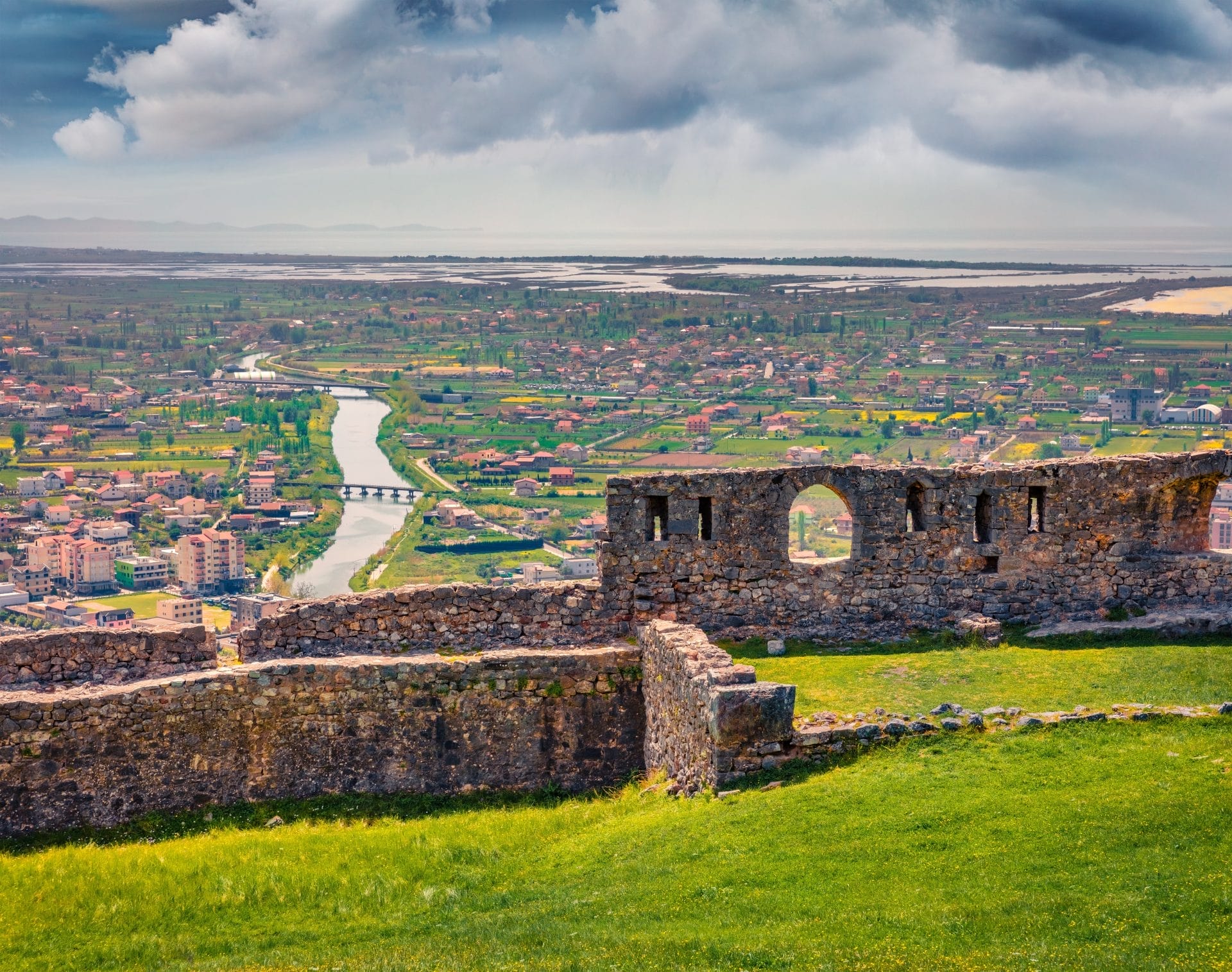
The hilltop site in central Lezhë combines ruins from multiple periods into a single archaeological and commemorative complex. Walking the grounds means navigating layers that aren’t always clearly delineated—ancient foundations support medieval construction rebuilt with Ottoman modifications, all crowned by 1981 communist-era Skanderbeg Memorial.
Castle Fortifications: The defensive walls visible today represent accumulations from Illyrian, Roman, Byzantine, medieval Albanian, and Ottoman periods. Archaeologists haven’t fully sorted which sections date to which era, and most visitors can’t distinguish the building techniques without expert guidance. What’s clear is the strategic importance of this position—commanding views across the coastal plain, controlling the road north toward Montenegro and south toward Tirana, and observing Drin River approaches from the mountains.
Cathedral Ruins: The Church of St. Nicholas, built in the 13th century during Byzantine control, shows characteristic Byzantine architectural elements—domed central space, thick stone walls, remains of frescoes though heavily damaged, and layout designed for Orthodox liturgy. After Ottoman conquest in 1478, the building was converted to mosque, its Christian imagery covered or destroyed and minaret added. Following Albanian independence in 1912, the structure fell into disuse and gradual ruin. What remains today are partial walls, foundation outlines, and fragments of the building that once housed Skanderbeg’s tomb.
Skanderbeg Memorial: The 1981 communist-era memorial dominates the hilltop with heroic bronze statue of Skanderbeg mounted on high pedestal, flanked by stone walls and approached through formal entrance gate. The design follows communist monumental architecture principles—imposing scale, heroic imagery, and clear ideological messaging about national resistance and historical destiny. The memorial includes small museum presenting Skanderbeg’s biography, the League of Lezhë, and Albanian resistance through communist interpretive framework.
The site operates daily (typically 9 AM-6 PM, verify current hours), with entrance fee around 300 lek (€3) covering castle grounds, cathedral ruins, and memorial/museum. English information panels exist but are minimal—most interpretation assumes baseline knowledge of Albanian history that international visitors might lack.
The hilltop’s commanding views provide panoramic perspective across Lezhë and surrounding coastal plain—you can see the Adriatic to the west, mountains to the north and east, and Drin River delta systems. The strategic value of controlling this position becomes immediately obvious.
Drin River Delta and Coastal Access
The Drin River, at 285 kilometers Albania’s longest, flows from its source in North Macedonia through northern Albania before reaching the Adriatic near Lezhë. The river historically provided crucial transportation route between coastal lowlands and inland mountain valleys, and the delta’s ecosystem supports diverse bird populations that attract ornithologists and nature photographers.
The delta area includes the Kune-Vain Lagoon system, a protected wetland where freshwater from the Drin meets saltwater from the Adriatic, creating brackish environment that supports species adapted to these transitional conditions. Bird species observed here include various herons, egrets, cormorants, and seasonal migrants using the Albanian coast along their Mediterranean flyways.
Boat tours operate from Shëngjin (15 kilometers from Lezhë) through the delta’s channels and lagoons, typically lasting 2-3 hours and costing €15-25 per person. The tours focus on birdwatching and ecosystem explanation, though the commentary quality varies depending on guide’s knowledge and language skills.
Shëngjin itself functions as small beach resort, its sandy coastline attracting primarily Albanian tourists during summer months. The town lacks the development intensity of southern Albanian beaches like Ksamil but offers functional beach facilities—hotels, restaurants, beach loungers for rent—at prices lower than more famous coastal destinations.
The beach water quality is acceptable though not exceptional—the Drin River’s outflow affects clarity and the coastal plain’s agricultural runoff impacts water quality. For travelers prioritizing pristine swimming conditions, the Albanian Riviera offers superior options. But for combining historical tourism in Lezhë with beach access, Shëngjin provides convenient proximity without requiring the long drive to the southern coast.
Practical Lezhë
Getting There: Lezhë lies 60 kilometers northwest of Tirana, a journey requiring 50-70 minutes by car or bus on generally good roads. Multiple daily buses depart from Tirana’s northern bus terminal (cost: 300-400 lek, journey 70-90 minutes depending on stops). The highway passes through Lezhë, making it accessible for travelers driving between Tirana and northern destinations like Shkodra or the Albanian Alps.
Accommodation: Options remain limited compared to coastal resorts or Tirana. Several hotels in town center offer basic but clean accommodation (€25-40/night), while guesthouses provide budget alternatives (€15-25/night). Most visitors base themselves in Tirana or Shkodra and visit Lezhë as day trip, or overnight in Shëngjin if combining with beach time.
Dining: Beyond Mrizi i Zanave (requires reservation and 30-minute drive), Lezhë’s restaurants serve standard Albanian fare—grilled meats, pizza, byrek, simple pasta dishes. Quality is acceptable but unremarkable. Budget €8-15 per person for complete meals at local tavernas.
Timing: The castle, memorial, and archaeological sites are accessible year-round, though summer (June-September) offers best weather for exploring outdoor ruins. Spring (April-May) and autumn (September-October) provide pleasant temperatures without summer heat. Winter visits are viable but mean cold winds on exposed hilltop positions.
Visiting Mrizi i Zanave: Book reservations at least several days ahead during peak season (June-September), mentioning any dietary restrictions. The restaurant serves lunch and dinner, with lunch allowing better light for photographing the farm landscape. Transportation requires private car or taxi from Lezhë (€15-20 each way, arrange return pickup time with driver).
Nearby Destinations
Shkodra (40km north): Northern Albania’s largest city with medieval castle, traditional architecture, and access to Lake Shkodra—Albania’s largest lake straddling the Montenegro border.
Albanian Alps (70km northeast): Mountain region with exceptional hiking, traditional villages, and the scenic Komani Lake ferry route connecting coastal lowlands to highland valleys.
Krujë (45km south): The fortress where Skanderbeg based his resistance, with castle ruins, Skanderbeg Museum, and traditional bazaar—essential pairing with Lezhë for understanding Albanian medieval history.
Tirana (60km southeast): Albania’s capital, offering museums, Ottoman architecture, communist monuments, and contemporary urban culture providing contrast to Lezhë’s small-town historical focus.
The Understated Historical Site
Lezhë operates outside Albania’s primary tourist circuits. It lacks the dramatic scenery of coastal destinations, the UNESCO designation of Berat or Gjirokaster, or the beach resort infrastructure that draws summer crowds to the Riviera. The town functions primarily for its roughly 15,000 residents rather than for tourism, which means limited accommodation, basic restaurant options, and minimal English proficiency among local businesses.
What Lezhë offers instead is concentrated connection to Albanian historical narrative. The League of Lezhë represents the foundational moment when Albanian principalities successfully united against external threat. Skanderbeg’s burial site marks where Albania’s greatest military leader was laid to rest. Ancient Lissus demonstrates that this location held strategic importance for nearly three thousand years before medieval events occurred.
For travelers interested in Albanian history beyond beaches and coastal scenery, Lezhë provides essential context that other destinations can’t offer. The town won’t occupy multiple days of itinerary, but allocating 3-4 hours to explore castle, cathedral ruins, and memorial creates understanding of Albanian national identity that enriches experiences elsewhere in the country.
Combining Lezhë with Mrizi i Zanave transforms historical day trip into fuller experience—morning exploring ruins and museums, afternoon experiencing Albanian agricultural traditions and exceptional local cuisine. This combination justifies the journey even for travelers based in Tirana who wouldn’t otherwise prioritize small northern town without major tourist infrastructure.
The historical significance is genuine and well-documented. The League of Lezhë occurred. Skanderbeg was buried here. Ancient Lissus thrived for centuries. These aren’t romanticized legends but documented facts that shaped Albanian history and continue influencing Albanian identity today.
If you’re interested in understanding Albania beyond its natural beauty and beach culture, Lezhë deserves your attention. The town won’t provide the photo opportunities of the Riviera or the atmospheric charm of stone villages, but it offers something more fundamental—connection to the historical events that Albanians reference when explaining who they understand themselves to be.
That historical depth has value for travelers willing to engage with it, even when packaged in modest small-town setting rather than dramatic UNESCO-designated grandeur.