How to Get to Krujë
From Tirana
- By Bus: Frequent buses from northern terminal. Journey takes 45-60 minutes and costs 150-200 LEK (€1.50-2).
- By Car: 32km northwest via SH1/SH34. Drive time approximately 45 minutes to 1 hour.
- By Tour: Day trips from Tirana starting at €25-35 per person including guide.
From Durrës
- By Car: 60km via SH1/SH34. Drive time approximately 1 hour.
- By Bus: Connect via Tirana or take direct furgon (irregular schedules).
Note: The castle entrance involves a steep uphill walk from parking areas. The Old Bazaar is along this climbing path. Wear comfortable shoes.
The Boy Hostage Who Became National Hero
In 1415, a ten-year-old Albanian boy named Gjergj Kastrioti was taken from his family in Krujë as hostage to the Ottoman court. This was standard Ottoman practice—securing loyalty from conquered territories by holding sons of local nobility, educating them in Ottoman military traditions, converting them to Islam, and training them to serve the empire. Most boys subjected to this system became Ottoman officers, their Albanian origins gradually fading into imperial identity.
Gjergj Kastrioti followed this path initially. Renamed Iskender (Alexander) by Ottoman authorities—later combined with “bey” (lord) to create “Skanderbeg”—he rose through Ottoman military ranks through exceptional tactical skills demonstrated in campaigns across the Balkans and Asia Minor. By the early 1440s, he commanded Ottoman cavalry units and had earned Sultan Murad II’s trust despite his Albanian Christian origins.
Then, in November 1443, during an Ottoman campaign against Hungarian forces, Skanderbeg deserted. He seized Krujë fortress through deception, presenting forged documents claiming the Sultan had granted him governance of the region, then revealed his true intentions once inside the castle. He renounced Islam, returned to Christianity, and declared rebellion against Ottoman rule.
This should have been a brief regional revolt quickly crushed by Ottoman military power. Instead, it became 25 years of sustained resistance (1443-1468) that prevented Ottoman consolidation of Albanian lands, influenced broader European conflicts between Ottoman and Christian powers, and created the foundational narrative of Albanian national identity.
Skanderbeg died of fever on January 17, 1468, at age 63. The fortress at Krujë fell to Ottoman forces in 1478, ending the resistance he’d led. But the historical memory of those 25 years—when a small mountain fortress defied the era’s most powerful empire—became the core story through which Albanians understood their national character across five subsequent centuries of Ottoman rule, creating a hero whose legacy survived into modern Albanian identity.
Why Visit Krujë
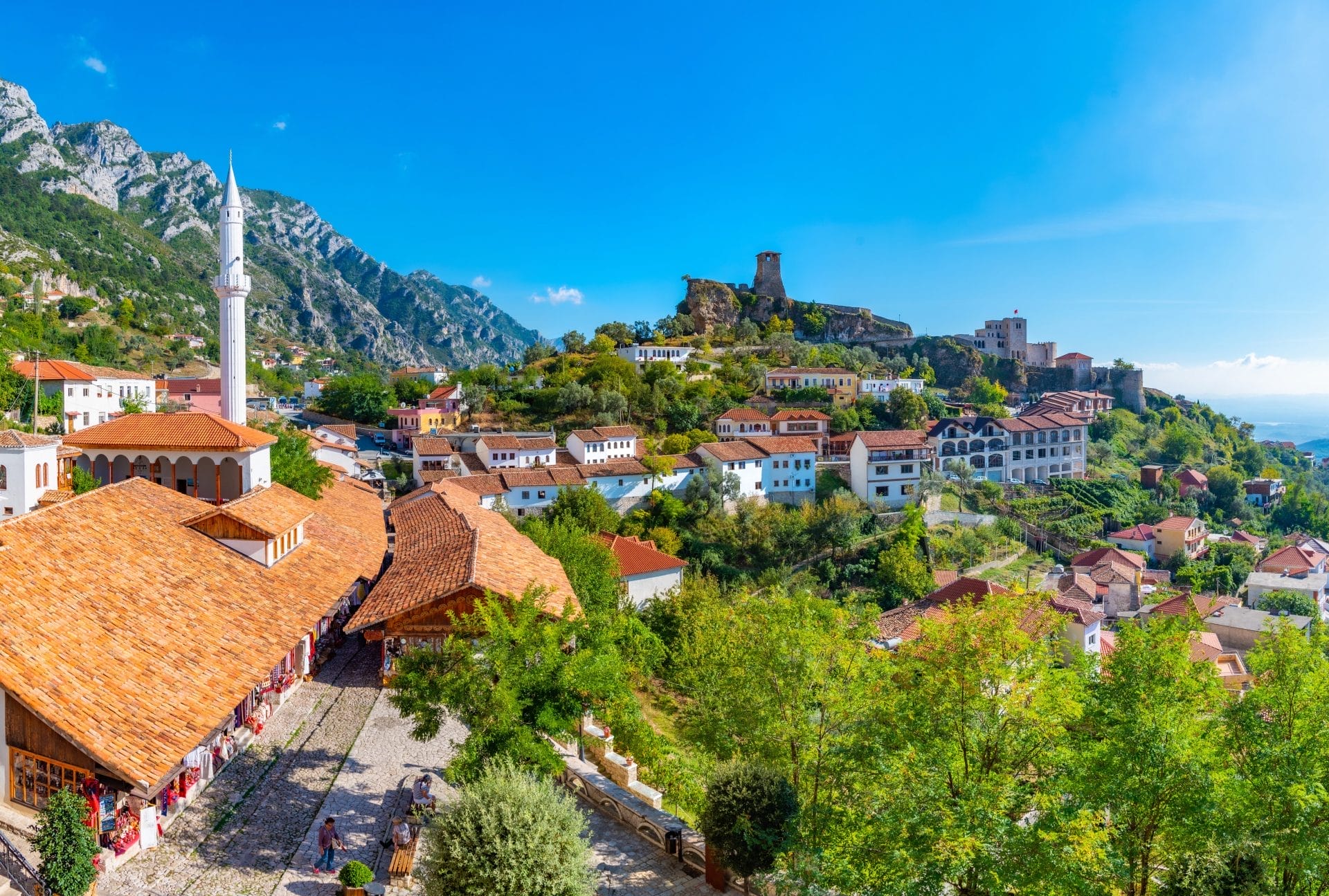
Krujë sits on a mountainside approximately 600 meters above sea level, about 32 kilometers northwest of Tirana. The town of roughly 20,000 people occupies a position commanding views across the Adriatic coastal plain—you can see Tirana sprawling to the southeast, the port of Durrës on the coast, and on clear days, the Adriatic Sea itself.
This strategic position explains why medieval fortifications were built here. The mountain location provided natural defensive advantages—attackers faced uphill assaults, defenders controlled supply routes through mountain passes, and the fortress could observe approaching threats across the plain below. These same advantages made Krujë valuable enough that Skanderbeg chose it as his primary base despite alternatives.
For modern visitors, Krujë offers something rare in Albanian tourism—a destination where historical significance outweighs natural beauty or beach access. The castle ruins aren’t Albania’s most impressive fortifications, the museums aren’t the largest collections, and the Old Bazaar doesn’t rival major Ottoman commercial districts elsewhere in the Balkans. What Krujë provides is concentrated connection to the single most important figure in Albanian historical consciousness, preserved in the landscape where that history actually occurred.
The National Skanderbeg Museum, housed within the castle grounds in a building completed in 1982, presents comprehensive overview of Skanderbeg’s life, the 25-year resistance, medieval Albanian culture, and the subsequent centuries when Albanian national identity coalesced around this historical memory. The Ethnographic Museum, occupying an 18th-century Ottoman house, shows how Albanians lived during the long Ottoman period following Skanderbeg’s death. The Old Bazaar maintains traditional handicrafts in stone buildings dating to the 17th century, creating atmosphere of Ottoman-era commercial life.
Visit Krujë if you’re interested in understanding Albanian historical identity beyond ancient Illyrians or communist-era history, if you want to experience a small mountain town that functions primarily for residents rather than tourists, or if castle ruins with genuine historical weight appeal more than perfectly preserved fortifications in tourist-focused locations. Skip Krujë if you’re primarily interested in beaches, dramatic natural scenery, or need destinations requiring more than a day’s exploration.
The town works best as day trip from Tirana (1 hour drive) or overnight stop while traveling between Tirana and northern Albania, allowing sufficient time to tour castle, museums, and bazaar without feeling rushed.
The Castle and Its Accumulating Histories
Krujë Castle occupies the mountaintop commanding approaches from the coastal plain, its fortifications wrapping around rocky outcrops in irregular pattern dictated by terrain rather than geometric ideal. The site has been fortified since at least the 5th-6th century CE, when Byzantines built defensive works controlling this mountain passage, though earlier fortifications may have existed.
What visitors see today represents accumulations from multiple periods. Byzantine foundations support medieval Albanian additions built during the 13th-14th centuries when local Albanian feudal lords controlled the region. Skanderbeg’s forces modified and strengthened these fortifications during the 1440s-1460s, preparing defenses for the Ottoman sieges they knew would come. Ottoman forces, after finally capturing the fortress in 1478, rebuilt damaged sections and added their own modifications during the subsequent centuries of Ottoman control.
Walking the castle walls means navigating this palimpsest without clear delineation between periods. Original Byzantine masonry appears in foundations, Albanian medieval work rises above, Skanderbeg-era modifications reinforce strategic points, and Ottoman repairs patch breaches from various sieges. No comprehensive archaeological study has fully mapped these layers, leaving much ambiguity about which section dates to which period.
The castle suffered particularly during the early 20th century, when rapid urban development, material scavenging for new construction, and general neglect led to collapse of several sections. Communist-era restoration (1960s-1980s) partially stabilized the ruins and made them accessible for tourism, though the restoration prioritized creating dramatic setting for the Skanderbeg Museum rather than archaeological accuracy.
Key elements visible today:
Skanderbeg Tower: A partially restored stone tower claiming association with Skanderbeg’s command post, though the current structure shows substantial later reconstruction and the connection to Skanderbeg is more symbolic than architecturally documented.
The Circuit Walls: Fragmentary sections of defensive walls following the mountain ridge, with several watchtowers in various states of preservation. The walls show multiple construction techniques and materials indicating rebuilding across centuries.
Cisterns and Storage: Underground chambers for water storage and supplies, essential for withstanding sieges that sometimes lasted months. These practical military installations reveal the logistics of medieval siege warfare more directly than dramatic towers.
The Small Mosque: Ruins of an Ottoman-period mosque built after 1478 conquest, its presence inside the castle indicating how Ottoman authorities converted the fortress from Albanian Christian stronghold to Ottoman Muslim garrison.
Views: The castle’s commanding position provides spectacular panoramas—Tirana visible to the southeast, the Adriatic coastal plain spreading westward, mountains rising to the north and east. The strategic value of controlling this viewpoint becomes immediately obvious.
The castle grounds are accessible during museum hours (typically 9 AM-5 PM, verify current schedule), with entrance fee of 300-400 lek (roughly €3-4) covering both castle access and Skanderbeg Museum. The site lacks extensive safety barriers—visitors walk along ancient walls, climb unstabilized stone steps, and navigate ruins where fall hazards exist. This creates authentic experience but requires reasonable care.
The Skanderbeg Museum: Nationalism in Concrete
The National Skanderbeg Museum building, completed in 1982, represents one of communist Albania’s most ambitious architectural projects dedicated to historical commemoration. Designed by Albanian architects Pirro Vaso and Pranvera Hoxha, the structure deliberately incorporates traditional Albanian architectural elements—stone construction suggesting medieval fortifications, geometric patterns from traditional Albanian textiles, and overall form evoking Albanian tower houses—while utilizing modern concrete construction.
The building itself makes bold statement. Unlike typical museum designs prioritizing neutral presentation of artifacts, this structure insists on dramatic architecture serving ideological purposes. The communist regime that commissioned it understood Skanderbeg as proto-nationalist hero whose resistance against Ottoman Empire provided historical precedent for Albanian independence and communist-era narratives about national sovereignty.
The museum’s interior spaces continue this dramatic approach—high ceilings, dramatic lighting, murals depicting battle scenes, and exhibition design emphasizing heroic narrative rather than objective historical analysis. This isn’t criticism but observation: the museum’s design honestly reflects how communist-era Albania understood Skanderbeg’s significance rather than pretending to neutral academic presentation.
The collection includes:
Biographical Materials: Timeline of Skanderbeg’s life from 1405 birth through Ottoman training, 1443 return to Albania, 25 years of military campaigns, and 1468 death. The presentation draws on limited primary sources (much knowledge of Skanderbeg comes from later European accounts rather than Albanian documents), supplemented by archaeological finds and artistic interpretations.
Military Equipment: Replica weapons and armor representing 15th-century Albanian and Ottoman warfare, including the famous goat-horned helmet that became Skanderbeg’s symbol (the original, if it existed, has been lost). The displays explain medieval siege warfare, cavalry tactics, and the military innovations that allowed Albanian forces to repeatedly defeat larger Ottoman armies.
Campaign Maps: Detailed maps showing the various Ottoman invasions of Albania (1450, 1466-1467 major campaigns, plus numerous smaller offensives), the sieges of Krujë (1450, 1466-1467, 1478), and how Skanderbeg’s forces utilized Albanian mountain terrain for defensive advantage.
European Context: Materials explaining how Skanderbeg’s resistance fit into broader 15th-century conflicts between Ottoman Empire and Christian European powers, including Pope’s designation of Skanderbeg as “Athleta Christi” (Champion of Christ) and attempts by Venice, Naples, and Hungary to support Albanian resistance as buffer against Ottoman expansion.
Cultural Legacy: Exhibits tracking how Skanderbeg’s memory evolved from immediate post-death period through centuries of Ottoman rule, Albanian National Awakening (late 19th century), independence (1912), Italian and German occupations (1939-1944), and communist era when Skanderbeg became central to state-promoted nationalism.
Artistic Representations: Paintings, sculptures, and folk art depicting Skanderbeg, showing how various artists across centuries imagined his appearance and battles despite limited historical descriptions.
The museum provides English information panels and occasional guided tours (verify availability), though the presentation assumes some baseline knowledge of Albanian and Balkan history that casual visitors might lack. The building and collection received UNESCO protection status, recognizing both historical importance and the museum as significant example of communist-era Albanian architecture.
Critics note the museum’s nationalistic presentation sometimes simplifies complex historical reality—15th-century “Albania” wasn’t a unified nation-state but a collection of feudal territories whose nobles sometimes cooperated and sometimes competed, Skanderbeg’s forces included Muslims and Christians, and Ottoman records present different perspectives on these conflicts than Albanian nationalist narratives emphasize. But the museum honestly represents how Albanians understand their foundational national story rather than claiming neutral academic objectivity.
The Old Bazaar: Ottoman Commerce Frozen in Stone
The Old Bazaar (Pazari i Vjetër) stretches downhill from the castle entrance, its cobblestone lanes lined with two-story stone buildings housing shops and workshops in a layout established during the 17th century when Ottoman authorities rebuilt Krujë following conquest and various conflicts.
The bazaar’s architecture follows typical Ottoman commercial district patterns—narrow covered or semi-covered lanes providing shade and weather protection, shops opening directly onto the street with display space extending into the lane itself, workshop areas visible behind retail fronts where artisans produce goods for immediate sale, and residential quarters on upper floors housing shopkeepers and craftspeople.
The buildings date primarily from the 17th-19th centuries, though foundations incorporate earlier stonework and various structures have been rebuilt or modified following fires, earthquakes, and general wear across centuries of continuous commercial use. The communist period saw the bazaar decline as state-controlled distribution systems replaced private commerce, with some buildings converted to other uses or abandoned.
Post-1991, the bazaar revived as tourism to Krujë increased and traditional handicrafts experienced commercial renaissance. Today, the district presents mixed character—genuine artisan workshops producing traditional items exist alongside souvenir shops selling mass-produced goods marketed as “traditional,” with varying proportions of authentic craft versus tourist commerce depending on specific establishments.
Walking the bazaar means navigating this commercialized but still atmospheric environment. Key elements:
Traditional Crafts: Several workshops maintain genuine traditional production—hand-woven textiles using patterns passed through generations, copper working creating functional vessels using historic techniques, wood carving producing furniture and decorative items, and silver filigree jewelry continuing Albanian goldsmith traditions.
Souvenir Production: Many shops sell items marketed as traditional Albanian handicrafts but mass-produced elsewhere (often in Turkey or China)—“antique” brass items showing identical modern casting, carpets labeled handwoven but machine-made, and decorative weapons produced for tourist market rather than following authentic historical patterns.
Textiles and Carpets: Albanian rug and textile traditions receive extensive representation, ranging from genuinely handwoven pieces using natural dyes and traditional patterns to machine-made reproductions. Distinguishing authentic from commercial requires either expertise or willingness to ask detailed questions about production methods, materials, and origins.
Antiques Market: Several dealers specialize in Ottoman-period household items, religious objects, and everyday artifacts. The authenticity varies enormously—some pieces represent genuine Ottoman-era Albanian material culture, others are reproductions or items imported from elsewhere in the Balkans and marketed as Albanian. Expert authentication would be advisable for significant purchases.
Food and Refreshment: Traditional cafes serve Turkish coffee and raki in settings that maintain Ottoman coffeehouse atmosphere, while small restaurants offer Albanian cuisine in historic stone buildings. The quality ranges from excellent traditional cooking to tourist-focused versions prioritizing convenience over authenticity.
The bazaar’s commercial character shouldn’t deter visitors—even the souvenir shops operate in genuinely historic buildings along lanes that have hosted commerce for four centuries, creating atmosphere that reproduces Ottoman-era commercial districts even when specific merchandise doesn’t maintain traditional production methods.
Bargaining remains culturally acceptable and economically expected. Initial quoted prices often run 30-50% above what sellers will ultimately accept, particularly for larger items or when customers show genuine interest. The negotiation process is part of the cultural experience rather than exploitative practice, though tourists should maintain realistic perspective about values.
The Ethnographic Museum: Life Under Ottoman Rule
The Ethnographic Museum occupies an 18th-century Ottoman house restored to approximate how wealthy Albanian families lived during the centuries following Skanderbeg’s death when Albania existed under Ottoman administration.
The house itself represents typical upper-class Ottoman Balkan architecture—stone construction on the lower level (used for storage and animals), wooden upper floor with projecting bay windows (hajat) providing additional living space and light, interior organization separating men’s quarters (selamlik) from family/women’s quarters (haremlik), and decoration showing synthesis of Ottoman design principles with local Albanian building traditions.
The museum furnishings recreate domestic life from roughly the 18th-19th centuries:
Living Quarters: Traditional Albanian interiors with low seating around room perimeters, wool carpets and cushions, minimal furniture reflecting Ottoman preference for flexible space use, and decorative elements including carved wooden ceilings, painted panels, and metalwork.
Kitchen Areas: Cooking equipment, food storage, and preparation spaces showing how Albanian households functioned before modern utilities—wood-burning hearths, hand-milled grains, preserved foods, traditional pottery, and copper vessels for food preparation and serving.
Textile Production: Looms, spinning wheels, and examples of traditional Albanian textiles demonstrating how households produced their own cloth, carpets, and garments. The displays explain the patterns, techniques, and social significance of traditional Albanian textile work.
Clothing: Examples of traditional Albanian folk costumes varying by region, social class, and occasion—everyday work clothes, festive garments, wedding attire, and the elaborate costumes that became symbols of Albanian cultural identity during the National Awakening period.
Religious Objects: Items reflecting both Muslim and Christian Albanian household practices, showing how religious identity functioned in Albanian Ottoman society where significant populations of both faiths coexisted.
The museum provides window into the centuries between Skanderbeg’s defeat and 20th-century independence—the period when “Albania” existed as geographic and cultural concept but not as independent political entity, when Albanians maintained distinct identity within the Ottoman system through language, customs, and historical memory while also participating in Ottoman economic, political, and cultural life.
Entrance fees (included with castle/Skanderbeg Museum ticket or separate entry around 200 lek) provide access during typical museum hours. English information panels explain exhibits, though the presentation assumes familiarity with Ottoman social organization and Albanian cultural traditions that international visitors might not possess.
Practical Krujë
Getting There: Krujë lies 32 kilometers northwest of Tirana, accessible by private car (40-50 minute drive on generally good roads) or public furgon (minibus) departing from Tirana’s bus station near the train station (cost: 200-300 lek, journey 50-70 minutes depending on passengers and stops).
Multiple tour companies in Tirana offer half-day or full-day tours to Krujë, typically combining castle, museums, and bazaar with lunch at traditional restaurant. These organized tours run €25-40 per person and eliminate logistics concerns, though they operate on fixed schedules allowing limited exploration time.
The town center is compact and easily walkable. The main road enters town from below, with parking available near the bazaar entrance (paid parking, 100-200 lek). From parking, cobblestone paths lead uphill through the bazaar to the castle entrance—approximately 15-20 minutes walking on uneven historic stone paving.
Accommodation: Krujë offers limited accommodation compared to coastal destinations or Tirana. Several guesthouses and small hotels operate in and around the bazaar, including unique options inside the castle walls itself. Rates run €20-40/night for basic but clean guesthouses, €40-80 for more comfortable hotels with views. Many visitors base themselves in Tirana and visit Krujë as day trip.
Dining: Traditional restaurants near the castle and in the bazaar serve Albanian staples—grilled meats, byrek, tavë kosi (baked lamb with yogurt), fresh bread, and local wine or raki. Quality varies but prices remain reasonable (€8-15 per person for complete meals). Several establishments occupy historic buildings with terrace seating offering views across the plain.
Timing: Allow 3-4 hours minimum for meaningful visit covering castle, Skanderbeg Museum, Ethnographic Museum, and bazaar exploration. Full-day visit enables more thorough museum time and relaxed bazaar browsing.
Season: Krujë’s elevation (600 meters) creates moderate climate—summers are warm but less intense than coastal heat (25-32°C), winters bring occasional snow and temperatures that can drop below freezing. Spring (April-May) and autumn (September-October) provide ideal conditions. The site remains open year-round, though winter visits mean cold wind on exposed castle walls.
Nearby Destinations
Sari Salltik Cave: Religious site sacred to both Muslims and Christians, located on mountain above Krujë. The cave contains shrine to Sari Salltik, a semi-legendary figure venerated in Albanian folk religion. The site attracts pilgrims but also offers hiking and views. Access requires steep 30-45 minute climb from town.
Tirana (32km southeast): Albania’s capital, with museums, Ottoman architecture, communist-era monuments, and contemporary urban culture providing contrast to Krujë’s small-town historical focus.
Durrës (50km west): Albania’s main port city with Roman amphitheater, Byzantine fortifications, and Adriatic beaches—accessible for day trips combining historical sites with coastal scenery.
Shkodra (90km north): Northern Albania’s largest city, with medieval castle, traditional architecture, and access to Lake Shkodra and Albanian Alps.
The Symbol That Survived Five Centuries
Skanderbeg’s historical significance for Albanian identity cannot be overstated. During the five centuries of Ottoman rule following his death (1468-1912), Albanians maintained distinct cultural and linguistic identity while existing as subjects within a multi-ethnic empire rather than independent nation-state. Throughout this period, memory of Skanderbeg provided foundational narrative—the story of when Albanians successfully resisted absorption, when a leader from Albanian lands commanded European respect, when independence seemed achievable.
When Albanian nationalism emerged during the 19th-century National Awakening, Skanderbeg became the central historical reference point. The double-headed eagle that had been his heraldic symbol became the Albanian national flag. The 25 years of resistance became proof that Albanians deserved independent statehood. His name appeared in poetry, literature, political manifestos, and revolutionary declarations.
The communist regime that ruled Albania 1944-1991 continued this veneration, though reinterpreting Skanderbeg through Marxist-Leninist ideology as proto-nationalist revolutionary rather than feudal Christian warrior. The massive investment in the Skanderbeg Museum reflected the regime’s understanding that this historical figure remained central to Albanian identity even within communist framework.
Post-communist Albania maintains Skanderbeg’s symbolic importance. His image appears on currency, public monuments, and official symbols. Tirana’s central square bears his name. Political figures across the ideological spectrum reference him. The consistency of this veneration across radically different political systems—Ottoman resistance, nationalist movement, communist dictatorship, democratic transition—demonstrates how deeply Skanderbeg is embedded in Albanian self-conception.
For visitors, this means Krujë functions as more than historical tourism destination—it’s a site where Albanian national identity becomes tangible through landscape, architecture, museums, and ongoing cultural significance. The castle isn’t just medieval ruins but the physical location where foundational national narrative occurred. The museums don’t simply present artifacts but explain how Albanians understand their own history and identity.
This cultural weight makes Krujë valuable for travelers interested in understanding Albania beyond beaches and ancient sites—it provides insight into how nations construct identity through historical memory, how a single figure can carry symbolic importance across centuries, and how the past shapes contemporary culture in ways that aren’t always obvious to outsiders.
If you visit Krujë simply to photograph castle ruins and buy souvenirs, you’ll find both. If you engage with the museums, consider why this particular history matters so much to Albanians, and reflect on how the physical landscape shaped events that occurred here, you’ll gain perspective on Albanian culture that more obviously touristic destinations can’t provide.
The small mountain town where a medieval warlord once defied an empire remains, five and a half centuries later, the place Albanians go to remember who they understand themselves to be.