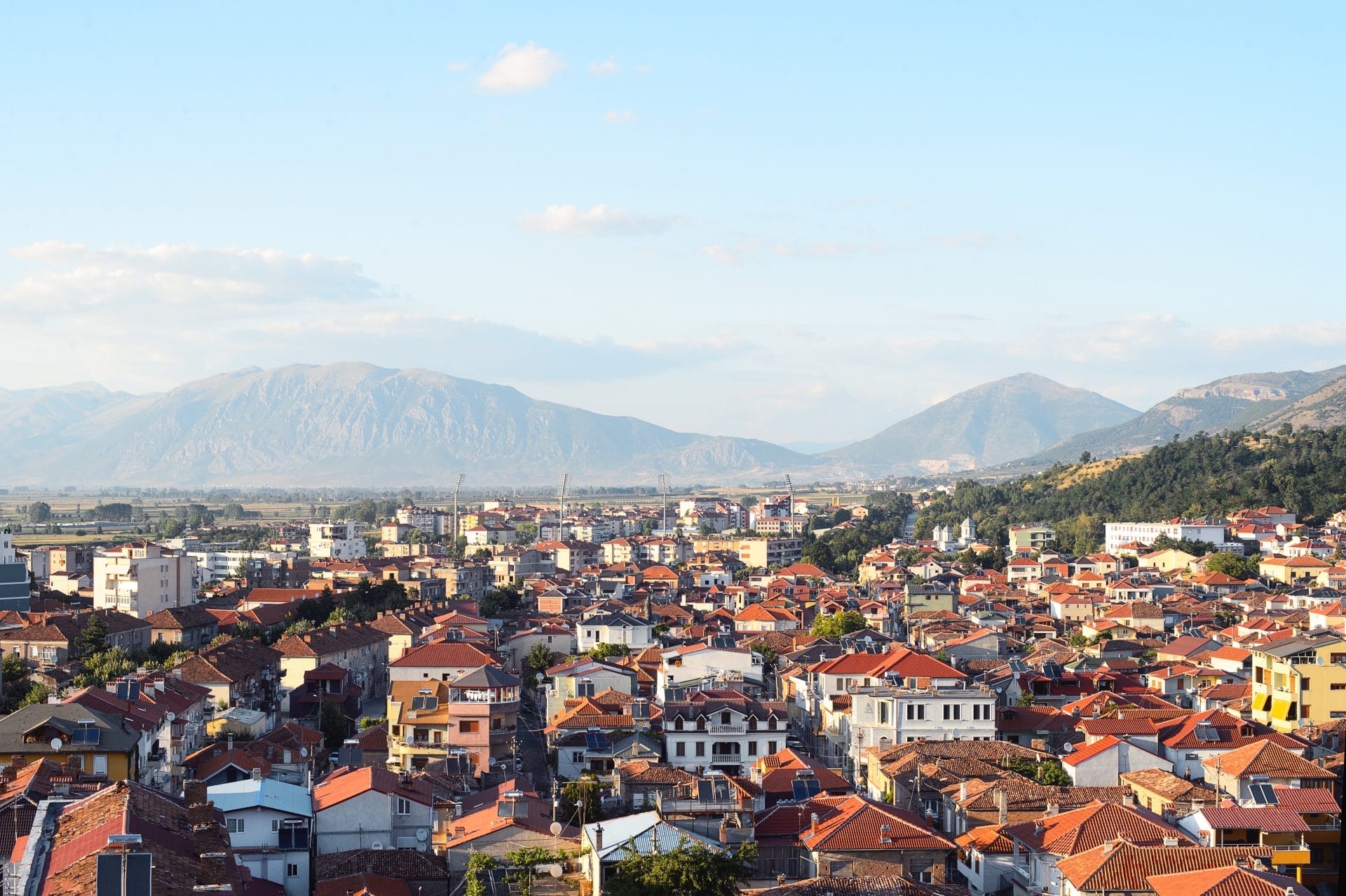
How to Get to Korçë
From Tirana
- By Bus: Multiple daily buses from southern terminal. Journey takes 3-3.5 hours and costs 800-1,000 LEK (€7-9).
- By Car: 180km via A3 highway through Elbasan. Drive time approximately 3 hours on good roads.
From Pogradec
- By Bus: Frequent buses. Journey takes 1 hour and costs 300-400 LEK (€2.50-3.50).
- By Car: 50km via good roads. Drive time approximately 1 hour.
From Greece
- Border Crossing: Kapshticë border (20km from Korçë) is closest Greek crossing. Thessaloniki is 190km from Korçë via Florina, Greece (3-3.5 hours).
The School That Challenged an Empire
On March 7, 1887, a single-room school opened in Korçë with seven students and one teacher named Pandeli Sotiri. The curriculum consisted of reading, writing, and arithmetic—subjects taught in hundreds of Ottoman schools across the empire. What made this school revolutionary wasn’t what was taught but the language used to teach it: Albanian.
This violated Ottoman policy. The empire had systematically suppressed Albanian-language education for decades, viewing linguistic nationalism as threat to imperial cohesion. Albanian wasn’t officially recognized as a written language in the empire’s administration, no standard Albanian alphabet existed, and teaching in Albanian risked attracting unwanted attention from Ottoman authorities who understood that language preservation fueled nationalist movements.
The school in Korçë opened anyway, operating initially in secret, then semi-openly as local support grew. Within months, enrollment expanded to dozens, then hundreds. Other Albanian-language schools followed the model in towns across southern Albania and what’s now North Macedonia. The movement they sparked became central to the Albanian National Awakening—the cultural and political revival that led to Albania’s 1912 independence declaration.
This history established Korçë’s identity as Albania’s intellectual and cultural capital, a reputation the city maintains despite being neither the political center (Tirana) nor the largest city nor the wealthiest. Korçë became the place where Albanian language, literature, education, and arts were cultivated even when doing so meant defying empires, occupying armies, and later, communist authorities who preferred culture that served state propaganda rather than genuine intellectual inquiry.
Today, visitors come to Korçë not for beaches or UNESCO sites but for something harder to quantify—to experience the Albanian city that most resembles a European cultural capital, where museums matter, where beer brewing is taken seriously, where locals actually read poetry, and where the past exists not as tourist attraction but as living cultural foundation.
Why Visit Korçë
Korçë sits in southeastern Albania near the borders with Greece and North Macedonia, surrounded by mountains on a plateau at approximately 850 meters elevation. The city of roughly 75,000 people occupies a geographic position that made it historically important for trade routes connecting the Adriatic coast with inland Balkans, while the elevation creates a climate distinct from coastal Albania—genuine four seasons with cold winters, pleasant summers, and the kind of autumn that produces good beer-brewing conditions.
The city lacks dramatic tourist-pulling features. No ancient amphitheaters survive here, no spectacular beaches exist 200 kilometers from the coast, and UNESCO hasn’t designated any sites. What Korçë offers instead is cultural authenticity—the experience of an Albanian city that functions primarily for residents rather than tourists, where cultural institutions exist because locals value them rather than because they attract foreign visitors.
The National Museum of Medieval Art houses Albania’s finest collection of religious icons and church artifacts from the Byzantine and post-Byzantine periods, with pieces that would attract scholarly attention in any major European museum. The Korça Brewery, established in 1928, continues producing Albania’s most widely consumed beer, offering tours that reveal Albanian brewing history and the unexpected story of how an Albanian brewery survived nationalization, economic collapse, and privatization. The Old Bazaar maintains artisan workshops where traditional crafts continue not as tourist performances but as actual skilled trades passed through generations.
The city possesses unusual francophone character for the Balkans—a legacy of the French lycée established in 1917 that educated Albanian elites for decades and created cultural connections with France that persist in older generations’ language skills, architectural preferences, and the unexpected number of Korçë residents who spent portions of their lives in France or French-speaking countries.
Visit Korçë if you’re interested in Albanian culture beyond beaches and ancient ruins, if you appreciate cities that maintain intellectual traditions, or if you want to understand what differentiates Albanian regions from each other (Korçë feels culturally distinct from Tirana, which feels different from Shkodra, which differs from Gjirokastra). Skip Korçë if you need spectacular natural scenery, if three hours from Tirana feels too far for what’s essentially a city experience, or if museums and cultural institutions don’t appeal to you.
The Medieval Art Nobody Expected
The National Museum of Medieval Art occupies a restored building in central Korçë, housing a collection that surprises visitors who assume Albania’s finest Byzantine artifacts would be in Tirana or at major archaeological sites. What you find instead is the country’s most comprehensive collection of religious icons, frescoes, wood carvings, and liturgical objects from roughly the 13th through 19th centuries—pieces that reveal the artistic traditions connecting Albanian lands to broader Byzantine and post-Byzantine cultural spheres.
The collection originated from a peculiar historical circumstance. During Albania’s communist period (1944-1991), the regime pursued aggressive atheist policies, particularly intense during 1967-1990 when Albania was declared the world’s first atheist state. Religious buildings were closed, converted to other uses, or demolished. Clergy were imprisoned. Religious practice of any kind became illegal.
This created a practical problem: what to do with centuries of religious art and artifacts from hundreds of churches and monasteries across southeastern Albania? Destroying everything would eliminate valuable cultural heritage, even if that heritage represented the “opiate of the masses” that communist ideology opposed. The solution was consolidation—gather the most valuable pieces, remove them from religious contexts, and display them as historical artifacts in a state museum stripped of devotional function.
Korçë became that repository, receiving icons, frescoes (carefully removed from church walls), carved iconostases, illuminated manuscripts, and religious objects from across the Korça region and beyond. The collection grew to include over 7,000 items, though only a fraction displays at any time due to space limitations.
What you see walking through the museum:
Icon Collections: Byzantine and post-Byzantine icons from the 14th-19th centuries, painted on wood panels using traditional egg tempera techniques. The styles range from purely Byzantine formalism to later works showing Western European Renaissance influences as Albanian church art began incorporating elements from Italian painting. The technical quality varies dramatically—some pieces show master craftsmanship comparable to works in major Byzantine collections, while others reveal provincial artists working within traditions they partially understood.
The Onufri Tradition: Several icons attributed to Onufri or his workshop represent Albania’s most celebrated icon painter (16th century). Onufri worked primarily in central Albania but his style influenced icon painting across Albanian lands, characterized by particular red pigment formulation (sometimes called “Onufri red”) and distinctive approaches to depicting religious figures.
Carved Wood Elements: Iconostases (altar screens) and their components demonstrate the wood-carving traditions that developed in Albanian churches, particularly during the 18th-19th centuries when Orthodox churches in Ottoman territories often couldn’t build monumentally in stone but developed elaborate interior wood decoration as alternative artistic expression.
Post-Byzantine Developments: The collection tracks how Albanian religious art evolved as the Byzantine Empire collapsed and Albanian lands came under Ottoman control. Icons from the 17th-19th centuries show increasing stylistic diversity as artists incorporated influences from Western European religious art, Venetian painting, and continuing Byzantine traditions into hybrid styles unique to Albanian and broader Balkan contexts.
The museum operates Tuesday-Sunday (typically 9 AM-5 PM, though verify current hours), with entrance fees around 300 lek (roughly €3). English information panels accompany major pieces, though the explanatory materials assume some baseline knowledge of Byzantine art history and Orthodox Christianity that casual visitors might lack. The building itself—a renovated early 20th-century structure—provides appropriate atmosphere without being architecturally significant in its own right.
What makes the collection particularly valuable is its comprehensiveness for a specific region and time period. This isn’t a curated selection of absolute masterpieces; it’s a systematic preservation of religious art from southeastern Albanian lands, including great works alongside competent provincial pieces and examples showing artistic decline. The totality reveals how religious art actually functioned in Albanian churches rather than presenting only the finest examples.
Beer, Brewing, and Albanian Industrial History
The Korça Brewery occupies an unexpected position in Albanian cultural identity—it’s a beer brand that achieved near-universal recognition, a business that survived multiple political and economic upheavals, and a rare example of Albanian industrial production achieving sustained quality and market dominance.
The brewery’s founding in 1928 occurred during Albania’s interwar period under King Zog, when the country was attempting to develop modern industrial capacity while remaining largely agricultural and poor. An Italian businessman named Umberto Umberti established the brewery using equipment imported from Czechoslovakia, then Europe’s brewing capital, and recruited brewmasters trained in Central European traditions.
The timing was fortunate—Albania’s Muslim majority population included substantial numbers of Muslims who consumed alcohol (particularly in urban areas and among more secular populations), while Christian minorities (Orthodox and Catholic) had no religious prohibitions on drinking. The country also bordered Greece, itself developing modern brewing industry, creating regional market for quality beer.
The brewery succeeded commercially during the 1930s, producing pilsner-style lager that became popular in Korçë and surrounding regions. Then came World War II, Italian occupation (1939-1943), German occupation (1943-1944), and finally communist takeover (1944).
The communist period should have destroyed the brewery. Private enterprise was systematically eliminated, foreign ownership was ideologically unacceptable, and Albania’s extreme isolationist policies under Enver Hoxha (particularly after 1961 split with Soviet Union and 1978 break with China) meant minimal foreign trade or technical exchange. Most Albanian industries suffered from these policies, producing goods of declining quality using obsolete equipment that couldn’t be upgraded due to isolation.
The Korça Brewery somehow maintained production throughout this period. The state nationalized it in the late 1940s, but continued operating the facility because beer remained culturally acceptable even under communist atheism, and because workers’ recreational needs included alcohol consumption. The brewery used its 1920s-era Czechoslovak equipment for decades with minimal upgrades, relied on Albanian-grown hops and barley when foreign inputs became unavailable, and trained new generations of brewmasters using knowledge passed from earlier employees.
The beer quality declined compared to pre-war production, but it remained drinkable and familiar. More importantly, it remained the beer that Albanians knew—Korça beer became synonymous with Albanian beer culture itself, the taste of celebrations, the accompaniment to meals, the drink shared among friends.
The 1990s brought new challenges. Communism’s collapse meant the state brewery needed privatization, but Albania’s chaotic transition to capitalism, pyramid scheme economic collapse (1996-1997), and general lawlessness created extremely difficult business environment. The brewery was eventually privatized in 2004, purchased by a German-Danish consortium that invested in equipment upgrades while maintaining traditional brewing recipes.
Today, Korça beer dominates Albanian beer market despite competition from international brands. The brewery produces multiple varieties (classic blonde lager, dark beer, and specialty brews) while maintaining the 1928 recipe for its flagship product. Market share estimates vary but generally place Korça at 60-70% of Albanian beer consumption—an extraordinary dominance in an open market with international competition.
The brewery offers tours (book ahead, particularly during summer season) that walk visitors through brewing process, explain the Czech-style equipment, discuss the history of surviving communism and economic collapse, and conclude with tasting session. The tour reveals unexpected sophistication—this isn’t a large industrial facility producing mediocre mass-market beer, but a medium-sized brewery maintaining traditional methods and genuine quality standards.
For understanding Albania beyond beaches and ancient ruins, the Korça Brewery’s survival story provides valuable perspective. It demonstrates how certain institutions persisted through regime changes and economic upheavals by remaining genuinely rooted in cultural life rather than being imposed from above or imported without adaptation.
The French Connection
Korçë possesses unusual francophone character for an Albanian city, a legacy of the French Lycée established in 1917 and operating until communist authorities shut it down in the early 1930s. During its brief existence, the lycée educated the elite of southeastern Albania and created cultural connections with France that shaped the city’s character for generations.
The lycée emerged from World War I’s particular circumstances. French forces occupied Korçë in 1916 as part of the Macedonian Front campaign against Central Powers. After establishing military control, French authorities created a semi-autonomous region called the Republic of Korçë (1916-1920), a short-lived entity that functioned under French protection while Albania’s broader political situation remained chaotic following 1912 independence.
During this period, French administrators established the lycée to provide French-language education to Albanian students, simultaneously serving French cultural influence goals and addressing the educated Albanian class’s desires for Western European educational models. The school operated with French curriculum, French teachers, and instruction entirely in French, producing graduates fluent in French and familiar with French culture, literature, and political thought.
The lycée’s closure in the early 1930s ended formal French education, but its legacy persisted. Many graduates became prominent in Albanian professional, political, and cultural life. They maintained French language skills, sent their children to France for education when possible, and preserved francophone cultural orientation that distinguished Korçë from other Albanian cities.
This francophone identity survived even through communism. While Albania’s isolation limited contact with Western Europe, older Korçë residents who had been educated in French or whose parents attended the lycée maintained language skills and cultural connections that re-emerged after 1991 when travel and communication became possible again.
The result today is a city where you’re more likely to encounter French speakers than in most Balkan locations, where French cultural institutes maintain presence, and where architectural and urban planning reflects French influence in subtle ways—wider boulevards than typical Albanian cities, parks designed in French style, building facades showing French aesthetic preferences.
This doesn’t mean Korçë feels French—it remains distinctly Albanian. But the francophone layer adds cultural complexity that makes the city intellectually cosmopolitan in ways that larger Albanian cities sometimes aren’t.
The Old Bazaar and Artisan Traditions
Korçë’s Old Bazaar occupies the city center, a district of narrow streets and two-story buildings housing shops, cafes, and workshops that continue functioning as commercial center rather than preserved historical zone. The bazaar evolved during Ottoman period when Korçë served as regional trade hub, with merchants dealing in agricultural products from the surrounding plateau, manufactured goods imported from coastal cities, and artisan products made locally.
The bazaar’s architecture reflects typical Ottoman commercial district design—narrow streets providing shade and protection from weather, shops on ground floors with residential quarters above, covered sections for specific trades (though much of Korçë’s bazaar lacks formal covered passages). The buildings date primarily from the 19th and early 20th centuries, as earlier Ottoman structures were replaced during periods of growth.
What distinguishes Korçë’s bazaar from more touristy equivalents is its continuing function as actual commercial district. Yes, tourism has brought some gift shops and cafes targeting visitors, but the majority of businesses serve local residents—grocers, butchers, bakers producing bread for neighborhood consumption, tailors, shoemakers, and artisan workshops.
The artisan workshops particularly reveal continuity with traditional crafts:
Metalworking: Coppersmiths and tinsmiths continue producing traditional household items—copper coffee pots (xhezve), serving trays, decorative items—using techniques essentially unchanged for generations. The quality varies (some workshops produce mainly tourist souvenirs, others create genuine functional pieces), but the skills persist.
Jewelry: Traditional Albanian silver filigree work continues in several workshops, creating the elaborate pieces that Albanian brides traditionally wore. The designs draw on patterns established centuries ago, though modern adaptations also exist.
Wood Carving: Small workshops produce carved wooden items ranging from tourist trinkets to genuine furniture pieces and decorative elements using traditional Albanian and Ottoman design motifs.
Bakeries: Multiple bakeries produce byrek (savory pastries) and Korçë’s special contribution to Albanian cuisine—lakror, a multi-layered pie filled with vegetables, cheese, or meat that’s become synonymous with Korçë food culture.
Walking the bazaar means navigating narrow streets where delivery trucks squeeze past pedestrians, dodging motorbikes that somehow navigate the crowds, and stopping frequently at tiny cafes where espresso costs 50 lek and old men argue politics in corners. It’s emphatically not sanitized or pedestrianized or made safe for tourism—it’s a working commercial district that happens to be old and architecturally interesting.
Lakror, Byrek, and Korçë Food Culture
Korçë has cultivated reputation as Albania’s culinary capital, a claim contested by other regions but rooted in several local food traditions that gained wider Albanian recognition.
Lakror represents Korçë’s signature dish—a multi-layered pie similar to byrek but distinctive in preparation and texture. Traditional lakror uses thin sheets of dough layered with filling (spinach, leeks, cheese, or combinations), brushed with butter or oil, baked until crispy outside and soft inside. The texture distinguishes it from standard byrek—more layers, thinner dough, creating different ratio of crust to filling.
Every bakery in Korçë produces lakror, but quality varies enormously. The best versions achieve perfect layering, crispy top and bottom, evenly distributed filling, and the kind of butter richness that makes nutritionists weep. Tourist-focused versions often substitute margarine for butter, use thicker dough (easier to handle but wrong texture), and over-fill (appealing visually but destroying structural integrity).
Finding good lakror requires either local recommendations or willingness to try multiple bakeries. As general rule, bakeries crowded with locals early morning (when fresh batches emerge from ovens) produce better versions than those seeming to cater primarily to afternoon tourist traffic.
Tavë Kosi reaches its supposed pinnacle in Korçë, according to local chauvinists. This baked lamb and rice dish with yogurt sauce appears throughout Albania and isn’t unique to Korçë, but local restaurants claim their versions surpass others due to superior local yogurt (from highland dairies), better lamb (from mountain-grazed flocks), and generations of perfected technique.
Beer and Food Pairing: Korça beer’s local production has fostered a food culture specifically built around beer pairing—tavernas design menus considering which dishes complement the brewery’s different varieties, creating a beer-focused food culture unusual in Albania where wine or raki typically accompany meals.
The city’s restaurants range from traditional tavernas serving Albanian staples to more contemporary establishments attempting fusion approaches, French-influenced bistros (legacy of the francophone tradition), and pizza places of varying quality that Albanians favor as much as traditional cuisine.
Dining costs remain reasonable by Western European standards—€8-12 per person for substantial taverna meals with beer, €15-25 for more upscale restaurants, €3-5 for bakery breakfast of lakror and espresso.
Practical Korçë
Getting There: Korçë lies approximately 180 kilometers southeast of Tirana, a journey requiring 3-3.5 hours by car via highways that improve annually but still include winding mountain sections demanding attention. Multiple daily buses connect Tirana to Korçë (cost: 800-1,200 lek, about €8-12), departing from Tirana’s southern bus terminal. The journey takes 3.5-4 hours depending on traffic and stops.
From Greece, the Kapshticë/Krystallopigi border crossing lies 40 kilometers south of Korçë, making the city accessible from Thessaloniki (approximately 250 kilometers, 3.5 hours) for those combining Albanian and Greek travel.
Accommodation: Hotels range from budget guesthouses (€20-30/night, basic but clean) to mid-range hotels (€40-60/night, comfortable with modern amenities) to the upscale Life Gallery Hotel (€80-120/night, boutique property in restored historical building). The city doesn’t attract mass tourism, so accommodation doesn’t reach coastal resort pricing even during peak summer season.
Timing: Korçë rewards visits year-round more than coastal destinations. Summer (June-September) offers pleasant temperatures (20-28°C) without the intense heat of coastal Albania, though afternoons can get warm. Spring (April-May) and autumn (September-October) provide ideal conditions—cool mornings, comfortable afternoons, and the kind of weather that makes walking cities enjoyable.
Winter (December-February) brings genuine cold with temperatures frequently below freezing, occasional snow, and the atmosphere of a European city in winter rather than Mediterranean mildness. The ski resort at Dardha (25 kilometers away) operates during good snow years, and Korçë itself takes on different character when cold—cafes become vital refuges, beer drinking shifts from outdoor terraces to warm interiors, and tourism essentially disappears leaving the city to residents.
Logistics: Most businesses accept only cash (Albanian lek), though larger hotels and restaurants take cards. ATMs are widely available. Many older residents speak some French (legacy of lycée influence), younger generations increasingly speak English, and Greek is common given proximity to the border.
Nearby Destinations
Korçë’s position in southeastern Albania makes it convenient base for several excursions:
Voskopojë (25km west): Former wealthy trading city reduced to a small village, with five surviving 18th-century churches containing exceptional frescoes. The dramatic rise and fall of Voskopojë—from major Balkan commercial center to destroyed village—provides powerful historical narrative about how war and economic change can erase urban centers.
Dardha (25km east): Mountain village with small ski resort (operating December-March when conditions allow), summer hiking, and traditional stone architecture. The village maintains authentic character despite ski infrastructure.
Prespa Lake (40km east): Straddling Albanian, Greek, and North Macedonian borders, this high-altitude lake (853 meters elevation) supports unique ecosystem and hosts significant bird populations. The Albanian villages along Prespa’s shores include Pustec, where Macedonian-speaking communities maintain distinct identity.
Boboshticë (15km south): Mountain village with well-preserved traditional architecture and reputation for culinary traditions, particularly roasted lamb and local cheeses.
The Intellectual Capital
Korçë’s claim to be Albania’s cultural and intellectual center rests less on current conditions than on historical legacy and persistent self-identity. The city isn’t wealthier than Tirana, doesn’t have better universities, and can’t match the capital’s cultural programming or artistic scenes.
What Korçë maintains is a sense of itself as place where intellectual and cultural traditions matter, where education is valued, where knowing poetry and literature indicates sophistication rather than eccentricity, and where brewing beer well or baking perfect lakror is treated as craft worthy of respect rather than merely commercial activity.
This self-conception shapes how the city presents itself and how residents interact with heritage. The medieval art museum exists because preserving Byzantine icons matters culturally, not because it generates tourism revenue. The Old Bazaar maintains artisan workshops because skilled craft work is valued, not because visitors want to photograph coppersmith. The brewery takes pride in technical quality rather than just market dominance.
For travelers, this means Korçë rewards curiosity and interest rather than just checking boxes. If you visit only to photograph the cathedral and try lakror before driving on, you’ll find those activities pleasantly sufficient but unremarkable. If you spend time in the medieval art museum understanding how Albanian religious art developed, tour the brewery learning how it survived communism, walk the bazaar observing which workshops serve locals versus tourists, and eat at tavernas where locals argue about which establishment makes better tavë kosi, you’ll encounter a city with genuine cultural substance.
That’s not every traveler’s priority—perfectly reasonable to prefer beaches, ancient ruins, or dramatic mountain scenery to urban cultural experiences. But for those interested in understanding contemporary Albanian identity and how it’s rooted in complicated historical developments, Korçë provides insights that the more obviously tourist-focused destinations can’t offer.
The city exists primarily for its residents rather than visitors, maintains intellectual traditions despite limited resources, and preserves cultural identity that includes Byzantine art, French influences, Albanian-language education, and quality beer brewing all coexisting as layers of the same local heritage.
If that kind of cultural complexity interests you, Korçë deserves your time. If it doesn’t, the coast has better beaches and the south has more dramatic ruins.