The Tunnel That Changed the Riviera
In summer 2024, Albania opened the Llogara Tunnel, a 5.7-kilometer passage bored directly through the Ceraunian Mountains that separate the Albanian Riviera’s northern and southern sections. The tunnel’s completion represents more than engineering achievement—it fundamentally altered access to the entire southern coast, nowhere more dramatically than at Jalë Beach.
The old route required driving the Llogara Pass, a serpentine climb above 1,000 meters elevation involving dozens of tight switchbacks as the road clung to mountainsides while offering spectacular but demanding views. The pass required 40-50 minutes of focused driving through terrain where attention lapses could have serious consequences. From Tirana, the total journey to Jalë took roughly 4 hours.
The tunnel reduces this to 10-12 minutes of straight-through passage, cutting the overall Tirana-Jalë journey to 3-3.5 hours. For a beach destination that previously required significant commitment to reach, this represents transformation from difficult day trip to accessible weekend escape.
The infrastructure change arrives precisely as Jalë undergoes its own evolution from Albanian insider secret to emerging Mediterranean luxury destination. What was communist-era military zone in the 1980s, then local beach hangout in the 1990s-2000s, has become the Albanian Riviera’s center for beach club culture, celebrity performances, and ambitious resort development—all now dramatically more accessible than ever before.
Why Visit Jalë Beach
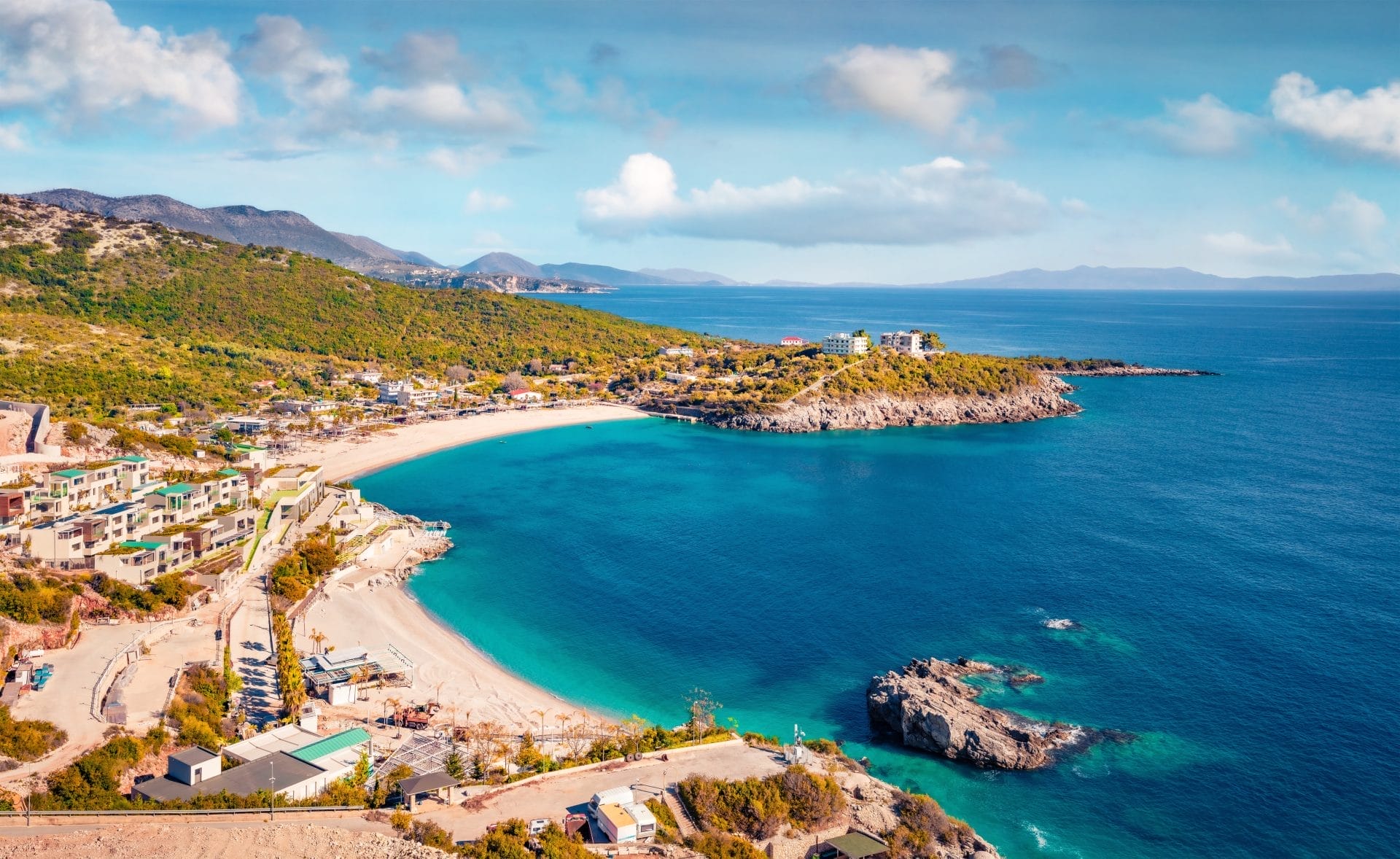
Jalë occupies a horseshoe-shaped bay where the Ceraunian Mountains descend sharply to meet the Ionian Sea, creating a beach backed by dramatic slopes covered with Mediterranean scrub, olive groves, and increasing amounts of development. The pebble beach—smooth stones ranging from white to grey to rust-red—creates water clarity that rivals anywhere in the Mediterranean, with visibility extending meters down even in deeper offshore zones.
But physical beauty alone doesn’t explain Jalë’s particular appeal or its rapid transformation. What makes this beach significant is how it represents a specific moment in Albania’s tourism evolution—the transition from authentic local character to self-conscious luxury destination, with both aspects currently coexisting in sometimes awkward, sometimes fascinating combination.
Folie Marine resort dominates the beach, having evolved from a 2011 beach bar with 20 rooms into the Albanian Riviera’s defining beach club, attracting politicians, celebrities, diaspora Albanians with serious spending power, and increasing numbers of international visitors drawn by Instagram posts and word-of-mouth. Weekend performances by Albanian rappers and DJs create a cultural scene unique in the region—simultaneously exclusive and accessible, expensive and casual, polished in some aspects while retaining rough edges in others.
The beach itself reflects Albania’s complicated relationship with coastal development. Roughly three-quarters of the sand is covered with organized lounger sections operated by hotels and beach bars (rates €20-50 per day depending on position and season), with the remaining quarter technically public though this free section shrinks annually as development expands. New government regulations aim to reduce private beach claims from 80% to 70% of coastlines, though implementation and enforcement remain unclear.
Visit Jalë if you’re interested in witnessing Albanian beach culture in its contemporary form—the whole complicated package of stunning natural setting, legitimate luxury amenities, celebrity culture, service inconsistencies, development pressures, and the unique energy of a place transforming in real-time. Skip it if you need reliable service standards, predictable experiences, or prefer destinations where the transition from local to international has already completed and been smoothed into seamless tourism product.
From Military Zone to Beach Club Capital
During Enver Hoxha’s communist regime (1944-1985), Albania’s entire coastline functioned as militarized zone, with beaches either directly restricted or requiring permits for access. The government built a hotel on the hillside above Jalë Bay specifically for communist party nomenclature and their families—allowing the elite to enjoy coastal holidays while ordinary citizens faced restrictions. That building still stands, now operating as private accommodation, a physical remnant of the system that controlled Albanian life for over four decades.
The regime’s collapse in 1991 opened the coast to general access, though initial development came slowly given Albania’s economic chaos throughout the 1990s. Jalë remained relatively simple through the early 2000s—a beautiful bay known primarily to Albanians, with minimal infrastructure beyond basic tavernas and informal camping.
The transformation accelerated with Folie Marine’s establishment in 2011. What began as ambitious beach bar expanded year by year—adding rooms, restaurant facilities, beach club amenities, and eventually achieving critical mass as the destination where Albanian celebrities and wealthy diaspora returned home to be seen during summer season. This created a self-reinforcing cycle: celebrity presence attracted crowds wanting to observe or participate in that scene, which attracted more businesses and development, which drew more visitors, continuing the spiral of transformation.
The dynamic reveals something about contemporary Albanian tourism—it’s being shaped as much by internal cultural forces (where do wealthy Albanians from Germany, Switzerland, Italy want to spend their summer holidays?) as by international tourism trends. The result is a scene that feels distinctly Albanian in character even as it increasingly resembles Mediterranean beach clubs elsewhere.
The Llogara Pass and New Tunnel Access
The Llogara Pass remains one of Albania’s most spectacular drives—a road climbing from sea level to over 1,000 meters through dozens of switchbacks, each turn revealing more dramatic coastal vistas until the entire southern Riviera spreads below like a topographic model. The route traverses Llogara National Park, passing through zones of endemic Bosnian pine forest found nowhere else, with occasional pullouts allowing stops for photographs of scenery that genuinely justifies the overused term “breathtaking.”
But spectacular scenery doesn’t make for easy driving. The pass requires constant attention—narrow sections where tour buses squeeze past each other, curves with inadequate barriers between pavement and substantial drops, and grades steep enough that engine overheating becomes concern for older vehicles during summer heat. Many visitors found the pass stressful enough to detract from enjoyment.
The new Llogara Tunnel provides alternative—a dual-lane bore with modern ventilation and lighting, bypassing the pass entirely. For regular visitors, residents, and commercial traffic, the tunnel represents pure practical improvement. For first-time visitors, the choice becomes whether to prioritize scenery (pass) or efficiency (tunnel).
Most travelers arriving from Tirana will approach via highway to Vlorë, then turn south on the coastal SH8 road. The tunnel entrance lies approximately 45 kilometers south of Vlorë. Jalë Beach sits another 20 kilometers beyond the tunnel’s southern exit. The entire journey from Tirana takes 3-3.5 hours in normal traffic conditions, compared to 4+ hours via the old pass route.
Alternative approach comes from the south—Sarandë to Jalë covers about 50 kilometers (1 hour drive) along the coastal highway. Many diaspora Albanians favor this route, taking ferries from Corfu to Sarandë, then driving north along the Riviera. This allows experiencing Greek islands before crossing to Albanian coast, though Sarandë itself becomes chaotic during peak August season.
Folie Marine: From Beach Bar to Riviera Institution
Folie Marine’s evolution from 2011 beach bar with 20 rooms to the Albanian Riviera’s defining resort tells a broader story about Albania’s rapid tourism development and the emergence of domestic luxury market.
The resort now offers multi-level wooden deck architecture extending along the beach, with restaurant, beach bar, lounger sections, and accommodation ranging from standard rooms to suites with sea views. Room rates reflect the property’s positioning—€200-300 per night during weekdays in season, potentially reaching €800 during peak weekends when popular Albanian DJs perform, creating a pricing structure more typical of established Mediterranean luxury destinations than emerging markets.
The breakfast service receives consistent mention as among Albania’s best coastal offerings—comprehensive buffets combining traditional Albanian items (byrek, local cheeses, fresh bread) with international standards, fresh fruit, and particular attention to coffee quality. This attention to detail extends selectively—the property maintains high standards in visible areas like dining and beachfront, while other aspects remain inconsistent.
The beach club atmosphere operates on visible social hierarchies. Weekend parking lots display luxury vehicles—Mercedes G-Wagons, Ferraris, Lamborghinis—belonging to wealthy diaspora Albanians for whom summer return to the homeland involves demonstrating success achieved abroad. The clientele includes Albanian politicians, television personalities, Instagram influencers, and those wealthy enough or connected enough to secure reservations during peak periods.
Beach chair access for non-guests depends on occupancy. When the resort operates at capacity, chairs remain reserved for staying guests. During quieter periods, day visitors can typically rent chairs directly from beach staff for €20-40, though availability and pricing lack transparency—a recurring theme in Albanian coastal tourism where rate quotations can vary based on perceived tourist status.
The atmosphere cultivates exclusivity that intensifies during peak season, particularly August and weekends featuring musical performances. This exclusivity is both deliberate positioning and organic outcome of limited capacity meeting high demand in an environment where social visibility matters.
Albanian Celebrity Culture and Weekend Performances
One of Jalë’s more distinctive characteristics is its role within Albania’s domestic celebrity ecosystem—a cultural phenomenon that remains largely invisible to international visitors but shapes the beach’s social calendar and atmosphere.
Albania has developed its own complete entertainment industry—rappers, singers, pop stars, and DJs who are household names within Albania and Albanian diaspora communities but virtually unknown outside these boundaries. Rather than performing exclusively in major venues, these celebrities tour throughout Albania during summer, playing intimate beach clubs, bars, and resorts in a circuit that runs from north to south along the coast.
Folie Marine regularly hosts these performances on summer weekends, with Albanian rappers like Majk, Capital T, or Ledri Vula drawing crowds specifically for concerts that combine beach club atmosphere with live music. The events are heavily promoted through Albanian social media, attracting audiences willing to travel significant distances for the combination of beach, music, and the social cachet of attending the scene’s current hot event.
For international visitors, these performances offer window into contemporary Albanian culture that tourist guidebooks rarely mention. The music blends hip-hop, pop, and Balkan musical traditions, lyrics switch between Albanian and English, and the audience demographics skew young (20s-30s), urban, and relatively affluent by Albanian standards.
The phenomenon reveals something about Albania’s cultural self-sufficiency—a market large enough (including substantial diaspora) to support its own complete entertainment industry operating parallel to but largely separate from international music scenes. Jalë Beach functions as one stage in this uniquely Albanian cultural circuit.
Beach Privatization and Access Politics
Jalë’s beach presents visible manifestation of broader conflicts about coastal access playing out across Albania. The roughly 400-meter crescent of sand divides between organized sections (controlled by hotels and beach bars, covered with neat rows of loungers) and technically public areas (smaller sections where visitors can spread towels without paying for chairs).
The organized sections dominate—approximately 75% of the beach by most estimates, though precise measurements remain contentious. Hotels and beach bars claim these zones through arrangements whose legal foundations can be murky, often involving long-term leases from local authorities or claims based on proximity to their inland properties. During peak season, these organized zones generate substantial revenue through daily lounger rentals (€20-50) and beach bar sales to the captive audience.
Albanian government regulations implemented in recent years aim to limit private beach claims to 70% of coastlines, down from the 80-90% that had become common on popular beaches. The regulations also restrict beach concessions exclusively to hotel operators, theoretically eliminating independent beach bars without accommodation components. Implementation and enforcement remain inconsistent, and at Jalë the practical outcome of these regulations remains unclear as various stakeholders negotiate between legal requirements and economic realities.
For visitors, the situation means beach access remains theoretically free (public sections exist) but practically limited during peak periods when crowds concentrate in shrinking public zones while organized sections—with shade, service, and prime positioning—require payment. The dynamic creates visible class divisions: those willing or able to pay €30-40 for loung chairs spread comfortably with waiter service, while budget travelers and Albanian families crowd into smaller public sections with whatever shade they can improvise.
This isn’t unique to Jalë or even Albania—Mediterranean beaches from Greece to Croatia to Italy face similar privatization pressures. But the rapidity of change in Albania (from fully public access in early 1990s to substantial privatization within three decades) makes the conflicts particularly visible and sometimes contentious.
The Folie Village Development: 2026 Transformation
On the hillside above Jalë Beach, massive construction signals the next phase of the area’s evolution. Folie Village, developed by the team behind Folie Marine, represents an ambitious attempt to create Albania’s first true luxury coastal destination by Mediterranean standards.
The development plans encompass multiple components:
The Rock Hotel: 31 rooms and suites designed to blend with the natural landscape through architecture that incorporates the hillside rather than simply building atop it.
Jale Hotel: Additional accommodation property expanding the resort’s capacity.
Residential Components: Luxury villas and modern apartments/penthouses with sea views, marketed to both Albanian diaspora and international buyers seeking Albanian coastal properties.
Commercial Infrastructure: Shops, restaurants, bars, entertainment venues, casino, world-class spa, fitness facilities, exclusive rooftop areas, and beachside clubs creating a comprehensive resort environment where visitors theoretically need never leave the development.
The project draws architectural inspiration from traditional Albanian coastal villages like Vuno and Dhërmi, attempting to create aesthetic authenticity rather than generic Mediterranean resort architecture. Whether this succeeds in practice or produces sanitized theme-park versions of traditional architecture remains to be seen as construction continues toward projected 2026 completion.
The development scale signals clear ambitions—positioning this section of Albanian coast as legitimate competitor to established luxury destinations like Greek islands, Croatian coast, or southern Italy, with pricing likely to match those aspirations. For Jalë, Folie Village represents either exciting evolution toward international recognition or the final erasure of the local character that made the beach distinctive, depending on perspective.
What’s certain is that the Albania of 2026-2030 will offer dramatically different coastal experiences than the Albania of even the early 2020s, and Jalë sits at the center of this transformation.
The Pebble Beach and Water Quality
Strip away all the development, celebrity culture, and access politics, and Jalë’s fundamental appeal remains its physical setting—particularly the water quality created by the pebble beach composition.
Unlike sandy beaches where wave action suspends particles creating cloudiness, Jalë’s smooth, multi-colored pebbles (white, grey, rust-red, occasionally other hues) act as natural filter. The stones settle quickly after disturbance, and the lack of suspended sediment creates exceptional water clarity. On calm mornings, visibility extends meters down even in deeper water, allowing observation of the pebble bottom, occasional fish, and the precise gradient where lighter shallow zones transition to deeper blue offshore waters.
The pebbles represent trade-off—entry into the water requires more care than sandy beaches (water shoes help, though many swimmers forgo them), and extended lying on pebbles proves less comfortable than sand. But the resulting water clarity surpasses almost any sandy beach, creating swimming conditions where the Ionian Sea feels almost tropically transparent.
The bay’s horseshoe shape provides natural wave protection, making Jalë calmer than more exposed beaches even when offshore winds create chop. Water temperatures reach 23-25°C during July-August peak season, remaining swimmable (18-22°C) from late May through October.
Beyond the main beach, the coastline offers additional opportunities. Aquarium Bay, a smaller cove accessible by short hike or kayak trip from Jalë, provides more secluded swimming with even clearer water and fewer people. Pirates’ Cave, a limestone formation accessible by boat or kayak, creates the kind of dramatic coastal scenery that gets photographed extensively though it offers minimal practical amenities.
Camping: The Budget Alternative
Not all Jalë visitors come for resort amenities. Several campsites established around the beach offer dramatically different—and significantly cheaper—ways to experience the same coastline.
Social Camping and Aquariumi Jalë Camping operate sites nestled among olive groves a short walk from the beach. Basic tent rental starts around €20 per night, with some packages including meals and even group transportation from Tirana. Facilities provide communal kitchens, simple restaurants, basic bathrooms, and the fundamental elements needed for comfortable camping without insulating visitors from the natural environment.
The setting makes these options appealing beyond pure budget considerations. Mornings begin with light filtering through ancient olive trees, sea breezes rustle leaves at night, and the entire experience maintains connection to the landscape that resort isolation inevitably diminishes. The campsites attract younger travelers, backpackers, and Albanians seeking beach access without resort costs, creating social atmosphere distinct from the beach club scene down at the water.
As Jalë develops upmarket, these camping options provide important alternative—ways to experience the same beach, water, and coastline for €20-30 per day total rather than €200-300 per night for resort accommodation.
Practical Jalë
Getting There: From Tirana, follow highway toward Vlorë (approximately 140 kilometers, 2-2.5 hours), then turn south on coastal SH8 road toward Llogara Tunnel (45 kilometers from Vlorë). Jalë Beach lies 20 kilometers beyond the tunnel’s southern exit. Total journey: 170 kilometers, 3-3.5 hours in normal conditions.
Alternatively, approach from Sarandë heading north (50 kilometers, 1 hour drive). Multiple daily buses run Tirana-Sarandë route with Jalë stops (cost: 1,500-2,000 lek), though schedules remain flexible and advance booking is advisable during peak season.
For those taking the old Llogara Pass route (recommended once for the scenery despite longer journey), allow extra time and ensure vehicle is in good condition—the grades and switchbacks stress older engines and brakes.
Accommodation: Folie Marine represents the premium option (€200-800/night depending on season, day of week, and events). Several other hotels and guesthouses operate around the bay with rates €60-150/night during summer. Campsites offer budget alternatives (€20-40/night for tent rental/camping spot).
Book well ahead for July-August, particularly for weekends or when Albanian celebrity performances are scheduled. Shoulder season (June, September) offers significantly better value with comparable weather.
Dining: Folie Marine’s restaurant serves the beach’s highest-end meals (€25-40 per person with wine). Multiple beachfront tavernas offer fresh seafood sold by weight (1,200-1,800 lek per kilo) and standard Albanian dishes (€8-15 per person). Quality varies dramatically—establishments busy with Albanian families generally indicate better execution than those surviving purely on tourist traffic.
Beach Access: Public beach sections are free but limited in size. Organized lounger sections charge €20-50 per day depending on position and season. Folie Marine’s beach chairs are primarily reserved for hotel guests, with day visitor access depending on occupancy.
Money: Most establishments accept cash (Albanian lek) only, though larger hotels take cards. ATMs exist in the area but can run out during peak weekends—withdraw sufficient cash in Vlorë before arrival if visiting during high season. Some places accept euros but typically offer unfavorable exchange rates.
When to Visit
June and September: Optimal timing for those seeking the best balance of good weather without peak-season chaos. Water temperatures remain swimmable (20-23°C), beaches are less crowded, prices drop 30-50% from August peaks, and the overall atmosphere relaxes considerably. Most but not all businesses operate, and you avoid the intense social density that defines July-August.
July-August: Peak season brings maximum crowds, highest prices, warmest water (23-25°C), and the full beach club scene with regular celebrity performances and weekend parties. Folie Marine operates at capacity, beach space becomes premium, and reservations are essential for accommodation and sometimes even beach chairs. The energy is undeniable—this is when Jalë fully expresses its beach club character—but it comes with corresponding crowds and costs.
May and October: Shoulder season edges offer cooler water (18-20°C in May, 20-22°C in October) and reduced infrastructure as businesses begin opening (May) or closing (October). May mornings can be cool, October weather becomes less predictable, but for those comfortable with these trade-offs, the pricing and crowds make these periods attractive.
November-April: Most tourism infrastructure closes completely. The beach remains accessible but without services, and weather becomes unpredictable though winters stay mild by northern European standards. Only consider for off-season coastal hiking rather than beach activities.
Nearby Destinations
Jalë’s position on the southern Riviera makes it effective base for exploring adjacent coast:
Dhërmi (7km north): Traditional hillside village above dramatic beaches, with its own beach club scene and increasing development competing with Jalë for Riviera attention.
Himarë (8km south): Larger coastal town with Greek-Albanian cultural complexity, ancient castle, and multiple beach options ranging from organized to secluded.
Gjipe Beach (15km north): Canyon-mouth beach accessible only by hiking or boat, offering genuine seclusion and dramatic limestone scenery. The antithesis of Jalë’s development.
Llogara National Park: The mountains immediately behind the tunnel, with hiking trails, endemic Bosnian pine forests, and spectacular viewpoints over the entire Riviera coastline.
Sarandë (50km south): Albania’s primary southern resort town with ferry connections to Corfu and access to Butrint archaeological site.
The Unpolished Luxury
Jalë Beach exists at a fascinating moment—far enough along its transformation that genuine luxury amenities now exist, but not so far that all rough edges have been smoothed away. The result is a destination that can feel simultaneously exclusive and accessible, polished and improvised, expensive and relatively affordable depending on how you engage with it.
You can experience Jalë by camping in olive groves for €25/night and walking to the free beach section, or by staying at Folie Marine during a celebrity DJ weekend for €800/night with premium beach club access. These experiences share the same water and coastline but otherwise inhabit almost entirely different realities.
What you won’t find is the seamless, predictable experience of fully mature Mediterranean destinations. Service quality varies dramatically based on factors both obvious (how much you’re spending) and less so (perceived tourist status, linguistic fluency, connections to local or diaspora networks). Beach access politics create visible inequality between those who can afford organized sections and those relegated to shrinking public zones. Infrastructure exists but doesn’t always function as expected. The luxury pretensions are real but coexist with distinctly unpolished elements.
For some travelers, these inconsistencies prove frustrating—the gap between aspiration and execution feeling like false advertising. For others, the rough edges provide the authenticity that makes destinations interesting, the evidence that you’re experiencing a place still in genuine transition rather than fully packaged tourism product.
The Llogara Tunnel’s opening and Folie Village’s pending completion suggest that Jalë’s period of transitional character may be brief. By decade’s end, this beach might offer the seamless luxury experience currently promised but inconsistently delivered. Whether that represents progress or loss depends on what you value in travel destinations.
For now, Jalë remains genuinely interesting—a beach where you can observe Albanian culture in its contemporary complexity, where communist-era history meets luxury development, where domestic celebrity culture creates scenes that guidebooks don’t describe, and where the Ionian Sea achieves colors that camera phones struggle to capture accurately.
If you need predictable standards and reliable service, choose more established destinations. If you’re comfortable navigating complexity in exchange for experiencing a place at a particularly revealing moment in its evolution, Jalë offers something increasingly rare—the chance to witness transformation in progress rather than only its completed outcome.