How to Get to Himarë
From Tirana
- By Bus: Multiple daily buses from southern terminal. Journey takes 4-5 hours and costs 1,500-2,000 LEK (€13-17).
- By Car: 220km via Fier and coastal SH8. Drive time approximately 4 hours including spectacular Llogara Pass.
From Sarandë
- By Bus: Regular buses along coastal SH8. Journey takes 1 hour and costs 300-400 LEK (€2.50-3.50).
- By Car: 50km via coastal road. Drive time approximately 1 hour.
From Vlorë
- By Bus: Frequent buses heading south. Journey takes 1.5 hours and costs 500-600 LEK (€4-5).
- By Car: 85km via dramatic SH8 coastal road and Llogara Pass. Drive time approximately 1.5 hours.
Note: The coastal highway (SH8) clings to mountainside with spectacular views but tight curves. Drive carefully, especially in summer traffic.
The Town With Two Names
Road signs approaching this coastal settlement along the Albanian Riviera present a peculiarity: “Himarë” appears first in Albanian Latin script, followed immediately by “Χειμάρα” (Himara) in Greek. This dual-language signage, mandated for areas with substantial Greek minorities, captures something essential about this place—it exists at the intersection of two distinct cultural identities, each claiming historical precedence, neither entirely yielding to the other.
The 2011 Albanian census recorded roughly 2,800 people identifying as ethnic Greek among Himarë’s population of approximately 7,800—though these numbers remain contested, with Greek sources claiming significantly higher percentages and Albanian nationalists disputing the methodology. What’s indisputable is that you’ll hear as much Greek as Albanian spoken in the old kastro (castle) quarter above the modern beach town, that Orthodox churches here maintain closer ties to Greek ecclesiastical authorities than Albanian ones, and that cultural affiliations run deeper than citizenship documents might suggest.
This isn’t abstract political controversy—it’s everyday reality that shapes how the town functions, how development proceeds, who owns which properties, and occasionally which language gets used in which contexts. For travelers, it manifests in small ways: some restaurant menus list items in Greek first, certain older residents speak minimal Albanian, and cultural references assume familiarity with Greek traditions as much as Albanian ones.
The complexity creates something unusual in Albanian tourism—a place where you’re experiencing not one culture but two, coexisting with varying degrees of harmony and tension, both rooted in centuries of shared history on this same stretch of Ionian coastline.
Why Visit Himarë
Himarë offers what the more developed sections of the Albanian Riviera increasingly don’t: genuineness born from being an actual functioning town rather than a purpose-built tourist destination. People live here year-round, conducting normal lives that don’t revolve around summer visitors. The modern beachfront developments coexist with the kastro’s stone houses where families have resided for generations, where grandmothers still sweep front steps at dawn and men gather in kafeneia to argue politics in Greek-accented Albanian.
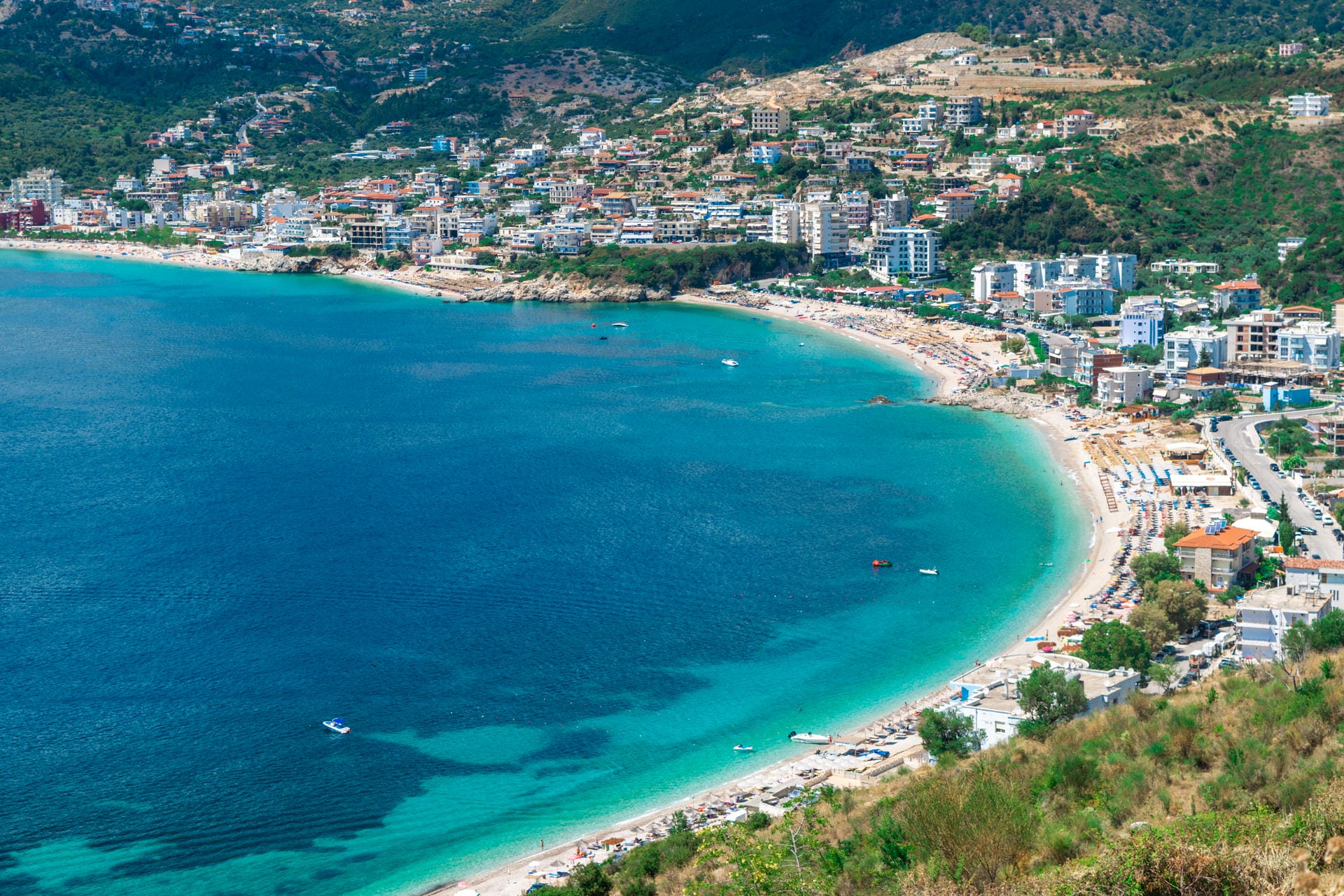
The setting provides the fundamental appeal—a dramatic coastline where the Ceraunian Mountains descend sharply to the Ionian Sea, creating a series of pebble beaches separated by rocky headlands. The water achieves that particular Mediterranean turquoise that occurs where clear shallow zones meet deeper offshore channels. The beaches stretch both north and south of town, some accessible by paved road, others requiring dirt tracks or boat access.
But if you’re seeking polished resort infrastructure, reconsider. Himarë remains stubbornly rough around edges that other destinations have smoothed. Beach access involves navigating poorly maintained roads, accommodation ranges from genuinely nice to questionable budget options with minimal standards, and restaurant quality varies dramatically from excellent family tavernas to tourist-trap establishments serving mediocre food at inflated prices.
The appeal lies precisely in this unevenness—Himarë hasn’t yet been standardized into seamless tourist experience. You’ll encounter genuinely interesting cultural complexity, eat exceptionally fresh seafood at waterfront restaurants where fishing boats tie up directly outside, explore castle ruins that haven’t been manicured into archaeological theme parks, and swim at beaches where you might be the only foreigner among Albanian and Greek families on holiday.
Skip Himarë if you need reliable wifi, consistent English proficiency, or predictable service standards. Visit if you’re comfortable navigating cultural ambiguity, can handle infrastructure challenges, and prefer authenticity over convenience.
The Castle Through Millennia
The fortress crowning the hill above modern Himarë presents archaeological complexity spanning roughly 2,500 years, though local tourism materials often claim considerably greater antiquity. The earliest confirmed fortifications date to the 4th century BCE during the Chaonian period, when indigenous Illyrian tribes controlled this coastline before Greek and Roman conquest.
The Chaonians—about whom relatively little survives beyond archaeological evidence and fragmentary classical references—built defensive works throughout the region they called Chaonia, roughly corresponding to modern southern Albania and northwestern Greece. Their fortifications typically utilized naturally defensive positions enhanced with cyclopean masonry, massive limestone blocks fitted without mortar in techniques predating formal Greek architectural influence.
What you see walking through Himarë Castle represents accumulations from multiple subsequent periods. Byzantine engineers reinforced and expanded the Chaonian foundations during the 6th-9th centuries CE, when this coastline formed the empire’s western frontier against various threats from across the Adriatic. The fortress churches—now mostly ruins—date to this Byzantine period, their foundations still visible within the kastro.
The Venetians, who briefly controlled coastal Albanian positions during medieval competition for Adriatic dominance, added their own modifications during the 14th-15th centuries. Venetian engineering focused on adapting medieval castles for early gunpowder warfare—you can identify their work by the lower, thicker walls designed to withstand cannon bombardment rather than the higher, thinner Byzantine construction intended to repel scaling and siege engines.
Ottoman conquest in the early 16th century brought further modifications. The Ottomans repaired existing fortifications and constructed the small mosque (now ruined) within the castle complex, though they never heavily garrisoned this particular position—the harbor wasn’t significant enough to warrant major military investment, and local populations remained largely self-governing under Ottoman suzerainty as long as taxes were paid.
Walking through the kastro today means navigating a palimpsest where different historical periods intersect without clear delineation. Original Chaonian blocks support Byzantine archways rebuilt with Venetian modifications, all surrounded by Ottoman-era residential construction that extends into 19th and early 20th century stone houses still occupied by local families.
The site receives minimal official management—no ticket booth, no guided tours, minimal signage beyond a few weathered information panels. You simply walk up the cobbled path from the modern town (about 20 minutes steep climbing) and explore. The main church (Kisha e Shën Mërisë/Church of St. Mary) sometimes opens for services but otherwise remains locked. The castle walls remain accessible, offering panoramic views across the Ionian toward the Greek island of Corfu, visible on clear days approximately 50 kilometers northwest.
The kastro’s residential section still houses perhaps fifty families, their stone homes built directly against and incorporating ancient fortification walls. Narrow stepped alleys connect these dwellings, washing hangs between buildings, cats sleep on sun-warmed stones, and the entire quarter maintains an atmosphere of living history that more carefully preserved archaeological sites inevitably lose.
Ali Pasha’s Triangular Fortress
Twenty kilometers south of Himarë, the peninsula of Porto Palermo extends into the Ionian Sea, crowned by one of Albania’s most distinctive fortifications—a perfectly triangular castle built by Ali Pasha of Ioannina between 1804 and 1807.
Ali Pasha Tepelena (1740-1822) remains among Albania’s most complex historical figures—simultaneous Ottoman governor, Albanian warlord, Greek cultural patron, and proto-nationalist who played European powers against each other while building a semi-autonomous statelet across what’s now southern Albania and northwestern Greece. His court at Ioannina attracted European travelers, his military campaigns terrified Ottoman authorities, and his eventual assassination by Ottoman forces seeking to reassert control became the subject of French Romantic literature.
The Porto Palermo fortress represents Ali Pasha’s strategic thinking translated into stone. Unlike traditional square or irregular castles adapting to terrain, this structure forms a perfect equilateral triangle with bastions at each corner—an unusual design reflecting early 19th-century military architecture’s transition toward geometric fortification systems designed for artillery warfare.
The fortress’s position controlled the deep natural harbor of Porto Palermo Bay, one of few anchorages along this otherwise exposed coastline capable of sheltering naval vessels. Ali Pasha constructed the castle to protect his small fleet and control maritime approaches to his territories, while the harbor’s depth (reaching 16 meters close to shore) allowed even large warships to anchor safely.
The fort saw minimal actual combat. By the time construction completed, Ali Pasha’s power was already declining, Ottoman authorities were moving against him, and the European balance of power had shifted following Napoleon’s defeat. After Ali Pasha’s death in 1822, the fortress passed through various hands—Ottoman authorities, Greek forces during independence struggles, Albanian control following Ottoman collapse, then Italian occupation, German occupation during WWII, and finally Albanian communist use as a naval facility.
The communist period transformed Porto Palermo into a military zone closed to public access. The Albanian navy maintained a submarine base in the harbor, constructing tunnels and bunkers throughout the peninsula, adding Cold War-era fortifications to Ali Pasha’s 19th-century works. The site remained off-limits until the early 1990s following communism’s collapse.
Today you can visit the fortress (entrance fee 200 lek, roughly €2) by driving or taking buses running the coastal road between Himarë and Sarandë. The castle interior houses a small museum dedicated to Ali Pasha with multilingual information panels explaining the fortress’s history and the broader context of Ali Pasha’s rule. The triangular ramparts remain walkable, offering views across the peninsula and bay.
The harbor below has seen recent development—a few waterfront restaurants now operate during summer months, serving fresh seafood to visitors who combine castle exploration with swimming in the remarkably clear bay waters. The beaches here are pebble, the water depth increases quickly offshore, and the entire setting remains dramatically scenic—mountains rising directly behind the peninsula, the Ionian stretching uninterrupted toward Italy, and Ali Pasha’s geometric fortress presiding over it all.
The Beaches and Coastal Access
Himarë’s coastline extends roughly 25 kilometers, encompassing the main town beach and numerous smaller coves accessible by varying degrees of effort. The beaches share common characteristics—pebbles rather than sand, remarkably clear water, dramatic mountain backdrops, and uneven development ranging from organized beach clubs to completely undeveloped shoreline.
Spile Beach forms the town’s main waterfront—a broad pebble strand directly fronting the modern beachfront promenade. This is where infrastructure concentrates: hotels line the road behind the beach, restaurants and cafes occupy ground floors, beach loungers and umbrellas are available for rent (800-1,500 lek depending on season and position), and summer crowds can be substantial. The water clarity remains excellent despite proximity to the port and town, and the beach’s southern exposure ensures sun from morning through evening.
Livadhi Beach, about 3 kilometers north of central Himarë, offers somewhat more space and marginally fewer crowds during peak season. The beach stretches longer than Spile, with a mix of organized sections (loungers, beach bars, watersports) and unorganized areas where you can spread a towel without charge. Several mid-range hotels and apartment complexes occupy positions directly above the beach, connected by staircases descending to the waterfront.
Filikuri Beach lies just south of town, accessible by a steep but paved road descending from the coastal highway. The beach itself remains relatively undeveloped—a pebble cove backed by olive groves rather than hotels, with a single small taverna operating during summer. The swimming is excellent, the water noticeably clearer than at more developed beaches, and the relative difficulty of access (15-minute walk from where most visitors park) keeps numbers manageable even during high season.
Potami Beach, approximately 4 kilometers south toward Dhërmi, requires either a dirt road drive (passable in normal cars during dry conditions, challenging after rain) or boat access from Himarë harbor. This additional difficulty translates to genuine seclusion—you might have the entire cove to yourself on weekday mornings, even in July. No facilities exist beyond what you bring, no loungers or umbrellas for rent, no cafes or restaurants. It’s pure beach experience, limited only by your willingness to carry supplies and tolerate pebbles underfoot.
The coastal highway (SH8) itself deserves mention as both spectacular scenery and genuine driving challenge. The road clings to the mountainside, climbing and descending via switchbacks while offering panoramic views across the Ionian. Pullouts allow stopping for photographs, though many curves lack barriers between pavement and substantial drops. The driving requires attention—this isn’t a route for distracted touring—but rewards with some of Albania’s most dramatic coastal vistas.
Cultural Life and Traditional Rhythms
The evening xhiro—the traditional Albanian promenade when entire communities emerge to walk, socialize, see and be seen—persists in Himarë with particular local character. As temperatures moderate following afternoon heat, families, couples, elderly men, teenagers, and tourists begin circulating along the beachfront road, moving in slow currents of conversation and observation.
The ritual follows unspoken rules: walk slowly, greet acquaintances, stop for extended conversations blocking the sidewalk, continue walking, pause at cafes for espresso or raki, resume walking. The point isn’t exercise or reaching a destination—it’s the walking itself as social activity, maintaining community bonds through regular visible presence.
In Himarë’s kastro, the xhiro takes different form—narrower stone alleys rather than beachfront promenades, kafeneia (Greek-style coffee houses) where men gather rather than modern cafes, Greek as often as Albanian spoken, and a slower, more traditional pace reflecting the old quarter’s demographics and cultural conservatism.
The town’s religious calendar follows Orthodox Christianity, with major celebrations including Easter (calculated by Orthodox rather than Catholic calendar, often falling on different dates), the Dormition of the Theotokos (August 15), and Saint Mary’s feast day. During these celebrations, the kastro’s churches hold services, families prepare traditional foods, and cultural affiliations become explicitly visible in ways that normal tourism might not reveal.
Practical Himarë
Getting There: Himarë lies 220 kilometers southwest of Tirana, a journey requiring 4-5 hours by car or bus. The route follows the highway toward Vlorë, then turns south on the coastal SH8 toward Sarandë. Multiple daily buses connect Tirana to Sarandë with stops in Himarë (cost: 1,500-2,000 lek), though schedules remain flexible and booking ahead is advisable during summer. Furgons (minibuses) run more frequently but with less predictable schedules.
From Sarandë, Himarë lies 50 kilometers north (1 hour drive), with frequent bus and furgon service throughout summer season. This makes Himarë feasible as either a base for exploring the southern Riviera or as a stop between Vlorë and Sarandë.
Accommodation: Options range from budget guesthouses in the kastro (€20-30/night, basic facilities, often family-run with limited English) to modern beachfront hotels (€60-100/night during peak season, air conditioning, wifi, breakfast included). Mid-range apartments near Livadhi Beach offer good value (€40-60/night) with kitchenettes allowing self-catering.
Book ahead for July-August when occupancy reaches capacity and prices rise 50-100% above shoulder season rates. May-June and September-October offer significantly better value with comparable weather and swimming conditions.
Dining: Waterfront tavernas dominate dining options, with quality varying dramatically. As general rule, establishments busy with Greek and Albanian families rather than exclusively tourists indicate better execution and value. Fresh fish is sold by weight (typically 1,200-1,800 lek per kilo), grilled and served whole with olive oil, lemon, and horta (wild greens). Seafood dishes to seek: grilled kalamari, octopus stewed with wine and tomatoes, barbounia (red mullet), and whatever the daily catch includes.
Traditional Albanian dishes appear alongside Greek staples—tavë kosi (baked lamb with yogurt), byrek (cheese or spinach pastry), pispili (local cornbread), moussaka, Greek salad, and horiatiki. Local wine comes from nearby valleys, often house wine served in carafes rather than bottles (300-500 lek per half liter).
Budget €15-25 per person for complete meals with wine at mid-range establishments, €8-12 for simpler taverna meals, €25-40 at higher-end seafood restaurants.
Money and Logistics: Most businesses accept only cash (Albanian lek), though some larger hotels take cards. ATMs exist in town center but can run out during busy weekends—withdraw sufficient cash in Vlorë or Sarandë if visiting during peak season. Many establishments accept euros but give unfavorable exchange rates; lek provide better value.
Mobile coverage is generally reliable, wifi available at most accommodation and cafes. Larger supermarkets exist near the main square for self-catering supplies. Pharmacies stock basic supplies; serious medical issues require traveling to Vlorë or Sarandë where proper hospitals exist.
When to Visit
May-June: Ideal timing for those avoiding crowds. Water temperature reaches swimmable range (18-20°C) by late May, weather is reliably warm (22-28°C), and beaches remain relatively uncrowded. Most but not all tourism infrastructure operates, and prices stay at shoulder-season rates. This period offers the best balance of good conditions without summer chaos.
July-August: Peak season brings maximum crowds, highest prices, hottest weather (28-35°C), and warmest water (23-25°C). The town fills with Albanian families from Tirana on weekend beach holidays, Greek tourists, and increasing international visitors. Beach space becomes premium during July-August weekends, restaurants get crowded, and accommodation requires advance booking. Only visit during peak summer if your schedule allows no alternative.
September-October: September rivals May-June for optimal conditions—water retains summer warmth (22-24°C in September, 20-22°C in October), weather remains reliably sunny, crowds diminish significantly after mid-September, and prices drop. Many businesses begin closing by late October as seasonal tourism ends, but through early October the town functions fully with dramatically fewer visitors.
November-April: Most tourism infrastructure closes, weather becomes unpredictable (though winters remain mild by northern European standards), and the town returns to year-round residents’ rhythms. The kastro and Porto Palermo remain accessible, but beach activities are limited. This period suits those interested in cultural exploration without beach tourism.
Nearby Destinations
Himarë’s central position on the southern Riviera makes it an effective base for exploring adjacent coastline and inland valleys:
Dhërmi (15km north): Village perched dramatically above the coast with excellent beach access and increasing development. The drive includes the spectacular Llogara Pass crossing the Ceraunian Mountains.
Gjipe Beach (20km north): Accessible only by hiking or boat, this canyon-mouth beach offers genuine seclusion and dramatic scenery. The hike from coastal highway takes 30-45 minutes descending steep terrain.
Sarandë (50km south): Albania’s primary southern resort town with ferry connections to Corfu, more developed infrastructure, and access to nearby archaeological sites including Butrint.
Borsh (30km south): Village with Albania’s longest beach (7 kilometers) and significantly less development than Himarë or Dhërmi. Traditional olive oil production continues here using methods unchanged for centuries.
Vlorë (85km north): Major port city marking the Riviera’s northern terminus, with historical significance as Albania’s independence declaration site (1912) and ferry connections to Italy.
The Unpolished Appeal
Himarë persists as something increasingly rare along developed Mediterranean coastlines—a real place that happens to have tourism rather than a tourism destination that happens to have residents. The distinction matters enormously for the experience you’ll have.
You’ll encounter genuine cultural complexity here, the kind that guidebooks usually simplify into digestible narratives but that reveals itself in overheard conversations switching between languages, in competing historical interpretations presented by different sources, in small tensions over identity and belonging that shape local politics and daily life.
The castle holds extraordinary history spanning two and a half millennia, yet receives none of the careful management or interpretation that comparable sites elsewhere command. Porto Palermo presents one of the Balkans’ most unusual fortifications, built by a historical figure whose life could support multiple Hollywood films, yet most guidebooks mention it only briefly if at all.
The beaches offer Mediterranean swimming conditions without Mediterranean prices or crowds—at least outside peak August weeks. The seafood comes directly from boats you can see from restaurant tables. The cultural traditions persist not as tourist performances but as actual community practices continuing because that’s what people here have always done.
But you’ll work for these rewards. The infrastructure frustrations are real, the cultural ambiguities sometimes uncomfortable, the lack of polish occasionally exhausting. Himarë demands flexibility, tolerance for imperfection, and comfort with situations where you’re not the primary audience.
If you need seamless experiences and predictable standards, choose more developed destinations. If you’re comfortable navigating complexity in exchange for authenticity, Himarë offers something the smoothed-out tourist destinations increasingly don’t—the chance to experience a place on its own terms rather than yours.