Where Thirty People Guard Albania’s Agrotourism Secret
Grabovë perches at 344 meters above sea level on the sunny side of the Vjosa Valley, five kilometers southeast of the small town of Këlcyrë. The permanent population numbers perhaps thirty residents, most of them elderly, maintaining stone houses their families have occupied for centuries. Olive groves and grape vines terrace the slopes. Hornbeam forests climb higher elevations. Spring water flows from mountain sources so pure you can drink directly from roadside fountains.
This is not a destination that announces itself. The village doesn’t appear on most tourist itineraries. No signs on the main highway advertise its existence. The narrow road climbing from the valley floor gives no indication that something exceptional waits at the top.
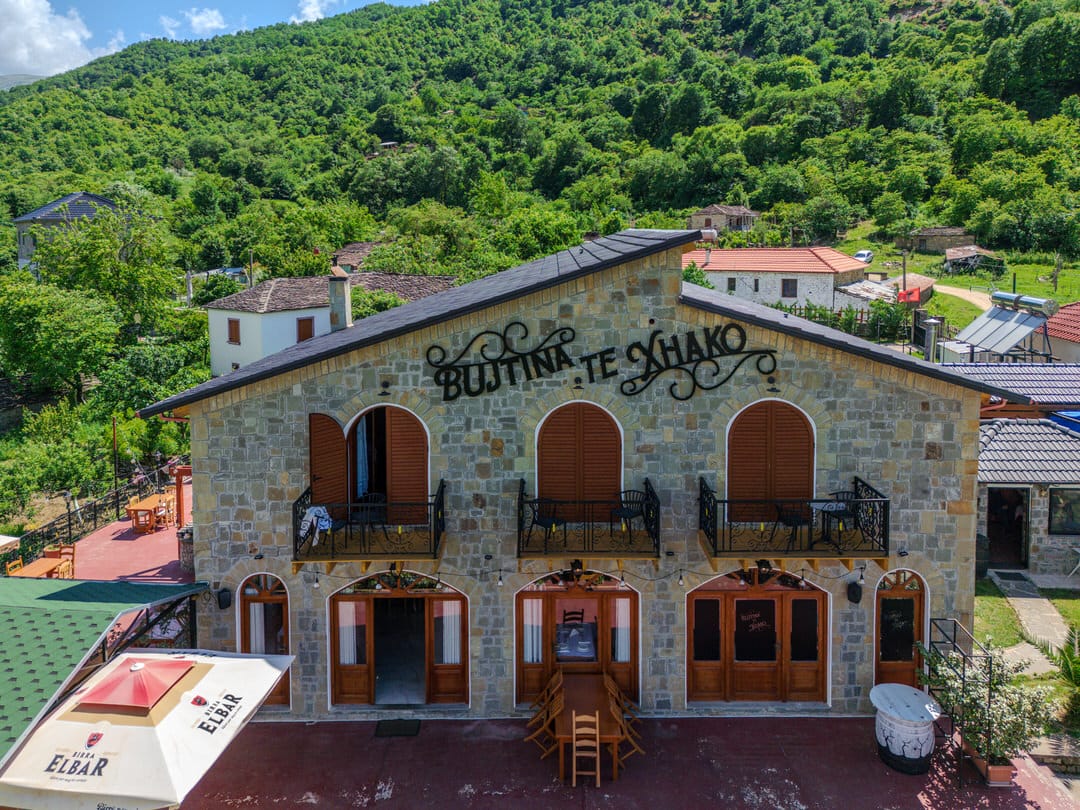
What waits is Bujtina Te Xhako—a restored three-story stone guesthouse that has quietly become one of Albania’s highest-rated accommodations (9.2/10 on Booking.com) not through marketing but through the simple power of doing agrotourism exactly right: impeccable traditional cooking using ingredients from surrounding gardens and forests, comfortable rooms in architecture that respects village heritage, and hospitality so genuine it makes guests feel like they’ve been adopted into an Albanian family rather than merely renting a room.
The Xhako family has created what agrotourism promises but rarely delivers—authentic immersion in village life without sacrificing either comfort or honesty. You sleep in a building where people actually live, eat food grown in gardens you can see from your window, hear the rhythms of agricultural seasons, and experience Albanian mountain culture as it exists rather than as tourism marketing presents it.
This combination—remoteness that discourages casual visitors, exceptional quality that rewards those who make the effort, landscape beauty that rivals anywhere in southern Albania—makes Grabovë worth understanding, even if most travelers never visit.
Why Visit Grabovë
Establishing honest expectations matters particularly with places like Grabovë. This is not a destination for travelers seeking extensive activities, nightlife, shopping, or the ability to move between multiple attractions quickly. The village offers essentially one accommodation option. Restaurant choices beyond your guesthouse don’t exist. Entertainment means conversation, walking, reading, and watching village life proceed at agricultural pace.
What Grabovë provides instead is increasingly rare: complete escape from tourism infrastructure and the chance to experience Albanian village life without performance or adaptation for foreign visitors. The elderly residents tend their gardens, make wine from family grape vines, gather wild herbs from mountain slopes, and conduct their daily routines regardless of whether anyone is watching.
Staying at Bujtina Te Xhako places you inside this world temporarily. The guesthouse operates as part of the village rather than separate from it—the Xhako family sources ingredients from surrounding gardens, employs neighbors for cooking and maintenance, participates in village festivals and religious observances, and maintains the kind of deep local knowledge that comes from generations of continuous residence.
The food alone justifies visiting. Albanian cuisine generally gets overlooked in international food conversations, dismissed as heavy peasant cooking without finesse or interest. The Xhako family’s kitchen demonstrates why this dismissal is ignorant. Their cooking represents mountain Albanian traditions at their finest—slow-cooked lamb that falls from bone, stuffed vegetables using produce harvested that morning, përshesh (cornbread soup) rich with free-range chicken, house wine from grapes pressed in the courtyard, grape raki that burns clean rather than harsh.
The setting provides the other half of the appeal. Grabovë sits above the Vjosa River—Europe’s last major wild river, flowing undammed from Greece through Albania to the Adriatic. The valley spreads below the village in patterns of agriculture and wild land, the river threading silver through green, mountains rising on both sides in formations that geology shaped over millions of years.
If you’re comfortable with limited options, willing to spend days walking and reading rather than checking off attractions, and interested in experiencing how Albanian villages actually function rather than how tourism presents them, Grabovë offers experiences that more developed destinations can’t match.
Bujtina Te Xhako: Agrotourism Done Right
The guesthouse occupies a restored stone house typical of village architecture—three stories stacked vertically, built entirely from local limestone with chestnut-beam ceilings and pine floors. The renovation maintained traditional features while adding modern necessities: eight en-suite rooms with comfortable beds and functional heating, hot water that works reliably, WiFi that functions adequately though not spectacularly.
What distinguishes Te Xhako from conventional rural accommodations is the complete integration between lodging and local food culture. The family maintains extensive gardens producing vegetables, herbs, and fruits used in the kitchen. They source meat from neighboring farms where they know exactly how animals are raised. Wine comes from family vineyards. Cheese arrives from shepherds in higher villages whose production methods haven’t changed in generations.
Breakfast begins with petulla—fried dough that emerges from the kitchen still hot, crispy outside and soft within, served with mountain honey and homemade preserves. Eggs come from chickens wandering the courtyard. Bread is baked daily in a traditional wood-fired oven. The coffee is Turkish-style, strong enough to provide necessary morning fortification. Mountain tea—a wild herb infusion unique to this region—offers a gentler alternative.
Dinner represents the kitchen’s real achievement. The menu changes based on what’s available—there is no printed menu, just whatever the family has sourced that day. Typical offerings include:
Të Mbushurat (stuffed vegetables): Peppers, tomatoes, and eggplants hollowed and filled with rice, minced meat, herbs, then baked until the vegetables collapse into their filling. The technique seems simple until you taste versions where timing and seasoning create completely different results. The Xhako kitchen gets this right—vegetables soft but not mushy, filling moist without being wet, herbs balanced so no single flavor dominates.
Përshesh: Cornbread crumbled into rich chicken broth, creating something between soup and porridge. This is mountain Albanian comfort food, the dish grandmothers make when grandchildren need nourishment and reassurance. The Xhako version uses free-range chickens that actually taste like chicken rather than vague poultry, broth simmered long enough to extract every bit of flavor, cornbread with enough structure to not completely dissolve.
Slow-cooked lamb: Mountain lamb differs from lowland versions—the meat tastes stronger, the fat distributes differently, the bones contain more marrow. Cooking it properly requires time and attention that restaurants rarely invest. Here, lamb roasts for hours in the wood-fired oven, emerging tender enough to eat with a spoon, seasoned simply because the meat needs no disguise.
The house wine—red and white varieties from grapes grown within sight of the terrace—won’t impress sommeliers trained on French appellations. But drunk with food it accompanies, in the place it was made, served by people who pressed the grapes themselves, it achieves exactly what village wine should: enhancement of the meal and the moment without demanding attention for itself.
Dinner typically costs €20 for two people including wine and raki—pricing that makes the quality seem impossible until you understand that nearly everything comes from sources measured in meters rather than kilometers, with minimal distribution costs and no intermediaries taking cuts.
The 9.2/10 rating on Booking.com reflects hundreds of visitors discovering that authentic agrotourism—when done with skill and genuine hospitality—exceeds what resort luxury provides. Guests consistently mention the warmth of the Xhako family, the exceptional food, the peaceful setting, and the sense that they’ve experienced something real rather than merely consumed a tourism product.
The Vjosa Valley and Këlcyrë Gorge
Grabovë’s position above the Vjosa River provides access to one of Europe’s most significant wild waterways. The Vjosa flows 272 kilometers from Greece through southern Albania to the Adriatic, remaining completely undammed throughout its length—the last major European river in this condition.
The river hosts diverse ecosystems: gravel banks where rare birds nest, deep pools holding endemic fish species, riparian forests providing crucial habitat for species pressured elsewhere. Environmental organizations have campaigned for years to designate the entire Vjosa watershed as a national park, protecting it from hydroelectric development plans that would dam the flow and destroy the ecological integrity.
From Grabovë, you can drive or hike down to the river’s edge in roughly twenty minutes. The valley floor at this point consists mainly of broad gravel banks and shallow channels perfect for summer swimming. The water runs cold even in August—this is snowmelt from Greek mountains, maintaining temperatures that shock skin accustomed to warmer seas or lakes.
The Këlcyrë Gorge, a few kilometers downstream, demonstrates the Vjosa’s power to carve landscape. The river slices through the Trebeshinë-Dhëmbel mountain range, creating canyon walls that rise hundreds of meters on both sides. The highway follows the gorge, offering continuous views of vertical limestone cliffs, river rapids, and the occasional shepherd leading flocks across impossibly steep terrain.
Rafting operators based in Përmet run trips through this section—mostly gentle floating with occasional rapids, suitable for families and inexperienced rafters. The Xhako family can arrange transport to put-in points and pickup at takeout locations.
St. Kyriaki Chapel and Hidden Worship
On Grabovë’s edge, beneath a massive oak tree estimated at over 200 years old, stands the small St. Kyriaki Chapel. The current structure is recent, rebuilt in the 1990s after Albania’s transition from communism. But the site’s significance reaches back through periods when openly practicing Christianity required dangerous deception.
During Enver Hoxha’s extreme atheism campaign (1967-1990), the communist government demolished or converted most religious buildings across Albania, proclaiming the country the world’s first atheist state. In Grabovë, villagers dismantled their chapel to avoid complete destruction, disguised the ruins as a barn, and gathered for clandestine worship beneath the oak tree where authorities were less likely to notice.
The practice carried genuine risk—religion was officially prohibited, and informers reported neighbors for even minor infractions. Families caught worshiping faced punishment ranging from job loss to imprisonment. Yet Grabovë’s small community maintained their faith through these decades, passing traditions to children in whispers, marking feast days in secret, preserving Orthodox practices that went back centuries.
After 1991, when religious freedom returned, villagers rebuilt the chapel on its original foundation, erecting the white cross now visible from the valley. The oak still dominates the site, its massive trunk and spreading canopy creating shade over both chapel and the graves of villagers who maintained faith through persecution.
The site functions as active church rather than museum—services occur on major feast days, with villagers and visitors from surrounding areas gathering to worship in the same location their grandparents risked punishment to maintain. Whether you’re religiously inclined or not, the chapel and oak together tell powerful stories about how communities preserve identity against state pressure to conform.
Kosinë Church: 13th-Century Frescoes
Six kilometers east of Grabovë, accessible via rough track requiring either high-clearance vehicle or willingness to walk the final kilometers, the Byzantine Church of Kosinë occupies a hillside position overlooking the valley.
Built in the 13th century—making it roughly contemporary with construction happening across Byzantine territories before Ottoman conquest—the church follows typical Orthodox architectural patterns: stone construction, barrel-vaulted ceiling, eastern apse for the altar, western narthex for those not participating in liturgy.
What makes Kosinë particularly valuable are the frescoes that still adorn interior walls. These paintings survived centuries of weather, Ottoman-era neglect (when Christian sites lost official protection and maintenance), communist-era abuse (when religious art became targeted for destruction), and the post-communist chaos when looters vandalized churches for anything saleable.
The frescoes show typical Byzantine religious iconography—Christ Pantocrator, the Virgin Mary, various saints and biblical scenes—executed by artists whose training connected them to broader Byzantine artistic traditions while incorporating local stylistic elements. The colors have faded dramatically from their original brightness, and large sections have been lost entirely to moisture damage and deliberate defacement.
But enough remains to demonstrate the quality of original work and the artistic sophistication that existed in this remote valley during medieval periods. The faces still show the characteristic Byzantine expression—eternal, slightly melancholic, focused on spiritual realm rather than physical world. The drapery demonstrates the technical skill required to suggest three-dimensional form through two-dimensional painting.
Visiting requires coordinating with local guides (the Xhako family can arrange this) who hold keys and know when the track is passable. The church remains active for worship, so visits should respect that this is sacred space for the Orthodox community rather than merely historical artifact.
Foraging, Cooking, and Agricultural Rhythms
One of Bujtina Te Xhako’s most popular offerings involves teaching guests to forage wild greens from mountain slopes, then preparing traditional dishes using what you’ve gathered.
Late spring (April-May) offers the best foraging—wild herbs emerge after winter dormancy, producing tender leaves ideal for cooking. The expedition typically begins after breakfast, with family members leading small groups up mountain paths to areas where specific plants grow reliably.
Learning to identify edible plants requires attention—many wild species look similar, and some have toxic variants that dangerous to consume. The guides point out lepjetë (wild greens that go into pie fillings), mountain oregano (stronger and more complex than cultivated versions), wild garlic, various herbs used in traditional medicine.
Gathering takes several hours, moving between different elevations and exposures as you search for plants at optimal growing stages. The walk itself provides value—these mountain trails offer extraordinary views across the valley, passing through forests and meadows that see few visitors.
Back at the guesthouse, the foraged greens get transformed into byrek—flaky pastry filled with herbs, cheese, and sometimes meat. The process involves making dough from scratch, rolling it impossibly thin (the mark of skilled byrek-makers), layering filling and fat, then baking in the wood-fired oven.
Watching experienced cooks make byrek demonstrates how much technique matters even in “simple” peasant food. The dough rolling requires specific hand movements developed through years of practice. The filling proportions affect texture and flavor in ways that become obvious when you eat versions where ratios are off. The oven temperature and timing determine whether pastry achieves the perfect balance of crispy and tender.
The experience connects visitors to agricultural traditions that predate supermarkets, packaged foods, and the entire infrastructure that makes modern eating possible while obscuring where food actually comes from. You’re eating greens you picked that morning, prepared using methods unchanged for generations, in the same place people have cooked this exact dish for centuries.
September-October brings grape harvest—the season when villagers pick fruit from family vineyards and begin the winemaking process. Visitors during harvest can participate in picking grapes, crushing them in traditional presses, and tasting last year’s wine while this year’s fermentation begins.
Practical Grabovë
Reaching Grabovë requires either rental car or coordinated use of public transport combined with taxi/arrangement with your guesthouse.
By car from Gjirokastër (65km northeast): Take highway SH4 toward Tepelenë, then SH75 following the Vjosa Valley through Këlcyrë Gorge. After Lekli Bridge, turn right onto the steep narrow road climbing to Grabovë (clearly marked once you know what to look for—not marked at all if you don’t). The drive takes roughly 100 minutes under normal conditions.
From Përmet (24km south): Follow SH75 north toward Këlcyrë, watching for the Grabovë turnoff shortly before reaching Këlcyrë town. The drive takes 30-40 minutes.
Furgons (minibuses) run the Përmet-Këlcyrë route regularly throughout the day. Tell the driver you’re going to Grabovë; they’ll drop you at the highway turnoff. From there, it’s a steep 10-15 minute uphill walk to the village center, or call Bujtina Te Xhako for pickup (they can arrange this when you book).
The village has no ATMs, shops, or restaurants beyond the guesthouse. Bring sufficient cash for your entire stay. The nearest ATM is in Këlcyrë (5km), the nearest substantial services in Përmet (24km).
Mobile coverage works adequately—Vodafone and One both provide 4G in most areas of the village. WiFi at Bujtina Te Xhako functions well enough for email and light browsing, though not ideal for streaming or large downloads.
Water from all taps and fountains is drinkable—this is mountain spring water that needs no filtration. Many visitors comment that it tastes noticeably better than what they’re accustomed to.
Best Time to Visit
Spring (April-June) offers ideal conditions: comfortable temperatures for walking, wildflowers blooming across mountain slopes, snow melting to create maximum water flow in streams and waterfalls, and the foraging season when wild greens are at their best. This is perhaps optimal timing for visitors interested in the agricultural and culinary aspects.
Summer (July-August) brings hot afternoons when the village’s elevation provides welcome relief from valley heat. Swimming in the Vjosa becomes essential daily activity. Evening temperatures remain pleasant for terrace dining and conversation. This is peak season—book well ahead.
Autumn (September-October) rivals spring for ideal conditions. September means grape harvest and the beginning of winemaking season. October brings autumn colors to mountain forests, cooler temperatures perfect for extensive hiking, and golden light that photographers appreciate. Early October can still offer swimmable water temperatures in the river.
Winter (November-March) sees the village quiet with minimal tourism. Many residents spend winters in lower towns, returning for spring planting. Bujtina Te Xhako operates year-round but with reduced capacity. This timing works for travelers seeking complete isolation and willing to accept that weather may limit activities.
Nearby Connections
Grabovë works well as part of southern Albania itineraries combining mountains, history, and coast:
Përmet (24km): Mountain town known for thermal baths, wine production, and access to Vjosa rafting. The Benja Thermal Baths lie 15km from Përmet—natural hot springs where you can soak in mineral water emerging at 28-30°C.
Gjirokastër (65km): UNESCO World Heritage “Stone City” with Ottoman architecture, massive fortress, and literary heritage as birthplace of Albania’s greatest writer.
Trebeshinë-Dhëmbel-Nemërçkë National Park: The mountains surrounding Grabovë form part of this protected area, offering extensive hiking trails, rare endemic plant species, and wildlife including bears and wolves in higher elevations.
Albanian Agrotourism’s Highest Expression
Grabovë demonstrates what Albanian agrotourism can achieve when done with genuine commitment to quality and authenticity rather than merely capitalizing on rural location and traditional architecture.
The Xhako family has created something valuable not by importing external tourism models but by perfecting what already existed—Albanian mountain village hospitality, traditional cooking using local ingredients, architecture that respects heritage while providing comfort, integration with community rather than isolation from it.
This approach produces experiences that mass tourism infrastructure can never match: you’re eating food that tastes specific to this place because it literally comes from this place, sleeping in buildings that reflect centuries of local architectural evolution, experiencing hospitality that emerges from cultural traditions rather than hospitality school training, seeing how Albanian village life actually functions rather than how tourism marketing presents it.
The village’s remoteness and limited capacity mean Grabovë will never become mass destination. That’s appropriate—some places can’t scale without losing exactly what makes them valuable. But for travelers willing to make the effort to reach it, comfortable with several days of limited options, and interested in experiencing Albanian mountain culture at its most authentic, Grabovë offers rewards that more developed destinations can’t provide.
The Vjosa flows past as it has for millions of years. The mountains rise unchanged despite centuries of human habitation. The village continues rhythms established long before tourism existed. You visit briefly, eat exceptionally well, walk in beautiful landscapes, and leave with understanding that authentic experiences still exist for those willing to travel beyond where signage makes everything obvious.