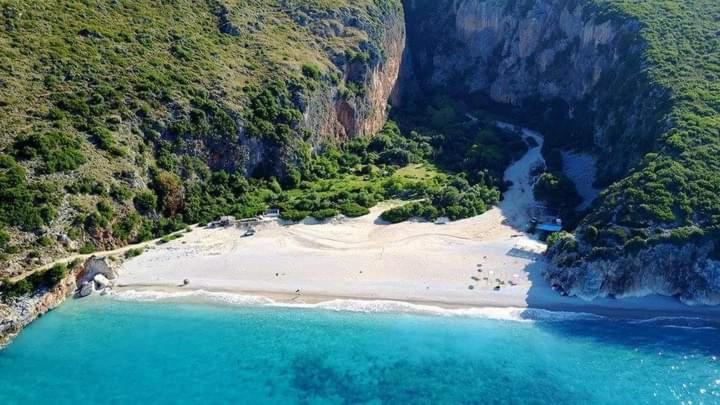
Where Geology Carved an Amphitheater to the Sea
From the coastal highway between Dhërmi and Himarë, nothing about the landscape suggests what waits hidden just inland. Olive groves descend toward the sea in familiar Mediterranean patterns. Concrete bunkers from Albania’s paranoid communist decades dot the hillsides. The view is pleasant enough but not particularly remarkable.
Then you reach the canyon rim, and the earth simply drops away.
Gjipe Beach reveals itself suddenly—an 800-meter gorge slicing through Triassic dolomites and Jurassic limestone, its walls rising 150 meters on either side of a pebble beach where fresh water meets salt at the exact transition point between Adriatic and Ionian seas. The canyon has been carving itself deeper for 252 million years, creating vertical geology that exposes layer upon layer of Mediterranean’s ancient seabed, now lifted and tilted and worn by relentless water into one of the coast’s most dramatic natural amphitheaters.
The beach itself occupies the canyon’s mouth—perhaps 100 meters of white pebbles where a seasonal stream emerges from inland valleys to meet waves that arrive gentled by the canyon’s protection. The water achieves that impossible clarity that characterizes Albania’s best beaches, visibility extending twenty meters down through water so transparent it seems to magnify rather than obscure the seafloor.
Standing at the canyon rim looking down, you understand immediately why Gjipe has remained relatively undeveloped despite being only a few kilometers from the increasingly built-up stretches of the Albanian Riviera. Access requires commitment—either a 45-minute steep descent on an exposed trail, or arrival by boat. There’s no road to the beach, no easy way to move construction equipment or resort infrastructure down those cliffs. Geography has protected this place through sheer inaccessibility.
That protection may not last much longer, but for now, Gjipe remains what the entire Riviera once was: wild, difficult to reach, and entirely worth the effort required to get there.
Why Visit Gjipe
Establishing realistic expectations matters with Gjipe. This is not a beach where you arrive by car, rent an umbrella, order cocktails, and spend a comfortable day lounging. Reaching the beach requires either physical effort (the hike) or financial investment (boat charter). There’s minimal infrastructure—seasonal beach bars of variable quality, basic camping facilities, nothing remotely approaching resort amenities.
What Gjipe offers instead is increasingly rare on the Mediterranean: genuine wildness. A beach where you camp on pebbles beneath vertical cliffs, swim in water hosting dolphins and loggerhead turtles, explore sea caves that legend claims once hid medieval pirates, climb routes bolted into limestone that predates mammals, and experience landscape drama that makes the effort to arrive feel insignificant compared to what you find.
The canyon creates a self-contained world. Once you’ve descended and the trail behind you disappears from view, you’re effectively isolated—no road noise, no visible development, nothing except limestone, sea, and whatever weather the Ionian chooses to send. Cell phone coverage is unreliable. The nearest town lies kilometers away. If something goes wrong, help takes time to arrive.
That isolation is precisely the point. Gjipe attracts visitors seeking experiences that organized tourism can’t deliver—rock climbers drawn by 30+ bolted routes ranging from beginner-friendly to genuinely challenging, wild campers willing to carry all supplies in and out, snorkelers and divers interested in pristine transition zone marine ecology, hikers wanting trails that feel genuinely adventurous rather than carefully managed.
If you need comfort, convenience, or guaranteed good weather, choose elsewhere. The Albanian Riviera offers dozens of beaches with better access and more reliable infrastructure. But if you’re comfortable with some uncertainty, willing to carry what you need, and interested in experiencing Mediterranean coast as it existed before mass tourism transformed everything accessible, Gjipe delivers something increasingly difficult to find.
Accessing the Hidden Canyon
Three routes reach Gjipe, each with distinct characteristics and requirements.
The Main Trail from Road
The standard approach begins at a barely-marked turnoff for “Manastiri i Shen Theodhorit” on the coastal highway, roughly equidistant between Dhërmi and Himarë. A single-lane paved road winds 2.5 kilometers through olive groves, passing numerous communist-era bunkers, ending at a parking area where local landowners collect €4 parking fees (€6 if camping overnight, cash only).
From the parking area, the trail descends roughly 300 vertical meters over 45 minutes to an hour, depending on fitness and load. The path is rocky, completely exposed to sun, and steep enough in sections that proper footwear becomes essential rather than recommended. Attempting this in sandals or flip-flops creates real injury risk, while trying it in midday summer heat without adequate water can lead to heat exhaustion.
The return climb typically takes longer—expect 45 to 75 minutes back up, significantly harder if you’re carrying camping gear. Starting the descent in late afternoon means climbing out during cooler evening hours, though you’ll need headlamps if the return extends past sunset.
Boat Access
Multiple operators in Himarë (7km south) and Dhërmi (3.5km north) run boat trips to Gjipe, typically charging €20-30 per person for return transport. Private charters cost €150-200 for groups, offering flexibility in timing and the ability to explore sea caves and coastline en route.
Approaching from water reveals the canyon’s drama more effectively than the land trail. The cliffs rise sheer from the sea, their stratification clearly visible in the exposed rock faces. The canyon mouth opens suddenly, revealing the beach inside like a secret being shared. For photographers, the perspective from approaching boats provides shots impossible to achieve from land.
Coastal Trail from Dhërmi
A 4-kilometer hiking trail connects Dhërmi Beach to Gjipe, following the coastline across terrain that alternates between rocky scrambling and easier walking. The route takes 90 minutes to two hours, offering continuous Ionian views but requiring more technical hiking ability than the main trail. Only attempt this route with proper footwear, adequate water (3+ liters per person in summer), and realistic assessment of your abilities.
This approach works well for strong hikers wanting to experience multiple beaches in a day—starting from Dhërmi, hiking to Gjipe for swimming and exploration, then either returning the same way or taking a boat back to Dhërmi.
14th-Century Monastery Above a Pagan Temple
The Saint Theodore Monastery occupies the canyon’s northern rim, its Byzantine architecture seemingly growing from the cliff edge. Founded in the 14th century on foundations that archaeological evidence suggests belonged to an ancient Greek temple dedicated to Zeus, the monastery represents centuries of religious continuity at a site people have considered sacred for millennia.
The complex expanded gradually over five centuries, with Byzantine monks adding chapels, cells, and defensive walls as resources permitted. By the 18th century, Saint Theodore’s had become an important pilgrimage destination for Greek Orthodox communities throughout the region, with the annual celebration on March 4th drawing faithful from across Epirus.
World War II brought the first major disruption. Occupying forces used the monastery as a military observation post, its position providing surveillance across the entire coast. The communist government that followed continued this militarization, converting the sacred complex into a military base in the early 1950s.
In a peculiar twist, the monastery briefly became holiday accommodations for Soviet naval officers in 1952, when Albania’s alliance with the USSR brought Russian military advisors to coastal positions. After Albania broke with the Soviet Union in 1961, the complex was abandoned entirely, falling into deterioration that lasted through communism’s collapse in 1991.
Recent restoration efforts have stabilized the main structures and reopened them for religious services. The March 4th celebration continues, though on a smaller scale than historical pilgrimages. The monastery’s position offers extraordinary views across the canyon and coast—worth the climb even for visitors not particularly interested in religious architecture.
The site demonstrates a pattern common across Albania: pagan temples converted to Christian use, Byzantine structures militarized under Ottoman and then communist rule, sacred spaces slowly reclaimed after decades of secular occupation. The layers accumulate, each period leaving marks while never completely erasing what came before.
Albania’s 750,000 Bunkers
Scattered across the landscape surrounding Gjipe—along the trail, on hillsides, even on the beach itself—small concrete domes emerge from vegetation like mushrooms after rain. These are Albania’s infamous bunkers, physical manifestation of dictator Enver Hoxha’s paranoid conviction that invasion was imminent.
Between 1967 and 1986, Hoxha ordered his chief military engineer Josif Zagali to construct over 750,000 bunkers across Albania. The mathematics are staggering: 14.7 bunkers per square mile, or roughly one bunker for every four Albanians. The construction consumed resources the impoverished nation could barely spare, diverting concrete, iron, and steel that might have built housing or infrastructure into defensive positions meant to protect against invasions that never came.
The bunkers came in multiple designs—small pillboxes for individual soldiers, larger positions for artillery, massive coastal batteries. All were built to last, using reinforced concrete and steel that makes removal prohibitively expensive (roughly €800 per bunker). As a result, most remain exactly where they were built, slowly being reclaimed by vegetation and converted to unofficial purposes: storage sheds, animal shelters, impromptu changing rooms for beachgoers.
Around Gjipe, the bunkers create surreal counterpoint to ancient geology and pristine nature. You’re hiking through landscape that took hundreds of millions of years to form, heading toward a beach of extraordinary natural beauty, and every few hundred meters there’s a concrete dome representing a 20th-century totalitarian state’s delusions about its own importance and vulnerability.
Photographers love them for exactly this tension—these brutal, angular artifacts of paranoia appearing in settings of transcendent natural beauty. They’re also genuinely useful as shade on the exposed trail and as landmarks for navigation.
The Adriatic-Ionian Transition Zone
Gjipe sits at the precise point where the Adriatic Sea meets the Ionian, creating unique marine conditions that manifest in water quality, temperature, and biological diversity.
The canyon’s protection eliminates most wave action, creating swimming conditions that feel more like a saltwater lake than open ocean. Water temperature ranges from 22-25°C June through November, occasionally reaching 19°C even in October as lingering summer warmth persists. The lack of currents makes the beach safe for children and nervous swimmers, though the typical pebble entry means no sandy gradual shallows.
The transition zone hosts exceptional marine biodiversity. Snorkelers encounter parrotfish, damselfish, amberjack, sea bream, and dense concentrations of sea urchins that make water shoes advisable. The urchin forests serve as nurseries for smaller fish species while supporting starfish and other invertebrates in complex ecological relationships.
Three dolphin species frequent these waters: common bottlenose dolphins, short-beaked common dolphins, and the deeper-water Cuvier’s beaked whale. Loggerhead sea turtles use the shallows, particularly during May-August nesting season when females come ashore on quieter beaches throughout the region.
Early morning or late afternoon boat excursions offer the best chances for dolphin sightings, though encounters remain unpredictable. The turtles prove easier to spot when snorkeling over seagrass beds where they feed.
The canyon also preserves botanical significance. Plantlife International recognizes the area as an Important Plant Area due to endemic Mediterranean species that grow nowhere else—plants adapted to the canyon’s specific microclimate, finding in this sheltered gorge conditions unavailable on exposed coastal slopes.
Even the pebbles themselves hold interest. The beach reveals smooth stones in dozens of colors—limestone whites and grays, darker dolomite, occasional reddish rocks showing iron oxidation. Geologically inclined visitors can read millions of years of deposition, uplift, and erosion in the variety of stone types mixed on a single beach.
Limestone Walls and Bolted Routes
Rock climbers discovered Gjipe in the 1990s, recognizing immediately that the canyon’s vertical limestone offered exceptional climbing potential. Over the following decades, various teams bolted 30+ routes across seven sectors, creating one of Albania’s premier climbing destinations.
The routes range from French grade 4b (suitable for strong beginners) to 8b+ (requiring elite skill). The most accessible sector, Garten Eden, offers introductory climbing on solid rock with reliable bolt placement. The Ahorn sector deeper in the canyon presents more challenging routes on steeper walls.
The Mare sector near the canyon mouth provides dramatic positions directly above the sea but suffers from salt spray that corrodes bolts faster than inland sections. Check local climbing forums for current bolt conditions before attempting Mare routes—several routes have been closed due to unsafe bolt degradation.
The limestone quality varies. Most of the canyon walls offer solid Jurassic limestone with good holds and reliable protection. Some sections contain more friable dolomite that requires careful route selection. Local climbing guides (available in Himarë and Dhërmi) know current conditions and can direct climbers to routes matching their abilities and risk tolerance.
The climbing season runs April through November, with May-June and September-October offering optimal conditions—moderate temperatures, reliable weather, fewer tourists crowding the beach below. Summer climbing is possible but requires very early starts to avoid midday heat that makes the sunny walls unbearably hot.
Beyond bolted sport routes, the canyon offers opportunities for bouldering, deep-water soloing above the sea, and exploratory climbing for adventurous teams willing to establish new routes.
Pirate’s Cave and Canyon Exploration
Sea caves puncture the canyon walls, carved by waves and freshwater seepage over millennia. The largest and most accessible is Pirate’s Cave, reachable by swimming or kayaking about 200 meters from the main beach.
The cave extends roughly 30 meters into the cliff, large enough to accommodate a dozen people standing. The acoustics create remarkable sound effects—whispers carry clearly, while louder sounds create echoing reverberations. Local legend claims medieval pirates used this cave to hide contraband and escaped slaves, which may or may not be historical but certainly enhances the atmosphere.
Swimming to the cave requires moderate ability and awareness of conditions. Even on calm days, surge near the cave entrance can be stronger than expected. Never attempt this swim alone, and turn back if conditions seem challenging.
Kayak rentals (€10 per hour from seasonal operators on the beach) offer safer exploration, allowing access to smaller caves and coves along the canyon walls without swimming the distances. The kayaking also enables exploring up the canyon beyond where swimmers can comfortably reach.
Walking inland up the canyon itself reveals different geological and botanical features. The path follows the seasonal stream roughly one kilometer to Petasma waterfall—though “waterfall” overstates what’s usually a trickle except during spring melt or after heavy rains. The canyon walk passes more bunkers, interesting rock formations, and increasingly dense Mediterranean scrub vegetation as you move away from the coast.
The Electronic Music Invasion
Something unexpected has developed in Gjipe over the past decade: the canyon has become a venue for electronic music festivals that bring thousands of international visitors to this remote beach for long weekends of performances in settings that seem designed for exactly this purpose.
Kala Festival typically occurs in late June, transforming Gjipe and neighboring beaches into stages for house, techno, and experimental electronic music. Anjunadeep Explorations follows similar timing, featuring artists from the London-based deep house and progressive label. These aren’t massive commercial festivals, but intimate events (2,000-5,000 attendees) that attract dedicated electronic music fans primarily from the UK and Europe.
The festival organizers construct temporary stages on the beach, install sound systems powerful enough to fill the canyon with bass frequencies that seem to resonate with the ancient stone, and create experiences where world-class DJs perform as the sun sets behind 150-meter cliffs. The 2023 Anjunadeep edition featured performances directly on Gjipe Beach, with sunset sets creating moments where music, landscape, and crowd achieved rare synchronization.
The festivals generate mixed local reaction. They bring substantial income to the region—hotels fully booked, restaurants at capacity, temporary employment for dozens. But they also bring noise, behavior that offends conservative sensibilities, and concerns about environmental impact from thousands converging on a beach with minimal sanitation infrastructure.
For travelers, the festivals represent either perfect timing (if you specifically want to experience electronic music in extraordinary settings) or weekends to absolutely avoid (if you’re seeking the quiet natural experience Gjipe offers most of the year). Check dates carefully when planning visits—the character of the place transforms completely during festival weekends.
The region also hosts the Himara International Music Festival in August, focusing on classical and chamber music that reflects the area’s Greek Orthodox heritage. This event draws older, quieter crowds but similarly transforms the local atmosphere during its run.
Wild Camping and Limited Infrastructure
Gjipe permits wild camping directly on the beach—one of the few remaining Albanian beaches where you can legally pitch a tent on pebbles and spend the night meters from the waterline. This creates opportunities for experiences increasingly rare on Europe’s developed coastlines: sleeping under stars with nothing but canvas between you and the elements, waking to sunrise over the Ionian, swimming before breakfast in water you have entirely to yourself.
The Gjipe Eco Campground operates seasonally (typically May through September), charging roughly €24 per night for designated camping spots with access to basic toilets and cold-water showers. “Eco” may overstate the facilities, but they maintain reasonable standards and provide the minimal infrastructure that makes multi-night stays feasible.
Wild camping outside the designated campground remains common, though technically prohibited. Enforcement is inconsistent—some periods see nobody checking, others bring local authorities demanding fees or ordering people to move. If wild camping, practice rigorous leave-no-trace principles: pack out all waste, don’t disturb vegetation, keep noise minimal, respect other campers’ space.
Critical point: there is no freshwater supply on the beach beyond what seasonal operators truck in. If camping, you must carry all water you’ll need—2-3 liters per person per day minimum, more in hot weather or if planning strenuous activities. Dehydration becomes dangerous when the nearest reliable water source requires a 45-minute hike.
Similarly, all food must be carried in, and all waste packed out. The seasonal beach bars serve basic meals (grilled fish, simple salads, cold beer) at roughly double the prices in nearby towns—expect €5 for a beer, €12-15 for simple meals. Cash only; the nearest ATM is in Dhërmi or Himarë.
The Development Threat
In August 2025, Albanian authorities arrived at Gjipe Beach with police escort and demolished the existing seasonal beach facilities—the simple bars and restaurants that had operated for years. The official explanation involved illegal construction on land that had been sold to developers. The unofficial story, widely believed locally, suggests the demolitions cleared the way for resort development planned by politically connected investors.
This incident represents part of Albania’s larger coastal development push. The government has set ambitious tourism revenue targets (€6.7 billion annually by 2030), requiring massive expansion of hotel capacity and resort infrastructure. Prime coastal land, including areas previously considered too difficult or remote for development, has been sold to developers whose plans often remain opaque until bulldozers arrive.
The new Llogara Tunnel, completed in 2023, cut 45 minutes off the drive from Vlorë, making Gjipe and the entire southern Riviera far more accessible. What once required commitment and time now lies within easy day-trip distance of Vlorë’s 130,000 residents. Increased accessibility inevitably brings increased development pressure.
Environmental protections exist on paper—Albania claims to protect 21.4% of its territory through various conservation designations. In practice, these protections prove flexible when confronting development interests. The controversial Vlorë International Airport is being constructed within a protected wetland. Resort developments appear inside supposed national parks.
Whether Gjipe will retain its wild character or succumb to resort development remains genuinely uncertain. The canyon’s steep terrain makes construction challenging and expensive, which provides some protection. But challenging and expensive don’t mean impossible, particularly when political will and investor capital align.
This uncertainty adds urgency to visiting. Places don’t stay unchanged—they evolve, develop, transform. Gjipe as it exists now, with wild camping on pebbles and minimal infrastructure, may not be Gjipe in five years. The Mediterranean has already lost most of its wild beaches to development. Albania’s coast represents some of the last holdouts, and those holdouts are shrinking.
Practical Requirements
Visiting Gjipe successfully requires preparation beyond what typical beach days demand:
Essential Items:
- 2-3 liters of water per person (3+ liters if hiking in summer heat)
- Sturdy hiking shoes (ankle support recommended for the trail)
- High-SPF sunscreen (zero shade on the descent)
- Cash in small denominations (LEK or euros)
- First aid supplies (the trail creates opportunities for scrapes and twisted ankles)
- All food for the day (if not buying at beach restaurants)
- Waterproof phone case (for cave exploration and general beach use)
If Camping:
- All camping gear (tent, sleeping bag, pad)
- All food for the duration
- Additional water (5+ liters per person per day)
- Portable toilet arrangements (or acceptance that sanitation is primitive)
- Headlamps with extra batteries
- Warm layers (nights can be surprisingly cool even in summer)
The return hike takes 30-75 minutes depending on fitness, load, and trail conditions. Build in extra time rather than rushing—the trail is unforgiving when fatigued. Cell coverage is unreliable at beach level. Emergency number is 112, but the nearest hospitals are in Vlorë (42km) or Himarë (7km), meaning serious injuries require extended evacuation time.
Weather monitoring matters more here than at accessible beaches. The canyon can flood during heavy rains, creating genuine danger from flash flooding. The trail becomes treacherous when wet. If weather looks uncertain, postpone your visit.
Best Time to Visit
September offers optimal conditions: water still warm (22-24°C) from summer heating, summer crowds departed, accommodation prices dropped 30-50%, weather generally stable though occasional autumn storms become more likely. Early September is particularly good, retaining summer’s energy without its excesses.
June works well for those willing to accept cooler water (20-22°C). The landscape shows spring green, wildflowers bloom in the canyon, and tourist infrastructure is fully operational without peak-season crowding. Festival weekends transform the scene entirely—check schedules.
July-August brings guaranteed warm weather, warmest water, maximum crowds, and highest prices. The trail becomes genuinely punishing in midday heat. These months work only if your schedule allows no alternative or if you specifically want to experience the festival scene.
May and October represent shoulder season gambles—possible to get perfect conditions and very few people, also possible to encounter rain, cooler temperatures, and reduced services as operators close for the season. Water temperature in May (18-20°C) and October (19-21°C) is swimmable but requires acclimation.
Nearby Destinations
Gjipe’s position in the heart of the Albanian Riviera makes it an ideal anchor for exploring the coast:
Dhërmi (3.5km): The nearest town offers full accommodation and dining infrastructure, with the old Orthodox village on the hillside and beach development below presenting fascinating cultural contrasts.
Himarë (7km): The Riviera’s largest town provides extensive services, good restaurants, and a sizable old quarter worth exploring for its Greek Orthodox architecture and coastal fortress.
Jale Beach (2km south): Perhaps the Riviera’s most hedonistic beach, where party atmosphere runs continuously through summer.
Llogara National Park (20km north): Mountain scenery, hiking trails through pine forest, the dramatic Llogara Pass, and paragliding launches with extraordinary Ionian views.
The Last Wild Mediterranean
Gjipe forces a question that many travelers prefer to avoid: what are you actually seeking when you go to the beach?
If the answer involves comfort, convenience, reliable services, and ease of access, dozens of excellent beaches throughout Albania and the broader Mediterranean deliver those experiences without requiring 45-minute hikes down exposed trails carrying everything you need.
If the answer involves something more difficult to articulate—a desire to experience coastline that feels genuinely wild, a willingness to trade comfort for drama, an appreciation for places that demand effort before revealing their rewards—then Gjipe offers something increasingly difficult to find.
The canyon has carved itself for 252 million years. Humans have occupied it for at least two millennia, farming olives in the microclimate, building monasteries on the rims, conducting whatever business medieval pirates actually conducted in those caves. Communist dictators added bunkers. Contemporary Albanians add music festivals and eco-campgrounds and seasonal beach bars.
All these layers accumulate without erasing what came before—the geology remains dramatic, the water impossibly clear, the isolation real despite encroaching accessibility. Whether these qualities survive the development pressures now approaching remains genuinely uncertain.
For now, you can still descend that trail, set up a tent on pebbles, swim in water hosting dolphins and turtles, climb routes on Jurassic limestone, and wake to sunrise over the Ionian with nothing between you and the elements except canvas. These experiences won’t be available forever at this particular location. Mediterranean history suggests they eventually disappear beneath resort development.
The honest recommendation: if Gjipe interests you, don’t wait. The canyon will outlast all human development—limestone endures while civilizations rise and fall. But the experience of that canyon in its wild state has an expiration date none of us can precisely predict.