How to Get to Durrës
From Tirana
- By Bus: Frequent buses (every 20-30 minutes) from northern terminal. Journey takes 40-60 minutes and costs 150-200 LEK (€1.50-2).
- By Car: 38km via SH2 highway. Drive time approximately 30-45 minutes (heavy traffic during rush hours).
From Italy
- By Ferry: Direct ferries from Bari, Italy (8-9 hours, multiple daily in summer) and Ancona (15-16 hours). Book ahead in summer, especially with vehicles.
From Albanian Riviera or South
- By Bus: Regular buses from Vlorë (2 hours, 400-600 LEK) or Sarandë (5-6 hours, 1,500-2,000 LEK).
- By Car: 147km from Vlorë via A2 highway (2-2.5 hours).
Note: Durrës port is 3km from city center. Taxi from port 500-800 LEK (~€5-7).
The Amphitheater That Disappeared Beneath a City
In 1966, construction workers digging foundations for a new housing block on Kalaja Street broke through concrete and earth to discover something unexpected: massive stone blocks arranged in a perfect arc. They’d accidentally rediscovered the Roman amphitheater of Dyrrachium, one of the ancient world’s largest entertainment venues, which had been completely buried and forgotten for over a thousand years.
What they uncovered was staggering—an elliptical structure built to hold 15,000 to 20,000 spectators, making it the largest Roman amphitheater in the Balkans and among the largest anywhere in the former Roman Empire. The structure had been so thoroughly absorbed by later construction that apartment buildings literally sat atop its highest tiers, residents living above ancient stone vaults without ever knowing what lay beneath their homes.
This discovery captured something essential about Durrës: it’s a city where extraordinary history exists not in carefully preserved archaeological parks, but embedded directly in urban fabric—ancient and modern so intermingled that you can’t separate them without demolishing half the city.
Today, you can walk into this amphitheater through a nondescript entrance on a busy street, descend stairs past excavated walls, and emerge into the exposed arena where gladiators once fought for the entertainment of Roman Adriatic elites. Then you look up and see modern apartment buildings framing the sky where the upper tiers would have been, laundry hanging from balconies above 2,000-year-old masonry.
It’s jarring, vaguely absurd, and absolutely fascinating—a perfect introduction to a city that refuses to treat its ancient past as something separate from present-day life.
Why Visit Durrës
Let’s establish honesty immediately: Durrës is not beautiful. Albania’s second-largest city and primary port, it’s a working urban center that suffered particularly badly from communist-era planning, post-communism chaos, and the 2019 earthquake that damaged or destroyed thousands of buildings. The beachfront has been overdeveloped with hotels and restaurants of wildly varying quality. The city center combines Ottoman remnants, Italian colonial architecture, communist blocks, and recent construction in a jumble that urban planners would call “challenging.”
What Durrës offers instead of beauty is significance—historical weight that few Albanian cities can match. This was ancient Epidamnos, founded by Greek colonists in 627 BCE, later becoming Dyrrachium under Roman rule when it served as the western terminus of the Via Egnatia, the great highway connecting Rome to Byzantium. For centuries, this was where overland routes from the eastern Mediterranean met Adriatic shipping lanes to Italy, making it one of the most strategically important cities in the region.
That history manifests in layers you encounter while walking ordinary city streets. The amphitheater is the most dramatic example, but Byzantine Forum foundations sit behind shop fronts, sections of city walls from the 5th century emerge between buildings, Roman bathhouses wait beneath parking lots. The city functions as a living archaeological site where discovering ancient remains means occasionally disrupting modern life rather than cordoning off pristine ruins.
For travelers arriving on ferries from Italy, Durrës serves as introduction to Albania—often their first impression of the country after the short crossing from Bari or Ancona. As introduction, it’s honest: here’s a place with extraordinary past meeting complicated present, where tourism infrastructure coexists with working-class Albanian life, where ancient amphitheaters share neighborhoods with fish markets and shipping containers.
If you need picture-perfect preservation and seamless tourist experiences, skip Durrës for Berat or Gjirokastra. But if you’re curious about how Albanian cities actually function when they’re not primarily performing for tourists, Durrës reveals realities that more carefully curated destinations conceal.
The Balkans’ Forgotten Colosseum
The Roman Amphitheater dominates any serious visit to Durrës, both for its scale and for what it represents about how cities absorb their own histories.
Built in the early 2nd century CE (probably during Emperor Trajan’s reign, though some scholarship suggests Hadrian), the structure reflects Dyrrachium’s importance within the Roman Empire. Cities didn’t get amphitheaters of this size unless they were significant—this was infrastructure for entertaining large populations and demonstrating Roman cultural dominance over conquered territories.
The structure followed typical Roman amphitheater design: an elliptical arena surrounded by rising tiers of stone seating, with underground chambers and corridors for moving gladiators, animals, and equipment. At capacity, it could hold a substantial portion of ancient Dyrrachium’s population, creating the kind of mass spectacle that Romans used to maintain social order and political control.
What makes this amphitheater particularly intriguing is its later transformation. By the 6th or 7th century, when gladiatorial games had been banned and the Roman Empire had officially Christianized, someone converted part of the amphitheater into a chapel. The mosaics that decorated this chapel floor—depicting saints and Christian symbols—still survive, preserved by the very burial that hid the amphitheater for centuries.
Walking through the excavated sections reveals the building’s evolution. You see original Roman construction—massive limestone blocks fitted without mortar, drainage systems still visible beneath arena sand. You see the Byzantine chapel built into what were once spectator corridors, its floor mosaics showing figures of saints with Greek inscriptions. You see medieval walls built from Roman stones, scavenged and repurposed when the amphitheater became a convenient quarry for later construction.
Then you look up at apartment buildings literally incorporating the amphitheater’s upper tiers into their foundations, built in the 1960s and 70s when Albania’s communist government was constructing housing without particular concern for anything buried underground.
The whole complex tells a story about continuity—how cities keep building on the same ground, each generation using what previous inhabitants left behind, until the original structure disappears beneath accumulations of later life.
Visiting practicalities: The amphitheater entrance lies on Kalaja Street in the city center (entrance fee 300 lek, roughly €3). Opening hours vary seasonally but generally run 9 AM to 5 PM. The site isn’t large—you can thoroughly explore the accessible sections in thirty to forty minutes—but it rewards careful attention to details like the chapel mosaics and the way different historical periods intersect in the architecture.
Via Egnatia’s Western Gateway
If the amphitheater represents Durrës’ importance within Roman leisure culture, the city’s position as western terminus of the Via Egnatia reveals its commercial and military significance.
The Romans built this highway in the 2nd century BCE to connect their newly conquered territories in Greece and Macedonia to the Adriatic coast. From Durrës, goods and soldiers could ship easily to Brindisi in southern Italy, making the overland journey to Rome relatively straightforward. The road ran over 1,000 kilometers eastward through what’s now North Macedonia and northern Greece, eventually reaching Byzantium (later Constantinople, now Istanbul).
This positioning made ancient Dyrrachium wealthy. The city controlled the crucial junction where eastern overland trade met western maritime routes. Merchants paid taxes here, armies resupplied, diplomatic missions transferred from ship to road or vice versa. Roman writers including Strabo and Cicero mentioned Dyrrachium’s commercial importance, while archaeological evidence—particularly coins found in the city—shows trade connections spanning from Britain to Persia.
Sections of the Via Egnatia still exist in Albania, though most have been built over or disappeared entirely. Near Durrës, some scholars identify ancient road remnants, though separating original Roman construction from later repairs becomes difficult after two millennia of continuous use and rebuilding.
What’s unquestionable is the port’s continuing importance. Modern Durrës remains Albania’s primary maritime gateway, with ferries running daily to Bari and Ancona in Italy, occasional routes to other Adriatic ports, and cargo shipping that handles most of Albania’s import-export trade. The port has functioned continuously for over 2,600 years—among the longest-operating commercial harbors in the Mediterranean.
The Byzantine Walls and Venetian Tower
Durrës’ defensive walls reveal the city’s strategic vulnerability—its coastal position made it valuable but exposed to attack from both land and sea.
The oldest substantial fortifications date to Byzantine Emperor Anastasius I in the late 5th/early 6th century CE. Anastasius, who was actually born in Dyrrachium before becoming emperor, funded extensive city walls incorporating earlier Roman defensive works. Sections of these Byzantine walls still stand, particularly on the western side of the old city, their massive blocks testament to the engineering required to protect a coastal urban center.
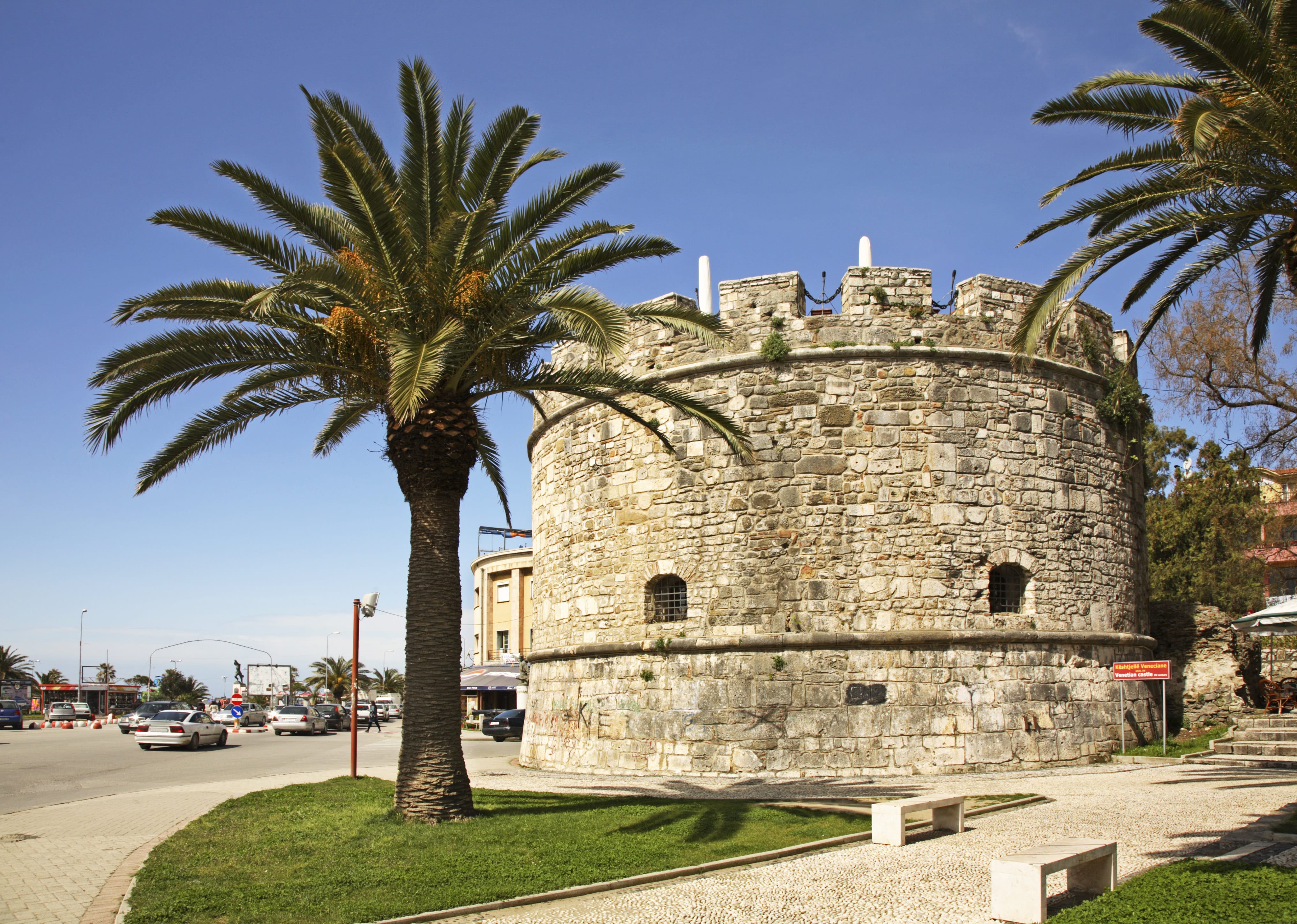
The Venetian Tower, one of Durrës’ most photographed monuments, actually sits atop Byzantine foundations. Venetians controlled the city periodically during the medieval period, each occupation adding to or repairing defensive structures. The current tower dates primarily to the 15th century, though it incorporates stones from earlier periods in the characteristic medieval pattern of recycling ancient building materials.
Climbing the tower (when open to visitors—hours can be irregular) provides panoramic views across the city and port, the same surveillance advantage that made this high point militarily valuable for over a thousand years.
The Archaeological Museum
The Archaeological Museum of Durrës, located near the beachfront, houses Albania’s second-largest collection of ancient artifacts after the National History Museum in Tirana.
The collection spans the full chronology of human habitation in this region: Illyrian artifacts from the pre-Greek period, Greek pottery and sculptures from the colonial era, Roman statuary and household items, Byzantine religious objects, and medieval materials through the Ottoman period.
Highlights include:
The Venus of Durrës: A 2nd-century CE Roman copy of a Greek original, showing the goddess in classical contrapposto pose. The sculpture’s quality suggests Durrës’ wealthy elite could afford first-rate artwork.
Illyrian Gold: Jewelry and decorative objects from pre-Roman burials, demonstrating the sophistication of indigenous culture before Greek colonization.
Greek Ceramics: Imported pottery showing Durrës’ ancient trade connections with Athens, Corinth, and other Greek city-states.
Byzantine Mosaics: Fragments rescued from destroyed churches, their tessellation preserving patterns and religious imagery from Christianity’s early centuries.
The museum building itself represents communist-era architecture from the 1950s—functional brutalist design that makes no concessions to aesthetic considerations. It’s currently (as of 2024) undergoing renovations that have closed certain sections, though the main collection remains accessible. Verify current status before visiting.
The Beach Reality
Durrës Beach stretches roughly 10 kilometers along sandy coastline north and south of the port. This is not the crystalline water and dramatic scenery of the Albanian Riviera—it’s an urban beach serving primarily local Albanian tourists, especially from nearby Tirana, who descend en masse during summer weekends.
The beachfront has been heavily developed with hotels, restaurants, beach clubs, and seasonal infrastructure of widely varying quality. Some establishments are genuinely nice—clean facilities, decent food, professional service. Others are decidedly rough, operating on minimal standards and charging prices that reflect their captive weekend audience.
The water quality has improved significantly from the pollution that plagued the beach during the 1990s and early 2000s, though it still doesn’t match the pristine conditions further south. The sand is fine and the beach broad, making it perfectly acceptable for sunbathing and swimming if you’re not expecting paradise.
Summer (June-August) brings crowds that can feel overwhelming, with beaches packed nearly solid during July-August weekends. Hotels raise prices, restaurants get crowded, traffic along the coastal road slows to frustration. If you visit during peak season, adjust expectations accordingly.
The beach works best as a day trip from Tirana (frequent buses make the 40-minute journey) or as a brief stop for ferry passengers with time before embarkation. As a primary beach destination, the Riviera offers dramatically better options.
Practical Port City Life
Durrës functions primarily as a working city rather than tourist destination, which means infrastructure focuses on resident needs rather than visitor convenience.
Getting there: The city lies 38 kilometers west of Tirana, connected by highway that sees heavy traffic but makes the journey in 30-45 minutes depending on conditions. Buses run frequently from Tirana’s northern bus terminal (cost: 150-200 lek). For ferry passengers, the port lies at the city’s southern edge, about 3 kilometers from the amphitheater and city center—easily reached by taxi (500-800 lek) or bus.
Ferry connections: Multiple daily ferries run to Italian ports during summer season (April-October), with reduced frequency in winter. Bari is the most common destination (8-9 hours crossing), with Ancona also served regularly (15-16 hours). Book ferry tickets in advance during summer, especially if traveling with a vehicle. Ticket offices cluster near the port entrance, though online booking through companies like Adria Ferries or European Seaways is often more convenient.
Accommodation: Hotels range from basic €20-30 guesthouses to €60-100 beachfront properties. The city doesn’t attract luxury tourism, so even “upscale” options are modest by international standards. Many visitors overnight in Durrës only when catching early ferries, in which case proximity to the port matters more than amenities. Budget chain hotels like Vila Park and Select Hotel offer clean, functional rooms near the port.
Dining: Seafood restaurants dominate the beachfront, their quality variable. As general rule, places busy with Albanian families indicate better value and execution than those surviving purely on tourist traffic. The city center has Albanian tavernas serving standard grilled meats, pasta, and traditional dishes at reasonable prices (€5-8 for complete meals). Pizza is ubiquitous and generally acceptable if not exceptional.
When to Visit
Spring (April-June) brings comfortable temperatures without oppressive crowds. The beach becomes swimmable by late May, while museums and archaeological sites operate without the summer crush. This is ideal timing for visitors interested primarily in history rather than beach activities.
Summer (July-August) means maximum crowds, highest prices, intense heat, and beaches packed with Tirana residents escaping the capital. Ferry schedules run most frequently, but book well ahead. Only visit during peak summer if your schedule allows no alternative.
Autumn (September-October) rivals spring for optimal conditions—water still warm from summer heating, crowds diminished, prices dropping. September is particularly good, with reliably warm weather and functioning summer infrastructure without summer chaos.
Winter sees most beach establishments closed, reduced ferry schedules, occasional rough weather. The archaeological sites and museums remain accessible, making this viable for ferry passengers or those specifically interested in urban exploration without tourist infrastructure. Budget significantly less for accommodation as beachfront hotels drop prices dramatically.
Nearby Destinations
Durrës’ proximity to Tirana and position on the main coastal highway makes it a convenient base for several excursions:
Apollonia (80km south): Ancient Greek and Roman archaeological site with substantial ruins and excellent museum. Allow half-day for meaningful visit.
Krujë (60km northeast): Medieval castle town, Albania’s center of resistance against Ottoman conquest, with bazaar and museums dedicated to national hero Skanderbeg.
Cape of Rodon (35km north): Relatively undeveloped peninsula with medieval church ruins, beaches less crowded than Durrës proper, and scenic coastal landscapes.
Berat (120km southeast): UNESCO World Heritage site with exceptional Ottoman architecture and hilltop castle. Full-day excursion or overnight stay recommended.
The Gateway’s Role
Durrës occupies an unusual position in Albania’s tourism landscape—it’s simultaneously too important to ignore (main port, major historical sites) and too rough around the edges to rank among the country’s premier destinations. Most guidebooks mention it dutifully while directing travelers toward more obviously appealing options.
That ambivalence is understandable but somewhat unfair. Yes, the city has been poorly planned and inconsistently developed. Yes, the beach doesn’t rival the Riviera. Yes, significant archaeological sites sit embedded in decidedly unglamorous urban contexts.
But Durrës also demonstrates how Albanian cities actually work when they’re not performing primarily for tourism—where ancient ruins coexist with bus terminals and fish markets, where history is something you live among rather than visit at designated hours. The amphitheater alone justifies a visit for anyone interested in Roman architecture, while the city’s role as the Via Egnatia’s western terminus connects it to geographical and historical narratives spanning the ancient Mediterranean world.
For ferry passengers arriving from Italy, Durrës provides honest introduction to Albania—a country with extraordinary historical depth and contemporary challenges, where tourism is emerging but hasn’t yet transformed everything into carefully managed experiences designed for foreign consumption.
If you’re traveling between the port and destinations elsewhere in Albania, consider spending a few hours exploring the amphitheater and museum rather than rushing through immediately. The city reveals more to those willing to engage with its complications than to those seeking simple pleasures.
That’s not a criticism of travelers who prefer the latter—perfectly reasonable to want uncomplicated beach holidays or seamlessly presented historical sites. Just an acknowledgment that Durrës offers something different: a working city where ancient significance persists not in spite of modern realities but interwoven with them, messy and imperfect and genuinely interesting for exactly those reasons.