How to Get to Dhërmi
From Tirana
- By Bus: Multiple daily buses from southern terminal. Journey takes 4-5 hours and costs 1,500-2,000 LEK (€13-17).
- By Car: 210km via Fier and coastal SH8. Drive time approximately 4 hours including spectacular Llogara Pass.
From Sarandë
- By Bus: Regular buses along coastal SH8. Journey takes 1.5 hours and costs 400-500 LEK (€3.50-4.50).
- By Car: 65km via coastal road. Drive time approximately 1.5 hours.
From Vlorë
- By Bus: Frequent buses heading south. Journey takes 1.5 hours and costs 500-600 LEK (€4-5).
- By Car: 80km via dramatic SH8 coastal road and Llogara Pass. Drive time approximately 1.5 hours.
Note: Internal village access requires either driving switchback road (3km of tight curves) or descending steep stairs from old village to beach (20-minute walk down, harder coming back up).
Two Worlds, One Hillside
The old women in black still gather every morning outside the Church of St. Athanasios, their Greek-accented Albanian carrying across stone lanes that have echoed with Orthodox liturgy for three centuries. Below them, perhaps four hundred vertical meters down the mountainside, bass frequencies from beach bars pulse across water so clear you can count stones on the seafloor from ten meters up.
This is Dhërmi, where two completely different versions of Albania occupy the same geographic coordinates.
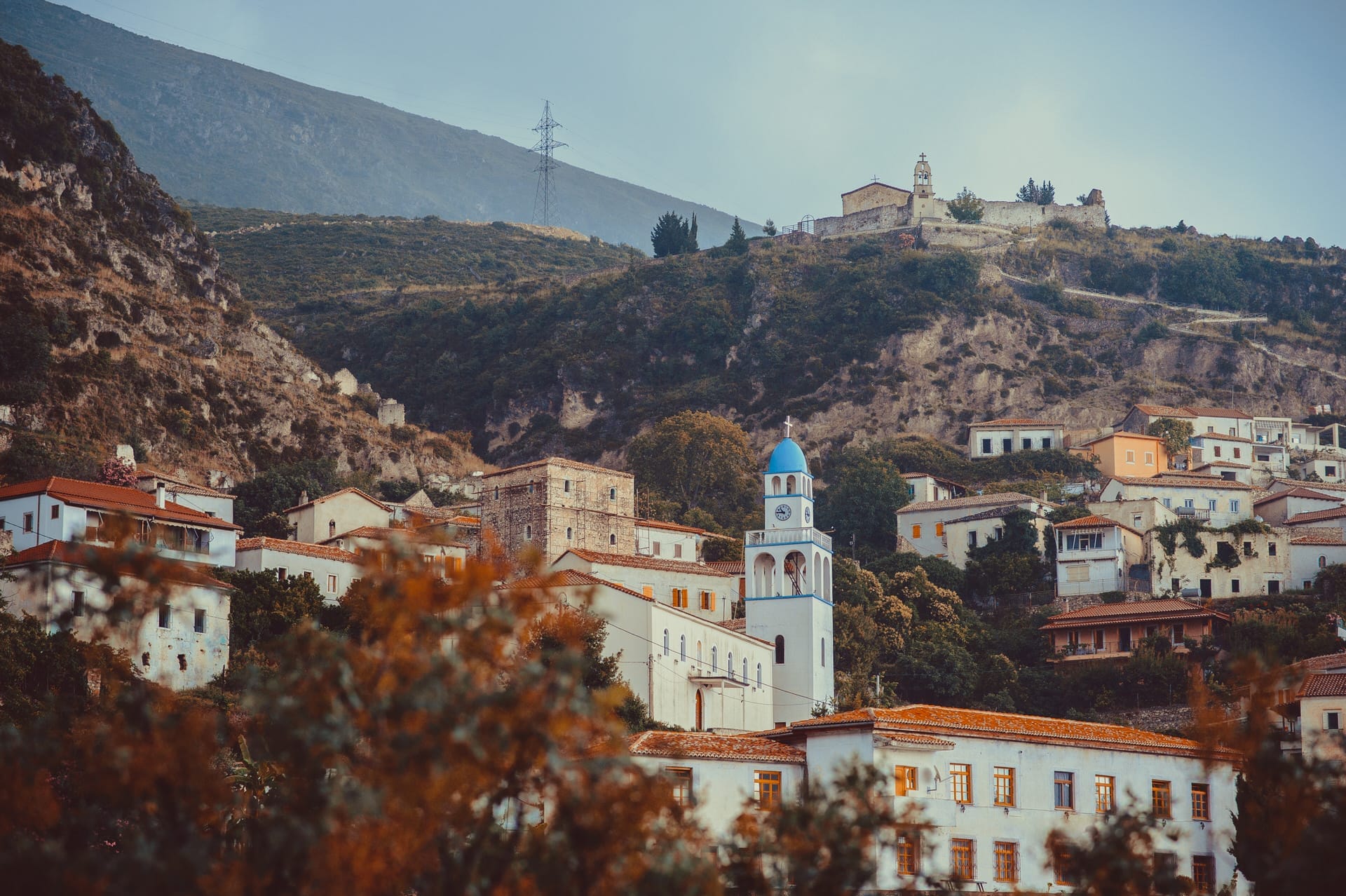
The original village clings to the steep slopes of the coastal mountains, its stone houses terraced into terrain that made agriculture challenging but provided safety when pirates controlled these waters. Greek Orthodox families who settled here in the 17th and 18th centuries built churches, maintained Byzantine traditions, and created a distinct cultural identity that persisted through Ottoman rule, communist isolation, and the chaotic transition that followed communism’s collapse.
Then tourism arrived with the force and suddenness of a summer thunderstorm.
The beaches below the old village—pebbled shores that locals had always used but never commercialized—attracted first backpackers, then developers, eventually major international music festivals that bring tens of thousands to this stretch of coast every summer. Within two decades, the beach became an almost entirely separate settlement, with hotels, bars, restaurants, and seasonal infrastructure that has little connection to the village three hundred meters above.
The relationship between these two Dhërmis remains complicated. Many of the beach hotels and businesses are owned by families from the old village, providing income that keeps the community viable. Yet the cultural gap feels vast—elderly Orthodox women crossing themselves before icons while electronic music drifts up from beach clubs that don’t close until sunrise represents a clash of worlds that no guidebook adequately captures.
This tension makes Dhërmi fascinating in ways that simpler destinations can never be. You can experience both versions in a single day—morning liturgy in a Byzantine church, afternoon swimming in water that rivals anything in the Mediterranean, evening drinks watching sunset turn limestone cliffs golden, night dancing at beach parties that attract DJs from London and Berlin.
Why Visit Dhërmi
If you need destinations to fit into neat categories, Dhërmi will frustrate you. It’s neither pure beach resort nor authentic cultural village, but something hybrid that doesn’t conform to conventional tourism narratives.
What Dhërmi offers instead is a window into how Albania’s coast has transformed over the past two decades—the opportunities and tensions that arise when international tourism meets communities with deep-rooted traditions. The beaches genuinely rank among the Albanian Riviera’s finest, with water clarity and pebble perfection that justify their growing reputation. The old village preserves an architectural and cultural heritage that becomes rarer with each passing year as younger generations migrate to Tirana or abroad.
The music festival scene—particularly Anjunadeep Explorations and Kala Festival—has established Dhërmi as a legitimate destination on the European electronic music circuit, bringing international visitors who might never otherwise discover Albania. For paragliding enthusiasts, the launches from peaks above Dhërmi offer some of the Mediterranean’s most dramatic flights, soaring above cliffs with the Ionian spreading blue and infinite below.
But the real reason to visit Dhërmi is experiencing how these elements coexist. How does a conservative Orthodox community adapt when their quiet beaches become party destinations? How do traditional values persist when summer brings an invasion of tourists whose culture and behavior couldn’t be more different? The answers play out daily in this village, creating social dynamics far more interesting than simple beach relaxation.
Summer (June-August) brings crowds that can overwhelm both the beaches and the narrow coast road, turning what should be a scenic drive into a frustrating crawl. Prices spike, accommodation becomes scarce, and the tranquil atmosphere the old village once knew completely disappears. If you visit during peak season, accept these realities or choose elsewhere.
Shoulder seasons (May and September) offer everything summer promises—warm water, reliable sunshine, functioning beach infrastructure—without the overwhelming crowds. The old village also becomes more accessible when tourism pressure eases, making it possible to actually engage with the community rather than just photographing it.
The Original Village
Old Dhërmi occupies steep terrain that seems to defy practical habitation. Stone houses built into hillsides create a vertical village where “neighbors” might live twenty vertical meters apart, connected by stairs that locals climb with the unconscious ease of lifelong practice while visitors arrive gasping.
The architecture reflects both geography and heritage. Houses use local limestone, their thick walls providing insulation against summer heat and winter storms. Many retain traditional features—arched doorways, wooden balconies, terracotta roof tiles that weather to colors ranging from rust to amber. Some have been renovated by families who returned from emigration with capital to invest; others deteriorate slowly as elderly residents age without younger generations to maintain them.
The Church of St. Athanasios
The village’s spiritual center stands near its highest point, a relatively modest structure whose significance far exceeds its size. Built in the late 17th or early 18th century (documentation from that period remains incomplete), the church preserves Byzantine architectural traditions and maintains services in Greek—a reminder that until recently, many villagers spoke Greek as their first language.
The interior contains faded frescoes that hint at what must have been more vibrant decoration before centuries of candle smoke, humidity, and the deliberate neglect of the communist period took their toll. The iconostasis, though damaged, shows skilled woodcarving that suggests the community once had enough wealth to commission significant artistic work.
Services still occur most Sundays, attended primarily by the village’s elderly population. Whether you’re religiously inclined or simply interested in cultural preservation, attending a liturgy offers rare access to traditions that function authentically rather than as tourist performance. The priest typically welcomes respectful visitors, though basic cultural sensitivity applies—modest dress, quiet observation, photography only with permission.
Hypapante Church and Panagia Monastery
Two other significant Orthodox structures mark the old village’s spiritual geography. The smaller Hypapante Church sits along the main footpath through the upper village, while Panagia Monastery occupies a more isolated position where olive terraces begin their descent toward the coast.
Both structures show signs of centuries-long use interrupted by the communist period when religious practice was officially banned. The monasteries that once housed monastic communities now stand empty except during major feast days when diaspora families return to maintain connections with their heritage.
The walk between churches provides the best way to experience the old village’s character—narrow lanes that weren’t designed for vehicles, stone walls marking ancient property boundaries, occasional courtyards where grapevines provide shade and elderly residents sit observing the diminishing life of their community.
The Beach Reality
The coast below the old village has transformed completely over two decades, evolving from essentially undeveloped pebble shore to a continuous strip of beach clubs, hotels, and seasonal infrastructure that operates at full capacity from June through September.
The main beach runs for roughly two kilometers, its white pebbles sloping into water that achieves the impossible blue-green clarity that makes the Albanian Riviera competitive with anywhere in the Mediterranean. The beach is wide enough that even during peak season, you can usually find space if willing to walk beyond the most popular clubs.
What makes Dhërmi’s water exceptional is the combination of pebble bottom, minimal pollution, and currents that keep the coast clean. Visibility often exceeds twenty meters, creating conditions ideal for snorkeling and the increasingly popular SUP (stand-up paddleboarding) that many beach clubs rent by the hour.
Beach clubs range from simple operations—some umbrellas, basic food service, maybe a DJ playing background music—to sophisticated establishments with imported sand to cover the pebbles, full restaurant menus, and sound systems that turn the beach into open-air nightclub after dark. Prices vary accordingly, from €5 for basic umbrella and lounger rental to €30-50 at the more exclusive venues.
The northern end of the beach, beyond the main development, offers more traditional beach experience—bring your own umbrella, no minimum spending requirements, more Albanian families than international tourists. If you prefer swimming without constant music and prefer spending €2 for a beer at a simple cantina rather than €6 at a beach club, head north.
When EDM Comes to the Orthodox Riviera
The annual arrival of major electronic music festivals represents perhaps the most visible manifestation of Dhërmi’s transformation from quiet village to international destination.
Anjunadeep Explorations typically occurs in late May or early June, bringing the London-based electronic music label’s artists and several thousand fans to Dhërmi’s beaches for a long weekend of performances that blur the line between festival and holiday. The event has grown significantly since its first Albanian edition, now selling out months in advance with attendees arriving from across Europe and beyond.
Kala Festival follows in summer, usually late June or July, offering a similar formula—electronic music performances on the beach, boat parties, pool parties at various venues—but with a more diverse musical program that includes house, techno, and experimental sounds alongside more mainstream EDM.
Both festivals have generated controversy within the old village community. The events bring substantial economic benefit—hotels full for weeks, restaurants at capacity, temporary employment for dozens of locals. But they also bring noise, behavior that offends conservative sensibilities, and a sense that the village has lost control of its own identity to forces driven by profit rather than community values.
Visiting during a festival requires accepting that you’re experiencing Dhërmi in its most extreme manifestation—packed beaches, inflated prices, 24-hour party atmosphere that bears little resemblance to the destination’s character during quieter periods. If that appeals, the festivals offer extraordinary settings for experiencing electronic music with production values and natural beauty that mainland European venues can’t match. If it doesn’t, avoid these specific weekends entirely.
Adventures Beyond the Beach
The mountains rising directly behind Dhërmi create opportunities that distinguish this destination from simple beach resorts.
Paragliding launches from peaks accessible via rough track (4x4 recommended) or guided hikes. Multiple operators offer tandem flights that don’t require previous experience, with twenty-to-thirty-minute descents that start roughly 800 meters above the sea, soaring along cliffs where the perspective transforms familiar beach landscapes into geological drama. The flight season runs roughly April through October, weather permitting. Expect to pay €60-80 for tandem flights that include transportation to the launch site.
Hiking trails connect Dhërmi with neighboring villages including Vuno to the south and Palasa to the north, following routes that predate the coast road and offer the chance to experience this landscape as locals knew it before tourism arrived. The Dhërmi-to-Vuno walk takes roughly ninety minutes, following a sometimes-steep path through olive groves and Mediterranean scrubland with constant Ionian views.
The Llogara Pass looms just north of Dhërmi, where the coast road climbs through spectacular switchbacks to cross the mountain barrier separating the southern Riviera from Vlorë. The pass sits within Llogara National Park, offering hiking trails through pine forest and viewpoints where paragliders launch on thermals rising from sun-heated cliffs. The drive itself ranks among Albania’s most dramatic, though the combination of steep grades, tight curves, and heavy summer traffic makes it stressful for nervous drivers.
Practical Beach Life
Accessing the beach from the old village requires either driving the switchback road that connects the two settlements (about three kilometers of tight curves) or descending via stone staircases that locals use—a steep twenty-minute walk that saves time during peak traffic but demands reasonable fitness for the return climb.
Most beach clubs operate on a consumption model—you’re welcome to use loungers and umbrellas if you order food and drinks, with minimum spending requirements varying by establishment and season. Budget €20-30 per person for a full day at a mid-range club including lunch, drinks, and lounger rental.
The water reaches comfortable swimming temperature by late May and stays warm through September. Early season (May-June) and late season (September-October) offer the best combination of warm water and manageable crowds. July and especially August bring peak temperatures, maximum crowds, and the highest prices.
For snorkeling, bring your own equipment—rental quality varies and availability can be inconsistent. The northern end of the main beach and the areas around the cape toward Drymades offer better underwater interest than the central developed section.
Where to Eat
Beach clubs dominate dining options, their menus focused on crowd-pleasing Mediterranean standards—fresh fish, Greek salads, pasta, grilled meats. Quality varies dramatically; the places popular with locals typically indicate better value and execution than those surviving entirely on tourist traffic.
A few recommendations based on multiple visits:
Taverna Vasili in the old village serves traditional Albanian and Greek dishes in settings that feel like eating at someone’s home—because essentially you are. The family prepares what’s available at the market that day. No printed menu, limited English, but generous portions of authentic home cooking at prices (€8-12 for complete meals) that seem locked in a different decade.
Drymades Restaurant at the southern end of the beach offers more sophisticated cooking than typical beach clubs, with excellent fresh seafood and views that improve as the day progresses toward sunset. Expect €15-25 for main courses, more for the premium fish sold by weight.
For simple meals, the various beach cantinas along the northern beach section serve perfectly adequate grilled meats, salads, and cold beer without the markup that fancier establishments charge. €10 covers most meals with a drink.
Where to Stay
Accommodation spans from basic rooms in the old village to boutique beach hotels charging rates that rival anywhere on the Mediterranean.
Old Village Guesthouses: Several families rent rooms in traditional stone houses, offering the most authentic cultural experience and the lowest prices (€20-40 for double rooms with private bath). The tradeoff is the climb—you’re living where locals do, which means steep terrain and distance from the beach. Guesthouse Flora and Villa Limona both maintain strong reputations for cleanliness and hospitality.
Mid-Range Beach Hotels: The strip of hotels between the main beach and the coast road offers convenience at €50-90 for summer doubles. Most are family-run, with breakfast included and basic but clean accommodations. Hotel Luciano and Paradise Beach Resort both deliver decent value without pretensions to luxury.
Boutique Properties: The top tier includes places like Dhermi Village Resort with infinity pools, spa services, and modern design that wouldn’t look out of place on Mykonos—along with prices to match (€120-200 for summer doubles). These hotels target upscale tourists and festival-goers seeking comfort without sacrificing proximity to the beach scene.
Booking well ahead for July-August is essential; by June, the best options are usually fully reserved. Shoulder season brings both lower prices and availability, often with room rates dropping 30-40% compared to peak weeks.
Getting There and Around
Dhërmi lies approximately 210 kilometers south of Tirana via the coast road, a drive that takes roughly four hours under normal conditions—longer when summer traffic clogs the route through Vlorë and over the Llogara Pass.
Public buses run from Tirana’s southern bus station with increasing frequency as summer approaches, though schedules remain somewhat flexible. The journey costs €10-12 and takes five to six hours accounting for stops. From Saranda, regular minibuses make the trip north along the coast, passing through Dhërmi en route to Vlorë.
Having a car provides significant advantages, allowing you to explore neighboring beaches and villages, visit the old village without the stair climb, and maintain independence from the unpredictable public transport schedules. Rental cars from Tirana cost €25-40 per day in summer, more during absolute peak weeks.
Within Dhërmi, most visitors either walk (if staying near the beach) or drive between beach and old village. The climb between the two is steep enough that doing it multiple times daily stops being enjoyable unless you’re training for mountaineering.
Best Time to Visit
May and early June offer the ideal combination of warm weather, functioning tourism infrastructure, and manageable crowds. The sea is swimmable, prices remain reasonable, and the coast road doesn’t yet suffer the congestion that makes July-August travel frustrating.
July-August brings guaranteed sunshine, warmest water, maximum crowds, highest prices, and the festival season. If you specifically want the party atmosphere or can only travel during traditional vacation months, accept these conditions as the price of peak season.
September rivals May for optimal visiting conditions—water still warm from summer heating, crowds diminished, prices dropping, weather mostly reliable though occasional storms become more likely. Early September is particularly good, with summer’s energy lingering without its excesses.
October pushes into shoulder season territory where weather becomes less predictable and many businesses reduce hours or close entirely. Accommodation costs drop significantly, but you’re gambling on conditions—possible to get glorious autumn Mediterranean days, but also likely to encounter rain that ends beach activities.
Nearby Destinations
Dhërmi’s position in the heart of the Albanian Riviera makes it an ideal base for exploring the coast:
Jale Beach (5km south): Perhaps the Riviera’s most purely hedonistic beach, where party atmosphere runs even harder than Dhërmi’s scene.
Himare (15km south): The Riviera’s largest town offers more services, better restaurants, and a sizable old quarter worth exploring.
Gjipe Beach (12km north): Accessible only by boat or hiking trail, this canyon beach preserves the coast as it existed before development arrived.
Llogara National Park (20km north): Mountain scenery, hiking trails, and the famous Llogara Pass viewpoint.
The Cultural Collision
On my most recent visit, I sat one evening in the old village watching sunset from the terrace of a traditional house where an elderly woman was hanging laundry. Below us, the beach clubs were starting their nightly transformation, lights beginning to glow, music systems testing, the first evening crowds gathering.
She said something in Greek-accented Albanian that I didn’t fully catch, but the gesture toward the beach and the expression on her face communicated perfectly—bemusement, resignation, perhaps a trace of satisfaction that at least the money from all this chaos flows partly to families like hers who have maintained connection to this place through centuries of change.
That’s Dhërmi in a single image: tradition and transformation occupying the same space, neither fully in control, both adapting to realities neither chose but both now depend on for survival.
If you come expecting either pure authenticity or simple beach resort, you’ll find both and neither. What you’ll definitely encounter is a place in the middle of profound transition, where the future of Albania’s coast is being negotiated daily between communities with deep roots and forces of tourism that recognize no tradition except profit.
That makes Dhërmi uncomfortable sometimes—harder to categorize, resistant to simple narratives. It also makes it one of the Albanian Riviera’s most honest destinations, where you see both the opportunities and costs of tourism development without the careful curation that disguises complexity elsewhere.
The beaches genuinely deliver. The old village genuinely preserves something valuable. The tension between them remains genuinely unresolved. Whether that appeals depends entirely on what you’re seeking—simple pleasure or complicated truth.