Where Two Albanias Meet on Ancient Foundations
The road from Saranda climbs steadily into mountains that separate coastal Albania from the highland interior. Somewhere around kilometer fifteen, the landscape shifts—olive groves give way to oak forests, Mediterranean humidity yields to mountain clarity, and the character of the villages changes in ways both obvious and subtle.
This is the Delvinë district, a transitional zone that has always existed between worlds. Between coast and mountains. Between Greek and Albanian cultural spheres. Between the ancient maritime civilization of Phoenike and the highland traditions that shaped so much of Albania’s identity.
The modern town of Delvinë sits among rolling hills that feel neither dramatically mountainous nor comfortably coastal, but somewhere in between—a fitting position for a place that has spent millennia as crossroads and borderland, gateway and frontier, where travelers heading inland from the Ionian ports have always paused before continuing into Albania’s more challenging terrain.
Most visitors pass through without stopping, using Delvinë merely as the turnoff point for the Blue Eye spring or as an unavoidable stretch of road between Saranda and Gjirokastra. That’s understandable but unfortunate, because this district tells stories about Albania that the more famous destinations can’t—stories about how border regions develop distinct identities, about what survives when empires recede, about places that matter strategically without ever achieving monumental significance.
Why Visit Delvinë
Let’s establish realistic expectations immediately: Delvinë town itself offers little to detain travelers seeking conventional attractions. The modern settlement functions primarily as administrative center for the surrounding district, with the standard infrastructure of provincial Albanian towns—cafes, small shops, a few basic restaurants, government buildings in various states of maintenance.
What makes this area worth exploring isn’t the town but what surrounds it: the substantial ruins of ancient Phoenike, one of southern Albania’s most important but least-visited archaeological sites; the Blue Eye spring, a natural phenomenon of such visual drama it seems digitally enhanced; and the landscape itself, which preserves a way of life increasingly rare in Albania’s rapidly developing coastal regions.
Delvinë works best as a brief stop rather than extended destination—a place to spend a morning exploring ruins that see more shepherds than tourists, to swim in spring water so clear it reveals every stone on the bottom, to understand how this corner of Albania developed differently from both the coast below and the mountains above.
If you’re traveling between Saranda and Gjirokastra and have flexibility in your schedule, Delvinë rewards a detour. If you’re seeking undiscovered archaeological sites where you can explore without crowds or ropes or entrance fees, Phoenike delivers. If you appreciate natural phenomena that justify their reputations, the Blue Eye earns its fame honestly.
But if you need extensive tourist infrastructure, English menus, or attractions that announce their significance through professional presentation, continue to more developed destinations. Delvinë requires some comfort with ambiguity, some willingness to find meaning in places that don’t market themselves aggressively.
The Ancient City Nobody Visits
Eight kilometers northeast of modern Delvinë, accessible via a road that degrades from pavement to track, the ruins of ancient Phoenike occupy a hilltop that commands views across valleys extending toward both the Ionian coast and the Drino River valley.
This was once among the most important cities in ancient Epirus—capital of the Chaonian tribe, significant enough to mint its own coins, prosperous enough to build defensive walls that still stand in sections up to six meters high. Yet unlike Butrint or Apollonia, Phoenike receives almost no tourist attention, partly because it lacks the dramatic preservation of those UNESCO sites, partly because reaching it requires determination.
The archaeological evidence suggests Greeks established a settlement here in the 4th century BCE, though local traditions claim much earlier origins. What’s certain is that by the 3rd century BCE, Phoenike had become powerful enough to host significant diplomatic negotiations—including the 205 BCE peace treaty that ended the First Macedonian War between Philip V of Macedon and Rome.
That treaty, negotiated in this hilltop city that most people today have never heard of, represented Rome’s first formal involvement in Greek affairs and arguably marked the beginning of Rome’s eventual domination of the eastern Mediterranean. World-changing diplomacy conducted in what was then a regional capital, now reduced to walls and foundations that shepherds use as windbreaks.
The site reveals itself gradually as you approach. First the defensive walls become visible, massive blocks of local limestone fitted without mortar in the polygonal style Greeks favored for military architecture. Then the city gate appears, still substantial after 2,300 years, its threshold stones worn smooth by centuries of foot traffic before the city was abandoned sometime in late antiquity.
Inside the walls, the street plan remains visible—ancient roads still defined by foundation walls that once supported houses, shops, public buildings. Archaeologists have identified what appears to be an agora, though excavation has been limited and much of the site remains unexcavated, waiting beneath accumulations of soil and vegetation for funding that may never arrive.
What makes Phoenike particularly interesting for visitors willing to engage with partially excavated sites is precisely this incomplete state. Unlike Butrint, where decades of archaeological work and UNESCO designation have created a thoroughly interpreted experience, Phoenike remains raw—closer to how all ancient sites looked before modern tourism infrastructure transformed them into managed attractions.
You can walk the circuit of walls without encountering another person, sit in what was probably the theater and hear nothing but wind through oak trees and the distant bells of sheep grazing below. The experience demands more from visitors—you need some historical imagination to populate these empty foundations with the city that once existed here—but that requirement creates different rewards than guided tours provide.
The views alone justify the climb. From the highest point of the ancient acropolis, the landscape spreads in all directions: the coastal plain toward Saranda, the Drino valley extending inland, the mountains of the Kurvelesh region rising to the east. On clear days you can see Corfu, the island that has shaped this coast’s history for millennia.
Standing here, you understand why Greeks chose this location—not for agricultural potential, but for strategic control of the routes between coast and interior. This hilltop offered surveillance, defensive advantage, and the ability to influence trade moving in both directions. The ancient city’s prosperity came not from what it produced, but from what passed through its territory.
The Blue Eye: Natural Drama
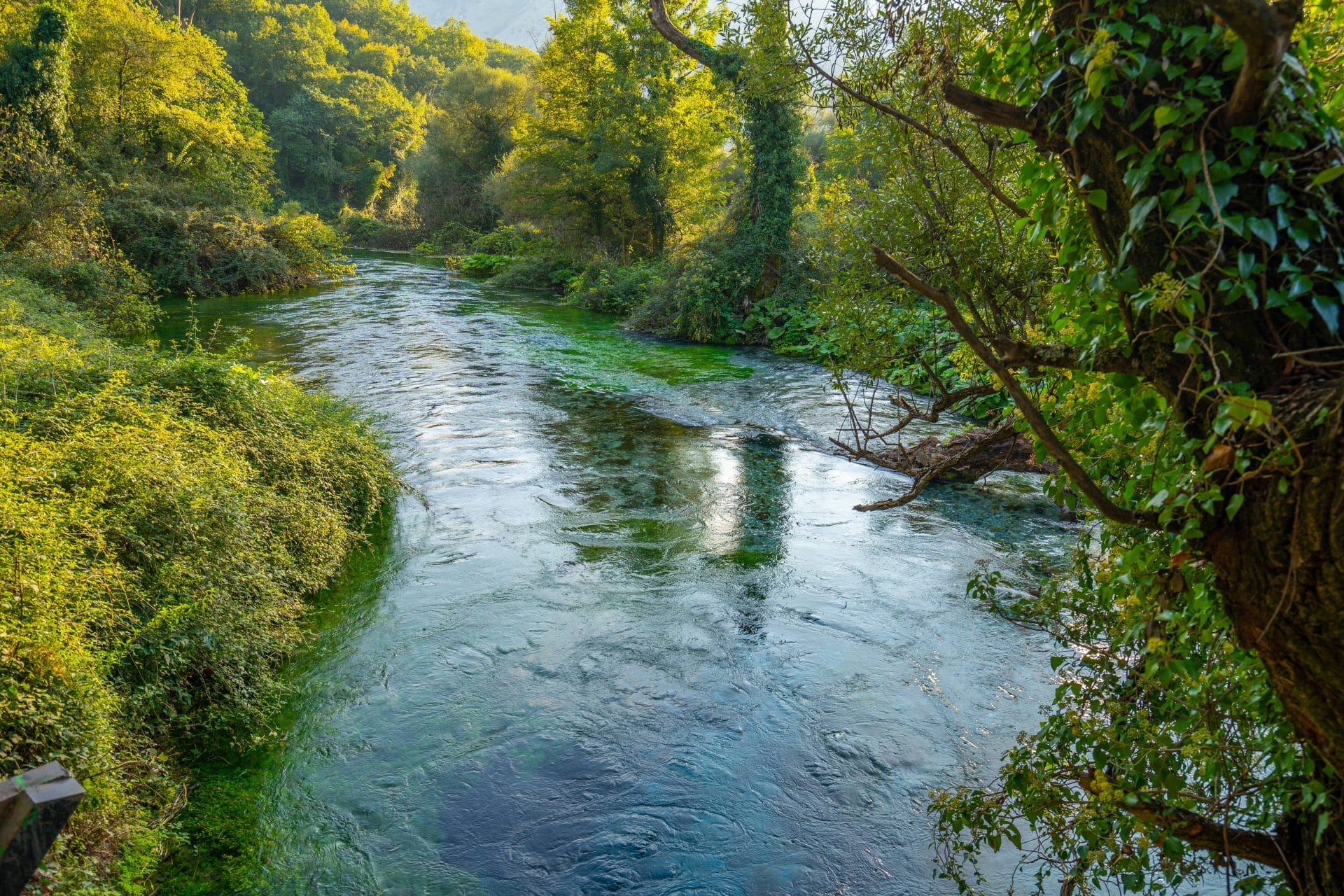
About twenty-five kilometers from Delvinë town, reached via a road that winds through increasingly attractive countryside, Albania’s most famous spring emerges from limestone in a display of such concentrated blue it seems impossible that nature produces such colors without chemical assistance.
The Blue Eye (Syri i Kaltër) has become one of southern Albania’s most visited natural attractions, and with good reason—the phenomenon delivers on its photographic promise. Spring water rising from unknown depths creates a pool of such intense azure that it appears to glow, surrounded by shallower water in graduated shades of turquoise and aquamarine.
The spring’s depth remains unknown. Multiple diving expeditions have descended beyond fifty meters without reaching the source, following an underwater cave system that seems to extend deep into the limestone mountain. The water temperature stays constant year-round at about 10°C (50°F), rising at an estimated rate of six cubic meters per second—enough flow to create the Bistrica River, which winds through the surrounding forest before eventually reaching the sea.
What photographs can’t convey is the sensory completeness of the experience. The sound of that much water emerging from stone creates a constant, layered rushing that changes character as you move around the pool’s perimeter. The temperature contrast when you wade into the shallows is immediate and bracing—this water was underground minutes ago, carrying the deep earth’s chill.
The site has been developed for tourism, which means entrance fees (currently 100 lek), paved pathways, and a restaurant overlooking the spring. Summer brings crowds that diminish the experience somewhat—too many people trying to photograph themselves in the same spots, the constant noise of conversations in a dozen languages.
Visit early morning or late afternoon for the best experience. Better yet, come in shoulder season (May or October) when visitor numbers drop significantly and the forest surrounding the spring shows seasonal character that peak summer lacks—wildflowers in spring, autumn colors in October.
Swimming is officially prohibited, though you’ll see locals wade into the shallower pools. The water is genuinely cold enough to create risk for anyone not acclimated—hypothermia becomes possible with extended immersion. The current where the main spring emerges is also strong enough to be dangerous. Admire rather than swim.
The Mountain Town Reality
Modern Delvinë doesn’t offer much beyond basic services, and pretending otherwise would be dishonest. The town exists primarily to serve the surrounding rural population—a marketplace, administrative center, and social hub for villages scattered through these hills.
The Ottoman-era castle, visible on its hilltop perch, remains closed to casual visitors, its interior used for telecommunications equipment rather than tourism. Some sources mention a small ethnographic museum, though opening hours remain unpredictable and the collection modest.
What the town does provide is a window into how provincial Albania functions away from tourist centers. The morning market, when farmers bring produce and cheese from surrounding villages, operates with rhythms unchanged for generations. The cafes fill with men conducting business over coffee that extends into lunch, then returns for evening sessions that continue until late.
This is Albania working rather than performing, doing daily business without particular concern for outside observation. Whether you find this interesting or boring depends entirely on your comfort with ordinary life as a form of travel experience.
Practical Considerations
Getting to Delvinë requires either rental car or the buses that run between Saranda and Gjirokastra, though schedules remain flexible enough that “regular” doesn’t mean “reliable.” The journey from Saranda takes about thirty minutes under good conditions, from Gjirokastra about the same.
For visiting Phoenike, you’ll need your own vehicle or willingness to hire a taxi for the return trip—the site sees too little traffic for public transport. The road to the ruins is passable for regular cars when dry, though high clearance helps during wet periods.
The Blue Eye lies on a different route, accessible via the Saranda-Gjirokastra highway with a well-marked turnoff. Most visitors approach from Saranda as a day trip, often combined with other destinations. Having independent transport makes this easier, though organized tours from Saranda frequently include the Blue Eye in their itineraries.
Accommodation options in Delvinë town itself remain limited—a few basic guesthouses that serve primarily Albanian travelers. Most visitors choose to base themselves in Saranda (25km) or Gjirokastra (30km), both of which offer far better accommodation and dining infrastructure while keeping Delvinë’s attractions within easy reach.
For eating, expect simple Albanian standards: grilled meats, vegetable dishes, fresh salads when ingredients are available. Nothing sophisticated, but genuine home cooking at prices that make coastal restaurants seem expensive by comparison.
Best Time to Visit
Spring (April-June) and autumn (September-October) offer the most comfortable conditions for exploring ruins and hiking around the Blue Eye. Summer brings intense heat that makes archaeological sites less pleasant and crowds that diminish the Blue Eye’s appeal.
Winter in these hills can be surprisingly cold, with occasional snow that closes the higher mountain passes. Unless you specifically enjoy off-season travel in conditions where tourism infrastructure shuts down, plan your visit for warmer months.
Nearby Connections
Delvinë’s position makes it a natural waypoint between several of southern Albania’s key destinations:
Saranda (25km): The coastal resort town offers beaches, restaurants, nightlife, and ferry connections to Corfu—everything Delvinë doesn’t provide.
Butrint (30km): Albania’s premier archaeological site makes an obvious pairing with Phoenike for anyone interested in ancient history.
Gjirokastra (30km): The UNESCO-listed stone city represents everything Delvinë isn’t—monumentally preserved, heavily visited, architecturally spectacular.
Ksamil (35km): Albania’s most photographed beaches offer perfect counterpoint to archaeological and natural attractions.
What This Place Teaches
Delvinë exists in the category of destinations that most guidebooks struggle to classify—neither dramatically beautiful nor historically significant enough to demand attention, yet representative of how much of Albania actually functions outside the handful of places that dominate tourism marketing.
The value here is contextual rather than absolute. Phoenike helps you understand ancient Epirus beyond its most famous sites, showing how many substantial cities existed in this region before Rome absorbed them into empire. The Blue Eye demonstrates Albania’s geological drama, how limestone mountains create phenomena that seem to belong in fantasy rather than geography.
The town itself, unremarkable as it may be, reveals patterns of life that continue in provincial Albania—the importance of local markets, the social function of cafes, the pace of daily business that refuses to accelerate just because coastal regions have discovered tourism.
If you’re spending time in southern Albania anyway, detouring through Delvinë adds dimension to your understanding without requiring significant time investment. If you’re specifically seeking undiscovered ruins where you won’t compete with tour groups for photographs, Phoenike rewards the effort to reach it.
But if your Albania itinerary is limited and you’re choosing between destinations, more compelling options exist in every direction. Delvinë offers authenticity and quiet discovery—valuable qualities, but not enough on their own to justify traveling here at the expense of more substantial attractions.
The honest assessment: worth including if you’re already nearby, not worth traveling out of your way to experience unless you specifically appreciate places that require you to supply most of the context and interpretation yourself.