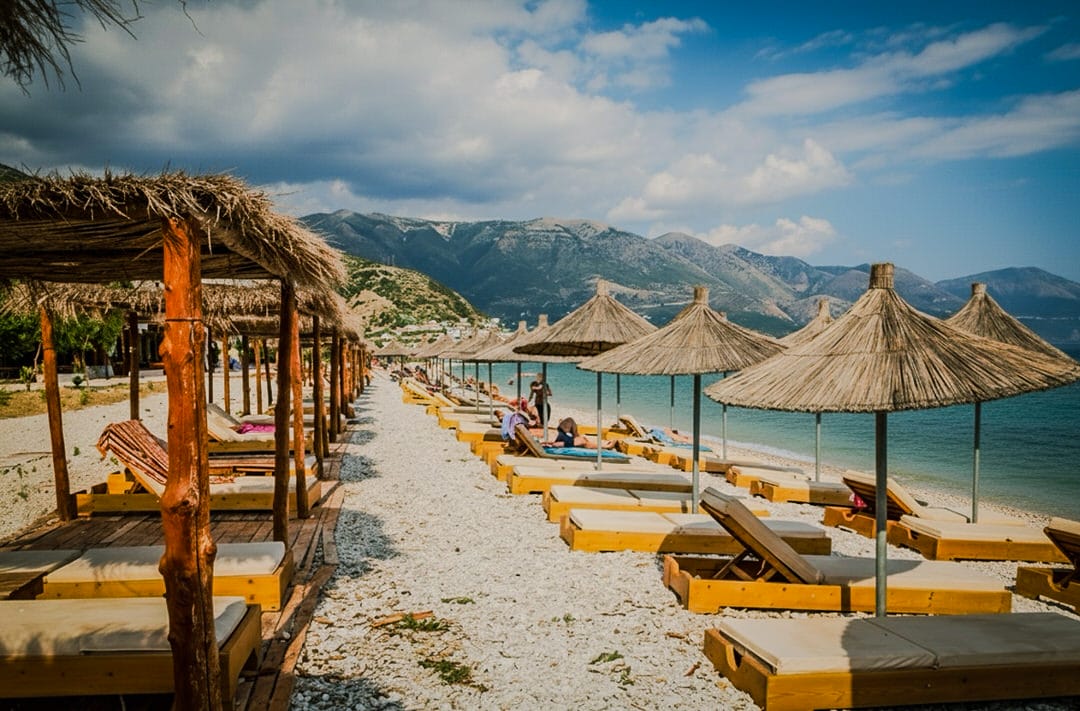
Seven Kilometers Where Beach Meets Agriculture
Borsh presents geographical rarity on the Albanian Riviera—seven uninterrupted kilometers of white pebble beach extending along the Ionian coast, making it Albania’s longest continuous beach and one of the region’s most extensive Mediterranean shorelines. This exceptional length creates space unusual on Albanian Riviera, where most beaches occupy coves measuring hundreds of meters rather than kilometers, resulting in congestion during summer peak seasons when domestic Albanian tourism and international visitors concentrate in limited coastal areas.
The beach sits at the base of mountains rising steeply behind the coast, with olive groves descending the slopes from Borsh village (population approximately 2,500, elevation 150-200 meters, located 2 kilometers inland from beach) to the waterfront. This topography creates visual continuity where agricultural landscape transitions directly to beach—olive trees frame the coastline rather than hotels or development, creating scenic character distinct from more built-up Albanian Riviera sections.
The seven-kilometer length encompasses varying beach character—the central section concentrates facilities including seasonal restaurants, sunbed rentals (€7-10 daily), and easy water access with gradual depth progression suitable for families. The northern sections become progressively quieter with fewer facilities but maintained beach quality—clear water, white pebbles, and views toward mountains. The southern section near Qeparo village becomes more rugged as topography steepens, with smaller accessible beach areas between rocky outcrops.
The white pebble composition (rather than sand) creates Mediterranean water clarity typical of stone beaches—visibility often exceeding 10 meters, water temperature reaching 22-26°C July-September, and relatively clean conditions since pebbles don’t suspend in water like sand. Water shoes address pebble discomfort for walking, while most visitors establish base on rented sunbeds or towels for extended beach time.
The length enables solitude even during August peak season—walking 1-2 kilometers from central facilities typically reduces beach density substantially, allowing travelers to find uncrowded sections while maintaining ability to return to restaurants and amenities. This combination of length, scenic setting, and maintained traditional agricultural landscape behind the beach creates Borsh’s primary appeal as Albanian Riviera destination offering space, authentic character, and budget-friendly alternatives to more developed coastal villages.
Why Visit Borsh
Borsh attracts travelers seeking Albania’s longest beach providing space unusual on crowded Albanian Riviera, budget-friendly accommodation €20-60 nightly from guesthouses to beachfront hotels, traditional olive oil production villages maintaining agricultural economy despite tourism growth, Borsh Castle ruins documenting 2,400+ years of military history, authentic Albanian coastal experience without resort development or international tourism infrastructure, proximity to Himarë (20km north) and Sarandë (45km south) for varied experiences, and scenic beauty combining long pebble beach with olive groves descending from mountains.
What Borsh offers: 7-kilometer beach creating space for uncrowded swimming and beach time even in peak August, accommodation ranging from village guesthouses (€20-30/night half-board) to beachfront hotels (€50-70/night), traditional Albanian cuisine emphasizing fresh seafood and local olive oil, access to Borsh Castle ruins (30-minute uphill hike, free entry) with panoramic coastal views, olive oil production villages (Borsh and Piqeras) maintaining traditional methods, budget-friendly prices compared to developed Albanian Riviera destinations, and authentic Albanian village life continuing agricultural rhythms alongside seasonal tourism.
What Borsh doesn’t offer: dramatic scenery or unique geological features (the beach is long but not exceptionally beautiful compared to other Albanian Riviera locations), extensive tourism infrastructure or English proficiency, varied accommodation beyond basic hotels and guesthouses, nightlife or entertainment beyond beach restaurants, fine dining or sophisticated cuisine, or activities beyond beach time and limited hiking to castle ruins.
Skip Borsh if you prioritize: dramatic coastal scenery over beach length and space, boutique tourism culture or international service standards, English-speaking guides and interpretation, varied activities and entertainment, sophisticated dining, or destinations offering immediate visual impact and varied experiences.
Choose Borsh if you value: Albania’s longest beach providing uncrowded space, budget-friendly Albanian Riviera access, authentic village life maintaining agricultural traditions, olive oil culture and traditional production, Borsh Castle historical significance, proximity to other Albanian Riviera destinations enabling regional exploration, or preference for local Albanian atmosphere over international tourism development.
The honest assessment: Borsh rewards travelers seeking affordable Albanian Riviera access with uncrowded beach space rather than those expecting dramatic scenery, extensive facilities, or varied activities. The seven-kilometer beach creates Borsh’s primary value—space allowing escape from Albanian Riviera congestion during peak season. The olive oil villages, castle ruins, and traditional culture add context but aren’t destination attractions independently justifying travel. Borsh functions best as Albanian Riviera base offering budget accommodation, beach space, and authentic Albanian character for travelers willing to accept limited infrastructure and basic services in exchange for lower prices and uncrowded conditions.
Borsh Castle: Twenty-Four Centuries on the Hilltop
Borsh Castle occupies strategic hilltop position approximately 200 meters elevation overlooking the seven-kilometer beach, the village spreading below, and the Ionian Sea extending to horizon. Archaeological evidence dates initial fortification to approximately 4th century BCE, when Illyrian tribes (likely the Chaonians, who controlled this coastal region) established defensive position controlling coastal routes and harbor access.
The Illyrian period fortifications used cyclopean masonry—large irregular stones fitted without mortar, creating walls surviving millennia despite minimal maintenance. These foundations remain visible in lower sections of current ruins, with construction techniques matching other Chaonian sites including Phoenice (ancient Phoinike, 20 kilometers inland) and Antigonea.
Roman conquest (229-168 BCE brought regional control under Roman administration, with Borsh Castle likely serving as local garrison point on coastal road connecting Apollonia and Nicopolis (in Epirus, modern Greece). Roman period modifications include more regular stonework using dressed blocks and architectural features suggesting administrative functions beyond pure military defense—the site apparently functioned as local administrative center managing surrounding agricultural territories.
Byzantine period (4th-15th centuries CE) brought renewed military importance as coastal defenses against various threats including Slavic incursions, Arab raids, and later Norman invasions. Byzantine renovation strengthened walls, expanded the fortress footprint, and added ecclesiastical structures (church foundations visible within complex, though dating requires archaeological investigation not yet comprehensively undertaken).
Ottoman conquest of the region (late 15th-early 16th century) brought final major construction phase. Ottoman forces modified Byzantine fortifications for gunpowder artillery defense, added cisterns for extended sieges, and maintained garrison through Ottoman period (1479-1912) as coastal observation post monitoring shipping and suppressing piracy. The fortress’s strategic value diminished in later Ottoman period as regional administration centralized in larger coastal towns including Sarandë and Vlorë, reducing Borsh to local administrative center requiring minimal military presence.
The 20th century brought abandonment—the castle ceased military functions, local population relocated to more accessible locations, and the structures gradually deteriorated through weather, vegetation growth, and stone removal for building materials. No comprehensive restoration has occurred—the ruins exist in archaeological condition with collapsed walls, foundation outlines marking vanished buildings, and vegetation reclaiming courtyards.
Contemporary visitors find fragmentary ruins requiring imagination to visualize complete fortress. The defensive walls remain partially intact along portions of perimeter, allowing appreciation of construction techniques and strategic positioning. Foundation walls mark building locations including what appears to be central administrative structure, storage buildings, cisterns, and possibly church. The views justify the 30-minute uphill climb—panoramic vistas across seven kilometers of Borsh beach, olive groves extending up mountains, and Ionian Sea creating dramatic setting demonstrating why successive civilizations fortified this position.
Access is informal—no tickets, no guards, no facilities, no interpretation beyond basic signage (Albanian only) at trail start in Borsh village. The hike follows path through olive groves, steepening as it approaches castle ruins. Early morning or late afternoon visits avoid midday heat and provide optimal photography light. The site receives minimal visitors—even in August peak season, the castle typically hosts fewer than a dozen tourists daily, creating solitude unusual at Albanian archaeological sites.
Olive Oil Villages: Borsh and Piqeras
Borsh village (approximately 2,500 permanent residents, though seasonal fluctuations bring more during summer tourism) centers economically and culturally on olive oil production maintained through generations using traditional methods. The olive groves extending across mountains surrounding the village include trees centuries old, with traditional cultivation methods emphasizing minimal intervention, hand-harvesting, and stone-press processing creating oil with distinctive character reflecting terroir and varietals.
The harvest occurs October-November, with families hand-picking olives from terraced groves where steep slopes prevent mechanized equipment. Traditional methods involve spreading nets beneath trees, hand-stripping olives from branches, transporting harvested fruit to pressing facilities (most families maintain communal access to traditional stone presses, though modern facilities also operate), and processing within days to maintain oil quality. The resulting product—extra virgin olive oil with low acidity, fruity characteristics, and green color indicating minimal oxidation—supplies family consumption, local sales, and increasingly, export markets recognizing Albanian olive oil quality.
The olive oil culture permeates village life—evening conversations discuss harvest timing, oil quality comparisons between families and years, traditional recipes using oil, and economic calculations balancing tourism revenue against agricultural income. For visitors, olive oil appears ubiquitously in cuisine—drizzled on bread, used generously in cooking, offered as gift from guesthouse hosts, and available for purchase at village shops (typically €10-15 per liter for quality extra virgin oil).
Piqeras village sits higher in mountains approximately 5-8 kilometers from Borsh (exact distance depends on route), accessible via winding mountain roads through spectacular olive terraces. Smaller than Borsh (population perhaps 300-500, exact figures uncertain due to seasonal migration patterns and diaspora communities), Piqeras maintains even more traditional character—stone houses built into mountainside, extended family compounds, agricultural rhythms dominating daily life, and minimal tourism infrastructure.
The villages exemplify Albanian mountain agriculture adapting to tourism economy—agricultural production continues as primary livelihood for many families, with tourism providing supplementary income through guesthouse operations, restaurant service, and informal guiding. This dual economy creates authentic atmosphere where visitors experience working agricultural villages rather than tourism-dependent communities performing traditional culture for commercial purposes.
The religious diversity reflects Albanian coastal regions’ historical pattern—both Orthodox Christian and Muslim families coexist peacefully, with some Catholic presence, all participating in shared community life through customary hospitality traditions, agricultural cooperation, and Albanian identity transcending religious divisions. This tolerance reflects both historical Ottoman period patterns (where religious diversity existed under millet system allowing religious communities self-governance) and modern Albanian secularism emphasizing national identity over religious affiliation.
Practical Borsh
Getting There: Borsh lies approximately 45 kilometers north of Sarandë and 20 kilometers south of Himarë, requiring 45-60 minutes by car from either direction via coastal road. From Tirana (approximately 185 kilometers), the journey requires 3.5-4.5 hours via national highways to coastal road near Vlorë, then south along Albanian Riviera.
Multiple daily buses connect Sarandë to Himarë, Dhërmi, and Vlorë, passing through Borsh (cost €5-8, journey 45-90 minutes from Sarandë depending on stops). Buses depart from area near Sarandë’s main square, with morning departures (7 AM, 9 AM, 10:30 AM) and afternoon options (1 PM, 6 PM). Return buses operate similar schedules. The bus drops passengers in Borsh village, 2 kilometers uphill from beach—walking requires 25 minutes downhill to beach (steeper 30-minute return uphill), or arrange transport through accommodation (typically €5) or village taxis (€8-10).
Accommodation: Options range from village guesthouses (€20-30/night including breakfast and dinner) to beachfront hotels (€50-70/night). Village accommodation provides authentic Albanian hospitality with home-cooked meals, olive oil from family groves, and cultural immersion, but requires daily transport to beach. Beachfront hotels offer immediate beach access, on-site restaurants, and tourism services, but at higher prices and reduced cultural authenticity.
July-August requires advance booking for beachfront properties; village guesthouses typically have availability even during peak season. Shoulder seasons (May-June, September-October) see 30-40% lower prices with better availability. Many beachfront hotels close October-May, though village guesthouses operate year-round.
Dining: Restaurants serve traditional Albanian cuisine emphasizing fresh seafood (€12-18 per person), grilled meats, salads using local olive oil, and seasonal vegetables. Beachfront restaurants include Luna Mare (reliable seafood, beachfront tables, international menu) and facilities at hotels. Village center restaurants offer lower prices (€8-12 per person) and more traditional Albanian fare. Fresh fish sold by weight (€25 per kilogram, typically feeding 3-4 people generously).
Activities: Swimming and beach time dominate most visitors’ days. Borsh Castle hike (30 minutes uphill, free entry, 1-2 hours including exploration and views) provides historical interest and exercise. Olive grove walks through traditional terraces offer cultural context, particularly during October-November harvest when families work in groves and welcome visitor observation (asking permission before entering private groves is customary). Day trips to Porto Palermo Castle (15km south), Himarë (20km north), or Gjirokastër (70km inland) provide variety.
Timing: June and September provide optimal conditions—warm temperatures (23-28°C), swimmable water (22-25°C), fewer crowds than July-August peak, and 30-40% lower accommodation prices. July-August brings warmest water (25-27°C), longest days, complete service availability, but highest prices, maximum crowds, and occasionally uncomfortable heat (30-35°C). May and October offer budget options and solitude but cooler water (18-22°C) and reduced service availability.
Money and Logistics: No ATMs exist in Borsh—withdraw cash in Sarandë or Himarë. Budget €35-60 daily including accommodation, meals, beach equipment rental, and transport. Most transactions require cash—village restaurants and guesthouses rarely accept cards.
Mobile coverage is reliable. English proficiency is limited—Italian or Greek more commonly understood among older residents, younger generation having some English from school. Tourist information is informal—accommodation hosts provide advice and arrangements.
Nearby Destinations
Himarë (20km north): Albanian Riviera town with Greek influences, varied beaches, more dining options, and livelier atmosphere providing contrast to Borsh’s village character.
Sarandë (45km south): Albanian Riviera’s largest coastal city with urban amenities, ferry connections to Corfu, and access to Butrint archaeological site.
Qeparo (5km south): Traditional village divided between old mountain settlement and new coastal development, offering additional Albanian Riviera perspective.
Gjirokastër (70km inland): UNESCO World Heritage town providing mountain scenery and Ottoman architecture contrasting with coastal experiences.
Porto Palermo: Bay and castle 15km south of Borsh, offering dramatic peninsula setting and Ottoman fortress ruins attributed to Ali Pasha of Tepelenë.
The Seven Kilometers
Borsh’s appeal rests fundamentally on the seven-kilometer beach creating space unusual on Albanian Riviera, where most coastal destinations concentrate on limited shoreline producing congestion and reducing beach experience quality during peak seasons. The length allows distribution—even when central section reaches capacity during August weekends (primarily Albanian domestic tourists from Tirana and northern cities seeking coast access), walking 1-2 kilometers in either direction typically provides uncrowded conditions.
This space creates value for travelers seeking Albanian Riviera access without paying premium prices for boutique villages (Dhërmi, Vunoi) or accepting extreme congestion at popular destinations (Ksamil). Borsh occupies middle ground—accessible, affordable, maintaining Albanian character, and offering beach space sufficient for comfortable experience without resort development or international tourism infrastructure.
The olive oil villages add cultural context—this isn’t resort destination but agricultural community adapting to seasonal tourism while maintaining traditional livelihoods. The castle ruins provide historical depth—2,400 years of military significance demonstrating strategic value of position. But fundamentally, Borsh’s significance is the beach length creating space for uncrowded Mediterranean swimming along white pebbles beneath olive groves on Albanian coast where space increasingly becomes scarce as tourism development continues.
Whether Borsh satisfies depends on priorities. If you seek dramatic scenery, boutique atmosphere, varied activities, sophisticated services, or extensive facilities, Borsh disappoints—these aren’t what the destination offers. If you value beach space, budget-friendly prices, authentic Albanian village life, olive oil culture, and ability to experience Albanian Riviera without crowds or premium pricing, Borsh delivers consistently. The seven kilometers speak for themselves—longest beach in Albania, white pebbles meeting clear water, olive groves descending from mountains, and space to breathe along Mediterranean coast that elsewhere becomes increasingly crowded each summer season.