Where Albania’s Last Rebel Made His Stand
In 1925, a tribal leader named Bajram Curri retreated to a cave in these mountains after his final rebellion against Albania’s central government failed. He’d spent years fighting—first against the Ottomans, then against foreign powers trying to partition Albania, finally against what he saw as authoritarian consolidation of power in Tirana. When government forces surrounded his hideout in the cliffs above what’s now the town bearing his name, Curri chose to die fighting rather than surrender.
The cave where he made his last stand still exists, accessible by a difficult hike from the town center. Local guides will take you there if you ask, though few tourists bother. Most pass through Bajram Curri without stopping, using it merely as a jumping-off point for the Valbona Valley or the ferry across Koman Lake.
That’s a mistake. This town tells a story about Albania that doesn’t fit neatly into tourism brochures—about resistance, isolation, and the complicated legacy of men who fought for independence using methods that made them simultaneously heroes and outlaws.
Why Visit Bajram Curri
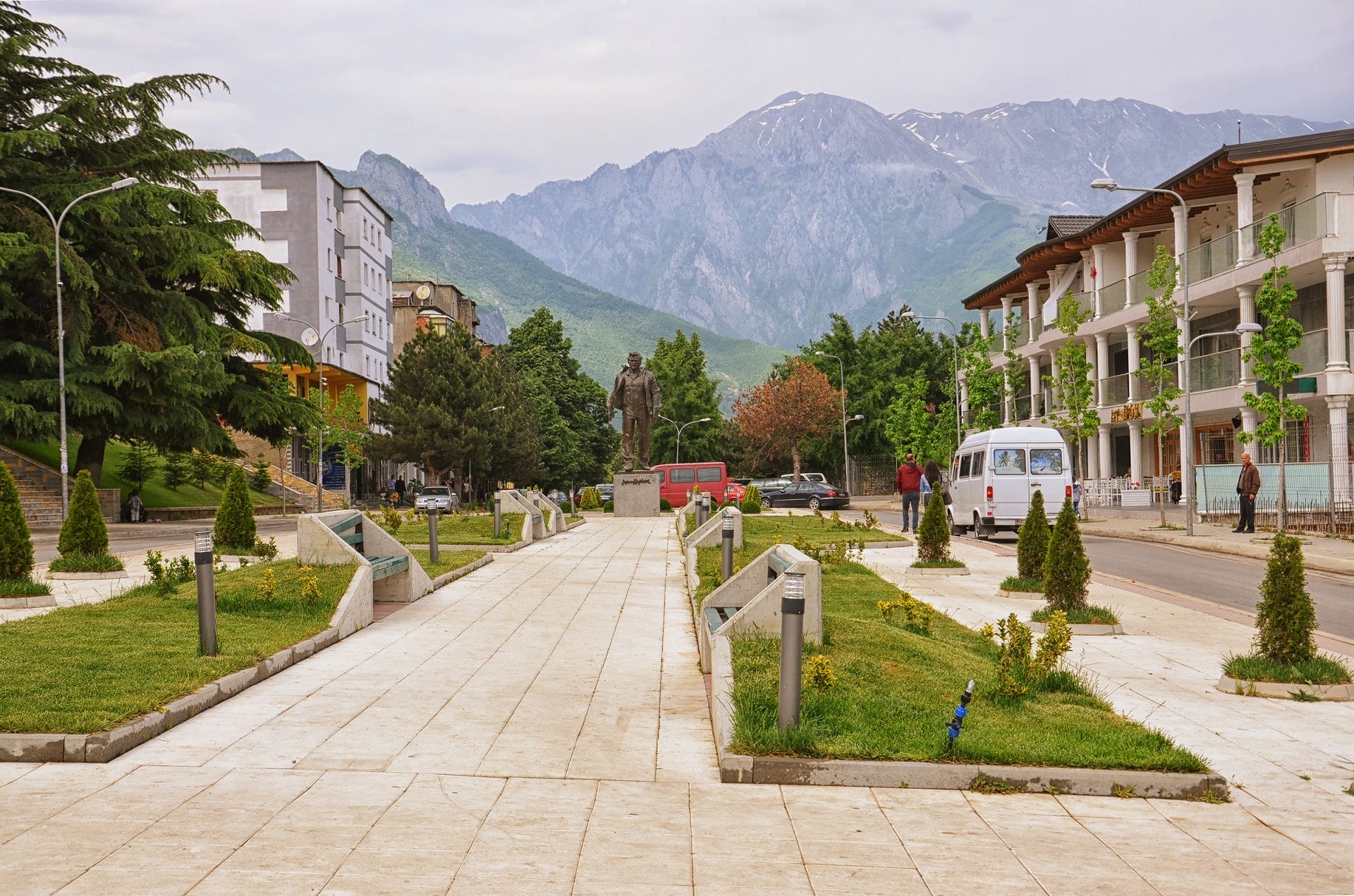
Let’s be clear: Bajram Curri isn’t beautiful in any conventional sense. The town itself consists mainly of utilitarian concrete buildings from the socialist era, a main street lined with modest shops and cafes, and a general sense that aesthetic considerations came second to practical needs. You won’t find medieval castles or Ottoman-era mansions here.
What you will find is authenticity—the unvarnished kind that comes from places that haven’t yet figured out how to package themselves for international tourism. Bajram Curri functions primarily as a service center for surrounding mountain villages and as a waypoint for travelers heading deeper into the Albanian Alps. It makes no particular effort to charm visitors, which paradoxically makes it more interesting than many places that try too hard.
The town works best as a base rather than a destination itself. From here, you can access some of Albania’s most spectacular mountain landscapes: the Valbona Valley to the east, Theth to the west, and dozens of smaller villages scattered through valleys that see few outsiders. The ferry crossing of Koman Lake—one of Europe’s most scenic boat journeys—begins just an hour’s drive away.
If you’re the type of traveler who needs constant entertainment, Instagram-worthy backdrops, and English menus at every restaurant, Bajram Curri will bore you. If you’re comfortable with a bit of roughness around the edges and curious about how ordinary Albanians live away from tourist centers, this place offers genuine immersion into northern highland culture.
The Man Behind the Name
Bajram Curri wasn’t originally from this area. Born in 1862 in Kosovo when it was still part of the Ottoman Empire, he became involved in Albanian nationalist movements as a young man, fighting in irregular bands that resisted both Ottoman rule and later attempts by neighboring countries to absorb Albanian territories.
His methods were controversial even among fellow Albanian nationalists. Curri led what amounted to a private army of highland tribesmen who followed him personally rather than any central authority. After Albania achieved independence in 1912, he continued operating as a semi-autonomous power in the north, sometimes cooperating with the government in Tirana, sometimes openly defying it.
By the 1920s, when Albania’s new rulers were trying to establish control over the country’s fractious regions, Curri represented exactly the kind of tribal authority they wanted to eliminate. His refusal to disarm his followers and submit to central government authority eventually led to open conflict. After his death in 1925, the government renamed the town Kolgecaj to Bajram Curri—partly as acknowledgment of his role in achieving Albanian independence, partly as symbolic victory over the tribal system he represented.
Today, a statue of Curri stands in the town center, rifle in hand, gazing toward the mountains where he made his final stand. Whether you see him as patriot or bandit depends largely on your perspective regarding state authority versus local autonomy—a debate that continues in modified form throughout Albania even now.
Gateway to the Mountains
Bajram Curri’s real significance lies in its geographic position. This is where roads from the lowlands meet the high Albanian Alps, where relatively easy access ends and serious mountain terrain begins. Everything that makes northern Albania special—dramatic peaks, isolated villages, hiking trails through pristine wilderness—starts from here.
The Valbona Valley
About 30 kilometers east of Bajram Curri, the Valbona Valley cuts deep into the Alps, its river flowing from snowmelt off peaks that remain frozen well into summer. The valley has become increasingly popular with hikers over the past decade, particularly those attempting the Valbona-to-Theth trek—a challenging day’s walk across a high mountain pass that many consider Albania’s finest one-day hike.
The road to Valbona follows the valley floor, passing through small villages where stone houses cluster beneath forested slopes. The pavement ends partway up the valley, giving way to rougher track that requires either a sturdy vehicle or willingness to walk the final kilometers. Several guesthouses operate in the upper valley, offering basic but comfortable accommodation plus home-cooked meals featuring local specialties: fresh trout from the river, wild herbs gathered from mountain slopes, cheese made from sheep’s milk.
Valbona Valley National Park, established in 1996, protects this landscape along with its wildlife—brown bears, wolves, lynx, and golden eagles all inhabit these mountains, though seeing them requires luck and patience. The park’s real draw is the landscape itself: limestone peaks rising above beech forests, alpine meadows carpeted with wildflowers in spring, glacial cirques carved into mountainsides by ice sheets that retreated millennia ago.
The Koman Lake Ferry
About 50 kilometers southwest of Bajram Curri, a different natural spectacle awaits. In the 1970s, communist planners dammed the Drin River, creating an elongated reservoir that filled the deep canyon the river had carved through the mountains. The dam itself is unremarkable Soviet-era engineering, but the landscape it created is extraordinary.
A daily ferry traverses the length of Koman Lake, carrying locals between isolated villages and transporting tourists who’ve heard about the journey’s scenic drama. The boat weaves between sheer cliffs that rise hundreds of meters directly from the water, passes beneath waterfalls cascading from hidden valleys, and navigates narrows where the canyon walls close in so tightly you feel you could reach out and touch stone from both sides.
The trip takes about two hours at a leisurely pace, though the scenery compresses time. Early morning departures offer the best light and typically fewer passengers, though even the crowded summer runs retain their impact—some landscapes simply overwhelm attempts to diminish them through commercialization.
You can make Koman Lake a day trip from Bajram Curri, catching the morning ferry down to Koman dam, then returning by the same route. Many travelers instead use it as transportation to or from Shkodër, combining spectacular scenery with practical travel needs.
The Highland Market
Thursday is market day in Bajram Curri, when farmers and small-scale producers from surrounding villages converge on the town to sell produce, livestock, and household goods. This isn’t a tourist attraction—it’s a functioning agricultural market where real commerce happens—but that’s precisely what makes it worth experiencing.
The livestock section occupies one end of the market grounds, where men negotiate over sheep and goats, examining animals with practiced eyes while discussing prices in quiet, serious tones. Elsewhere, women sell vegetables from small plots, stacking carrots and potatoes into neat pyramids while calling out to potential customers.
You’ll see things here that would never pass health inspections in Western countries: unpasteurized cheese wrapped in cloth, home-cured meats hanging in the open air, eggs in baskets without refrigeration. This makes some tourists nervous. But this is how food was sold for centuries before industrial agriculture and modern food safety regulations, and it’s how much of rural Albania still operates.
The experience offers a window into highland economic life that you won’t find in guidebooks or curated cultural tours. These are people making their living from small-scale agriculture in difficult terrain, selling directly to consumers without intermediaries or formal oversight. Whether you find this charming or concerning depends largely on your comfort with practices that industrial societies have mostly eliminated.
Practical Realities
Getting to Bajram Curri requires commitment. From Tirana, the drive takes roughly four hours under good conditions—longer if you hit traffic leaving the capital or if road conditions deteriorate, which they sometimes do in the northern mountains. Public buses run daily from Tirana’s main station, though schedules remain flexible enough that “daily” means “most days” rather than a guarantee.
The road itself represents a significant improvement over what existed even a decade ago. Once notorious for its rough surface and occasional landslide closures, recent upgrades have created a paved route that remains passable year-round. Still, this is mountain driving—expect switchbacks, narrow sections, and dramatic drop-offs where guardrails exist more in theory than practice.
Accommodation options range from basic to modest, with nothing approaching luxury. Several small hotels and guesthouses line the main street, offering clean rooms with private baths and WiFi that works most of the time. Expect to pay €20-40 for a double room, less if you’re willing to accept shared facilities. The owners typically speak some English, though fluency remains rare enough that a translation app proves useful.
Dining options follow similar patterns: solid, unexciting Albanian standards. Grilled meats feature prominently, supplemented by vegetable dishes, bean stews, and fresh salads when ingredients are available. A full meal with drinks costs €8-12 at most restaurants. If you’re looking for vegetarian options, communication is key—Albanian cuisine isn’t naturally vegetarian-friendly, but most places will prepare something meatless if you explain what you need.
Banking services exist but remain limited. Bring sufficient cash from Tirana; ATMs in Bajram Curri sometimes run empty, especially during peak summer months when tourist traffic increases. Card payment remains uncommon outside major hotels.
Best Time to Visit
Summer (June-August) brings the warmest weather and longest days—crucial advantages in mountain terrain where temperature drops dramatically with elevation and early darkness limits evening activities. However, summer also means crowds in the Valbona Valley and higher prices across the board.
Late spring (May) and early autumn (September-October) offer compelling alternatives. The weather remains mostly stable, prices drop, and the landscape shows seasonal character that peak summer lacks—wildflowers in May, autumn colors in October. The tradeoff is shorter days and increased chance of rain, particularly in October when weather patterns shift toward winter.
Winter in Bajram Curri is serious business. Snow closes high mountain passes, temperatures regularly drop below freezing, and many guesthouses shut down entirely. Unless you’re specifically interested in winter mountain conditions or enjoy the stark beauty of snow-covered peaks, plan your visit for warmer months.
Nearby Connections
About two hours’ drive west of Bajram Curri, though the road makes it feel longer. Theth occupies a high valley surrounded by dramatic peaks, its stone tower houses and traditional architecture making it one of northern Albania’s most photogenic villages. The Valbona-to-Theth hike begins or ends here, depending on which direction you choose.
Albania’s northern cultural capital lies about 70 kilometers to the southwest, accessible via the Koman ferry or by road. Shkodër offers everything Bajram Curri doesn’t—history, architecture, sophisticated dining, cultural attractions—making it an excellent complement if you’re spending time in the north.
Tropojë
This slightly larger town about 20 kilometers north of Bajram Curri serves similar functions but sees even fewer tourists. Worth a brief stop if you’re interested in how Albanian provincial towns operate away from any tourism influence whatsoever.
What This Place Teaches About Albania
Bajram Curri exists in a space most tourism narratives ignore—neither dramatically beautiful nor historically significant enough to attract crowds, yet representative of how much of Albania actually functions outside the handful of destinations that dominate guidebooks and travel blogs.
The town’s ordinariness is its value. Here you see Albania working rather than performing, doing daily business without particular concern for outside observation. The cafes aren’t designed for Instagram. The market isn’t curated for tourist cameras. The landscape doesn’t need to justify itself through aesthetic appeal because it serves practical purposes: grazing land, timber resources, water sources for downstream communities.
This doesn’t make Bajram Curri boring—quite the opposite. It makes it real in ways that carefully preserved tourist towns can never be. You either appreciate that authenticity or you don’t. But if you’re spending time in northern Albania, stopping here for a day or two provides essential context for understanding the region beyond its most photogenic villages and hiking trails.
The legacy of the man whose name the town bears reinforces this point. Bajram Curri wasn’t a tidy historical figure whose story fits neatly into nationalist narratives. He was complicated, contradictory, simultaneously patriotic and self-interested, fighting for Albanian independence while maintaining personal power that looked a lot like the system he opposed. The highlands he operated in share that complexity—beautiful but harsh, authentic but uncomfortable, resistant to easy categorization or simple narratives.
If that appeals to you, make the journey north. If it doesn’t, the coastal resorts await.