How to Get to Apollonia
From Tirana
- By Bus: Take bus to Fier (2 hours, 400-500 LEK), then taxi to Apollonia (12km, €8-10).
- By Car: 120km southwest via A2/SH4. Drive time approximately 2 hours. Apollonia is 12km from Fier.
- By Tour: Day trips from Tirana starting at €40-50 per person.
From Vlorë
- By Bus: Bus to Fier (45 minutes, 300 LEK), then taxi to site.
- By Car: 45km via A2 highway. Drive time approximately 45 minutes.
From Berat
- By Car: 70km via SH72 and SH4. Drive time approximately 1 hour.
Note: Limited public transport directly to the site. Most visitors arrive by car, taxi, or organized tour. The archaeological park entrance is well-signposted from Fier. No cafe on-site - bring water and snacks.
Why Visit Apollonia
In 44 BCE, Julius Caesar sent his 18-year-old nephew Octavian to Apollonia to study rhetoric. Not Rome. Not Athens. This Albanian city on the edge of the empire. The kid was brilliant but needed polish before Caesar handed him real power.
Then news arrived: Caesar had been assassinated. Octavian dropped everything, left Apollonia, raced back to Rome, and proceeded to become Augustus Caesar—the first Roman emperor, the guy who transformed a republic into an empire that lasted 500 years.
That’s the level of school that operated here. Future emperors came to Apollonia to learn how to think, argue, and lead. Cicero called it magna urbs et gravis—“a great and important city”—in his Eleventh Philippic, though he was actually complaining that Mark Antony’s brother was holding it as an enemy stronghold. Either way, the most famous orator of the late Republic knew the place by name. At peak, tens of thousands lived inside more than four kilometres of limestone walls, across 81 hectares that spilled out to 137 with the suburbs.
And here’s the wild part: archaeologists have excavated about 5% of it. The rest is still buried under olive groves and farmland, foundation stones poking through the soil like the city’s trying to resurface.
The part the guidebooks get wrong
Every guidebook in print will tell you Apollonia was founded by Greek colonists from Corinth in 588 BCE. Technically correct. Historically gutting.
Here’s what they leave out: the colonists were 200 men. Stephanus of Byzantium gives the number plainly. They didn’t conquer anything—they couldn’t have. The Taulantii Illyrians already living here outnumbered them by orders of magnitude, and the bones say so. In 2014 a team led by Britney McIlvaine and Lynne Schepartz analysed dental and cranial traits from 116 skeletons buried at colonial-era Apollonia against Corinthian skeletons from the supposed mother-city and Illyrian skeletons from Lofkënd inland. Roughly 90% of Apollonia’s population grouped with the Illyrians, not the Greeks.
Aristotle worked this out in the 4th century BCE without any bones to test. In Politics (1290b) he uses Apollonia as his textbook case of an oligarchy: “the few”—descendants of the original Greek settlers—holding power over a free majority who weren’t Greek at all. That Greek-descended elite even practiced xenelasia, the Spartan trick of expelling foreigners, to keep the bloodline closed. Three centuries of deliberate endogamy.
The inscriptions tell the same story. The French school under Pierre Cabanes spent decades cataloguing the names on Apollonia’s gravestones and public inscriptions, and they’re full of unmistakably Illyrian ones—Plator, Epicadus, Tritos, Teutaia, Monounios, Dazos. The tombstone of “Tritos, son of Plator” is in the museum. Greek script, Illyrian people. The funerary stelai show women in Illyrian dress.
So when you walk through the gate and read the panel that says “Greek colony founded 588 BC,” translate it in your head: an Illyrian place that absorbed and outlasted a small Greek elite, then a small Roman elite, then a Byzantine monastery, before the river killed it.
The hill was already sacred
The Greeks didn’t arrive to empty land. The hill at Pojan holds Bronze Age tumulus burials dating to 2680 BCE—nearly two thousand years before any Greek set foot here. Maria Grazia Amore’s excavation report on Tumuli 9, 10 and 11 documents local violin-figurine idols (a southern-Adriatic take on Early Cycladic forms) and bronze grave goods placing this in the same Adriatic-Cetina cultural network that raised tumuli at Rakića Kuće in Montenegro and Shtoj in northern Albania.
Inside one of those Illyrian tumuli: a Corinthian transport amphora from the last third of the 7th century BCE. Greek goods buried with Illyrian dead, before the colony existed. The trade was already running. The “founding” was less an arrival than a formalization—200 men cannot impose themselves on a tribal population unless the tribe wants something from the deal. What the Taulantii probably wanted was trade access and a coastal partner against rival Illyrians inland.
The settlement was first called Gylakeia, after Gylax, the founder sent from Corinth. The rebrand to Apollonia came later. There were 24 cities named Apollonia in the ancient Mediterranean. This one was the first.
What You’re Actually Getting
Let me be straight: Apollonia won’t blow your mind with Instagram-perfect Roman temples. Butrint has the dramatic seaside theater. Berat has the lived-in medieval castle. Apollonia has… space. Lots of it. 137 hectares where you can wander around limestone ruins with only wind through 2,000-year-old olive trees for company.
It’s weirdly undiscovered. Every guidebook mentions it, but tour buses skip it for flashier sites. Maybe because it’s inland, requiring a deliberate detour. Maybe because “only 5% excavated” sounds like “there’s not much to see” instead of “holy shit, almost all of an ancient city is still down there.”
If you need complete reconstructions, museum-quality signage, and guides explaining every stone’s significance—this will frustrate you. If you’re cool with subtle archaeology that reveals itself slowly, where you get to use your imagination and feel like you discovered something yourself? This is one of Albania’s most rewarding sites.
How Greeks Built a City That Impressed Romans
Greeks from Corinth and Corfu founded Apollonia in 588 BCE, and they weren’t here for the scenery. They wanted fertile land, the Vjosa River port access to the Adriatic, and—get this—asphalt deposits. Ancient peoples used natural asphalt for waterproofing ships and buildings. It was basically ancient petroleum money.
By the 4th century BCE, they’d gotten so rich they started minting their own coins (you can see them in the museum—intricate designs showing a cow and calf). Wealthy enough to attract philosophers and rhetoricians who turned Apollonia into an intellectual center. By Roman times the place had such a reputation that aristocratic families paid serious money to send their sons here.
When Rome conquered the region, they didn’t wreck Apollonia—they upgraded it. Made it a crucial stop on the Via Egnatia, the massive road connecting the Adriatic to Byzantium (modern-day Istanbul). That’s when they built the monuments you see today: the triumphal arch, the bouleuterion, the forum where the city’s daily business happened.
When an Earthquake Killed a City
In the 3rd century CE, a massive earthquake hit and shifted the entire course of the Vjosa River. That doesn’t sound immediately catastrophic until you realize: the river was Apollonia’s connection to the sea. Their entire port economy. Trade routes that had sustained tens of thousands of people.
The river moved. The port silted up. The plain went swampy and malaria moved in. The merchants moved out. By the 4th century what had been a city of tens of thousands was a small Christian community—bishops named Felix and Eusebius still turn up in the records of the councils at Ephesus (431) and Chalcedon (451)—while most of the population drifted south to Aulona, modern Vlora.
Apollonia died of geology, not history. No siege, no sack, no burning. An earthquake moved a river and the city bled out over two centuries.
Then, around 1250, Orthodox monks came back and built the Monastery of St. Mary inside the old sacred precinct, quarrying the ruins for stone. You can still see the layering when you visit—13th-century church walls rising from classical masonry.
The ruins sat there for centuries, mostly undisturbed, until French archaeologist Léon Rey showed up in 1924 and started systematic excavations. He uncovered the forum, defensive walls, residential quarters. Austrian teams picked up where he left off from 1994-2004, mapping more of the street plan.
But here’s the thing: a century of digging has touched about 5% of the city. Geophysical surveys can map streets and buildings under the soil, but funding runs out faster than archaeologists can write grant applications. The rest is still down there, under olive groves that have been there so long the trees might be 2,000 years old themselves.
What Actually Survived
The Bouleuterion, a.k.a. the Monument of Agonothetes
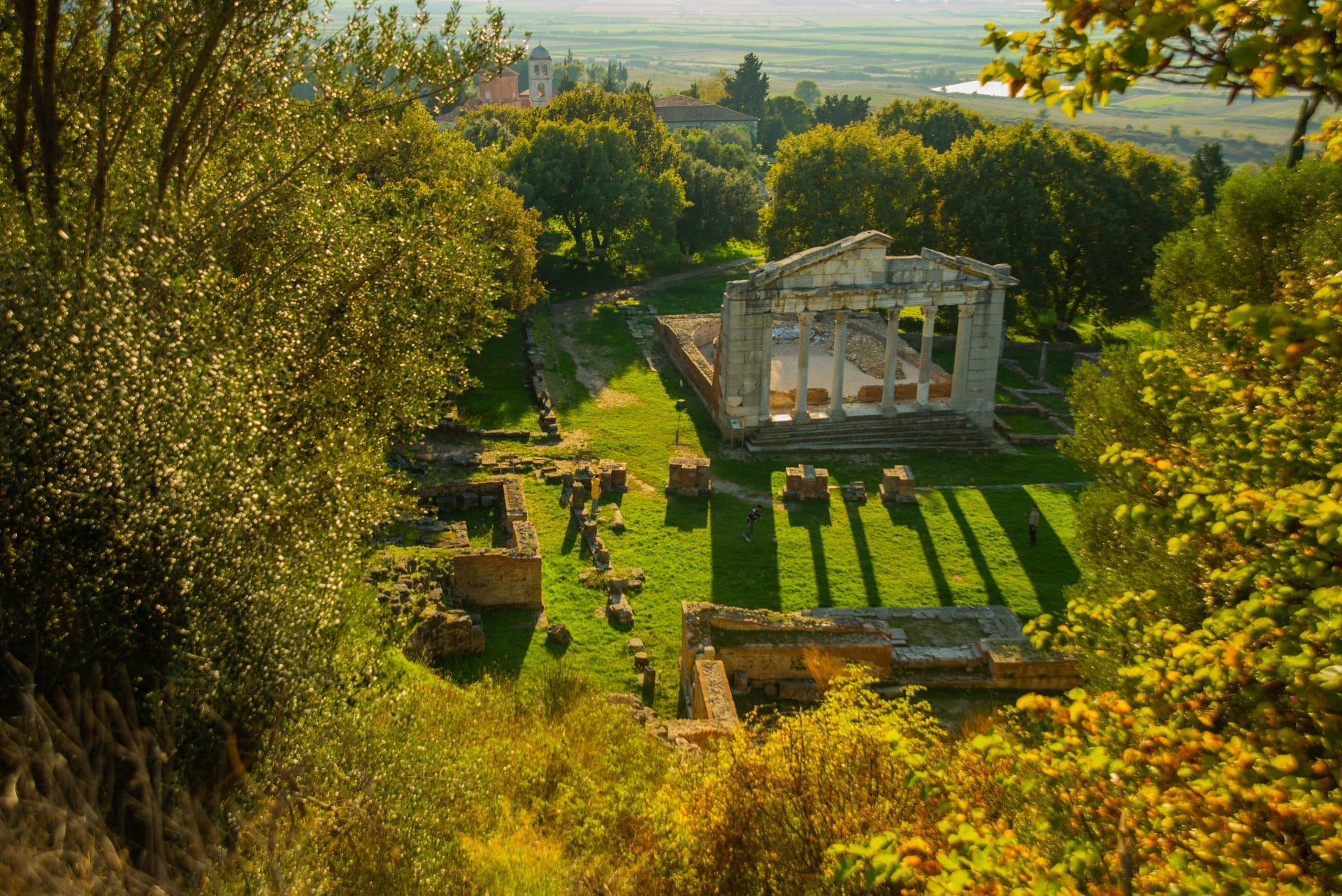
You’ve seen the photo even if you don’t think you have: six fluted Corinthian columns and an inscribed architrave, alone on a Mediterranean hilltop. It’s the symbol of Albanian archaeology and the cover image of nearly every book written about Illyria. These are two names for one building, not two buildings—worth knowing, because plenty of sources treat them as separate.
It’s also not a temple, which is what almost everyone calls it. It’s a council chamber, where the city’s elected assembly argued about taxes and roads. The full name honours Quintus Villius Crispinus Furius Proculus, the wealthy citizen who paid for it in the late 2nd century CE in memory of his dead brother. The dedicatory inscription is still legible on the architrave: a man memorializing a sibling by giving his city a building that’s still standing 1,800 years later. The inauguration featured 25 pairs of gladiators. Not “around 25”—the inscription is exact.
Léon Rey’s French team rediscovered the facade half-buried in the 1930s. Albania’s Institute of Monuments under Koço Zhegu reassembled it in the 1970s using anastylosis, returning original stones to original positions with discreet modern reinforcement.
Pro tip: In June 2020, during the COVID lockdown when the park was closed and unsupervised, vandals knocked one of the columns over. Reconstruction is ongoing and the park director has said parts of the damage are irreparable. You won’t notice in a tourist photo. Up close, you can see where new mortar meets old.
The Monastery of St. Mary
Around 1250, Orthodox monks came back to the abandoned hill and built the Monastery and Church of Saint Mary—Shën Mëri—directly inside the ancient sacred precinct. Faded frescos inside show medieval faces that haven’t changed in 800 years (no photography). But the real story is in the masonry.
They reused dressed ancient stone wherever they could, including a 5th-century BCE Doric column from the Temple of Apollo, which they set into the church as a structural element. That column is still holding weight. Christianity didn’t just build near the pagan sanctuary—it took the sanctuary apart and used the pieces.
A Greek-language school ran here from 1684 into the 1880s. Today the monastery houses the Apollonia Archaeological Museum, founded in 1958, looted during the 1991-92 unrest, and reopened in December 2011.
The Roman Theater
Past the monastery, you’ll find what’s left of the theater. It’s smaller than Rome’s grand amphitheaters, but it used the hillside brilliantly for acoustics. Only the lower seating rows survived, but enough to show you how clever the design was.
This is where people came for plays, public assemblies, entertainment. If the upper tiers had survived, they would’ve had views over the entire city toward the Adriatic—constant visual reminder of the sea routes that made all this wealth possible.
The Eternal Fires That Made the City Rich
Here’s the story most guides skip, and it explains where the asphalt money actually came from.
About 12km southeast of Apollonia, near a village called Selenicë, the ground has been seeping bitumen since prehistory. Sometimes the fumes catch and flames flicker out of the rock. The ancients had no idea what bitumen was. They concluded the rocks were sacred and the flames were the breath of nymphs.
Strabo described it in Geography VII.5.8: “In the country of the Apolloniates is a place called Nymphaeum; it is a rock that gives forth fire; and beneath it flow springs of warm water and asphalt.” There was a working oracle at the site, tied to the cult of Apollo—the city’s namesake—and the eternal flame appeared on Apollonia’s bronze coinage. Cassius Dio wrote that emperors and generals consulted it before campaigns. Apollonia thought the site important enough to conquer the town of Thronion around 450 BCE partly to control it.
The Selenicë mines are still working today, continuously since antiquity. A 2023 isotope study tracked Selenicë bitumen as far as Roca and Porto Badisco on the Italian Adriatic coast, with Apollonia as the export hub.
You can’t visit the Nymphaion as a curated site—it’s an active industrial mine. But knowing it’s out there, and that the city’s name and its fortunes both ran through it, changes how you read the ruins.
The Museum’s Small Details That Hit Hard
The archaeological museum is in the old monastery building, and honestly, most people rush through it on their way to the ruins. Mistake.
Skip the generic pottery displays and focus on the back corner case: a wealthy Roman woman’s complete burial goods. Bronze mirror she actually looked into. Cosmetic tools she used. Jewelry she wore. Someone 2,000 years ago chose that specific bracelet, looked at her reflection in that mirror, lived an entire life that ended with these objects being buried with her.
That transforms abstract history into something uncomfortably immediate.
The Dionysian mosaics still show original colors in their tiny tesserae after 2,000 years—wine-making scenes, revelry, life’s pleasures celebrated in stone that refuses to fade. The bronze medical instruments suggest healthcare sophistication you don’t expect from “ancient” civilizations. The coins reveal trade connections from Spain to Persia—this wasn’t some isolated outpost, this was plugged into the Mediterranean’s entire economic network.
The Landscape That Hasn’t Changed in 2,000 Years
The olive groves surrounding the ruins? Those gnarled trunks might be centuries old. Some could predate modern Albania. In spring, wildflowers carpet the fields between archaeological trenches in colors that would look familiar to those Roman philosophy students.
Bird watchers love this site because it’s relatively undisturbed. The Vjosa River delta (no longer connected to Apollonia like it was when this was a port) is one of Europe’s last major wild rivers. Early morning visits often reward you with bird species you won’t see in developed areas.
Walk the olive groves beyond the excavated zone and you’ll spot foundation stones poking through the soil. The outline of buildings nobody’s dug up yet. Walls and rooms and maybe entire temples still down there, waiting for archaeologists with funding and time.
The Numbers That Matter
Entry: 300 LEK (~€3). One of Albania’s cheapest archaeological sites.
Hours: 9 AM to shortly before sunset daily. Museum closes 12-2 PM for lunch (Albanian schedule).
Time needed: 2-3 hours minimum if you want to actually experience it. Rush through in one hour and you’ll miss the point.
Best months: April-June and September-October. Warm enough for comfortable walking, not summer-brutal.
Best time of day: Mornings for soft light and zero crowds. Afternoon sun on exposed hillsides is punishing—little shade except near the monastery.
What to bring: Water and snacks (no cafe on-site), proper walking shoes (not flip-flops), hat for sun protection, camera.
What to skip: Don’t come in July-August midday unless you enjoy sweating on ancient limestone with no shade.
Don’t Stay in Fier
Fier is Albania’s third-largest city and has zero charm. It’s an industrial/commercial center with basic guesthouses (€15-25) and restaurants serving functional Albanian food. Unless you have a specific reason, don’t base yourself here.
Better options:
Berat (70km southeast, 1hr drive): UNESCO “City of 1,000 Windows.” Stay in castle guesthouses, eat well, visit Apollonia as a day trip. Perfect cultural circuit.
Durrës (80km north, 1.5hr drive): Actual beach town with decent hotels (€35-60) and restaurant options. Use as base for northern archaeology.
Coastal route: Apollonia makes a perfect stop between Durrës and Vlorë if you’re driving the coast. Break up the beach itinerary with actual history.
Make It a Circuit
Ardenica Monastery (15km southwest): 13th-century hilltop complex where Skanderbeg married in 1451. Remarkable frescos, active pilgrimage site, worth the 20-minute detour.
Karavasta Lagoon (30km north): Dalmatian pelican nesting grounds, 200+ bird species. Access requires planning but birders love it.
Vlorë (40km southwest): Gateway to the Albanian Riviera. Where Adriatic meets Ionian. The archaeological museum provides useful context for Apollonia if you visit it first.
Why Apollonia Matters
Here’s what gets me about this place: 95% of the city is still buried. Foundation stones poke through olive grove soil like teeth. Somewhere under those fields are villas, temples, shops, homes where tens of thousands of people lived complete lives—argued about taxes, fell in love, raised kids, made wine, wrote philosophy that’s now dust.
Only about 5% has been dug up, and already you can test acoustics that work perfectly after 2,300 years. Already you can see where future emperors sat studying. Already you can stand in a monastery holding itself up with a column the monks pulled out of the Temple of Apollo.
What’s still down there?
Apollonia doesn’t have the flash of Butrint’s seaside theater or the lived-in charm of Berat’s castle. What it has is space. Quiet. Room to think. The ability to walk limestone that Romans polished with their feet and not bump into selfie-stick crowds.
Tour groups rush through in 45 minutes. Solo travelers spend entire afternoons sketching ruins from different angles, watching light change the stone, noticing details that transform on second observation.
The Bottom Line
If you need comprehensive signage and complete reconstructions, skip this. If you’re cool with subtle archaeology that demands you use your imagination, where you get to feel like you discovered something yourself instead of having it explained to death—this is one of Albania’s best sites.
Julius Caesar sent his great-nephew here to study because Apollonia’s school was that good. The acoustics still work. The Temple of Apollo is still holding up a Christian church. And 95% of the city is still waiting under the olive groves.
Some places refuse to give up their secrets quickly. Apollonia is one of them. Bring good shoes, actual curiosity, and enough time to let the place reveal itself slowly.
That hillside where emperors learned to think is still there. The stones remember. You just have to listen.