Where Every Regime Built Its Monuments
At the center of Tirana lies Skanderbeg Square (Sheshi Skënderbej), spanning 40,000 square meters of pedestrian plaza where every regime since 1917 has left architectural evidence of its vision for Albania. Austrian forces established the first public square during World War I. Italian fascists built Rationalist monuments in the 1930s. Communists added massive socialist buildings and held parades for decades. Democratic protesters toppled the dictator’s statue here in 1991. And in 2017, Belgian architecture firm 51N4E completed a redesign that removed all vehicles and paved the entire space with stone quarried from every Albanian region.
The result is Albania’s most important public space and the Balkans’ largest car-free plaza—a 40,000-square-meter stage where families stroll, children run through 100 fountain jets, and the accumulated architectural layers of the past century surround visitors on all sides.
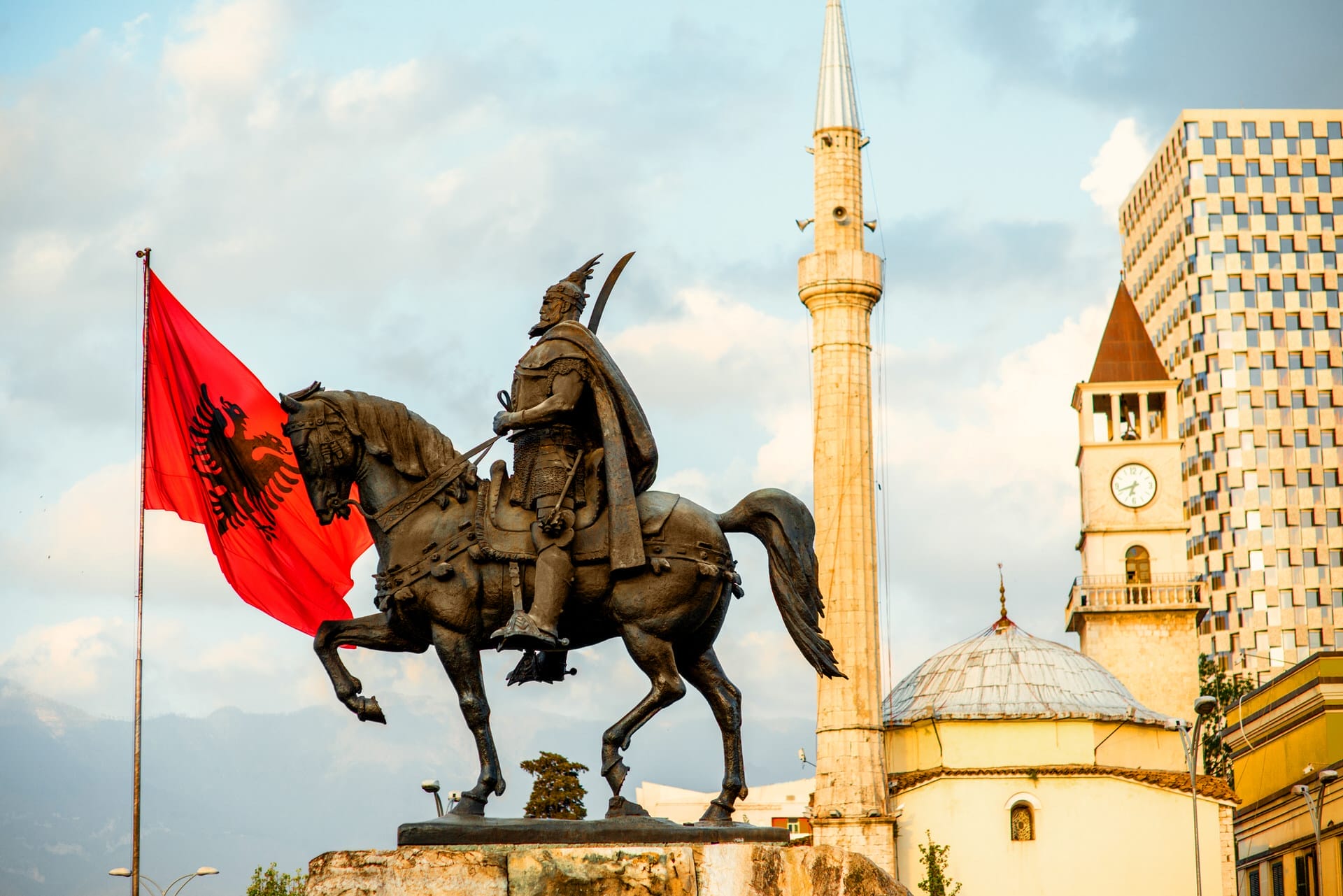
The square is named for Gjergj Kastrioti “Skanderbeg,” the 15th-century Albanian leader who united fragmented clans against Ottoman expansion (1443-1468). His resistance failed ultimately—the Ottomans conquered Albania after his death—but the historical memory of those 25 years when mountain fortresses defied empire became the foundational narrative of Albanian national identity. The bronze equestrian statue erected in 1968 captures this mythology: Skanderbeg on horseback, sword raised, eternally resisting.
The Architectural Layers
Walking the square’s perimeter means encountering a century of Albanian history condensed into adjacent buildings, each representing the regime or period that commissioned it:
Et’hem Bey Mosque (1790-1821): The only significant Ottoman structure surviving in the square. Construction began in 1789 and completed in 1821 with painted interior decorations showing trees, waterfalls, and buildings—unusual for Islamic religious art and evidence of Albanian artistic traditions persisting within Ottoman architectural forms. The mosque was closed during communist atheism campaigns (1967-1991) and reopened in January 1991 as one of the first signs that Hoxha’s system was collapsing. Its survival through demolition campaigns that destroyed hundreds of religious buildings makes it architecturally and symbolically significant.
Clock Tower (1828): Built during Ottoman period, this 35-meter tower originally featured an Ottoman clock mechanism that rang the hours across Tirana. The tower survived communist period despite regime’s general hostility to Ottoman heritage, likely because it functioned as civic infrastructure rather than religious symbol. Visitors can climb the internal stairs for panoramic city views (small admission fee, hours vary seasonally).
Bank of Albania (1938): Designed by Italian architects Vittorio Ballio Morpurgo during the period when Mussolini’s Italy occupied Albania (1939-1943). The Rationalist architecture—clean lines, symmetrical facades, stripped-down classical references—represents fascist-era building that predated outright occupation. The building still functions as Albania’s central bank.
Palace of Culture (1963): Massive communist-era complex housing the National Opera and Ballet Theatre and National Library. Designed by Albanian and Soviet architects, the brutalist structure reflects Khrushchev-era Soviet aesthetic influence on Albanian architecture before the Sino-Soviet split and subsequent Albanian-Soviet break in 1961. The building demonstrates how communist regimes used monumental public architecture to project permanence and legitimacy.
National History Museum (1981): Albania’s largest museum (27,000 square meters), recognizable by its massive socialist-realist mosaic facade titled “The Albanians.” The mosaic depicts Albanian history from ancient Illyrians through communist period, with heroic figures representing different historical epochs. The artistic style—idealized human forms, dramatic compositions, clear historical narratives—exemplifies socialist realism applied to architectural decoration. The museum operates daily with admission fees (see National History Museum for details).
Tirana International Hotel (1979): Once the city’s tallest building (now dwarfed by newer construction), built on the site of Tirana Cathedral which communists demolished in 1967. The hotel’s placement demonstrates how Hoxha’s regime literally built over religious sites, replacing churches with secular state infrastructure. The building continues operating as hotel.
Skanderbeg Monument (1968): Bronze equestrian statue by Albanian sculptors Odhise Paskali, Andrea Mano, and Janaq Paço, showing Skanderbeg on horseback. The monument replaced earlier versions including a statue from 1930s that Italian fascists installed. Communist regime removed the Italian statue and commissioned this version to reclaim nationalist symbolism for socialist purposes—turning Skanderbeg from feudal lord into proto-communist resistance fighter against foreign occupation.
The 2017 Redesign
For decades, Skanderbeg Square functioned as traffic roundabout with cars circling the monuments. The space was theoretically public but practically hostile—crossing from one side to another required navigating multiple lanes of traffic, making the square feel more like road junction than civic plaza.
The 2017 redesign by Belgian firm 51N4E removed all vehicles, converted the underground parking garage, and unified the 40,000 square meters into continuous pedestrian space. The design includes several conceptual elements:
Paving from All Regions: The plaza’s stone paving was sourced from quarries in different Albanian regions, creating literal mosaic of the nation’s geography underfoot. The material diversity acknowledges Albania’s regional variations while unifying them into single surface.
Sloped Surface: The plaza slopes upward approximately two meters from edges to center, creating gentle hill effect. Water from understated fountains trickles across the surface toward drainage at edges, making the plaza feel active and fluid rather than static.
Open Space: The design prioritizes emptiness over decoration, creating vast pedestrian area without barriers, fences, or excessive furniture. This openness allows the square to adapt to different uses—concerts, markets, demonstrations, casual recreation—without fixed programming dictating how people should use it.
The redesign earned the European Prize for Urban Public Space in 2018, recognizing its successful transformation of automotive infrastructure into pedestrian civic space.
Using the Square
Access: Skanderbeg Square sits at Tirana’s center with all major streets radiating from it. The square is easily walkable from most city center hotels (5-15 minutes depending on location). All city bus routes pass through or near the square. The airport shuttle bus terminates at a stop adjacent to the square.
Parking: Underground parking garage directly beneath the plaza (entrance/exit on perimeter streets). Parking costs approximately €1-2 per hour with daily maximum rates. The garage provides convenient but not cheap parking for those driving in Tirana.
Hours: Public space accessible 24/7. Individual buildings surrounding the square (museums, mosque, etc.) maintain their own operating hours.
Accessibility: The 2017 redesign made the entire plaza wheelchair accessible—no steps between perimeter and plaza surface, smooth paving throughout, accessible underground parking with elevator access to plaza level.
Best Times: The square functions differently depending on time and season:
- Morning (7-10 AM): Relatively quiet, some people crossing for work, mosque prayers at dawn
- Midday (11 AM-2 PM): Busiest tourist period, maximum crowds during summer
- Late Afternoon (4-7 PM): Local families, people finishing work, children playing in fountains
- Evening (7-10 PM): Peak social time when Tirana does the xhiro (evening stroll ritual), fountains lit at night, cafes on perimeter streets full
- Winter: Less crowded, Christmas/New Year markets create seasonal activity
What to Bring: Sun protection during summer—the open plaza offers minimal shade and paving reflects heat. Water during hot days. Camera for architectural documentation.
Events Throughout the Year
Skanderbeg Square functions as Albania’s public stage where national celebrations, political demonstrations, concerts, and markets occur:
National Holidays: November 28 (Independence Day) and November 29 (Liberation Day) bring crowds, official ceremonies, evening concerts, and fireworks.
Religious Observances: Eid prayers at Et’hem Bey Mosque can attract thousands gathering in the square. Christmas (December 25, Western Christian calendar) and Orthodox Christmas (January 7) bring seasonal markets.
Concerts and Festivals: Summer evening concerts feature Albanian and international artists. Various cultural festivals use the square as performance venue.
Markets: Weekend farmers’ markets occasionally occupy the square, featuring regional agricultural products and handicrafts.
Demonstrations: As Albania’s most visible public space, the square hosts political demonstrations and protests. These can range from small organized gatherings to large spontaneous crowds.
The Honest Assessment
Skanderbeg Square succeeds as public space—the 2017 redesign genuinely transformed automotive roundabout into pedestrian plaza where people actually gather rather than just pass through. The square now functions how civic spaces should: accessible, flexible, open to multiple uses.
What the square offers beyond functionality is concentrated architectural history. The buildings surrounding the plaza document Albanian 20th century better than any museum exhibit could—Ottoman mosque adjacent to fascist bank adjacent to communist palace adjacent to post-communist commercial development creates visual timeline of the ideologies and occupations that shaped modern Albania.
This makes the square valuable for travelers interested in understanding Albania beyond beaches and mountains. The architecture tells stories if you know how to read it: why the mosque survived when hundreds were destroyed, why Italian Rationalism appears in Albanian capital, why socialist buildings prioritized monumentality, how post-communist development adapts communist structures rather than demolishing them.
What the square doesn’t offer is traditional beauty. These buildings weren’t designed for aesthetic harmony—each regime built according to its own priorities without concern for neighbors. The result is architecturally chaotic collection that works as historical document but not as carefully composed urban design.
Skip Skanderbeg Square if you need destinations offering immediate visual gratification, if architectural history doesn’t interest you, or if you’ve limited time in Tirana and prefer focusing on specific museums or attractions rather than public space observation.
Visit if you’re spending more than a day in Tirana (impossible to avoid the square anyway—it’s literally the center), if you want to understand how Albanian history manifests in architecture, if public space transformation interests you, or if you need orientation point for exploring Tirana’s city center.
The square isn’t stunning, isn’t particularly beautiful, and probably won’t become favorite travel memory. But it functions as Albania’s most important civic space, documents the country’s turbulent 20th century in adjacent buildings, and provides access to multiple museums and landmarks within 30-minute walking radius. That’s sufficient purpose for a square that’s literally at the center of everything happening in Tirana.