From Dictator’s Monument to People’s Tech Hub
In 1988, Pranvera Hoxha and her husband designed a pyramid as a museum glorifying the dictator who had died three years earlier. The brutalist concrete structure opened just as Enver Hoxha’s regime was collapsing, making it an instant monument to failed ideology before it could serve any sustained purpose as propaganda tool.
For three decades, the building sat in architectural limbo while Tirana debated its fate. NATO briefly used it as a base during the 1999 Kosovo War. It became a nightclub for a while, then a conference center, then gradually a graffiti-covered ruin that the city couldn’t decide whether to demolish or preserve. The debate became a referendum on how to handle communist heritage—erase it entirely or transform it into something new.
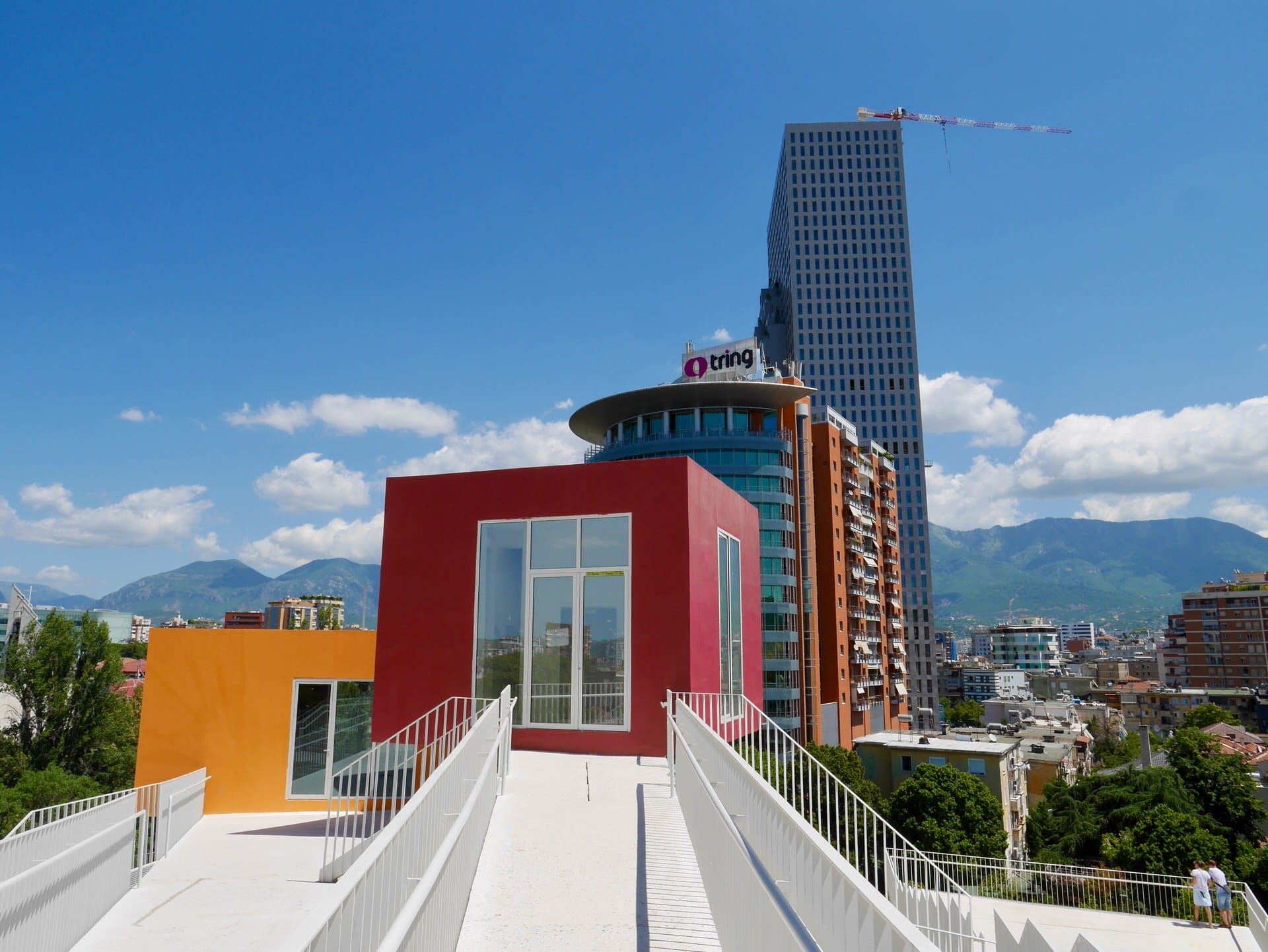
In October 2023, the transformation won. Dutch architecture firm MVRDV completed a renovation that kept the original concrete structure but radically reimagined its purpose. The building is now genuinely climbable—stepped facades with concrete stairs allow anyone to walk to the summit and look across Tirana from what was once off-limits architecture. Thirty-two colorful boxes scattered across and within the structure house cafes, studios, workshops, startup offices, and classrooms.
About half the space belongs to TUMO Tirana, a non-profit providing free afterschool education for 12-to-18-year-olds in software development, robotics, animation, music production, and filmmaking—exactly the kind of forward-thinking, globally-connected education that Hoxha’s regime would have banned as Western corruption.
As MVRDV founding partner Winy Maas framed it: “The transformed Pyramid has now become a monument for the people and their ability to overcome and outlive dictators.”
What the Transformation Created
The MVRDV renovation preserved the pyramid’s original concrete shell—the distinctive brutalist form remains intact, maintaining the building’s visual presence in Tirana’s skyline while completely changing its function and accessibility.
The Climbable Facades: Concrete stairs now cover all sloped sides of the pyramid, creating stepped surfaces that visitors can walk up from ground level to summit. The climbing experience takes 10-15 minutes depending on pace and provides progressively expansive views across Tirana as you ascend. At the summit, you’re approximately 60 meters above street level with 360-degree views spanning the city center, surrounding mountains, and on clear days, glimpses of the Adriatic beyond.
The stairs include safety features but remain genuine outdoor climbing—handrails exist at key points, but this isn’t a sanitized tourist attraction with barriers everywhere. You’re walking up concrete steps on a steep incline. Comfortable shoes and reasonable fitness make the experience straightforward, though small children and those with mobility limitations may find it challenging.
The Colorful Boxes: Thirty-two modular structures in vibrant colors (orange, yellow, green, blue) punctuate the pyramid’s white concrete. These boxes serve multiple functions—some house TUMO classrooms and studios, others contain cafes, coworking spaces, startup offices, and exhibition areas. The boxes create visual dynamism and provide functional spaces within the formerly hollow structure, transforming what was once a single-use monument into multi-functional civic space.
Glass Lifts: Two glass elevators provide accessible routes to upper levels for those unable to use stairs, ensuring the building remains inclusive despite its dramatic stepped architecture.
Interior Spaces: The ground level is open to the public during operating hours, featuring cafes, casual seating areas, and access to various programs and exhibitions. The TUMO educational spaces occupy designated areas but don’t dominate the entire building—the renovation maintained public accessibility rather than converting the pyramid into purely institutional space.
TUMO: Free Education in Former Propaganda Space
TUMO Tirana represents the conceptual heart of the transformation—where Hoxha’s monument to personality cult now houses education in technologies and creative fields that communist Albania suppressed for decades.
The program serves ages 12-18 with free afterschool education in:
- Software Development: Coding, app development, web design
- Robotics: Engineering, programming autonomous systems
- Animation: 2D/3D animation, motion graphics
- Filmmaking: Video production, editing, storytelling
- Music Production: Audio engineering, composition, digital music creation
Students attend on their own schedules, choosing courses based on interests rather than following standardized curriculum. The approach emphasizes project-based learning, peer collaboration, and skill development aligned with global tech industry standards—preparing Albanian teenagers for careers in fields where the country has growing startup scenes and remote work opportunities with international companies.
The program operates free of charge, funded through public-private partnerships and international support recognizing education’s role in Albania’s development. For a country where GDP per capita remains among Europe’s lowest, providing high-quality tech education at zero cost to families represents significant investment in future economic opportunities.
Visiting Practicalities
Location: The Pyramid sits in central Tirana at the junction of Bulevardi Dëshmorët e Kombit and Rruga Kont Urani, approximately 800 meters south of Skanderbeg Square. The location is easily walkable from most city center hotels (10-15 minutes from the square).
Access and Hours:
- Exterior climbing: Free 24/7 access. You can climb the pyramid anytime, day or night, though daylight hours obviously provide better visibility for views and safer footing on stairs.
- Interior spaces: Monday-Friday 9 AM-8 PM, Saturday 9 AM-5:30 PM, closed Sundays. The interior closes for TUMO programs on Sundays, though exterior climbing continues as always.
- Entry cost: Free. No tickets, no fees, no reservations needed.
When to Visit: Anytime works for exterior climbing. Sunset (roughly 5-8 PM depending on season) provides dramatic lighting for both climbing experience and city views. Early morning (7-9 AM) offers fewer crowds and cooler temperatures during summer months.
For interior exploration (cafes, exhibitions), visit during operating hours. Weekday afternoons when TUMO programs are active create livelier atmosphere if you want to see the education center functioning. Saturday mornings offer quieter interior access.
What to Bring: Comfortable shoes with good grip for climbing concrete stairs. Phone/camera for views and photos (the colorful boxes create striking compositions). Water during summer heat—there’s minimal shade on the facades.
Safety Notes: The climbing is straightforward but involves ascending steep concrete stairs without continuous handrails. Watch your step, especially in rain when surfaces become slippery. Small children should be supervised closely. The pyramid isn’t dangerous, but it’s not childproofed either.
The Honest Assessment
The Pyramid succeeds as architectural transformation and symbolic statement. MVRDV’s intervention created genuinely public space from what was previously either off-limits monument or inaccessible ruin. Making the building climbable democratizes access in ways that feel intentionally political—anyone can now stand on top of the structure built to glorify a dictator who kept Albania sealed from the outside world.
The views from the summit don’t rival mountain vistas or coastal panoramas, but they provide satisfying perspective on Tirana’s urban landscape—the painted brutalist blocks, the mosque minarets, the construction cranes documenting ongoing development, the mountains ringing the valley. It’s a view that tells Tirana’s story of transformation from isolated communist capital to aspirational European city.
The TUMO education component adds substance beyond photogenic architecture. This isn’t just converted monument—it’s functioning institution teaching skills that matter for Albania’s economic future, creating tangible benefit beyond symbolic gestures about overcoming dictatorship.
What the Pyramid doesn’t offer is extensive time investment. You can climb to the top, enjoy views, explore the ground floor cafes, and complete the experience in 30-60 minutes. That’s perfectly adequate for what this is—a transformed monument providing public space and photo opportunities in Tirana’s center.
Skip the Pyramid if you need destinations requiring substantial time commitment, if you’ve seen the transformation already documented in architecture publications, or if climbing stairs for city views doesn’t appeal when Mt. Dajti cable car provides more dramatic vistas with less effort.
Visit if you’re spending time in Tirana anyway (it’s walkable from most city center locations), if architectural transformation interests you, if you want to see how Albania is handling communist heritage through repurposing rather than destruction, or if free climbable structures providing panoramic city views sound appealing regardless of historical context.
The Pyramid stands as evidence that buildings can outlive the ideologies that created them. What Pranvera Hoxha built to honor her father now teaches Albanian teenagers to code, animate, and engineer—skills opening doors to opportunities her father’s regime denied previous generations. Whether you find that poetic or simply practical, the transformation represents Albania’s ongoing project of figuring out what to do with a difficult past while building toward a different future.