Closed Until 2028: What You Need to Know
The National History Museum—Albania’s largest museum at 27,000 square meters occupying the northern side of Skanderbeg Square—closed entirely on March 15, 2024 and will remain closed until 2028 for comprehensive renovation. This isn’t a partial closure affecting individual galleries—the entire building is inaccessible to visitors for the four-year renovation period.
The closure stems from damage sustained during the November 26, 2019 earthquake (magnitude 6.4) that killed 51 people and damaged hundreds of buildings across Albania. While the museum’s structure didn’t collapse, the earthquake exposed underlying vulnerabilities requiring complete restoration. The renovation project, funded through the European Union’s €40 million EU4Culture initiative and implemented by UNOPS (United Nations Office for Project Services), addresses both earthquake damage and decades of deferred maintenance dating to the museum’s 1981 opening.
What’s Being Renovated:
- Full structural restoration addressing earthquake damage and foundation issues
- Complete modernization of exhibition spaces with new climate control systems
- Accessibility upgrades including elevators, ramps, and tactile stations for visually impaired visitors
- Digital infrastructure for interactive displays, AR/VR elements, and 3D artifact scans
- Redesigned pavilions with chronological flow and bilingual Albanian/English labels
- Preservation and protection of the museum’s 5,000-artifact collection during construction
What Remains Visible: The museum’s iconic facade mosaic titled “The Albanians”—a massive socialist-realist work from 1981 depicting Albanian history from ancient Illyrians through the communist period—was restored in 2023 as an early project milestone (approximately €1 million investment). The mosaic remains fully visible from Skanderbeg Square, though scaffolding may appear during later renovation phases. Visitors can photograph the exterior and mosaic from the square without restrictions.
What the Museum Contains (When Open)
Before closure, the National History Museum functioned as Albania’s primary institution for historical interpretation, housing approximately 5,000 artifacts spanning from the 4th millennium BCE to the late 20th century. The museum opened October 28, 1981 after three years of planning involving specialists in history, archaeology, linguistics, and art—a massive state project during Enver Hoxha’s final years designed to present official communist interpretation of Albanian history.
The museum’s pavilions chronicled Albanian history through distinct periods, each occupying dedicated gallery spaces:
Pavilion of Antiquity: Archaeological artifacts documenting Illyrian civilization from prehistory through early Middle Ages, including sculptures, pottery, coins from Illyrian/Greek/Roman periods, and evidence of economic relationships between Illyrian cities and Mediterranean trading centers like Corinth and Athens. The collection demonstrated how Illyrian manufacturing continued thriving even after Roman conquest, with local craftsmanship maintaining significant place in inter-regional markets.
Medieval Pavilion: Material culture from Late Antiquity through Byzantine and Ottoman periods (4th-19th centuries CE), including 12th-14th century state formations (Principality of Arber, Principality of Karl Topia), the Byzantine treasury discovered at Kuçovë, and the Epitaf of Gllavenica (1373). The pavilion documented Albanian pashaliks under Ottoman rule, particularly the Shkodra Pashalik (Bushat family) and Ioannina Pashalik (Ali Pasha Tepelena), plus collections of handcrafted weapons demonstrating period artistry and military technology.
National Renaissance Pavilion: The 19th-early 20th century Albanian National Renaissance movement documenting efforts toward national unity, independent statehood, and development of Albanian language/education/culture. Exhibits covered the League of Prizren (1878-1881), Congress of Manastir (1908) adopting phonemic Albanian alphabet, and the November 28, 1912 Declaration of Independence.
Independence Pavilion: Albania’s path from 1912 independence through the 1920s-1930s state-building period, including the National Assembly of Vlora, the London Conference of Ambassadors recognizing Albanian borders, Prince William of Wied’s brief reign (1914), World War I’s impact, and Ahmet Zogu’s rise through presidency (1925) to kingship (1928-1939). The pavilion documented early infrastructure development, establishment of the National Bank of Albania, and cultural/societal modernization.
Pavilion of Icons: Approximately 70 post-Byzantine icons from 16th-early 19th centuries, established 1999 in collaboration with the Institute of Monuments of Culture. The collection featured works by Onufri (founder of the Berat atelier), Cypriot Onufri, David Selenica, Kostandin Shpataraku, Constantin Jeromoni, and others representing Albanian religious art’s flourishing during Ottoman period. Liturgical objects crafted in gold and silver—crosses, icon covers, gospel coverings with 17th-18th century inscriptions—demonstrated native goldsmith craftsmanship.
Anti-Fascist National Liberation War Pavilion: Documentation of Albanian resistance movements against Italian fascist occupation (1939-1943) and German occupation (1943-1944), including strategic collaborations with allied forces, key battles/operations, personal narratives from resistance fighters, weapons/uniforms/documents, and photographic exhibits capturing the period. The pavilion emphasized communist partisan role in liberation, aligning with post-war regime’s official historical narrative.
Communist Terror Pavilion: Opened post-1991 to document the 1945-1991 communist dictatorship’s repressions, including execution decisions, death punishment lists, political prisoner records, religious persecution (Albania declared world’s only atheist state in 1967), prisons/forced labor camps/internment camps, and the regime’s targeting of artists, writers, and intellectuals. This pavilion represented post-communist Albania’s effort to document and memorialize the previous regime’s abuses.
Mother Teresa Pavilion: Dedicated to Agnes Gonxha Bojaxhiu (Mother Teresa, 1910-1997), born in Skopje (now North Macedonia) to Albanian parents. The pavilion documented her life, humanitarian work in Calcutta, founding of Missionaries of Charity, Nobel Peace Prize (1979), and canonization (2016), positioning her as symbol of Albanian compassion and global humanitarian contribution.
What to Expect When It Reopens (2028)
The renovation aims to transform the museum from 1980s-era static displays with minimal interpretation into modern institution featuring interactive technology, comprehensive accessibility, and contemporary curatorial approaches. Based on tender documents and EU4Culture project specifications (subject to evolution during four-year construction):
Redesigned Pavilions: Chronological flow improving navigation through Albanian history, with clear thematic organization allowing visitors to understand connections between periods. Interactive media including touchscreens, video displays, and audio elements supplement physical artifacts, providing deeper context than static text panels permitted.
Bilingual Presentation: All labels, descriptions, and interpretive materials in both Albanian and English, ending the previous inconsistent translation that left international visitors struggling to understand exhibits.
Accessibility: Elevators and ramps throughout the building ensuring wheelchair users can access all floors and galleries. Tactile stations for visually impaired visitors providing physical/audio descriptions of key artifacts. Accessible restrooms, seating areas, and emergency exits meeting international accessibility standards.
Digital Storytelling: Augmented reality (AR) and virtual reality (VR) elements allowing visitors to experience historical scenes, 3D artifact exploration, and immersive storytelling that brings Albanian history to life beyond what physical objects alone can convey. Online access to 3D scans of key artifacts enabling virtual exploration for researchers, students, and those unable to visit in person.
Climate Control: Modern HVAC systems protecting artifact collection while maintaining comfortable visiting conditions year-round, replacing inconsistent climate control that threatened preservation and created uncomfortable viewing environments.
Retail and Services: Upgraded museum shop, improved cafe facilities, modern restrooms, and visitor amenities meeting contemporary expectations while respecting the building’s historical architecture.
Alternative Museums in Tirana (Open Now)
While the National History Museum remains closed, Tirana offers several alternative museums providing different perspectives on Albanian history and culture:
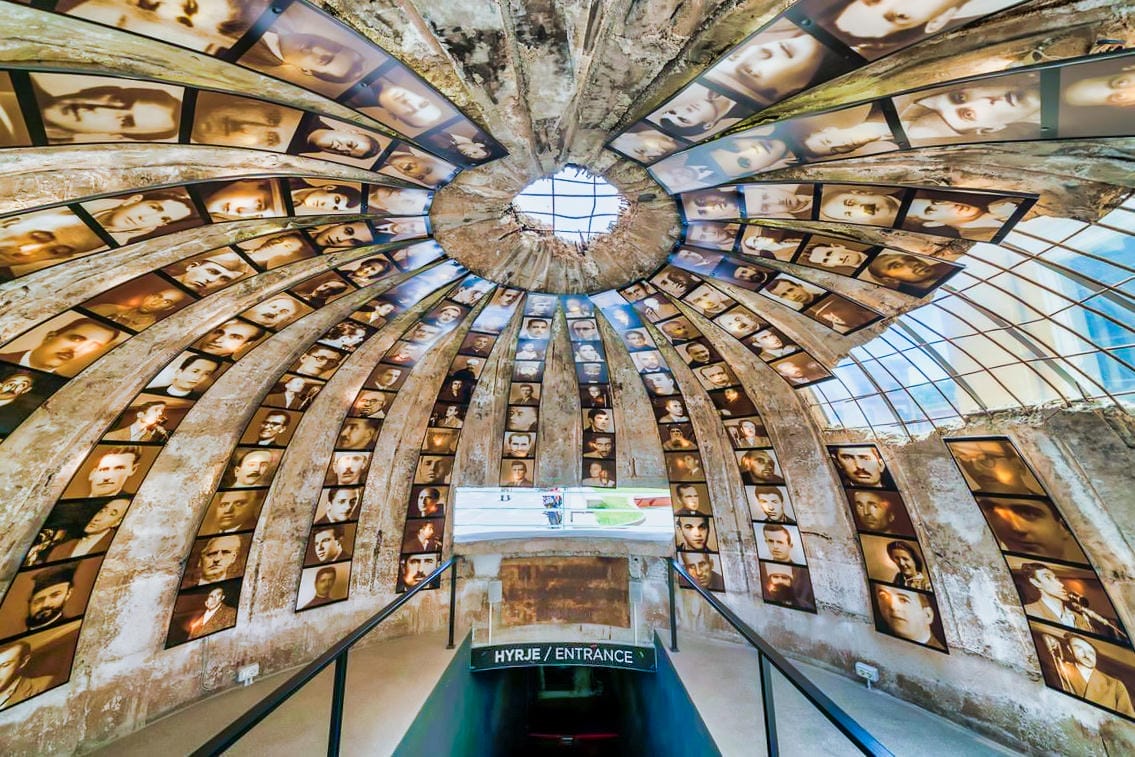
Bunk’Art 1: Enver Hoxha’s five-story nuclear bunker (106 rooms, built 1972-1978) now museum documenting Cold War paranoia, communist period repression, and secret police operations. Located 6.2km from city center near Dajti Express cable car station. Open 9:30 AM-6 PM daily, entry 900 LEK (~€9). Allow 2-3 hours minimum. Provides the most comprehensive alternative coverage of 20th century Albanian history during National History Museum closure.
Bunk’Art 2: Downtown bunker focusing specifically on Ministry of Interior and Sigurimi (secret police) surveillance methods, interrogation techniques, and political prisoner stories. More focused and darker than Bunk’Art 1, offering detailed examination of communist repression mechanics. Located 7 minutes walk from Skanderbeg Square. Open 9:30 AM-6 PM daily, entry 500 LEK (~€5). Allow 1-2 hours.
House of Leaves: Former headquarters of Sigurimi (secret police) and German Gestapo before that, now museum documenting surveillance state methods used against Albanian citizens suspected of disloyalty. The building itself—bugged rooms, hidden passages, interrogation chambers—functions as exhibit demonstrating how totalitarian surveillance operates. Located 5 minutes walk from Skanderbeg Square. Provides chilling complement to understanding communist-era Albania.
National Gallery of Art (partial reopening): Albanian art from 19th century through contemporary period, including socialist realism works from communist era and post-1991 contemporary Albanian artists. The gallery has partially reopened following its own renovation, though not all sections may be accessible. Located 10 minutes walk from Skanderbeg Square. Check current status before visiting as reopening remains phased.
Archaeological Museum (if reopened): Formerly housed in Mother Teresa Square, the archaeological museum contains artifacts from ancient Illyrian, Greek, and Roman periods found throughout Albania. The museum has faced its own closure/relocation challenges—check current status before visiting.
Staying Updated on Reopening
Official Sources:
- EU4Culture Albania: @eu4culturealbania on Instagram or eu4culture.al for renovation progress, construction milestones, and project updates
- National History Museum: @MuzeuHistorikKombetar on Instagram and Facebook for official announcements
- Ministry of Culture: meki.gov.al publishes periodic bulletins about major cultural projects including museum renovations
Expected Timeline: The museum closed March 15, 2024 with announced reopening target of 2028. Construction projects of this scale and complexity frequently experience delays—the 2028 date should be considered aspirational rather than guaranteed. Monitor official sources beginning spring 2027 for realistic reopening information. Soft openings or phased gallery reopenings may occur before full completion, though current project documentation indicates intention for complete renovation before public access resumes.
The Honest Assessment
The National History Museum closure creates significant gap in Tirana’s cultural offerings—this was Albania’s primary institution for comprehensive historical interpretation spanning ancient Illyrians through 20th century. The four-year closure means travelers visiting Albania between 2024-2028 miss access to the country’s most extensive artifact collection and official historical narrative.
However, the renovation addresses genuine needs. The museum’s 1981 design reflected Soviet-influenced approaches prioritizing monumental architecture over visitor experience, with minimal interpretation, inconsistent translations, poor climate control, and zero accessibility features. Artifacts deserved better preservation, international visitors deserved comprehensible labels, and wheelchair users deserved access to Albanian cultural heritage.
The €40 million EU investment represents recognition that preserving and presenting Albanian history matters for the country’s cultural development and tourism economy. Whether the renovated museum successfully balances preservation of important artifacts with contemporary curatorial approaches won’t be known until 2028 reopening.
For travelers visiting Tirana during the closure: the facade mosaic remains visible and photographable from Skanderbeg Square, providing glimpse of socialist-realist artistic ambitions even while the interior remains inaccessible. Bunk’Art 1 and 2 provide alternative access to 20th century Albanian history, while House of Leaves offers disturbing but important documentation of surveillance state mechanics. These alternatives don’t replace what the National History Museum offered, but they provide substantial historical context during the renovation period.
When the museum reopens in 2028 (or whenever construction actually completes), expect transformed institution featuring modern museum practices, comprehensive accessibility, and interpretive approaches that help international visitors understand Albanian history beyond what 1980s-era static displays permitted. Whether the renovation successfully executes these ambitions remains to be seen, but the closure at least addresses recognized deficiencies rather than allowing continued deterioration of important cultural infrastructure.