The Fig Tree That Fell Through History
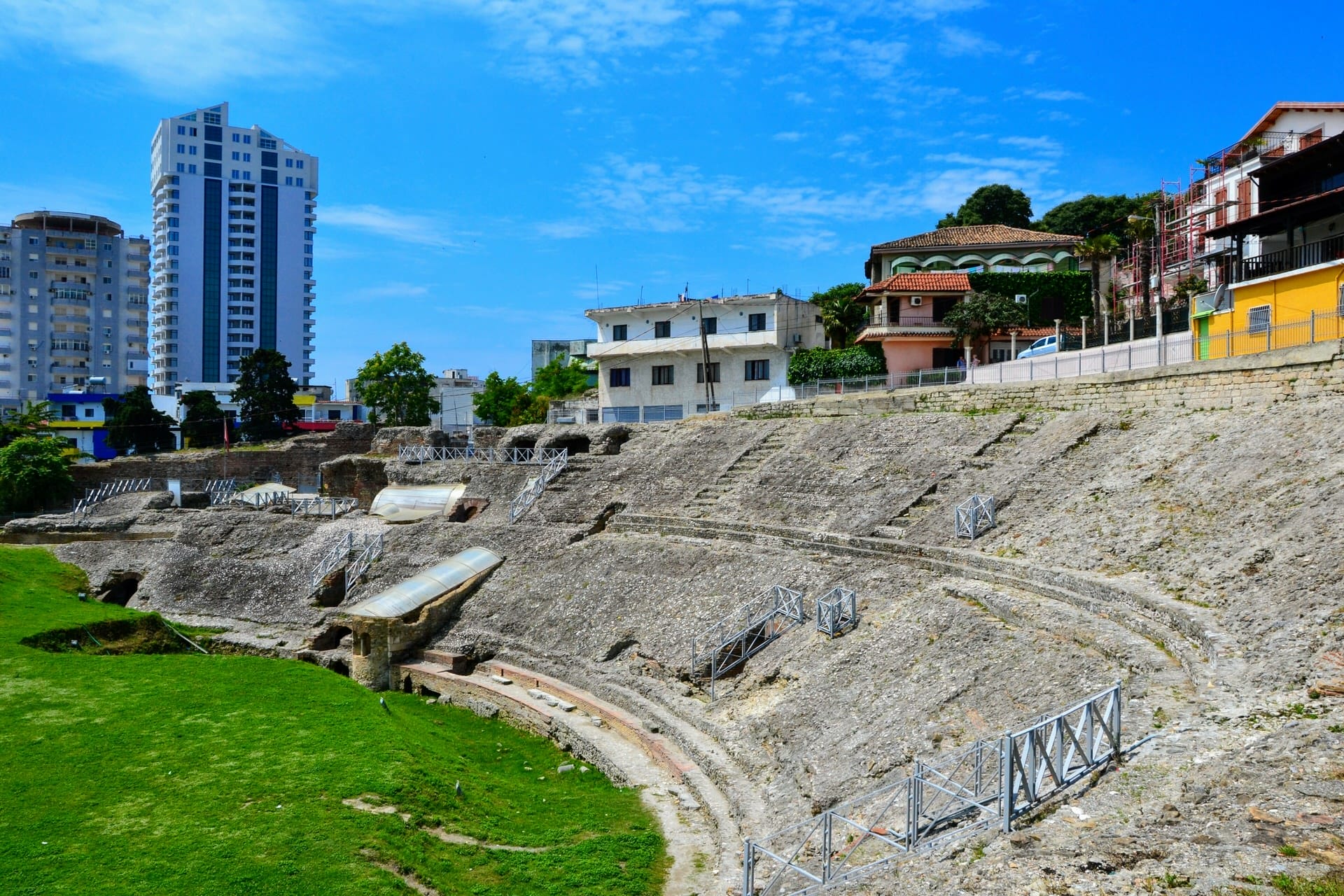
In 1966, residents of central Durrës watched a fig tree growing in someone’s yard suddenly drop several meters into the ground. The homeowner called authorities, who discovered the tree had fallen through the roof of an underground structure. Archaeologist Vangjel Toçi investigated and confirmed what seemed impossible: buried beneath medieval and Ottoman buildings sat a Roman amphitheatre—the largest ever built in the Balkans, capable of holding 20,000 spectators, constructed under Emperor Trajan around 100-110 AD.
The amphitheatre had been built at ground level in the 2nd century AD when Durrës (Roman Dyrrachium) functioned as major port connecting Rome to its eastern provinces via the Via Egnatia. After the structure fell into disuse in the 4th century AD, successive civilizations simply built on top of it, burying the arena under 6-8 meters of accumulated construction. For over 1,500 years, one of the Roman Empire’s largest entertainment venues sat hidden beneath a modern city, until a tree’s roots found weakness in an underground arch and crashed through.
What Remains After 1,900 Years
The excavated portion—approximately one-third of the total structure—reveals the amphitheatre’s scale. The elliptical layout measures 132.4 meters by 113.2 meters at its outer walls, with the actual arena floor occupying 61.4 meters by 42.2 meters. The walls rise 20 meters from arena floor to the top of the cavea (seating area), though the original height likely exceeded this as upper tiers were destroyed or dismantled for building materials over centuries.
Walking through the site means navigating both the ancient structure and the reality that most of it remains inaccessible. Modern apartment buildings sit atop the unexcavated two-thirds. You can see where excavation stops and residential foundations begin—a jarring collision of Roman engineering and 20th-century construction that creates one of Albania’s strangest archaeological situations.
The Arena Layout
The Hypogeum: Below the arena floor, a complex system of tunnels, chambers, and mechanical systems created the infrastructure for spectacles. Animals, gladiators, and scenery waited in underground rooms before being raised through trap doors into the arena using pulley systems. The Durrës hypogeum preserves evidence of this machinery—carved channels where ropes moved, spaces where caged animals waited, passages connecting different functional areas.
The Seating Tiers: Three distinct seating sections (ima cavea, media cavea, summa cavea) accommodated different social classes, with proximity to the arena indicating status. The ima cavea near the arena floor served elite citizens and officials, the media cavea held middle-class merchants and traders, and the summa cavea’s upper reaches accommodated everyone else. The preserved sections show limestone blocks fitted without mortar, demonstrating Roman engineering that allowed structures to flex during earthquakes rather than collapsing rigidly.
The Christian Chapel: In the second half of the 4th century AD, after gladiatorial combat ceased and the amphitheatre fell into disuse, someone built a small Christian chapel inside the arena. The chapel’s foundations and fragmentary walls remain visible, incorporating stones from the original Roman structure. This transformation from pagan entertainment venue to Christian worship space documents Albania’s religious transition under the late Roman Empire.
Why the Arena Stopped Functioning
The earthquake of 345 or 346 AD damaged the structure severely enough that authorities closed the ludi gladiatorii (gladiatorial games) permanently. By this point, Christianity had gained official status within the Roman Empire, and support for gladiatorial combat—never particularly strong among Christian leaders—declined rapidly. The damaged amphitheatre offered convenient excuse to end games that increasingly conflicted with Christian doctrine.
The structure wasn’t completely abandoned immediately. Evidence suggests the space served various civic functions through the 5th and 6th centuries as Durrës transitioned from Roman to Byzantine control. Eventually, as the city’s population declined and resources became scarce, residents began treating the amphitheatre as convenient quarry, removing dressed stones for new construction. Medieval and Ottoman-era buildings throughout Durrës incorporate Roman masonry almost certainly taken from the amphitheatre.
The Excavation That Never Finished
Vangjel Toçi directed excavation of approximately one-third of the structure between 1966 and the early 1970s. Archaeologist Lida Miraj continued work through the 1980s, exposing more of the arena floor and hypogeum. Then excavation stopped—not because archaeologists lacked interest, but because digging further meant demolishing modern buildings housing hundreds of families.
Albanian authorities faced impossible choice: displace current residents to expose ancient ruins, or preserve the status quo leaving most of the amphitheatre buried. They chose the latter. The University of Parma initiated restoration work in 2004 focusing on preserving what’s already exposed rather than expanding excavation. This work continues sporadically as funding allows, though progress remains slow.
The result is site that feels perpetually incomplete. You’re seeing significant Roman architecture, but you’re also constantly aware that most of it remains out of view, sitting beneath people’s homes a few meters away.
Visiting Practicalities
Location: The amphitheatre sits in central Durrës on Rruga Kalasë, approximately 1 kilometer from the waterfront and 400 meters from the Archaeological Museum. Walking from the beachfront hotels requires 10-15 minutes. The site is well-signed in Albanian and English.
Hours and Admission: The site operates daily, 9 AM-5 PM during winter months (November-March), extending to 9 AM-7 PM in summer (April-October). Entry costs 300 LEK (approximately €3), payable at a small booth near the entrance. No advance booking required—you purchase tickets on arrival.
Time Required: Most visitors spend 45 minutes to 1 hour exploring the exposed sections. The site isn’t extensive—you’re looking at roughly one-third of a Roman amphitheatre, plus small museum displays explaining the structure’s history. History enthusiasts might linger 90 minutes, casual visitors usually complete the visit in 30-40 minutes.
Guided Tours: English-speaking guides sometimes offer services at the entrance, charging €10-15 for 30-minute tours. The information panels throughout the site provide adequate context in Albanian and English, making guides optional rather than essential. If you’re particularly interested in Roman engineering or Albanian archaeology, a guide adds value. If you’re comfortable exploring independently with signage, you’ll manage fine without one.
What to Expect: The site is partially exposed to weather—some sections have protective roofing, others remain open to elements. Wear sun protection during summer months (shade is limited). The paths involve uneven surfaces, stairs, and narrow passages through ancient tunnels. Not wheelchair accessible. Children find the underground chambers engaging, though supervise them carefully as some areas lack protective barriers.
Photography: Allowed throughout the site without restriction. The best angles capture the contrast between exposed Roman walls and modern buildings literally built on top of the structure.
Combining Visits
The Durrës Archaeological Museum sits 400 meters from the amphitheatre (5-minute walk), housing artifacts from the city’s Roman, Byzantine, and medieval periods. Combined ticket prices aren’t available—you pay separately for each site (300 LEK amphitheatre + 300 LEK museum = 600 LEK total/~€6).
The Durrës Byzantine Forum excavation site (approximately 500 meters from the amphitheatre) remains partially closed to the public as excavation continues, though you can view portions from the perimeter fence.
Most visitors to Durrës base themselves at beachfront hotels and include the amphitheatre as half-day cultural excursion from beach time. This works well—the site is substantial enough to justify the visit but doesn’t require the full-day commitment of major archaeological parks like Butrint or Apollonia.
The Honest Assessment
The Durrës Amphitheatre delivers on scale—this genuinely was one of the Roman Empire’s major entertainment venues, and walking through the exposed hypogeum tunnels creates immediate connection to that infrastructure. The underground passages where animals waited before being hoisted into the arena remain tangibly present, not reconstructed or sanitized for tourism but simply excavated and left as they were.
What the site doesn’t deliver is completeness. You’re perpetually aware that you’re seeing a fragment, that most of the structure remains buried under residential buildings visible from where you stand. This creates cognitive dissonance—you’re looking at substantial Roman architecture while also confronting the practical impossibility of fully excavating it.
The 4th-century Christian chapel adds interesting layer, documenting the transformation from pagan spectacle to Christian worship space. The juxtaposition of gladiatorial entertainment infrastructure with religious conversion evidence compressed into the same space creates compact narrative about cultural transition under late antiquity.
The 300 LEK entrance fee makes cost irrelevant. For €3, you’re accessing genuine Roman engineering at impressive scale. Whether that translates to satisfying experience depends on your expectations regarding archaeological sites. If you need extensive interpretation, interactive displays, or complete excavation, you’ll leave wanting more. If you appreciate partial ruins that honestly present both their significance and their limitations, the Durrës Amphitheatre succeeds.
Skip the amphitheatre if you’re only in Durrës briefly (beachfront time likely matters more), if you’ve visited major Roman amphitheatres elsewhere and don’t need another example, if incomplete excavations frustrate you, or if you need full accessibility (the site’s uneven terrain and stairs make it challenging for anyone with mobility limitations).
Visit if you’re spending a full day or more in Durrës, if Roman engineering interests you, if you appreciate the cognitive challenge of partially-excavated sites where ancient and modern collide literally, or if you want to understand why Albanian archaeology faces practical constraints that wealthier countries don’t—you can’t just demolish people’s homes to expose ruins, regardless of their historical significance.
The fig tree that fell through in 1966 revealed something remarkable that authorities couldn’t fully excavate. That tension between historical importance and practical reality defines the site. You’re not just looking at a Roman amphitheatre; you’re looking at the complicated relationship between preservation and livability in a city where history literally sits beneath people’s homes, waiting for funding and political will that may never arrive to complete its excavation.