Why It Matters (Despite Being Mostly Collapsed)
Drisht Castle sits on a hilltop approximately 500 meters elevation, 7 kilometers southeast of Shkodër, controlling the valley route between Lake Shkodër and the interior highlands leading toward Kosovo. Archaeological evidence indicates continuous fortification from at least 1000 BCE (late Bronze Age Illyrian settlement) through 1478 CE when Ottoman artillery destroyed the Venetian-era fortress during the siege of Shkodër.
The site demonstrates 2,500 years of defensive architecture layered atop one geographic position—Illyrian cyclopean walls (massive stones fitted without mortar) form foundations for Byzantine construction, which Venetian engineers incorporated into late medieval fortifications that the Ottomans then systematically demolished. You’re looking at a stratigraphic timeline where each layer of ruins documents a different empire’s attempt to control Albanian trade routes.
What makes Drisht archaeologically significant is how clearly the destruction layers are visible—you can identify where Venetian walls were blown apart by 15th-century Ottoman cannons, where Byzantine repairs used recycled Roman materials, where Illyrian foundations proved too massive to dismantle so later builders simply built on top of them. Most castles get restored, obscuring construction history. Drisht remains ruined, making the architectural chronology visible for anyone with basic archaeological knowledge to interpret.
The Historical Context (Briefly)
Illyrian Period (1000 BCE - 167 BCE): The hilltop functioned as a fortified settlement controlling trade between the Adriatic coast and interior Balkans. No written records survive from this period—our knowledge comes from archaeological excavations showing cyclopean masonry techniques typical of Illyrian defensive works.
Roman/Byzantine Period (167 BCE - 1396 CE): Romans conquered the region in 167 BCE but maintained Drisht as a minor military post. Byzantine administration (4th-14th centuries CE) strengthened fortifications using alternating courses of stone and brick characteristic of Byzantine military engineering. The castle was called “Drivastum” in medieval Latin sources.
Venetian Period (1396-1478): Venice captured Shkodër and Drisht in 1396 during expansion along the Adriatic coast. Doge Michele Steno ordered fortification upgrades to defend against Ottoman expansion. Venetian engineers added artillery bastions and reinforced walls using contemporary Italian military architecture—lower, thicker walls designed to withstand gunpowder weapons rather than the high thin walls effective against pre-artillery siege tactics.
Ottoman Siege (1478): Sultan Mehmet II (who conquered Constantinople in 1453) sent armies to capture Venetian holdings in Albania. The siege of Shkodër and Drisht lasted 40 days with intensive artillery bombardment. Venetian defenders negotiated safe retreat rather than fighting to annihilation. Ottomans occupied the ruins but never rebuilt Drisht castle to its former scale—they moved administrative centers to Shkodër city, leaving Drisht as abandoned hilltop ruins.
Post-Ottoman Period (1478-present): The castle was never rebuilt. Local villagers quarried stones for house construction over subsequent centuries. The ruins you see today represent what remained after 550 years of neglect, weathering, vegetation growth, and stone robbing.
What Actually Remains on the Ground
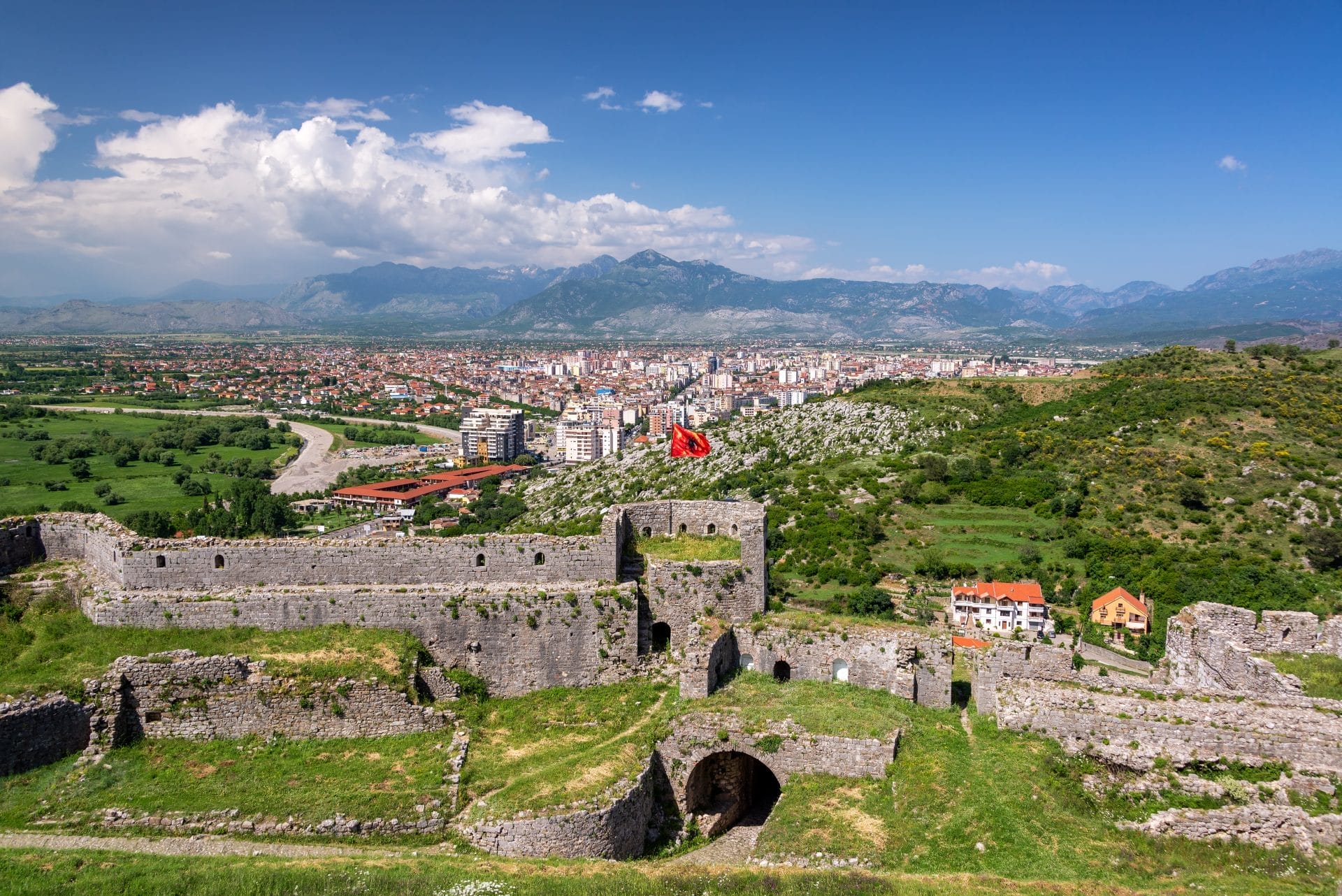
The ruins occupy approximately 3 hectares on the hilltop. The perimeter walls are the most intact structures—sections 3-5 meters high survive, showing Venetian-era construction incorporating earlier Byzantine and Illyrian foundations. The walls are thickest on the northern approach (the side vulnerable to attack) and thinner on the southern cliff face where natural topography provides defense.
The main gate area shows clearest evidence of Ottoman artillery damage—scattered stone blocks, walls blown outward, concentrated rubble suggesting focused bombardment to breach defenses at the weakest point. The gateway itself is a collapsed arch—you can identify the spring stones (top of the arch) among rubble, showing the arch was deliberately destroyed rather than collapsing from age.
Interior structures are largely foundation outlines—residential buildings, cisterns (critical for water storage on a hilltop without natural springs), storage chambers. One Byzantine church foundation is identifiable by its apsidal east end, though no walls remain standing above 1-2 meters height. The church was likely destroyed when Venetians occupied the site (Venice was Catholic, the existing church would have been Orthodox), rebuilt in Catholic form, then abandoned after Ottoman conquest.
The site has received minimal archaeological excavation. Austrian archaeologists conducted limited investigations in the 19th century. Albanian archaeologists returned in the 1970s-1980s with small test trenches. Most of the castle remains unexcavated, meaning subsurface archaeology could yield significant information about construction phases, daily life, defensive strategies—if resources existed for systematic excavation.
The Access Reality (It’s Genuinely Difficult)
Drisht Castle requires commitment. The site sits on an isolated hilltop accessible only by rough unpaved track or hiking. From Drisht village (7 kilometers southeast of Shkodër on the road toward Koplik), a vehicle track climbs the hillside—2 kilometers of steep, rocky, rutted road requiring high-clearance 4x4 vehicle driven carefully. Standard rental cars will damage undercarriage. Locals with appropriate vehicles sometimes offer transport for negotiable fees (€10-20).
The alternative is hiking. From Drisht village, ask locals for directions to “Kalaja” (castle)—the trail is not marked but locals know it. The hike takes approximately 2 hours ascending 400+ vertical meters through scrub vegetation, across rocky terrain, with sections requiring scrambling over boulders. The trail is steep, unshaded, and strenuous. Bring water (2+ liters per person), wear proper hiking shoes, avoid midday summer heat (temperatures exceed 35°C in July-August).
At the castle: no facilities, no signage beyond a basic information board (Albanian only), no maintained paths, no safety barriers at cliff edges, no shade. Mobile reception is available but unreliable. The site is completely exposed to sun and wind. Visiting in bad weather is dangerous—the ruins become slippery, visibility drops, and descent trails become hazardous.
Most visitors spend 60-90 minutes exploring the ruins and absorbing views. The return hike takes 1-1.5 hours. Total excursion requires 4-5 hours minimum from Shkodër including access time.
Why People Visit Despite the Difficulty
The castle’s appeal is precisely its difficulty and abandonment. You’re visiting ruins in their ruined state—no restoration, no tourism infrastructure, no crowds. During weekdays, you’ll likely have the site completely to yourself. The experience feels like discovering abandoned archaeology rather than visiting a managed tourist attraction.
The views are exceptional—360-degree panorama including Lake Shkodër (largest lake in the Balkans), the Albanian Alps to the north, Shkodër city to the west, the Drin River valley to the east. The elevation and isolation create profound silence broken only by wind and occasional birdsong. This atmosphere of abandonment and exposure to natural elements is exactly what some visitors seek—authentic engagement with historical ruins without modern mediation.
For photographers, Drisht offers dramatic subjects—crumbling walls silhouetted against mountain backdrops, vegetation growing through medieval masonry, the contrast between ruined human structures and enduring natural landscape. The site works particularly well for sunset photography when golden light illuminates the ruins from the west.
The Honest Assessment
Drisht Castle is archaeologically significant and visually dramatic. The layered construction history spanning 2,500 years, the visible evidence of military destruction, and the exceptional hilltop location make it genuinely interesting for visitors with background knowledge about Balkan medieval history and fortification architecture.
What Drisht isn’t is accessible or interpreted. The difficult access eliminates casual visitors. The lack of signage means you’re responsible for understanding what you’re seeing. The ruins are fragmentary enough that non-archaeologists might struggle to distinguish different construction periods or understand building functions. This is castle-as-adventure-destination rather than castle-as-educational-site.
Skip If: You expect tourist facilities and interpretation, if rough hiking or 4x4 vehicle access is problematic, if you prefer restored castles with obvious architectural features over fragmentary ruins requiring imagination, if you need maintained paths and safety infrastructure, if you have limited time in Shkodër and prefer more accessible attractions like Rozafa Castle, or if you’re not specifically interested in medieval fortification archaeology.
Visit If: You’re interested in Balkan medieval history and enjoy archaeological sites in ruined state, if you have appropriate vehicle access or hiking fitness/equipment, if you appreciate sites precisely because they’re undeveloped and require effort to reach, if you want exceptional views with guaranteed solitude, if you’re spending extended time in Shkodër region and have exhausted more accessible attractions, or if you’re researching Albanian castle architecture and need to see Drisht’s multi-period construction for comparative purposes.
Compare Drisht to Rozafa Castle (6 kilometers from Shkodër center)—Rozafa has paved access, maintained paths, interpretation, tourism facilities, and substantial intact architecture. Rozafa is the accessible, family-friendly option. Drisht is the adventurous, archaeology-enthusiast option. Both are valid choices depending on your priorities, fitness level, and interest in trading convenience for authenticity and isolation.