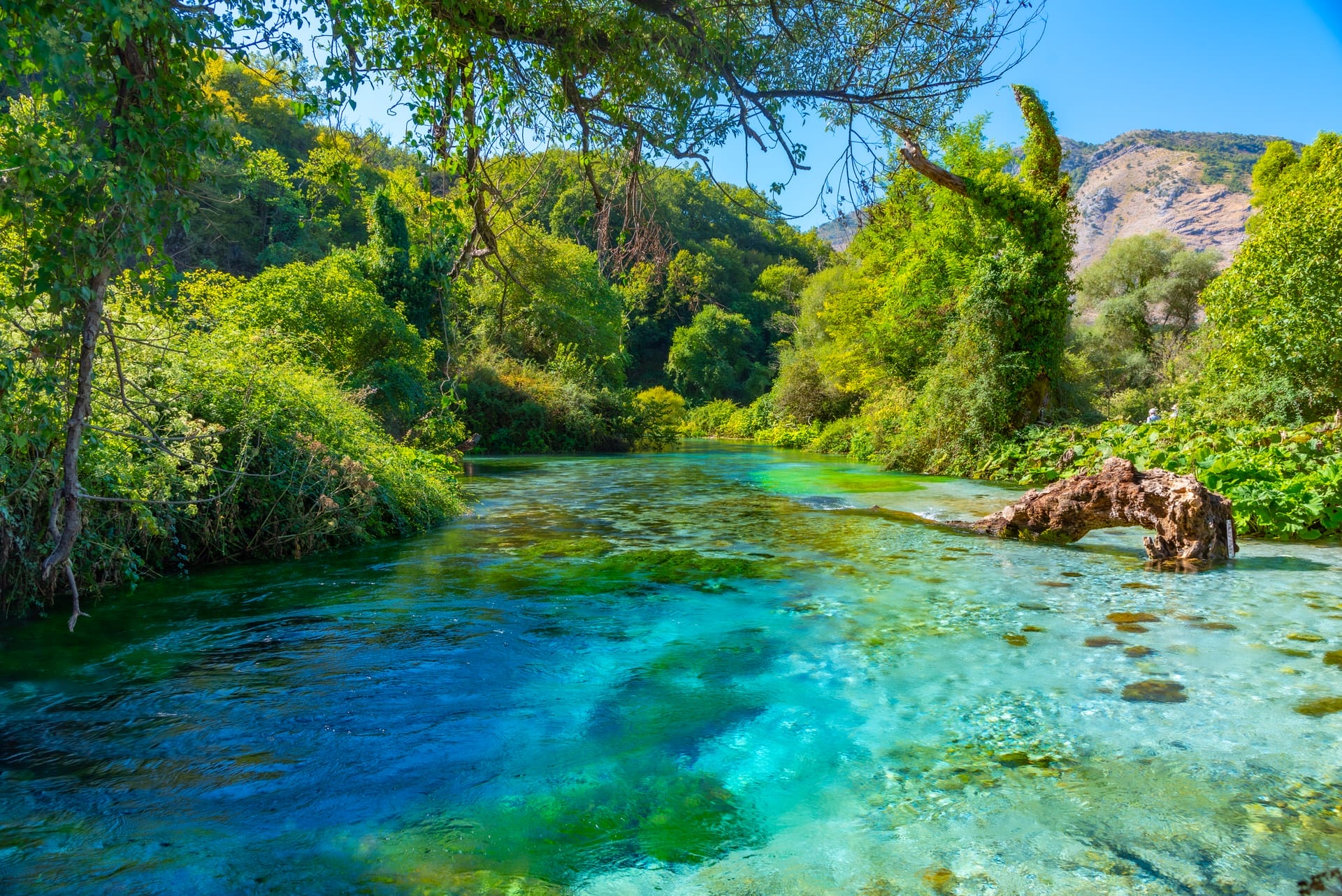
The Spring That Defeats Sonar
Thirty kilometers inland from Sarandë, crystal-clear water bubbles from a karst spring at approximately 6 cubic meters per second, creating the phenomenon Albanians call Syri i Kaltër—the Blue Eye—where brilliant turquoise water seems to emerge from nowhere in the middle of dense forest. The spring’s true depth remains unknown despite multiple diving expeditions; experienced technical divers have measured depths exceeding 50 meters before encountering passages that drop into darkness so complete their powerful underwater lights can’t penetrate more than a few meters ahead, and sonar equipment returns inconclusive or contradictory readings that suggest the spring connects to extensive unmapped underground river systems potentially extending well beyond 100 meters into the limestone mountain’s interior. The brilliant blue color results from light refraction through ultra-clear water combined with dissolved mineral concentrations in the karst limestone—primarily calcium carbonate and magnesium—creating the same geological and optical phenomenon that produces similar vividly colored springs throughout the Balkans including Bosnia’s Una River source and Croatia’s Cetina River spring. The water flows at approximately 6 cubic meters per second year-round, maintaining a remarkably constant temperature near 10°C (50°F) regardless of whether it’s January or August, fed by underground aquifers that collect rainfall and snowmelt from the surrounding limestone mountains and filter it through thousands of meters of porous rock before emerging at this single dramatic outlet.
The spring sits in Muzinë village, accessible via paved road from Sarandë (40 minutes, approximately 30 kilometers). From the parking area, a 2-kilometer trail through forest and alongside the outflow stream leads to the spring basin—a roughly 20-30 minute walk on maintained path suitable for most fitness levels.
What You’ll Find
The Blue Eye consists of a circular pool approximately 20 meters in diameter at the surface, surrounded by viewing platforms allowing observation from multiple angles. The water is extraordinarily clear—you can see several meters down into the basin where the blue color intensifies toward the center, creating the “eye” effect that gives the spring its name.
The outflow stream from the spring winds through beech and oak forest before joining the Bistricë River, which continues toward the coast. The stream creates small waterfalls and pools downstream from the spring, though the main attraction remains the source itself.
Swimming is officially prohibited—signs posted around the viewing platforms indicate no swimming allowed, ostensibly for safety reasons given the cold water temperature (10°C can cause cold shock) and unknown depths. In practice, some visitors swim anyway, particularly during hot summer months, though doing so means ignoring posted regulations.
The water temperature makes extended swimming impractical for most people—even in July-August heat, the 10°C water creates discomfort within minutes for anyone without cold water acclimatization or appropriate wetsuit. Locals occasionally swim briefly, but most visitors content themselves with wading at the edges or simply observing from platforms.
The Geology Behind the Blue
Karst limestone dominates the geology of southern Albania, creating landscapes where water dissolves rock over millennia, forming caves, sinkholes, underground rivers, and springs like Syri i Kaltër. Rainwater falling on mountains inland percolates through limestone, becoming slightly acidic from dissolved carbon dioxide, which gradually dissolves the rock creating channels and cavities.
These underground waterways can extend for kilometers through the limestone before emerging at springs. The Blue Eye represents one outlet for this system, though the full extent remains unmapped. Divers exploring the spring in the early 2000s descended to approximately 50 meters before encountering passages too narrow, dark, or complex to navigate safely with available equipment. The spring’s connection to broader cave systems likely extends significantly deeper, though exploration requires specialized technical diving equipment and skills.
The mineral content creates the distinctive blue color—calcium carbonate and other dissolved minerals interact with light passing through the water, preferentially absorbing longer wavelengths (reds, yellows) while reflecting shorter wavelengths (blues), enhanced by the water’s extreme clarity allowing light penetration to substantial depths.
Visiting Practicalities
Getting There: From Sarandë, drive northeast approximately 30 kilometers via the road toward Gjirokastër. The turn-off for Syri i Kaltër is signed, leading through Muzinë village to the parking area. The journey requires 40-45 minutes by car. Shared taxis or tour vans from Sarandë cost €10-15 per person for organized trips, or you can negotiate private taxi (€30-40 return trip including waiting time).
Public transportation reaches Muzinë village via infrequent buses from Sarandë (schedule varies seasonally), but the 2-kilometer walk from village to spring must be completed on foot regardless of transport method. Most visitors arrive by rental car or organized tour.
Hours and Fees: The spring is accessible 7 AM-7 PM daily year-round. Entrance fee is 50 LEK (roughly €0.50), collected at a booth near the trail entrance. Parking costs 100-300 LEK (€1-3) depending on duration and exact parking location. The site has minimal commercial development—a small café operates near parking during peak season serving basic refreshments at standard tourist prices (€2-4 for drinks/snacks).
When to Visit: The spring functions identically year-round since water temperature and flow remain constant. Summer (June-August) brings crowds that can overwhelm the viewing platforms—expect 50-100+ visitors during midday peak season. Spring (April-May) and fall (September-October) offer fewer crowds with pleasant hiking weather. Winter remains accessible but sees minimal visitors and the café typically closes.
Morning visits (8-10 AM) or late afternoon (5-7 PM) reduce crowds even during summer. The trail remains shaded by forest, making summer heat less oppressive than exposed coastal areas.
Combining Visits: The Blue Eye sits approximately 15 kilometers from Butrint UNESCO archaeological site, allowing combination of both attractions in a single day trip from Sarandë. Many organized tours from Sarandë include both sites in 6-hour itineraries.
The Honest Assessment
The Blue Eye delivers visually—the color genuinely impresses, the setting in forest creates pleasant atmosphere, and the geological phenomenon of unmapped underground systems adds intrigue. The photography opportunities are legitimate, particularly during less crowded periods when you can compose shots without other tourists in frame.
What the spring doesn’t offer is extensive activities beyond observation. You walk 2 kilometers, spend 20-40 minutes viewing the spring from platforms, perhaps wade briefly at edges, take photos, and return. The entire visit rarely exceeds 1.5-2 hours including walking time.
The 50 LEK entrance fee makes cost a non-issue, but the time investment (40 minutes from Sarandë each direction plus visit time) means this works best as half-day excursion or combined with other nearby attractions rather than sole focus of a travel day.
Skip the Blue Eye if you need varied activities, if you’ve seen similar karst springs elsewhere in the Balkans (Bosnia’s Una River source, Croatia’s Cetina source, etc.), or if short observation-focused attractions don’t appeal. Visit if you’re basing in Sarandë with time for side trips, if geological phenomena interest you, or if you’re combining with Butrint and need multiple stops to justify the inland drive.
The spring remains remarkable as natural phenomenon. Whether that translates to satisfying travel experience depends entirely on your expectations and how it fits within broader Albania itinerary.