Europe’s Only Lived-In Medieval Fortress
At Berat, approximately 100 families live inside castle walls that have been continuously inhabited for 2,400 years. This isn’t a heritage village or reconstruction—children kick footballs against Byzantine church foundations, neighbors dry laundry on lines strung between medieval towers, and families keep chickens in courtyards where Illyrian residents once did the same in the 4th century BC.
While most European castles function as museums where tourists shuffle through empty halls, Berat Castle (Kalaja e Beratit) remains a functioning neighborhood where residents maintain homes their families have occupied for generations. Morning call to prayer drifts up from the valley while someone waters geraniums on their doorstep, television news broadcasts escape through windows in Ottoman-era buildings, and the small café near the main gate has been operated by the same family for three generations.
This continuous inhabitation—not the walls or architecture—makes Berat Castle irreplaceable. The structure has absorbed every invasion, earthquake, and regime change for over two millennia by adapting rather than resisting. When Byzantines needed a fortress, it became one. When Ottomans required a garrison town, it transformed. Under communism, it housed workers. Now it serves tourists while remaining home to families who never left.
The Climb Through Architectural Layers
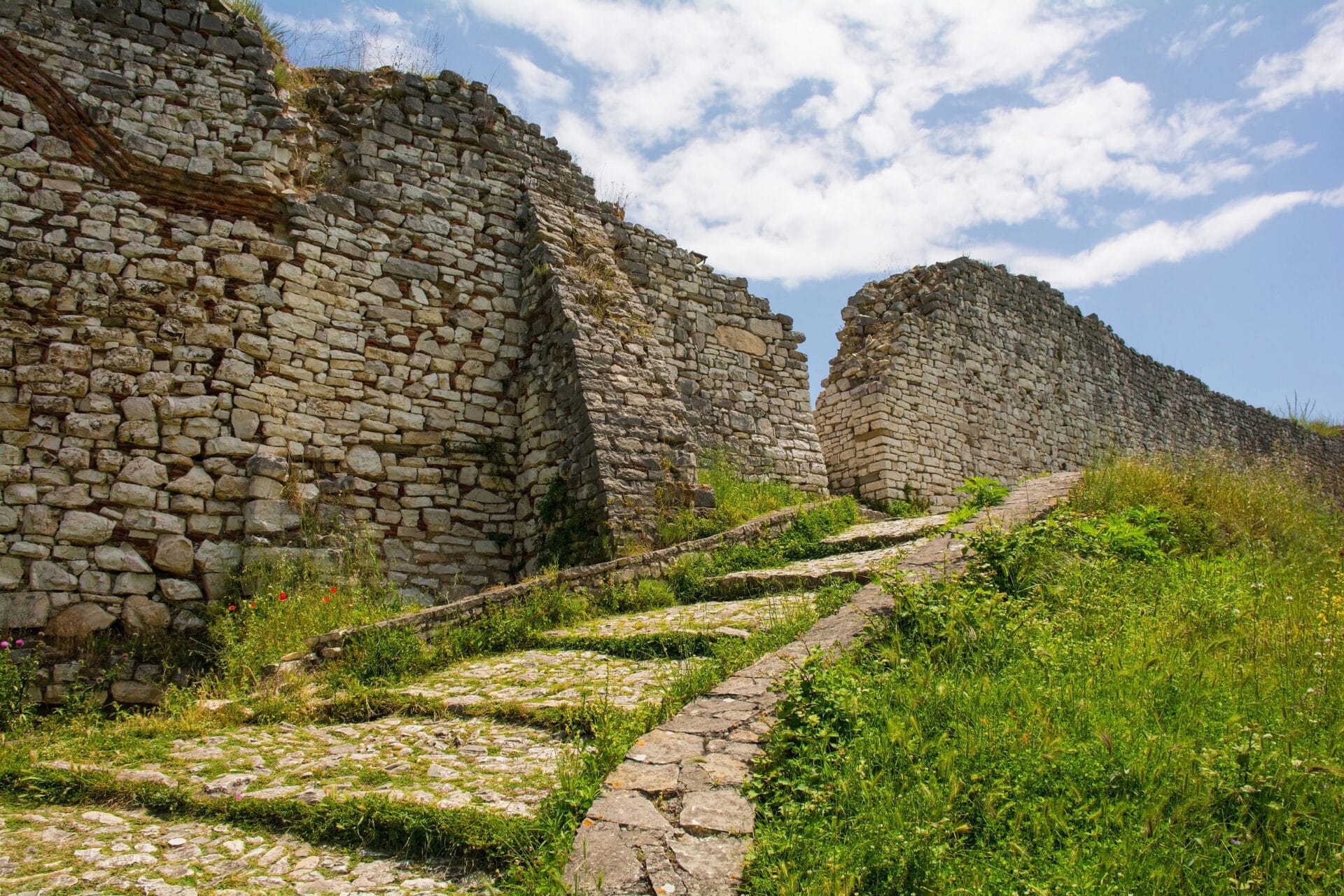
The approach from Mangalem quarter (the lower town) follows cobblestoned paths up approximately 1 kilometer at steep grade—15-20 minutes on foot, longer in summer heat. The stones underfoot document different eras: massive Illyrian blocks at the foundation (some approaching 2 meters in length), Byzantine repairs showing alternating courses of stone and brick, Ottoman patches where walls required reinforcement over centuries.
These are the same paths that Skanderbeg’s soldiers tried to scale in 1455, losing approximately 5,000 men in a catastrophic assault that failed to capture the Ottoman-held fortress. The defensive position that defeated 15th-century armies still challenges 21st-century visitors—the grade was designed to exhaust attackers carrying siege equipment, and it achieves similar effect on tourists carrying cameras.
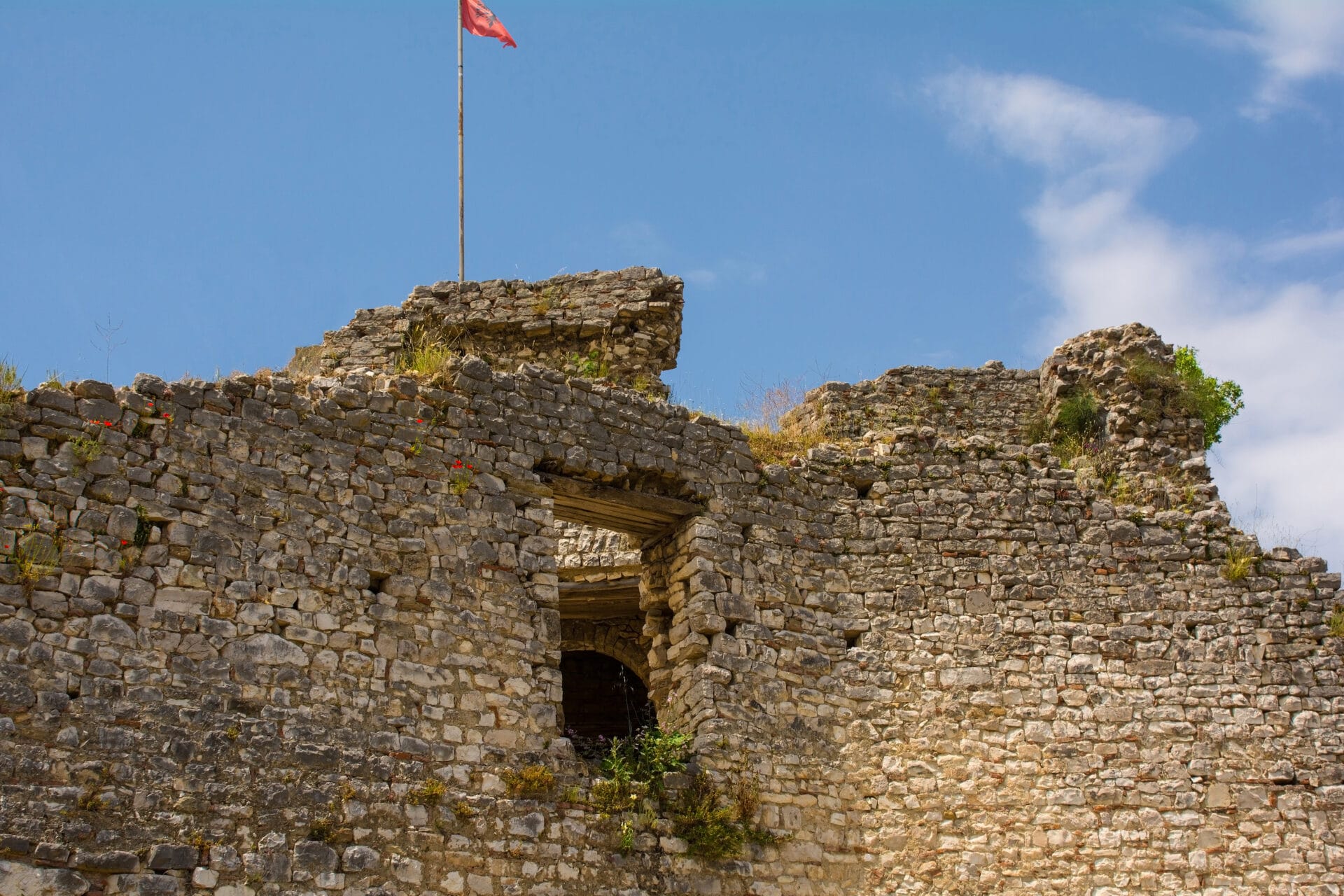
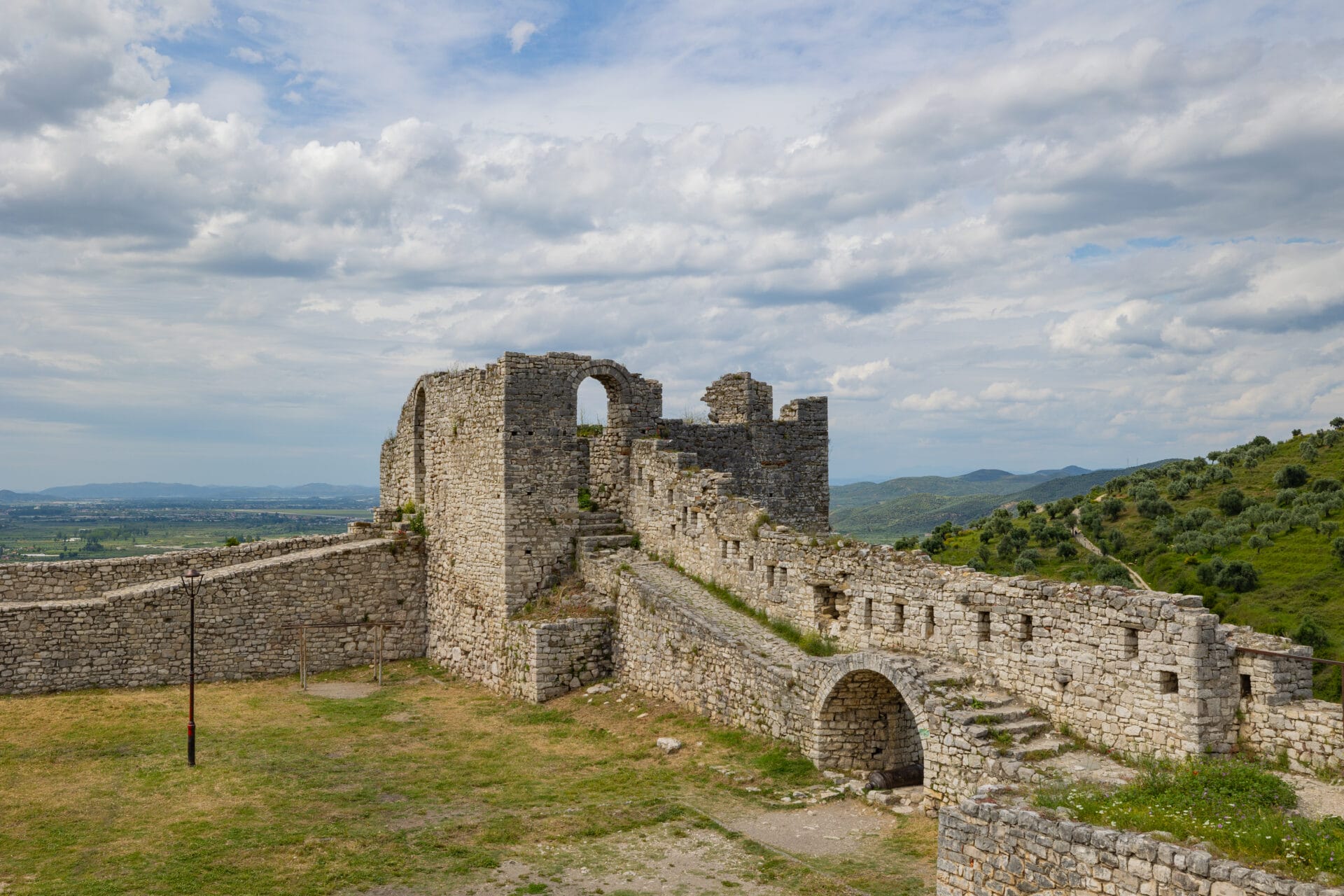
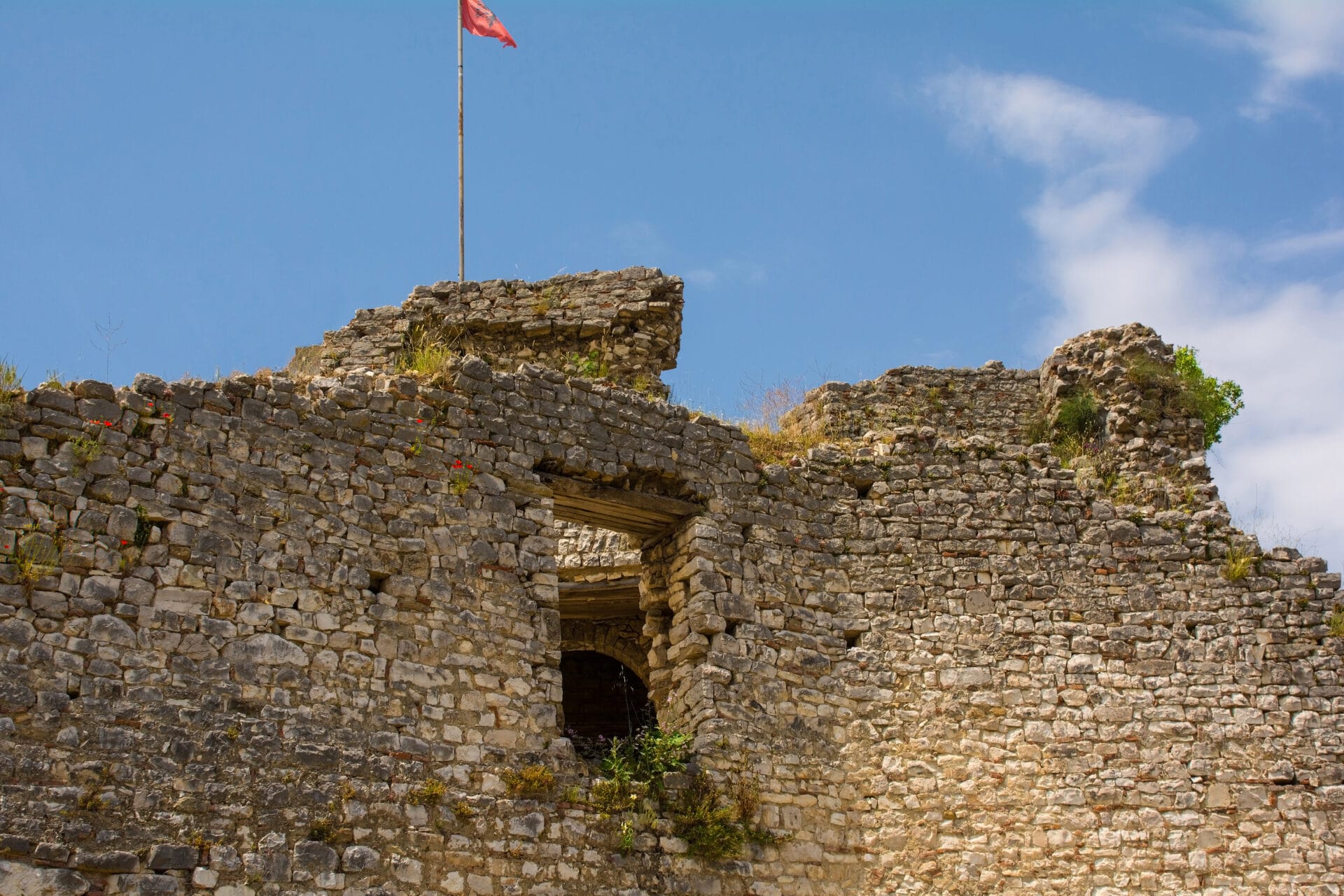
The main gate appears suddenly around a sharp turn. Built in the 13th century by Byzantine despot Michael I Komnenos Doukas, it retains his red brick monogram—an architectural signature declaring ownership that meant little to Ottoman soldiers who later controlled it, Italian troops who photographed themselves here in 1939, or communist partisans who made it their stronghold during World War II.
13th-century fortress walls with Byzantine despot Michael I Komnenos Doukas’s red brick monogram still visible above the main gate
The Inhabited Citadel
Inside the walls, the first surprise is normalcy. This isn’t preserved medieval atmosphere—it’s contemporary Albanian life happening inside ancient architecture. Laundry flutters from lines, cats sleep on Byzantine walls, children attend school in converted Ottoman buildings, and residents go about daily routines within spaces their ancestors occupied for centuries.
The paths wind without apparent logic because this was never planned city but organic growth spanning millennia. Turning corners reveals the Church of the Holy Trinity (14th century, distinctive red brick banding on dome), now functioning as Onufri Museum housing icons painted by master Onufri in the 16th century. The collection’s significance centers on Onufri’s unique red pigment—a formula that died with him and that scientists analyzing samples have failed to reproduce despite modern chemistry knowledge.
The museum preserves approximately 170 icons and frescoes demonstrating Onufri’s revolutionary approach to Byzantine religious art. Earlier icon painters followed rigid stylistic conventions creating idealized, emotionless faces. Onufri introduced individual expression—painted eyelashes visible on close examination, subtle variations in facial features, occasional hints of emotion that humanized religious subjects in ways that shocked traditional Byzantine sensibilities.
His reds glow with intensity unmatched by contemporary painters. The pigment apparently involved specific mineral combinations and application techniques that Onufri never documented. When he died around 1577, the formula disappeared, making the surviving icons irreplaceable examples of lost artistic technology.
Streets within the castle where approximately 100 families maintain homes their ancestors occupied for generations
Two Millennia of Fortification
The Illyrian foundations date to approximately 4th century BC. Ancient Greek and Roman sources reference the settlement as Antipatrea, a fortified Illyrian city controlling the Osum River valley and routes between the Adriatic coast and Macedonia’s interior. The strategic position made the fortress valuable to every power that sought to control the Balkans.
Roman destruction in 200 BC should have ended the settlement. Historian Livy recorded that Roman commander Lucius Apustius “killed the men of military age, granted all plunder to the soldiers, demolished the walls and burned the city.” Yet within a generation, Antipatrea was rebuilt—the position proved too valuable to abandon, controlling as it did the sole practical crossing point of the Osum River for kilometers in either direction.
Byzantine Emperor Justinian I reinforced the fortress in the 6th century CE as part of his systematic fortification of the Balkans against Slavic and Bulgar invasions. Bulgarian forces renamed it Beligrad (“White City”) when they controlled the region from 9th to 11th centuries. Serbian Empire under Stefan Dušan captured it in 1345. Each transition involved violence, yet the settlement absorbed changes and continued.
Ottoman forces took the castle in 1417, lost it briefly to Skanderbeg’s Albanian resistance (1450), and recaptured it definitively in 1455 after the catastrophic assault that cost 5,000 lives. The Ottomans held Berat for 463 years until Albanian independence in 1912, the longest continuous rule in the fortress’s history. Most surviving architecture dates to the Ottoman period (15th-19th centuries), though earlier foundations remain visible throughout.
13th-century fortress walls built by Byzantine despot Michael I Komnenos Doukas rising above the Osum valley
Engineering That Survived Millennia
The ancient cistern system drops approximately 6 meters below ground level, still partially functional after over 2,000 years. Recent archaeological excavations uncovered Illyrian-era wells even older than the visible cisterns, their stone linings intact and demonstrating sophisticated understanding of hydrology and siege survival.
Water management determined whether fortresses survived or fell during prolonged sieges. Berat’s engineers created systems ensuring reliable water supply even when enemies controlled the valley below and all external sources. The cisterns collected rainwater channeled from the fortress’s entire surface area through carved stone channels, with settling basins removing sediment before water reached storage.
Some residential properties within the castle still access natural springs emerging from the limestone bedrock—water sources that continued functioning during the communist period when municipal water systems in the lower town frequently failed. These springs represent geological features that made the hilltop valuable for habitation long before anyone built defensive walls.
UNESCO Status and Contemporary Challenges
In 2008, UNESCO designated Berat (including the castle) as World Heritage Site recognizing its “Outstanding Universal Value” as “rare example of an architectural character typical of the Ottoman period.” The designation brought international attention, funding opportunities, and complications.
The site management plan remains incomplete despite repeated UNESCO warnings. Albania’s entire Heritage Institute staff departed in recent years, leaving conservation efforts inadequately coordinated. Some castle wall sections damaged in the November 2019 earthquake (magnitude 6.4, Albania’s strongest in 40 years) still await proper repair due to funding gaps and bureaucratic delays.
Tourism has quadrupled since UNESCO designation—summer months now bring approximately 14,000 visitors monthly to a space that at its historical peak housed perhaps 6,000 residents. The narrow medieval streets weren’t designed for tour groups. Byzantine churches built for small congregations now accommodate hundreds of visitors daily during peak season, with camera flashes and crowd noise creating preservation concerns.
Illegal construction from the late 1990s (during Albania’s post-communist transition chaos) intrudes on UNESCO buffer zones. Some property owners added unauthorized modifications to historic buildings, creating enforcement challenges for authorities trying to balance residents’ property rights against heritage conservation requirements.
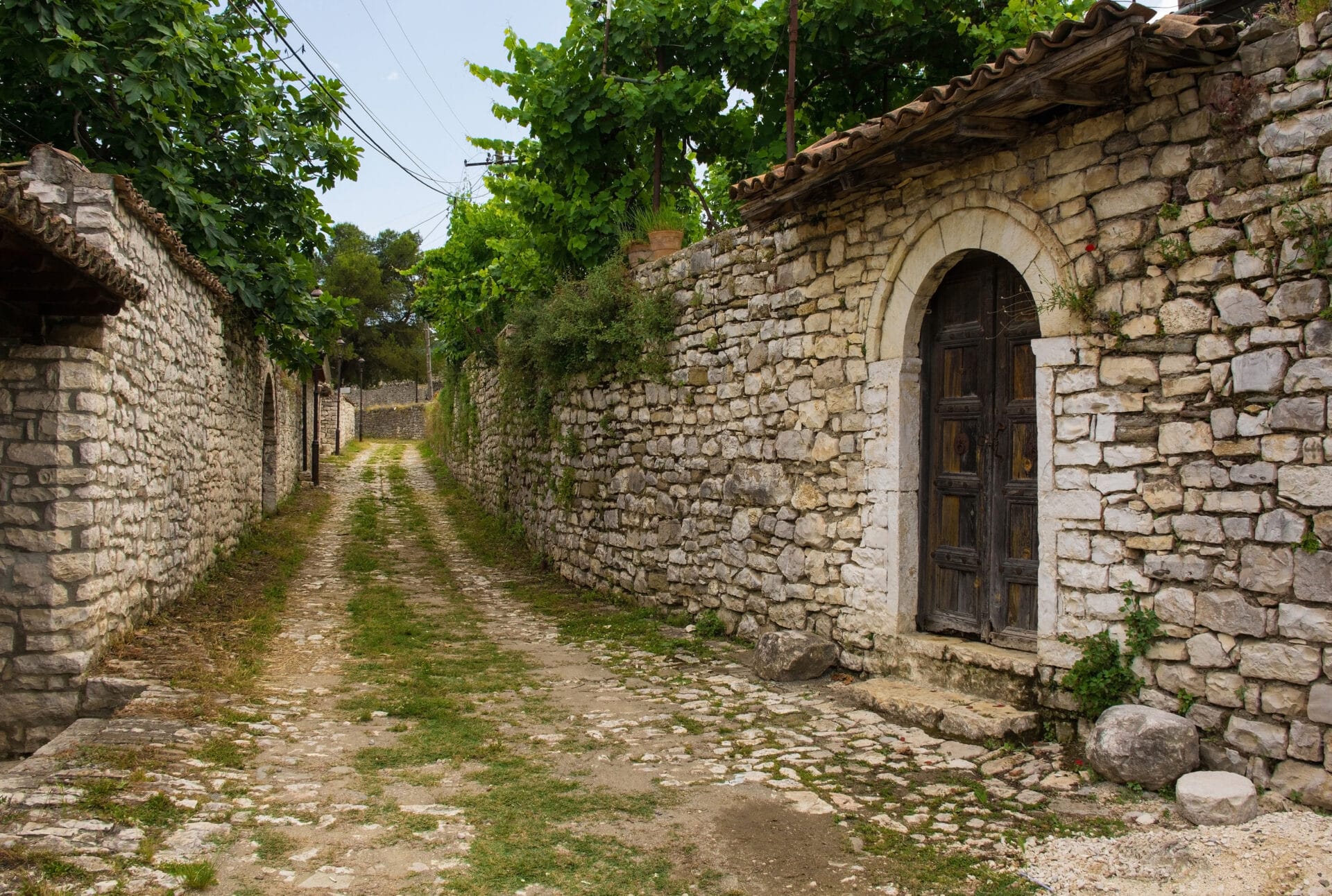
Worn cobblestones between inhabited stone houses where laundry dries on lines, one of countless paths threading through Kalaja quarter where families have lived for centuries
The Population Decline
Current population within the castle walls stands at approximately 100 families, down from thousands during the Ottoman period and several hundred as recently as the 1990s. Young people leave for Tirana, Athens, or further abroad seeking employment opportunities unavailable in a medieval fortress functioning as residential neighborhood.
The decline creates both preservation challenges and opportunities. Fewer residents means less daily wear on historic structures, but also means traditional maintenance knowledge (how to repair specific wall types, where water channels run, which foundations require seasonal attention) risks being lost when elders die without passing information to younger generations who’ve moved to cities.
Some families are converting unused buildings into guesthouses, creating tourism income that might incentivize younger generations to return. Several small cafés and craft shops now operate within the walls, owned by residents who’ve adapted to the tourism economy while maintaining family homes their ancestors occupied for generations.
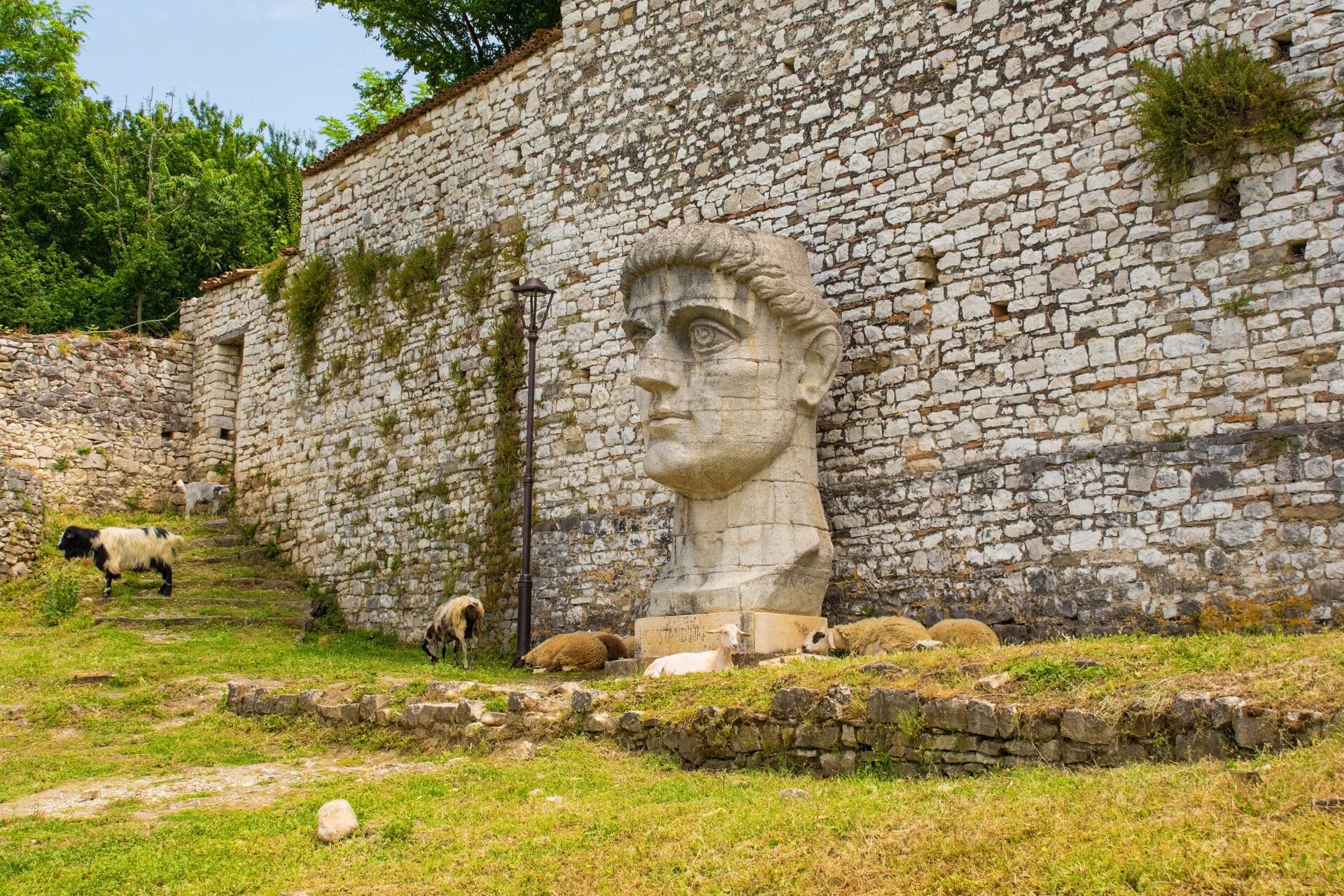
A 3.5-meter limestone head of Emperor Constantine from 330 AD where goats graze the castle grounds as they have for generations
Visiting Practicalities
Access and Hours: The main entrance operates officially 9:00 AM-6:00 PM daily, though because the castle remains a residential neighborhood rather than secured museum, access is technically possible 24/7—no fence completely surrounds the inhabited area. Entry fee is 300 LEK (approximately €3, cash only) collected at the main gate, though the ticket booth is sometimes unmanned outside peak season.
Getting There: From Berat’s lower town (Mangalem or Gorica quarters), follow cobblestoned paths uphill approximately 1 kilometer. The climb requires 15-20 minutes at moderate pace, longer in summer heat or for those with limited mobility. The grade is steep—comfortable walking shoes essential. Taxis can drive to the main gate (free parking available), though the narrow roads make driving challenging for those unfamiliar with the route.
Time Required: Allocate minimum 2-3 hours for thorough exploration. The castle encompasses approximately 10 hectares with numerous Byzantine churches, Ottoman mosques, residential areas, viewpoints, and the Onufri Museum (separate admission required, approximately 200 LEK). Visitors who rush through in 60-90 minutes see only the main gate area and primary viewpoints, missing the residential streets and smaller churches that reveal the site’s lived-in character.
Onufri Museum: Housed in the Church of the Holy Trinity, the museum preserves Albania’s most important collection of Byzantine religious art. Entry requires separate ticket (approximately 200 LEK). Operating hours sometimes differ from castle gate hours—verify before visiting if the museum is your primary interest.
What to Bring: Water (essential, especially summer—limited fountains within walls), sun protection (minimal shade on main paths), comfortable walking shoes with good traction (cobblestones are treacherous when worn smooth), cash (entry fees, café purchases, no card payment available).
When to Visit: May-October offers optimal weather with minimal rain. July-August brings peak crowds and heat. April and November remain accessible but weather is unpredictable. Winter (December-March) sees few tourists but some cafés close and conditions can be muddy or icy.
Best Times: Early morning (8:00-10:00 AM) or late afternoon (4:00-6:00 PM) avoid midday tour groups and heat. Sunset from the ramparts provides excellent valley views, though the ticket booth may be closed—entry still possible but technically requires payment the following morning.
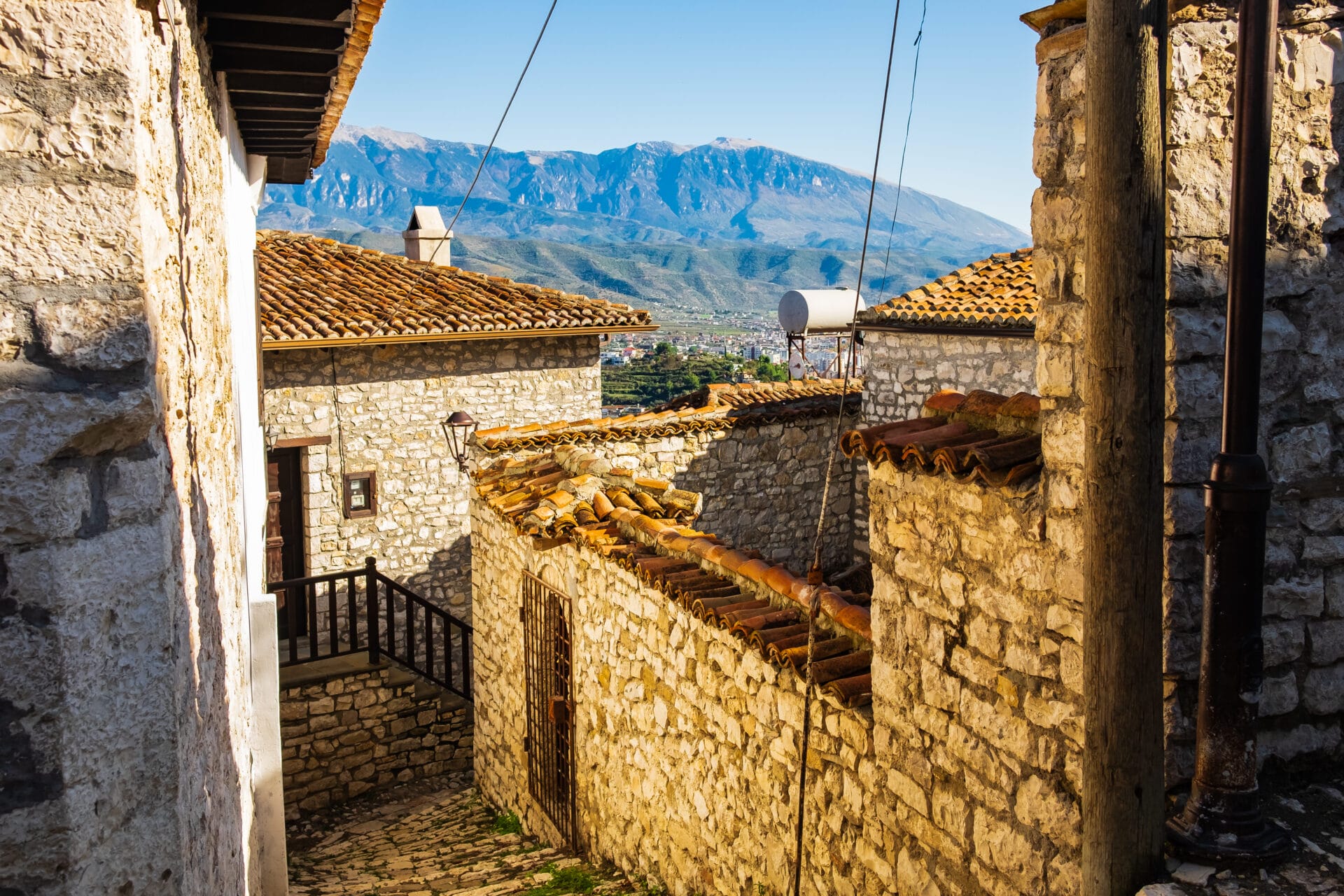
White Ottoman houses stacking down the hillside toward the Osum River—the architectural repetition that earned Berat its nickname “City of a Thousand Windows”
Staying Overnight
Several families within the castle operate guesthouses offering basic accommodation in Ottoman-era buildings adapted with modern plumbing and electricity. Staying overnight transforms the experience—morning begins with roosters rather than tour buses, evening brings quiet once day visitors descend to the lower town, and night reveals how the castle functions as actual neighborhood rather than tourist attraction.
The guesthouses typically include breakfast (often featuring homemade bread, local cheese, eggs, and preserves) prepared by owners who’ve lived within the castle for decades and can provide information about the site’s history and current community that no guidebook captures. Prices run approximately €20-40 per night depending on season and room type—basic but clean, with authentic atmosphere that hotels in the lower town cannot match.
The Honest Assessment
Berat Castle succeeds because it avoided becoming museum. The continuous inhabitation means the space functions as living community rather than preserved monument, creating authenticity that reconstructed heritage sites cannot achieve. Children play where Illyrian children played 2,400 years ago, families maintain homes their ancestors occupied under Byzantine and Ottoman rule, and daily life continues within walls that have absorbed every regime change and catastrophe across two millennia.
The architecture documents multiple civilizations layered atop each other—Illyrian foundations supporting Byzantine churches supporting Ottoman additions supporting modern electrical lines and satellite dishes. This palimpsest effect, where every era remains partially visible, creates texture and historical depth that purpose-built tourist attractions lack.
The Onufri Museum justifies the visit on its own merit—the icons represent irreplaceable examples of lost painting techniques and document the evolution from rigid Byzantine stylistic conventions toward more humanized religious art. The red pigment mystery adds intrigue, though the real value lies in seeing how 16th-century Albanian artists adapted imported Byzantine traditions toward local artistic sensibilities.
What the castle doesn’t offer is extensive interpretation or modern visitor facilities. Information panels are sparse and sometimes outdated, guides are available but not guaranteed, and navigating the unmarked paths requires either good orientation or willingness to get lost and ask residents for directions. The UNESCO designation hasn’t translated into comprehensive visitor infrastructure—this remains primarily residential neighborhood that tolerates tourists rather than tourist attraction that happens to have residents.
The steep approach deters some visitors, particularly those with mobility limitations. The cobblestoned paths, while atmospheric, create challenges for wheelchairs, strollers, and anyone requiring level surfaces. No elevators or alternative routes exist—if you cannot walk uphill for 15-20 minutes and navigate uneven medieval streets, the castle remains functionally inaccessible.
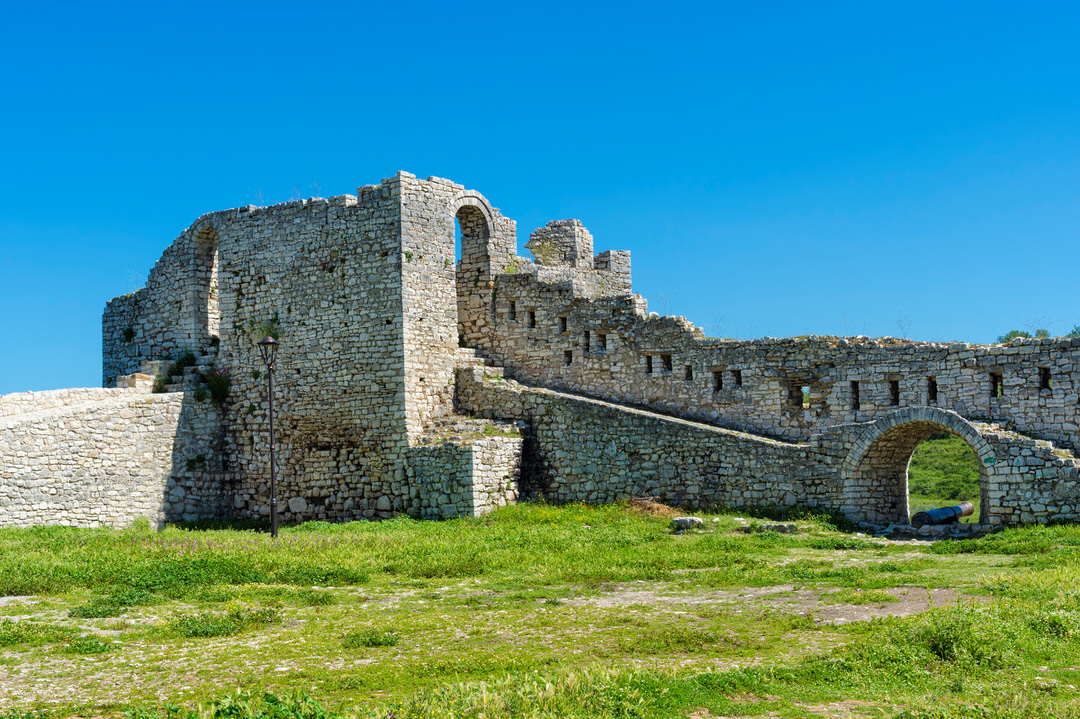
Limestone and brick fortifications along Berat’s northern cliff edge, oldest blocks laid by Illyrians in 4th century BC
Skip If/Visit If
Skip Berat Castle if you need extensive visitor facilities (modern restrooms, cafés every 100 meters, detailed signage), if mobility limitations prevent uphill walking on uneven surfaces, if you’ve visited other lived-in fortress towns (like Mostar’s old town or Dubrovnik) and don’t need another example, or if you prefer museums with comprehensive interpretation over sites requiring imagination to understand historical context.
Visit if you’re interested in continuously inhabited historical sites rather than preserved monuments, if Byzantine art and Ottoman architecture appeal to you, if you want to understand how Albanian communities adapted to successive regime changes across millennia, or if you appreciate places where contemporary life continues within ancient spaces rather than displacing it. The combination of 2,400-year inhabitation history, unique Onufri icons, and functioning residential community creates experience unavailable at conventional castle museums.
The castle demonstrates that heritage preservation doesn’t require freezing sites in particular historical moments—Berat succeeded by allowing continuous adaptation while maintaining core character. The families living within these walls carry forward traditions spanning generations while incorporating satellite television and modern plumbing, showing how historical spaces can remain relevant to contemporary life rather than becoming isolated from it.
Whether this approach succeeds long-term remains uncertain. The population decline, UNESCO management challenges, and tourism pressures create risks. But for now, Berat Castle offers rare opportunity to experience medieval fortress town as functioning neighborhood rather than museum exhibit—complete with laundry on Byzantine walls, children playing in Ottoman courtyards, and families maintaining homes their ancestors have occupied since before Rome ruled the Mediterranean world.