The Museum Building’s Own History
The Archaeological Museum of Apollonia occupies the Church of St. Mary (Kisha e Shën Mërisë)—a Byzantine-style Orthodox monastery built in the 14th century CE, approximately 1,700 years after Apollonia’s founding in 588 BCE. The monastery functioned as a religious center through the Ottoman period (when many Orthodox properties were converted or destroyed), survived abandonment during Albania’s communist-era religious prohibition (1967-1991), and was converted to a museum in 1958 when French and Albanian archaeologists began systematic excavations of the ancient city ruins.
This layered history creates unusual context—you’re viewing artifacts from a 6th-century-BCE Greek colony displayed inside a 14th-century-CE Christian monastery built atop that colony’s abandoned remains. The medieval stone walls, arched ceilings, and religious architectural details frame ancient artifacts, creating visual juxtaposition between different historical periods that occupied the same landscape across 2,500+ years.
The monastery itself is architecturally modest—small-scale Byzantine construction typical of Albanian Orthodox sites, without the grandeur of major Greek or Turkish examples. The conversion to museum added modern elements (climate control, lighting, display cases) while preserving the medieval structure. The building works better as historical context than architectural showcase—it’s interesting because it’s old and connected to the site, not because it’s impressive architecture.
What the Seven Halls Actually Contain
The museum organizes chronologically across seven exhibition rooms (two on the ground floor, five upstairs), moving visitors from Illyrian-period artifacts (7th-4th centuries BCE) through Greek colonial objects (4th-1st centuries BCE) to Roman imperial material (1st-4th centuries CE).
Illyrian Period Halls (Ground Floor): Funerary steles—carved stone grave markers—dominate the Illyrian sections. The most elaborate examples show warriors holding swords and shields alongside mythological creatures (griffins with lion bodies and eagle wings, serpents with multiple heads). These carvings document cultural exchange between indigenous Illyrian populations and Greek colonists who founded Apollonia—the imagery blends Illyrian warrior traditions with Greek artistic styles and mythological motifs.
Bronze and gold jewelry displays demonstrate metalworking techniques. One golden diadem (ceremonial headband) features anthemion designs—stylized honeysuckle flower patterns common in Greek decorative arts—showing how Illyrian elites adopted Greek luxury goods as Apollonia’s trade wealth spread inland. The jewelry comes from tumulus burials (earthen mounds covering stone chambers) excavated in the hills surrounding Apollonia, indicating the city’s economic influence extended beyond its walls to regional Illyrian populations.
Pottery collections include amphorae (two-handled storage jars) with stamped handles identifying workshops and dating vessels, plus fine black-glazed tableware showing refined ceramic production. The progression from crude local pottery to sophisticated Greek-style ceramics documents Apollonia’s transformation from frontier colony to established commercial center integrated into Mediterranean trade networks.
Roman Period Halls (Upper Floor): The upstairs rooms focus on Apollonia under Roman control (after 229 BCE, when Rome annexed the Adriatic coast). Statuary includes marble figures of river gods, civic officials, and imperial representations—typical Roman public art from the 1st-3rd centuries CE when Apollonia functioned as a regional administrative center and location where wealthy Romans built country villas.
The highlight is Roman mosaic floors—sections of geometric and figural designs excavated from villa ruins near the ancient city. The mosaics are fragmentary (removed panels rather than complete floor displays), showing the typical Roman mosaic technique of small colored stone tiles (tesserae) arranged in patterns. The quality is competent provincial work rather than exceptional artistry—these are wealthy-but-not-imperial-level decorations from regional elites.
Inscriptions (stone slabs carved with Latin text) document civic administration—magistrate names, building dedications, boundary markers. These provide historical data about who governed Apollonia, what public infrastructure existed, and how Roman administration functioned at the provincial level. For visitors without Latin knowledge, the inscriptions are interesting as artifacts but require label reading to understand their content.
Coin Collection: Multiple display cases contain coins from Apollonia’s mint and coins from cities across the Mediterranean found during excavations. Apollonia minted silver drachmas from the 5th-1st centuries BCE, typically showing a cow nursing a calf (punning on the city’s legendary foundation by colonists from Corinth, whose sacred animal was the cow). Coins found at the site include examples from Athens, Corinth, Macedonia, and Rome—documenting Apollonia’s role in Adriatic trade routes connecting Greece, Italy, and the Balkans.
What the Museum Explains (And What It Doesn’t)
The museum provides multilingual labels (Albanian, English, French, Italian) explaining artifact types, dates, and archaeological context. The labels are informative for visitors with basic historical knowledge—they identify objects, explain their function, and place them in chronological framework. What the labels don’t provide is deep contextual interpretation about daily life, cultural practices, or broader historical significance. You learn what objects are but not necessarily what they meant to people who made and used them.
Guided tours (available by arrangement, English-speaking guides €20-30 for groups) add interpretation beyond label text. Guides explain connections between artifacts—how pottery styles changed as trade patterns shifted, how burial practices reflected social status, how Greek and Illyrian cultures interacted through object exchange. Without a guide, you’re dependent on label reading and your own historical knowledge to understand significance.
The museum does not explain what happened to Apollonia—why a major city with 60,000 residents at its Roman peak was completely abandoned by the 5th-6th centuries CE. The standard explanation (the nearby Vjosa River shifted course, malaria spread in new marshlands, the harbor silted up making trade impossible) appears in external sources but not prominently in museum displays. Visitors leave knowing what Apollonia produced but not necessarily understanding why it died.
Access and Practical Considerations
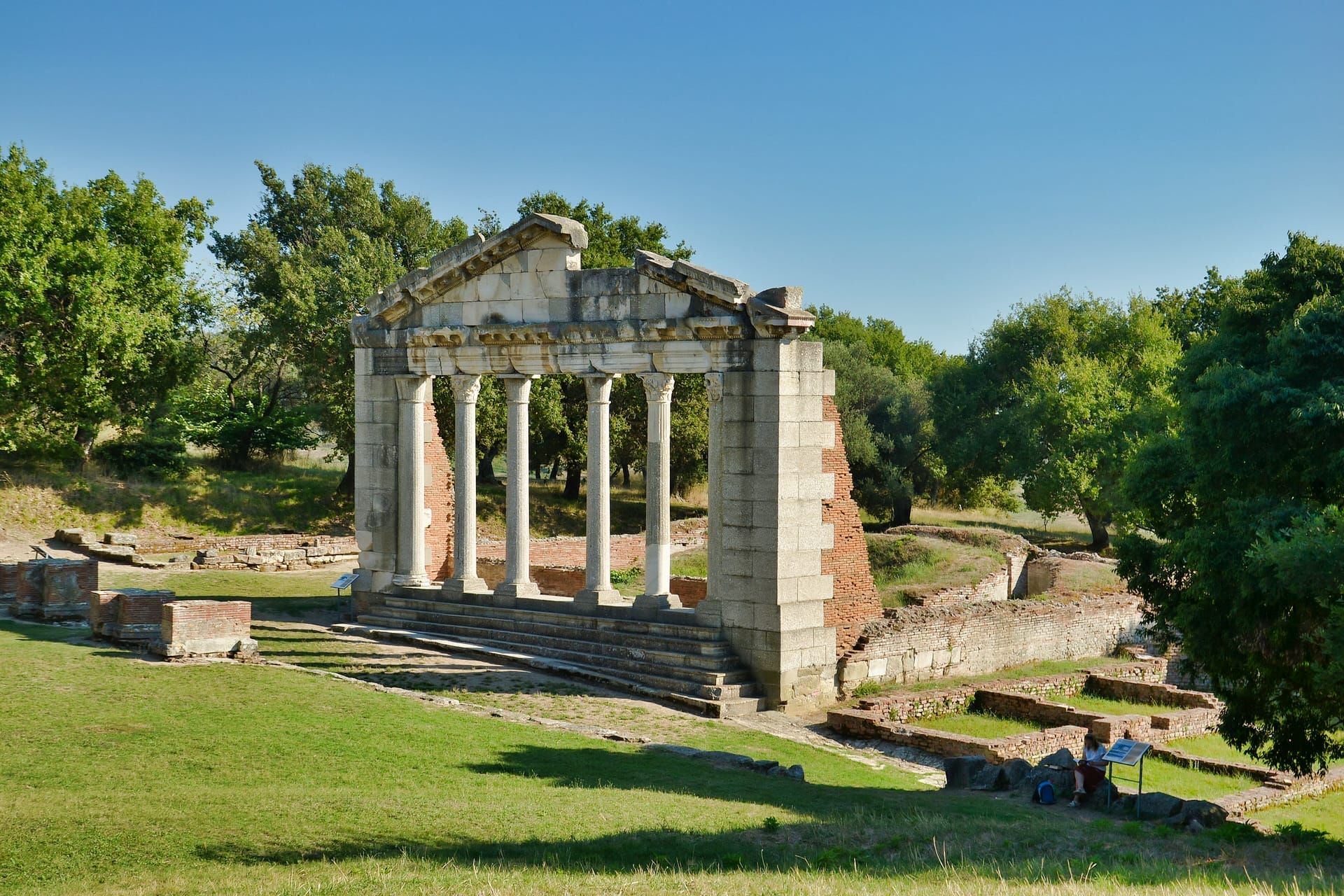
The museum sits within Apollonia Archaeological Park, 12 kilometers from Fier on the road toward Vlorë. Combined admission (700 LEK/~€7) includes the museum, the archaeological park grounds, and access to visible ruins (theater, odeon, bouleuterion foundations, defensive walls). The museum is the first structure you encounter after the entrance gate—most visitors tour the museum first, then explore outdoor ruins.
Parking is available at the entrance. Public buses from Fier (hourly during daytime) stop at Pojan village, 1.5 kilometers from the park entrance—walkable but no sidewalks, so traffic requires caution. Taxis from Fier cost approximately 1,000 LEK (~€10) one way.
The museum is wheelchair accessible on the ground floor; the upper floor requires stairs (no elevator). Photography is permitted without flash. The museum has minimal climate control—warm in summer, cold in winter. The archaeological park grounds are outdoor walking (uneven terrain, bring appropriate footwear).
Most visitors spend 60-90 minutes in the museum, then 1-2 hours walking the outdoor archaeological remains. Combined visit typically requires 2.5-3.5 hours. No food service exists onsite—bring water and snacks if needed.
The Honest Assessment
The Archaeological Museum of Apollonia is Albania’s most accessible ancient history museum—good artifact collection, clear organization, multilingual labels, reasonable admission price, easy access from Fier. The medieval monastery setting adds architectural interest. The combination of indoor museum and outdoor archaeological park provides varied experience (artifacts plus ruins) that works better than either component alone.
What the museum isn’t is world-class. The artifact collection is good for a regional archaeological museum but doesn’t compare to major Greek or Italian museums with richer collections and more sophisticated interpretation. The displays are traditional (objects in cases with text labels) without interactive elements or multimedia. The building is historically interesting but architecturally modest.
Skip If: You’re not interested in ancient history, if you have limited time in Albania and prefer to focus on beaches or mountains, if you’ve extensively toured Greek or Roman archaeological museums and these will feel repetitive, or if you expect museum experiences matching major European institutions.
Visit If: You’re interested in Albanian ancient history and want the most accessible archaeological museum experience in the country, if you’re traveling between Tirana and the coast (it’s directly on the route), if you’re combining the museum with outdoor ruins exploration at Apollonia park, if you want to understand Greek colonization and Roman expansion in the Adriatic region, or if you appreciate seeing artifacts in context near where they were excavated rather than in distant national museums.
Combine the museum with the archaeological park—the artifacts make more sense when you’ve walked the ancient city’s layout, and the ruins are more interpretable when you’ve seen objects that document who lived there and what they produced. Budget 3-4 hours for the combined experience rather than rushing through either component separately.