Why It Was Important (And Why It’s Obscure Now)
Phoenice functioned as the capital of the Chaonians—one of the three principal Greek-speaking tribes of Epirus (alongside the Molossians and Thesprotians)—from approximately the 6th century BCE until Roman conquest in 167 BCE. The city sat on a hilltop 12 kilometers inland from the modern town of Sarandë, positioned to control trade routes between the coast and the Balkan interior via the nearby Pavllë River valley.
During the 5th-4th centuries BCE, Phoenice was likely the largest settlement in Epirus, minting its own silver coins (drachmas showing a bull’s head and Greek inscriptions) that archaeologists have recovered as far as Italy and Egypt—documenting the city’s commercial reach across the Mediterranean. The city maintained religious connections with the Oracle of Dodona (Epirus’s primary sanctuary), and its theater suggests cultural sophistication matching better-known Greek cities.
Roman legions destroyed Phoenice in 167 BCE during Rome’s campaign to eliminate independent Hellenistic kingdoms in Greece and the Balkans. The city survived as a reduced Roman administrative center but gradually declined over the following centuries, abandoned completely sometime during the 3rd-4th centuries CE. Unlike coastal sites that evolved into modern towns (Durrës, Sarandë), Phoenice’s hilltop location had no strategic value after ancient trade routes shifted, so it was never rebuilt or repopulated. The ruins sat largely forgotten until Austrian archaeologists identified the site in the 19th century.
What Actually Remains on the Ground
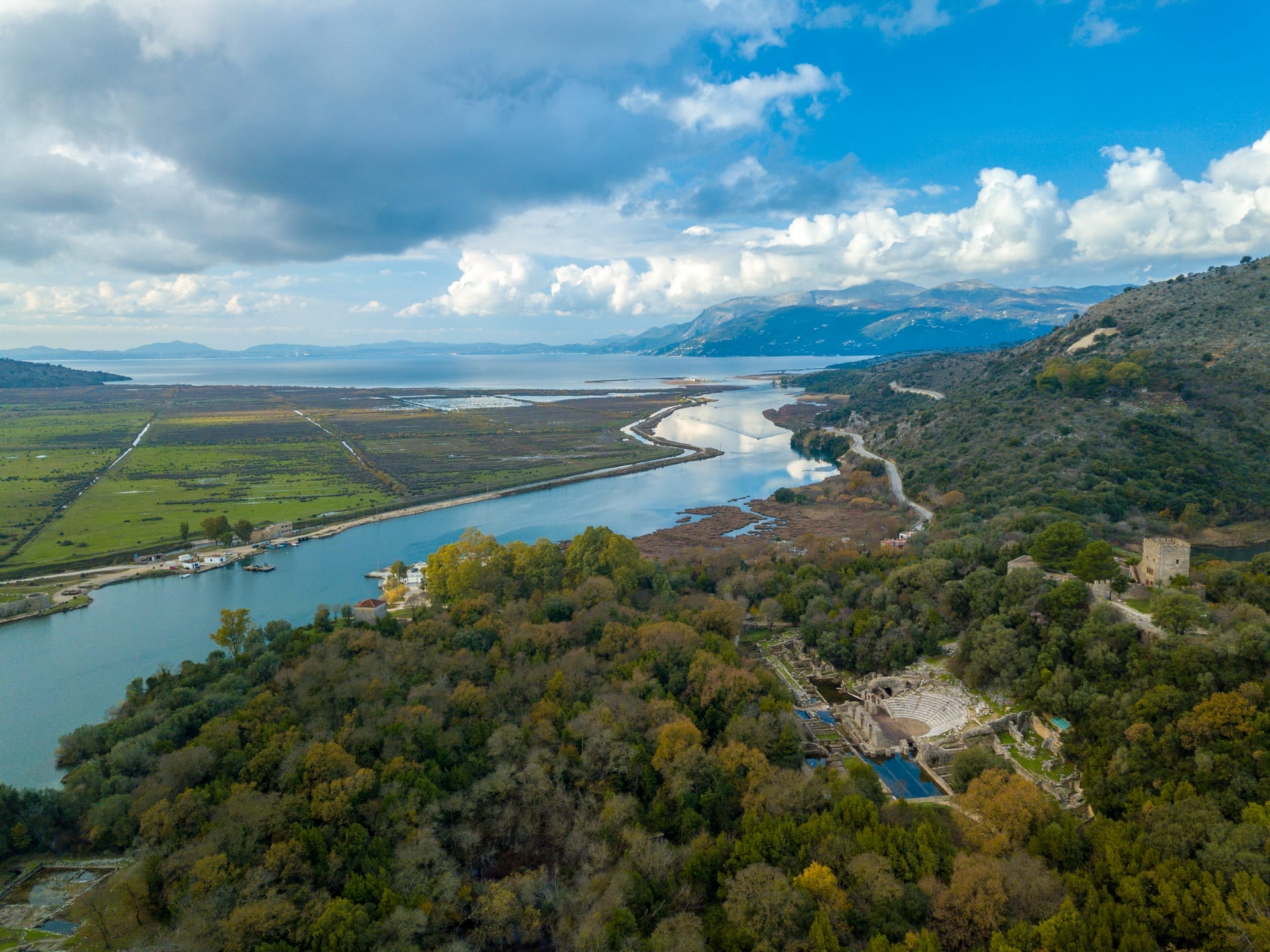
The theater is Phoenice’s most intact structure. Built in the 3rd century BCE, it could accommodate approximately 4,000 spectators—suggesting a city population of 15,000-20,000 during peak periods (theaters typically seated 20-25% of urban populations). The semicircular rows of stone seats (cavea) carved into the natural hillside slope remain largely intact. You can still see carved seat numbers and the broad staircases (klimakes) dividing seating sections. The performance area (orchestra and skene) shows foundation outlines but little elevation remains.
The city walls demonstrate Greek polygonal masonry—irregularly shaped stones fitted precisely without mortar—a technique used throughout Hellenistic Greece for defensive fortifications. Sections of wall several meters high survive around the acropolis perimeter, though most fortifications exist as foundation courses or scattered stones overgrown with vegetation.
The bouleuterion (council house) foundations indicate where Phoenice’s political assembly met. The building’s rectangular outline and interior column bases are visible, but no walls remain standing. Nearby temple foundations (attributed to Zeus based on architectural style and religious practice comparisons) consist of stone platforms and scattered architectural fragments—column drums, capitals, partial friezes—lying where they collapsed.
Residential and commercial areas spread across the hilltop as foundation outlines barely visible through grass and scrub. Few structures rise above foundation level. Cisterns for water storage (necessary on a hilltop without natural springs) appear as stone-lined depressions. The site has received limited excavation—most ruins remain unexcavated, meaning the visible remains represent a fraction of what lies buried.
What Archaeology Knows (And Admits It Doesn’t)
Systematic excavation of Phoenice has been minimal. Austrian archaeologists conducted initial investigations in the 19th century, focusing on the theater and basic site mapping. Albanian archaeologists returned in the 1970s-1980s with limited excavations in specific areas. Italian-Albanian collaborative projects since 2000 have added new data about city layout, chronology, and material culture, but large portions of the site remain unexcavated.
We know Phoenice’s political structure through coin inscriptions identifying magistrates (archons) and through ancient historians (Polybius, Livy) who mentioned the city in context of regional conflicts. We know architectural details of major buildings through comparative analysis with similar structures at Dodona, Kassope, and other Epirus sites. We know the approximate population through theater capacity and estimated urban area (approximately 8-10 hectares for the main settlement).
We don’t know specifics about daily life—houses remain largely unexcavated, so domestic architecture, household organization, and material culture details are unclear. We don’t have detailed information about the city’s economic base beyond general references to trade and agriculture. We don’t know how Christianization affected the site during its late Roman phase—no church ruins have been identified, though this may reflect limited excavation rather than absence.
The Access Reality
Phoenice sits approximately 4 kilometers from Finiq village (itself 12 kilometers from Sarandë on the road toward Gjirokastër). A rough unpaved track branches from the main road near Finiq, marked by a small archaeological site sign. The track is passable for normal cars driven carefully—2 kilometers of potholed gravel, stones, and occasional mud (depending on season). The final 200 meters requires parking at roadside and walking uphill to the theater area.
There is no visitor center, no ticket booth, no facilities, no maintained paths, and no signage beyond basic directional markers. The site is officially free to enter because there’s no infrastructure to collect fees or restrict access. Bring water—there’s no source onsite. The hilltop is completely exposed to sun—visit early morning or late afternoon during summer, or risk heat exhaustion walking across open ruins in July-August midday temperatures exceeding 35°C.
Mobile reception is available but unreliable. No food or services exist at the site—Finiq village has minimal facilities (one or two cafes), so plan accordingly. Most visitors combine Phoenice with nearby Butrint (15 kilometers south)—a UNESCO site with full tourism infrastructure that contrasts sharply with Phoenice’s abandoned condition.
The Visitor Experience Without Infrastructure
Visiting Phoenice means engaging with archaeological ruins without interpretation. You’re looking at stone foundations, collapsed walls, and overgrown theater seats, using archaeological imagination to reconstruct what existed 2,300 years ago. If you have background knowledge about Greek city-states, Hellenistic architecture, and Epirus history, the ruins provide tangible evidence of historical patterns you’ve read about. If you don’t have that background, Phoenice is a confusing hillside of old stones without obvious meaning.
The theater provides the clearest structure—you can sit on ancient seats, stand where performers once stood, and understand the spatial organization of a Hellenistic theater through direct experience. The city walls offer tactile connection to defensive architecture—you can examine polygonal masonry techniques up close, understanding how stones fit without mortar through friction and weight distribution.
Everything else requires imagination. The temple foundations are just rectangles of stone unless you can visualize Greek temple architecture. The residential areas are barely visible foundation traces. The cisterns are holes in the ground. This isn’t criticism—it’s reality for unmaintained archaeological sites. Phoenice rewards visitors who bring knowledge, preparation, and willingness to engage with fragmentary ruins.
The Honest Assessment
Phoenice is historically significant as the Chaonian capital and one of Epirus’s major cities during the Classical and Hellenistic periods. The theater is genuinely impressive—comparable to better-known examples in Greece and Turkey. The city’s role in Mediterranean trade and its connections to major historical events (Roman conquest, Hellenistic culture) make it archaeologically valuable.
What Phoenice isn’t is tourist-ready. The access is rough, the site is undeveloped, the interpretation is absent. You’re visiting ruins in their raw state—valuable for understanding how most archaeological sites actually exist (unmaintained, minimally excavated, lacking resources for tourism development) but challenging for visitors expecting facilities, guidance, and obvious visual rewards.
Skip If: You’re not specifically interested in Greek archaeology, if you expect maintained sites with facilities and interpretation, if rough vehicle access or walking on uneven terrain is problematic, if you need obvious visual impressiveness (like intact buildings or dramatic landscapes), or if you have limited time in southern Albania and prefer to focus on Butrint and the coast.
Visit If: You’re touring the Sarandë-Gjirokastër region and have time for detours, if you’re interested in Hellenistic Epirus and lesser-known Greek cities, if you appreciate archaeological sites precisely because they’re undeveloped and require imagination, if you’re visiting Butrint anyway and want to understand the broader ancient settlement pattern in the region, or if you enjoy the experience of exploring ruins without crowds or tourism infrastructure.
Combine Phoenice with nearby Butrint for context—Butrint shows what happens when archaeological sites receive UNESCO designation, funding, and tourism development. Phoenice shows what happens when equally significant sites lack those resources. Both experiences are valuable for understanding Albania’s archaeological heritage and the challenges of preserving it.