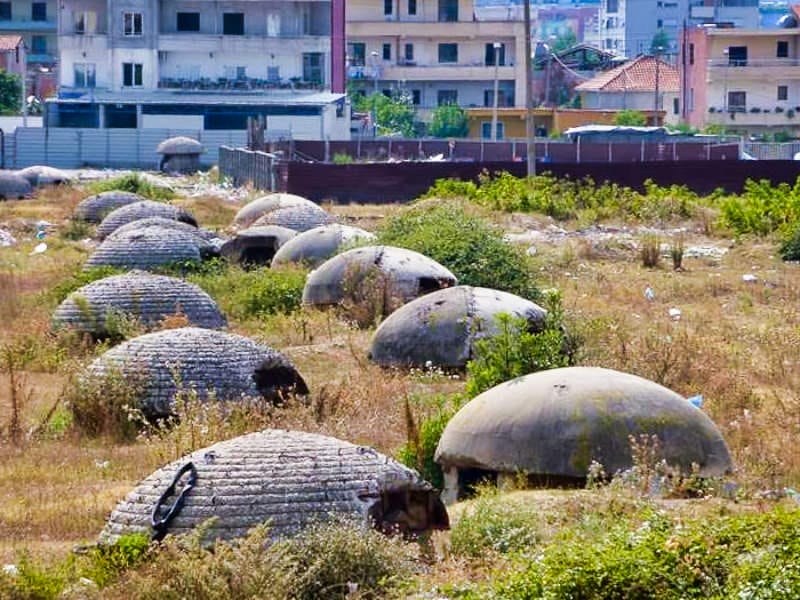
The Mushrooms Nobody Asked For
Here’s something you won’t see in most European countries: concrete bunkers erupting from beaches, punctuating city parks, crowning remote mountaintops—literally everywhere. Albania built an estimated 750,000 of these things between 1967 and 1986. That’s one bunker for every four citizens in a country smaller than Maryland. With 5.7 bunkers per square kilometer, they’re more common than gas stations.
I grew up playing hide-and-seek in these concrete mushrooms during the late 1980s. We called them bunkerët (literally just “bunkers”), and like every Albanian kid, I learned quickly that venturing inside required particular childhood courage. Many had become unofficial public toilets. Others sheltered packs of stray dogs. But beyond their peacetime uses as playgrounds and bathrooms, these structures served a deeper psychological purpose—daily reminders that enemies supposedly lurked beyond our borders, and that every citizen had the means to defend Albania.
The bunkers bred a siege mentality into the national consciousness. Enver Hoxha, Albania’s Stalinist dictator from 1944 to 1990, wanted us to believe that invasion was imminent—from imperialists, revisionists, counter-revolutionaries, basically everyone. In the event of attack, he envisioned every citizen taking up arms and defending from within these concrete domes.
What kills me is the economics. Each small bunker required enough concrete and steel to build a modest family apartment. Construction consumed up to 20% of Albania’s GDP during peak years—while people lacked adequate housing, schools, and hospitals. Between 70 and 100 workers died annually during construction. Their deaths were state secrets, their names lost.
How It Started: Paranoia With Some Basis in Reality
Look, Hoxha’s fears weren’t entirely unfounded—Albania has faced repeated invasions throughout its history. But his response proved catastrophically extreme.
After Albania broke with the Soviet Union in 1961 (accusing Moscow of revisionism), then lost its last major ally when China cozied up to the West in 1978, the country stood truly isolated. Surrounded by NATO forces in Greece and Italy to the south and west, and Tito’s Yugoslavia controlling northern borders, Albania had no friends left.
When former Warsaw Pact allies invaded Czechoslovakia in 1968, Hoxha’s paranoia intensified. If they could crush Prague, what would stop them from rolling into Tirana?
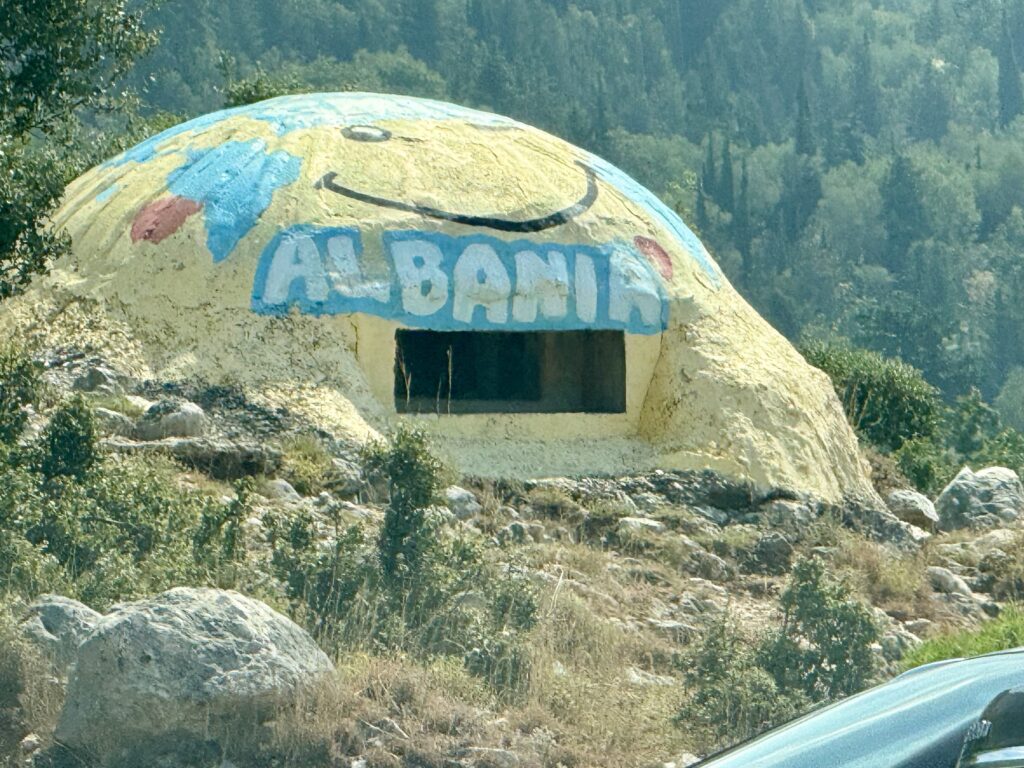
Bunker in Palase, near the Green Coast resort on the Albanian Riviera.
Switzerland and Finland had already launched national shelter systems in 1960 amid Cold War tensions. But Albania’s approach proved far more extensive, shaped by both precarious geopolitical position and one dictator’s pathological need for control.
Military engineer Josif Zegali faced an unprecedented challenge: design a defensive network protecting every corner of Albanian territory. His solution was the “Qender Zjarri” (firing post)—a hemispherical concrete structure with carefully positioned gun ports and walls between 0.6 and 1.1 meters thick, designed to withstand direct artillery fire.
The design worked. One prototype famously survived direct artillery fire during testing, with a military officer inside to verify its strength. (Can you imagine volunteering for that job? “Yes sir, I’ll sit inside while you shell it.”)
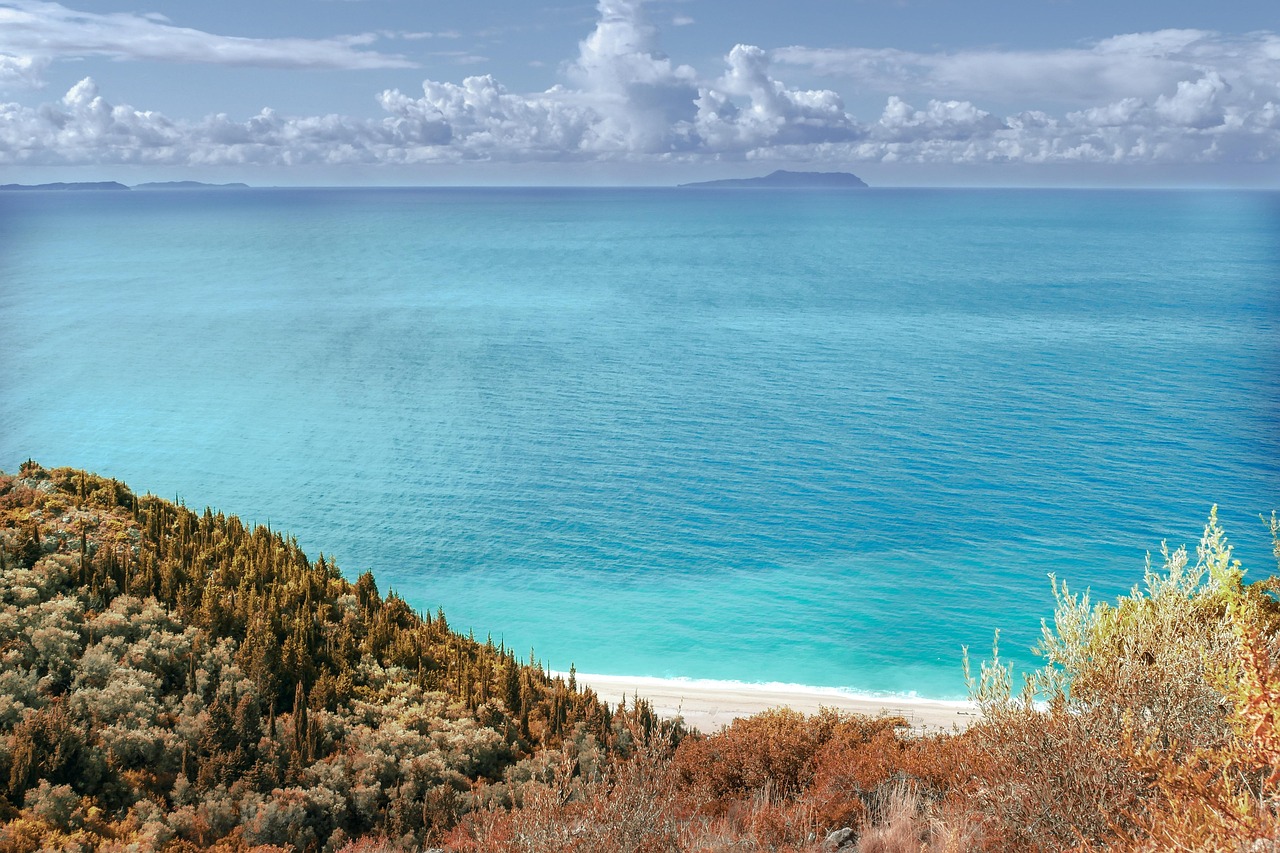
Bunker in Zvernec Island, Narta Lagoon, Vlorë—because even marshland needed defending
The Strategic Landscape (Or: Where We Put 750,000 Concrete Mushrooms)
The placement followed carefully orchestrated military strategy—or at least what passed for strategy in Hoxha’s increasingly paranoid mind.
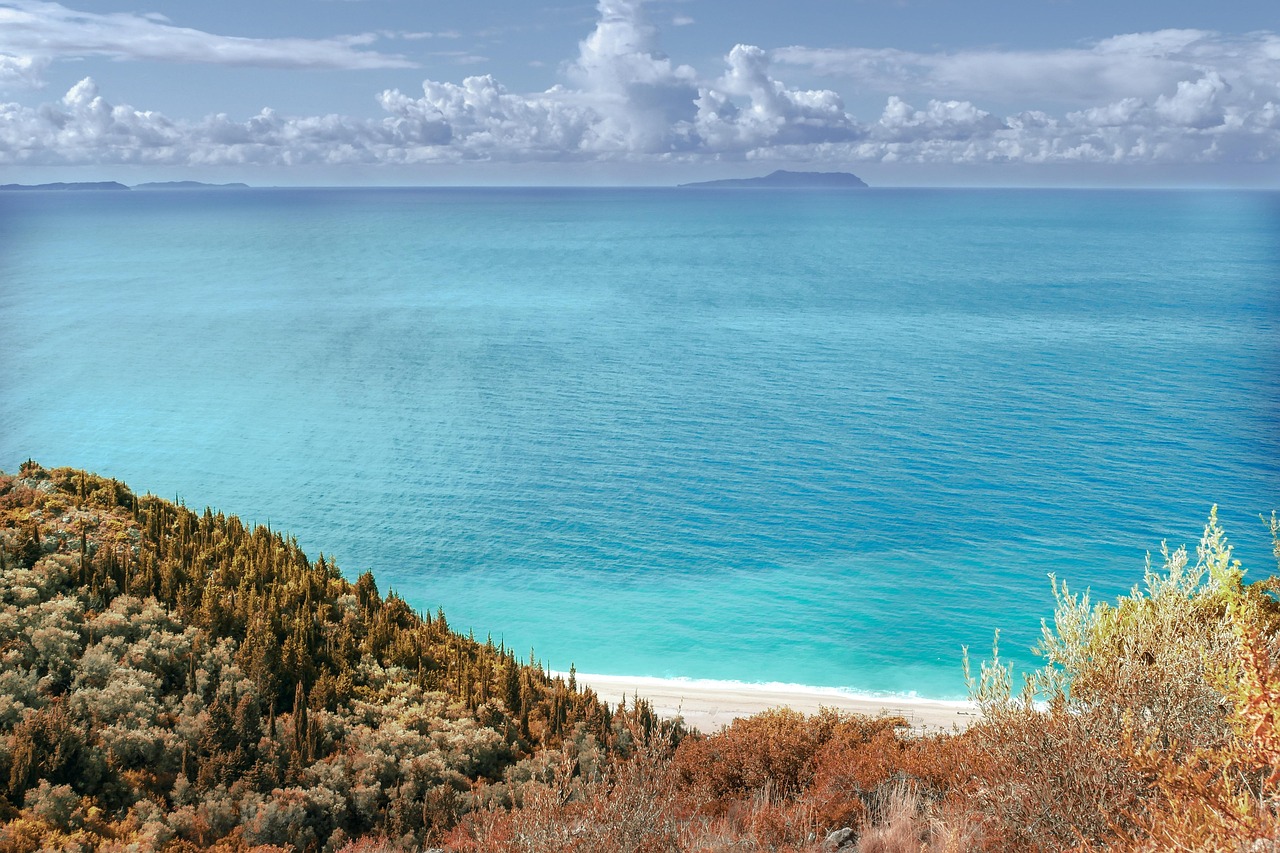
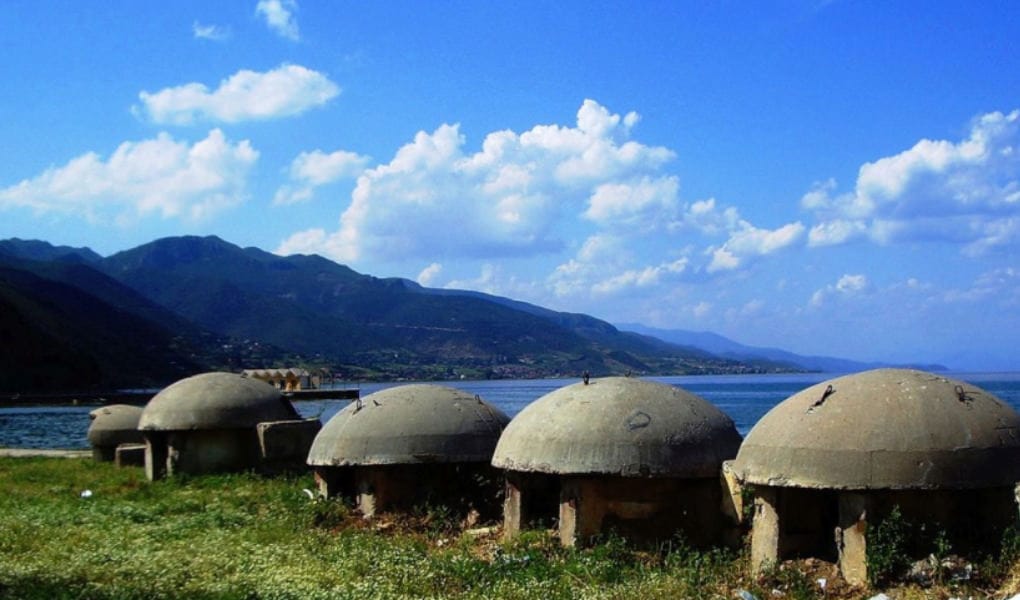
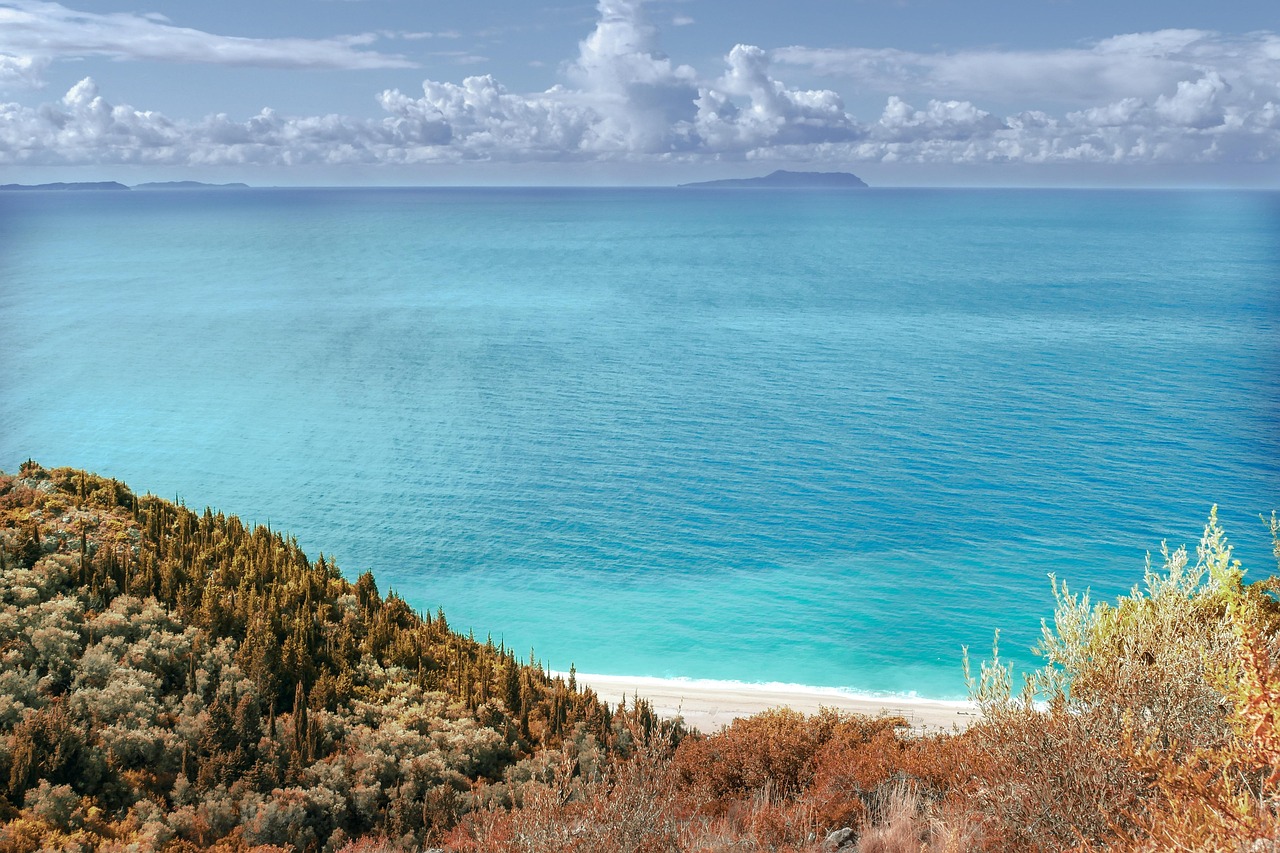
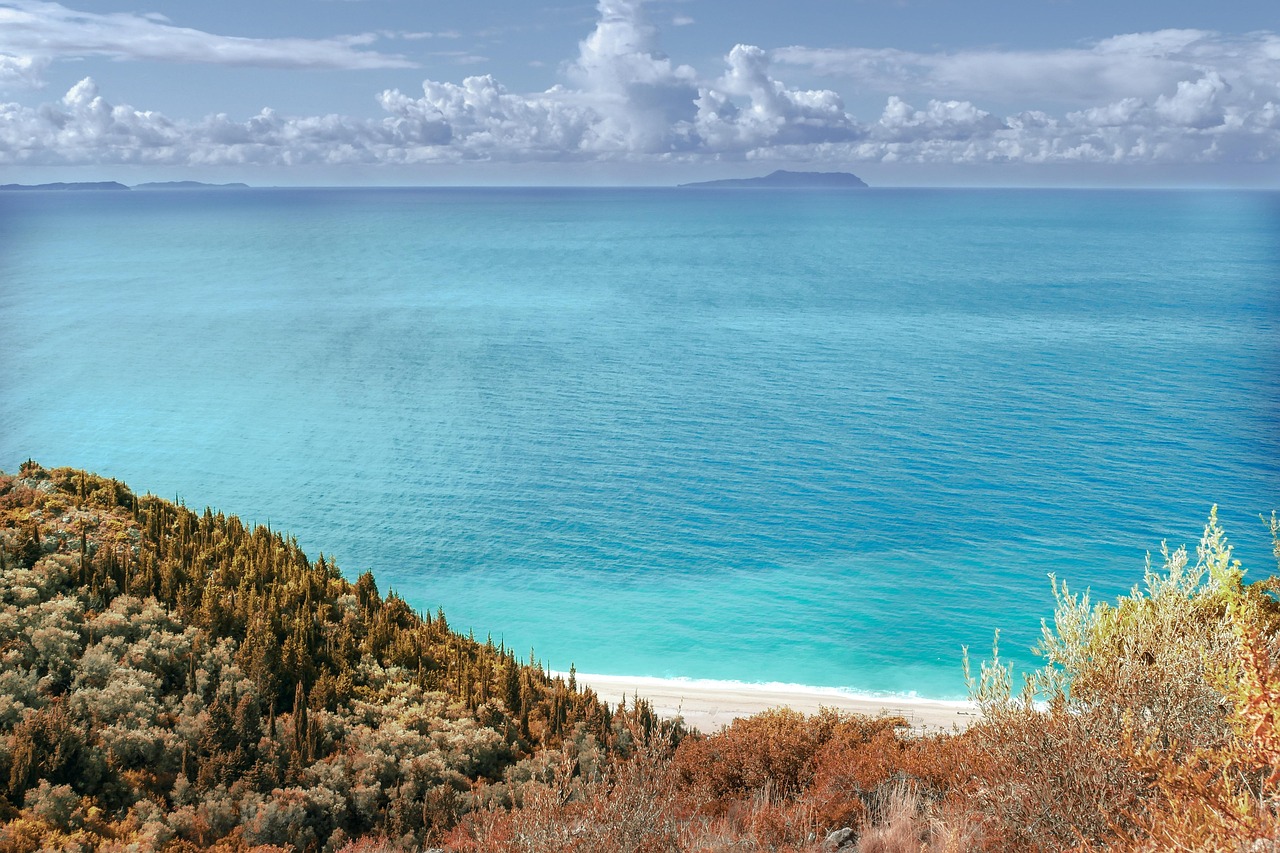
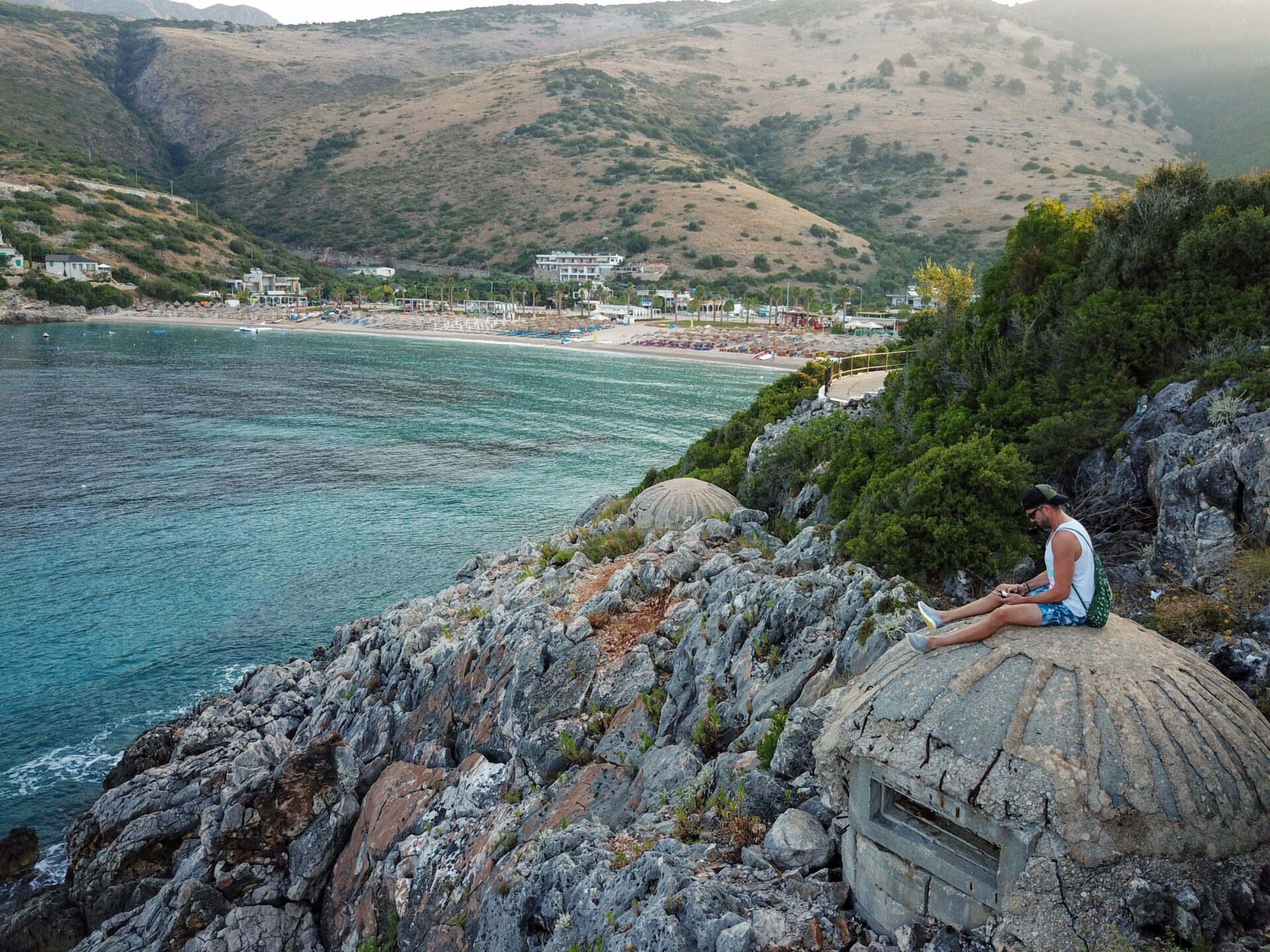
Along the coastline, bunkers emerged at mathematically calculated intervals, creating an unbroken chain of defensive positions against potential amphibious invasions. I’ve driven the entire Albanian Riviera, and you literally cannot find a beach without at least one bunker. Some of the most beautiful stretches—pristine sand, turquoise water—are interrupted by concrete domes that scream “Cold War neurosis.”
In the rugged northern mountains bordering Yugoslavia, bunkers clung to strategic passes and ridgelines, watching ancient invasion routes. In Tirana, they formed concentric rings of defense protecting government installations. Agricultural regions got bunkers positioned to protect not just territory but food production capacity—a strategic consideration revealing the regime understood modern wars are won with grain, not just guns.
The larger command bunkers, known as Pike Zjarri (point of fire), consumed even more resources. These 400-ton behemoths featured multiple rooms, advanced ventilation systems, and communication equipment. They formed the nervous system of Albania’s defensive network, theoretically capable of coordinating nationwide military responses.
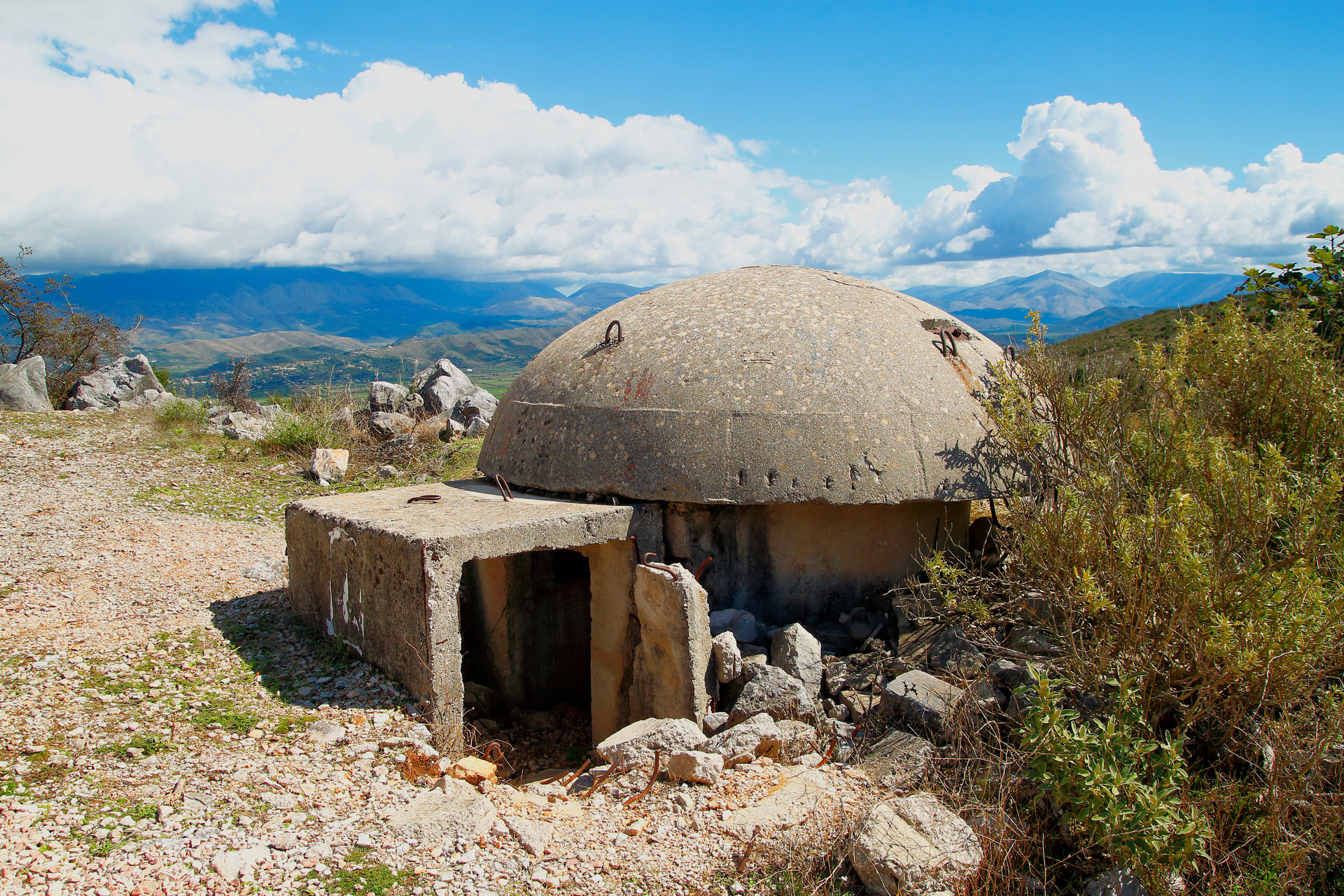
Interestingly, Hoxha himself expressed doubts about the bunkers’ practicality and cost-effectiveness. This has led some historians to believe they served a secondary purpose: instilling a siege mentality in the population and reinforcing his authoritarian, isolationist regime.
The invasion never came. The bunkers remain silent witnesses to paranoia made concrete.
The Price We Paid
The human and economic costs were staggering. Prime Minister Mehmet Shehu—Hoxha’s close associate who would later be purged and allegedly “commit suicide”—oversaw a program that diverted crucial resources from everything that actually mattered.
Workers, engineers, and civilians were militarized into construction brigades. Essential development projects were shelved while concrete domes sprouted across the landscape. The estimated cost in today’s value would be in the billions of euros.
During peak construction years, between 70 and 100 workers died annually. Concrete pouring accidents. Cave-ins. Transportation disasters. Industrial accidents with heavy machinery. These deaths were treated as state secrets, their victims unnamed martyrs to a vision of security that proved hollow.
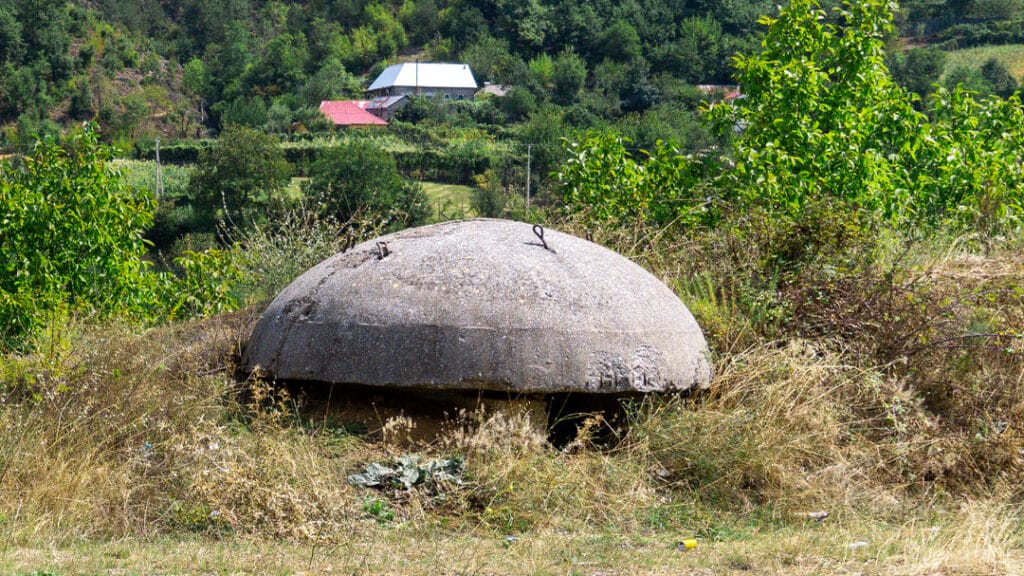
My grandfather’s village near Gjirokastër has seven bunkers within walking distance. Seven concrete domes that could have been seven family homes, seven schools, seven medical clinics. Instead, they’re used to store hay and occasionally shelter sheep during storms.
From Defense to Utility to Hipster Cafés
After communism’s fall in 1991, many Albanians laughed off the bunkers as relics of paranoid excess, monuments to a war that never came. The structures that once symbolized national defense became objects of ridicule, associated with an era of isolation and fear.
But here’s the weird thing about Albanian stubbornness: we don’t just tear things down. We repurpose them.
The bunkers’ practical value became unexpectedly clear during the Kosovo conflict of the 1990s when they provided shelter to refugees fleeing Milošević’s forces. These structures, built for a war that never happened, served a humanitarian purpose their builders never envisioned.
In Tirana, massive underground bunkers have become museums. Bunk’Art 1 and 2 transform former nuclear shelters into exhibitions spanning military history to contemporary art. Bunk’Art 1, a five-story underground complex meant to shelter Albania’s political elite from nuclear attack, now houses galleries you can actually visit for €5 (about the price of a decent byrek and coffee).
Bunk’Art museum in Tirana—because why let a perfectly good nuclear bunker go to waste?
Bunk’Art 2, near Skanderbeg Square, focuses on the darker aspects of the era, particularly operations of the feared Sigurimi secret police. Walking through displays of interrogation rooms and surveillance equipment, you understand why my parents’ generation speaks carefully even today about certain topics.
In Gjirokastër, the Cold War Tunnel offers perhaps the most authentic experience (€3 entry). Unlike its modernized counterparts in Tirana, this tunnel complex remains largely untouched since the communist era—dank, claustrophobic, genuinely unsettling. It’s the bunker experience without Instagram-friendly lighting.
But my favorite repurposing? The beach bunkers. Several along the Albanian Riviera have been converted into beach bars, changing rooms, even boutique accommodations. There’s something beautifully Albanian about sipping a cocktail inside a structure designed to repel amphibious invasion.
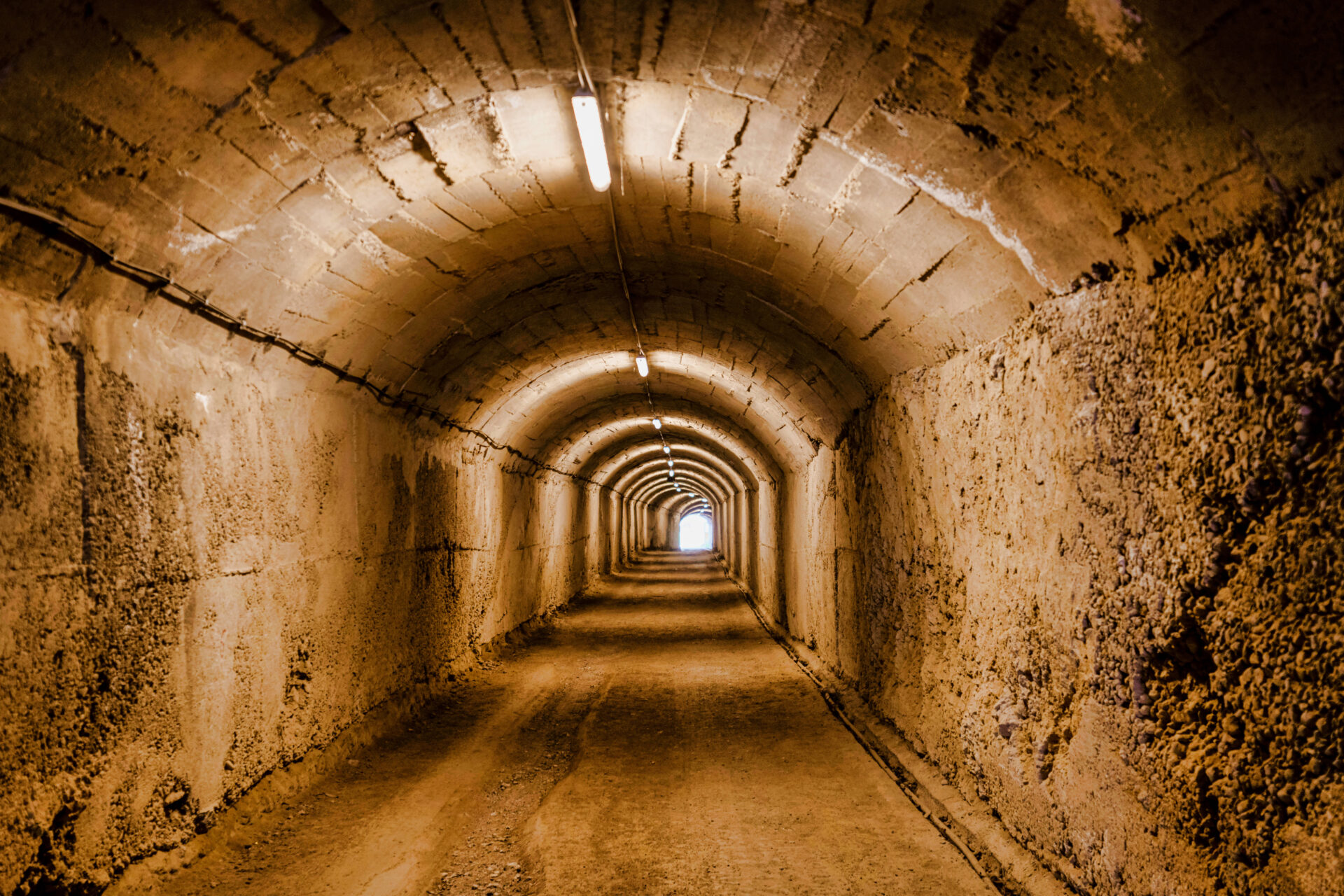
Tunnel leading to a WWII bunker. BunkArt
Old military bunker in Lin village, Lake Ohrid in the background—premium lakefront property, terrible architecture
The Great Bunker Debate
Albania has demolished many bunkers since 1991. Some were removed for development. Others because they’re eyesores or painful reminders of the past. The demolition sparked debate among historians and defense experts, especially as modern Europe again confronts security challenges.
Some Albanians see them as scars on the landscape. Others view them as unique historical monuments worthy of preservation. I’m somewhere in the middle—preserve the historically significant ones (Bunk’Art, Cold War Tunnel), repurpose the accessible ones (beach bunkers-turned-cafés), and remove the ones literally blocking development.
Current European defense spending exceeds €500 million on new fortifications. Finland maintains 54,000 civil defense shelters. Switzerland requires nuclear shelters in new buildings. The recent Ukrainian conflict has prompted renewed interest in civil defense structures.
Meanwhile, Albania systematically dismantles its defensive network. While Switzerland and Finland maintain their Cold War shelters, we’re blowing ours up to make room for hotels and parking lots.
Perhaps the bunkers’ greatest historical lesson lies not in their military value but in their cost—how a small, poor nation spent decades pouring limited resources into concrete domes while people lacked adequate housing, schools, and hospitals. Today’s Albania faces similar questions about resource allocation and national priorities, though now in the context of integration with Europe rather than isolation and defense.
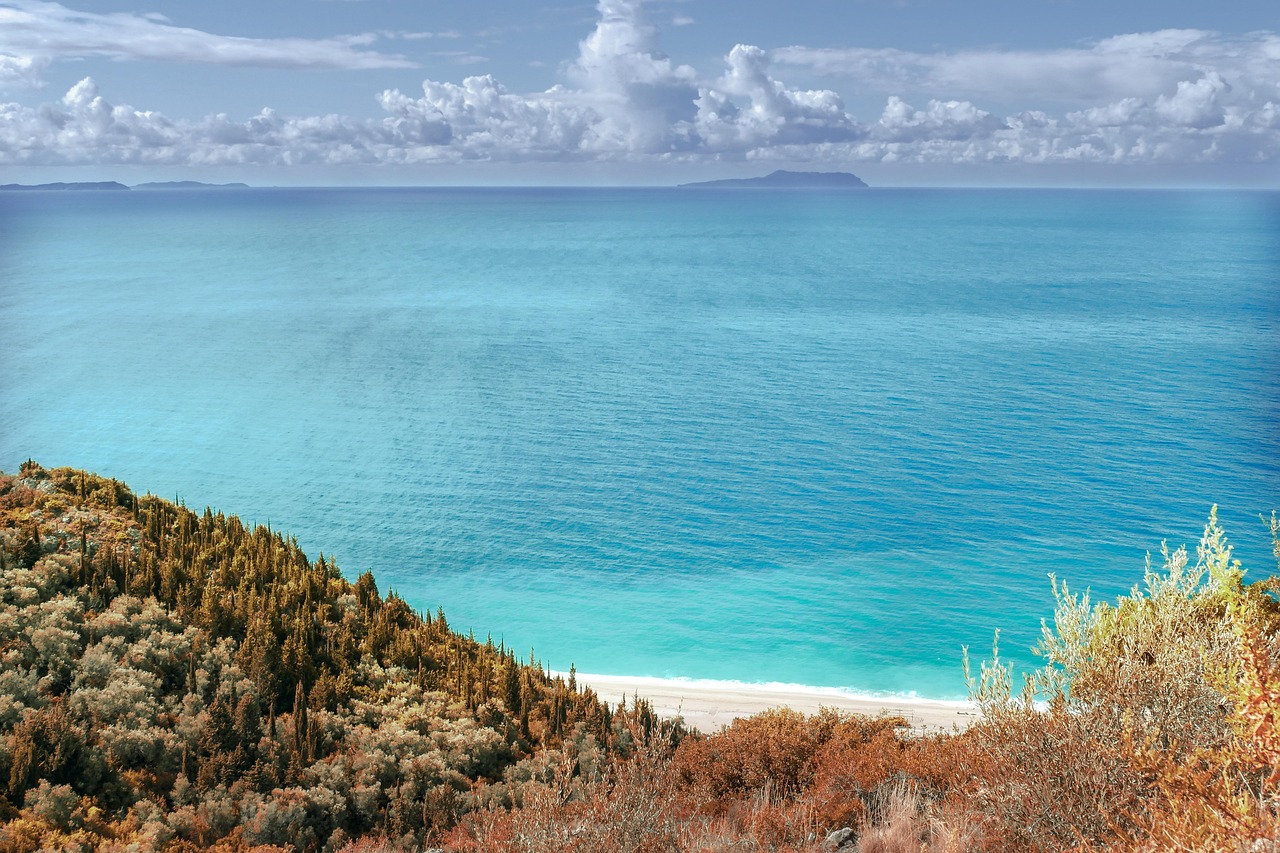
Defensive bunker on the seashore—defending Albania from… tourists?
What to Actually Visit
If you’re visiting Albania and want to experience bunker culture firsthand, here’s my honest guide:
Bunk’Art 1 (Tirana): €5 entry, allow 2-3 hours. The five-story underground complex is genuinely impressive. Climate-controlled, well-lit, excellent exhibitions. Take the free shuttle from Skanderbeg Square.
Bunk’Art 2 (Tirana): €4 entry, 1-2 hours. More focused on Sigurimi secret police operations. Darker, more disturbing, historically crucial. Right in the city center.
Cold War Tunnel (Gjirokastër): €3 entry, 1 hour. The most authentic bunker experience. Wear layers—it’s cold underground even in summer. Not wheelchair accessible.
Beach Bunkers (Albanian Riviera): Free, though now many house beach bars. Best examples near Himarë, Dhërmi, and Jale. Great for photos and appreciating the absurdity of fortifying beach paradises.
Random Countryside Bunkers: Free, everywhere, varying conditions. Some are pristine. Many are used for storage. A few shelter livestock. Exercise caution—structural integrity varies wildly.
Pro Tips for Bunker Exploration
Don’t enter random bunkers alone. Structural conditions vary. Some have unstable floors, hidden drops, or resident wildlife (dogs, snakes, occasionally bats).
Bring a flashlight. Most bunkers lack electricity. Your phone’s flashlight works but drains battery fast.
Watch for livestock. Shepherds use bunkers as animal shelters. Surprising a startled sheep in the dark is less fun than it sounds.
Respect private property. Many bunkers sit on private land. Ask permission before entering.
Skip the graffiti urge. Bunkers are historical artifacts. Don’t add to the existing layers of spray paint.
Visit museums first. Understanding historical context makes random bunker encounters more meaningful.
Why This Matters Beyond Tourism
For modern Albania, the bunkers represent a complicated legacy. They’re physical evidence of isolation, paranoia, and wasted resources. But they’re also testaments to survival—we built 750,000 concrete domes and somehow didn’t collapse economically (though we came close).
The bunkers also prompt uncomfortable questions about collective memory. My generation (born in the 1980s) remembers them as playgrounds. My parents’ generation remembers the fear they represented. Younger Albanians see them as quirky historical curiosities or obstacles to development.
As Europe again faces territorial aggression and security challenges, these concrete sentinels offer lessons about the cost of paranoia versus the necessity of preparedness. Perhaps Hoxha’s fear of invasion wasn’t entirely unfounded, even if his response proved catastrophically extreme.
But I think the real lesson is simpler: dictators who spend 20% of GDP on bunkers while people lack basic housing are building monuments to their own insecurity, not national defense.
The bunkers will outlast all of us. Albanian concrete, mixed with that particular communist-era combination of poor quality control and excessive quantity, somehow produces structures that refuse to crumble. We can’t destroy them with conventional explosives (we’ve tried). We can’t ignore them—they’re literally everywhere.
So we’ve done what Albanians do best: we’ve made them ours. Museums, cafés, livestock shelters, impromptu bathrooms, photography subjects, conversation starters. The bunkers that were supposed to save us from invasion now serve as reminders that the greatest threat often comes from within.
Experience Albania’s unique heritage through these concrete sentinels. From immersive museums to beachfront cafes, discover how a nation transformed its defensive past into cultural landmarks for the future.